Triple Whale competitors fall into four types: attribution suites, profit and store-analytics tools, server-side data tools and the free native stack. Pick the type by the job you need done, then compare names inside it.
This guide sorts the main Triple Whale competitors by that job, shows what each type overlaps with, compares what the vendors say their prices depend on, and ends with a scoring sheet you can redo with your own numbers.
Who are the main Triple Whale competitors?
Northbeam, Rockerbox and Hyros compete head-on on attribution. Polar competes on store reporting. Server-side tools and free native reports cover single parts of the job. That makes four types, not one list.
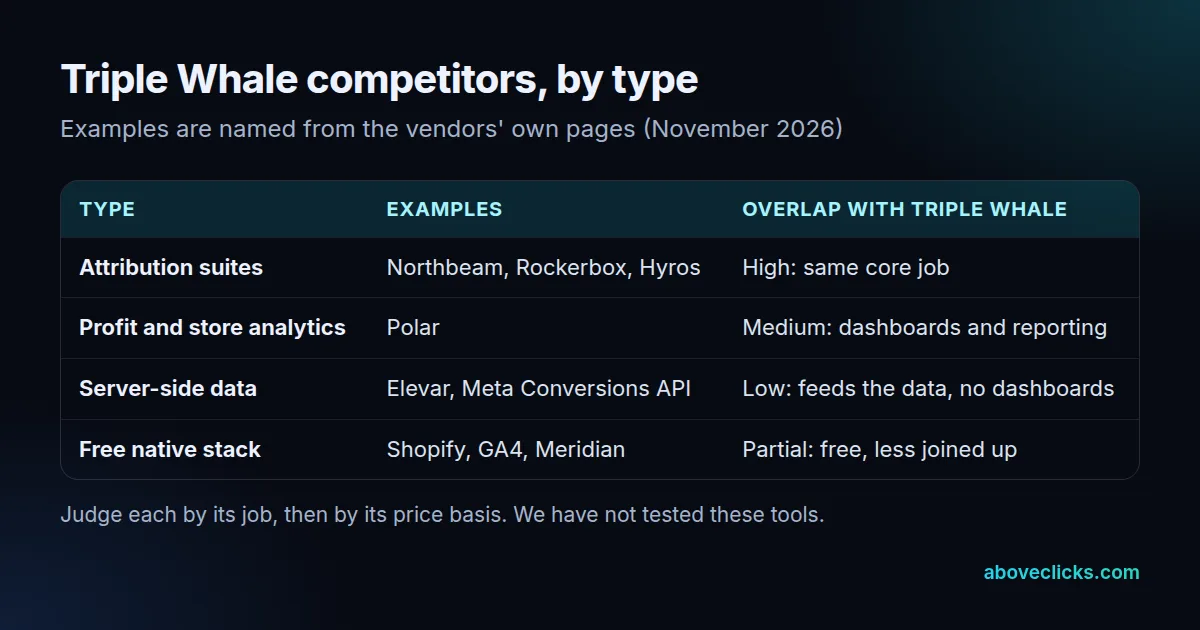
The table names examples from each vendor’s own site as of November 2026. We have not tested these tools, so treat every description as the vendor’s claim. For what Triple Whale itself does, see what is Triple Whale.
Searchers also pair the name with WeTracked, True Profit and Lifetimely, according to Google Autocomplete (November 2026). We haven’t reviewed those three, so they aren’t in the table.
Across all 4 types, the first test is the same. Over 14 days, a tool’s order count should land within 5% of Shopify’s. A tool that fails that test can’t be trusted on channel credit, whatever its price or features.
Most lists of Triple Whale competitors treat these four types as swaps for each other. They aren’t, and the mismatch is where money gets wasted: a brand that needs cleaner purchase events buys a dashboard, or a brand that needs a profit view buys another attribution model.
Which tools do the same attribution job?
Northbeam, Rockerbox and Hyros are the attribution-focused Triple Whale competitors. Each sells attribution software, and the first two also sell media mix modeling and incrementality testing, which is the same 3-method bundle Triple Whale describes.
Triple Whale describes its Compass product as “Attribution, MMM and incrementality in one measurement system”. Northbeam’s pricing page lists multi-touch attribution, media mix modeling and incrementality. Rockerbox lists multi-touch attribution, media mix modeling, incrementality testing and a marketing data foundation, with channels that include OTT/TV, direct mail and affiliate.
Hyros calls itself ad tracking and attribution software, with a one-click Shopify install, and also lists business models other than ecommerce, such as software, courses and booked calls. Our head-to-head guides cover Triple Whale vs Northbeam and Triple Whale vs Hyros.
The practical difference is channel mix. Rockerbox’s channel list leans toward brands that also buy TV, mail or affiliate. If you spend only on Meta and Google, 2 channels, a suite built for 10 or more may be more than you need.
When you shortlist Triple Whale competitors in this group, ask each vendor three things: which attribution model is the default, how its pixel handles consent, and whether a demo account can load your last 30 days of orders. Put the answers next to Shopify’s own figures, because an attribution suite is only as trusted as its order count.
Which competitors focus on profit and store reporting?
Polar Analytics is the clearest example among Triple Whale competitors. It presents itself as Shopify analytics that pulls data together in one place, rather than as an attribution engine first.
Polar’s site shows the problem it targets: Shopify, GA4 and Meta each report a different revenue figure for the same 30 days, and the page calls that “3 tools, 3 different answers”. It also says it is trusted by 4,000+ ecommerce brands and agencies (a vendor claim, as of November 2026).
That is a different job from attribution. A profit tool answers “what did we keep after shipping, fees and product cost”. An attribution suite answers “which channel gets the credit”. Many brands need the first before the second.
Profit reporting also needs inputs that no pixel can see: product cost, shipping cost and payment fees. Ask how each of the Triple Whale competitors in this group collects them, and who keeps them current when your catalog changes. A profit view with stale product costs looks precise and misleads.
If your finance questions are louder than your channel questions, put this type first in the scoring below. If your team argues about which ad set to fund, start with the attribution suites.
Are the free tools Triple Whale competitors too?
Partly. These free tools are Triple Whale competitors for single jobs, not for the whole suite. Shopify’s reports, GA4 and the ad platforms’ server events are free, and together they replace several pieces of a paid suite. They don’t give one joined-up view.
GA4 offers 3 attribution models: data-driven, paid and organic last click, and Google paid channels last click. All 3 give direct visits no credit unless the whole path is direct. Data-driven attribution evaluates both converting and non-converting paths.
On the ad side, Meta says server events are processed like pixel events, so they can be used in measurement, reporting and optimization. Google’s enhanced conversions supplement existing conversions with hashed first-party data. On Shopify, the Web Pixels API gives apps controlled access to customer events inside a sandbox.
Server-side tools such as Elevar sit here: they improve the data that reporting tools and ad platforms receive, rather than replacing the dashboard. Our Elevar server-side tracking guide covers that.
For media mix modeling, Google’s Meridian is an open-source model, free to use, that estimates each channel’s return, its response curve and a budget split. It needs someone who can run it.
Worked example (an invented store, not a client): in 14 days Shopify counts 400 orders and GA4 shows 372, a 7% gap. That is outside a 5% pass mark, so the first job is to fix the purchase event, not to shop for one of the Triple Whale competitors.
How do competitors to Triple Whale price their plans?
On different bases, which makes quotes from Triple Whale competitors hard to compare. Triple Whale prices on annual GMV and the package; Northbeam prices on annual marketing spend. Neither page we checked lists dollar amounts.
Triple Whale’s pricing page says prices combine a brand’s annual GMV with the package (Foundation, Automate or Enterprise). The paid packages are 12-month subscriptions, billed monthly or annually. There is also a free plan.
Northbeam says its plans are based on annual marketing spend. Its Growth plan is for seven-figure brands spending under $200K a month on ads, with a quote on request (as of November 2026).
Compare quotes on one basis. Write down your GMV and your monthly ad spend, ask each vendor what tier those numbers put you in, and ask what happens at renewal if either number grows. A 12-month term means a wrong choice lasts a year.
Example (invented numbers): a store with $2M a year in sales that spends $30K a month on ads sits in a very different tier from one with $12M in sales and $200K a month in spend. The same vendor can quote both. The price basis, sales or spend, decides which number moves your tier.
How do you choose between Triple Whale competitors?
Score each of the Triple Whale competitors on five criteria and weight them to 100 points. Start from your own pain: if it is order accuracy, give that criterion the most weight.
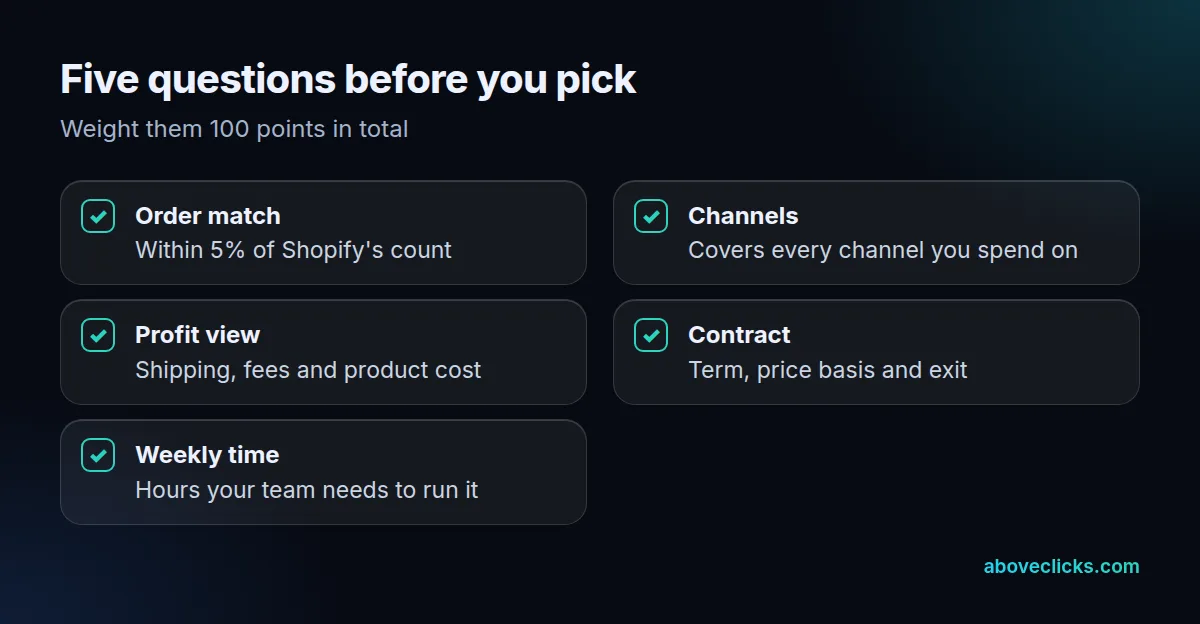
Worked example (an invented Shopify store, not a client): it spends on 2 channels and cares most about whether the numbers match Shopify. The weights are order match 30, channels 20, profit view 20, contract 15 and weekly time 15, which add up to 100.
Scores run from 1 to 5. The attribution suite scores 4, 5, 3, 2 and 3. The profit tool scores 4, 4, 5, 4 and 4. The free native stack scores 4, 4, 2, 5 and 3. Multiply each score by its weight, add them up and divide by 5.
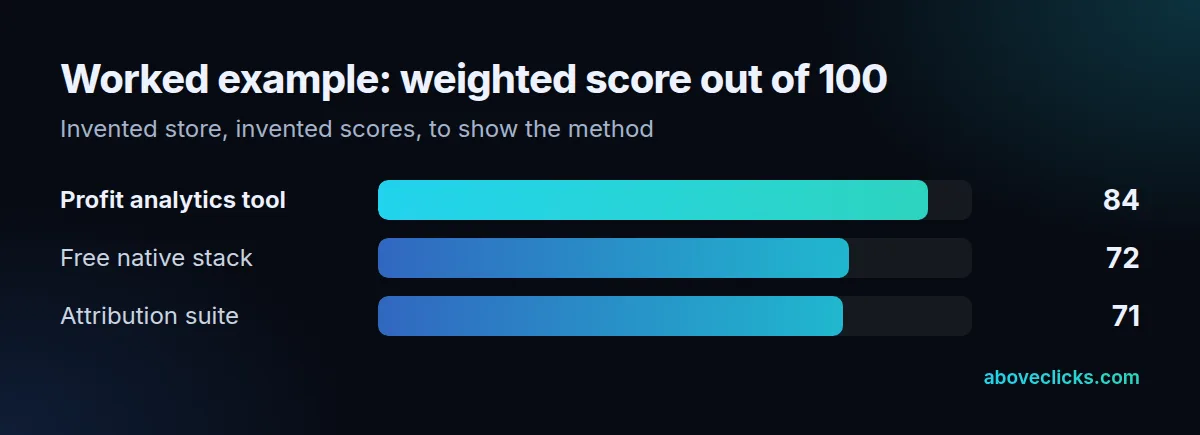
The profit tool wins at 84, the free stack gets 72 and the suite 71. The result comes from the weights: a store with 6 channels and a big TV budget would weight “channels” higher, and the suite would climb. Change the weights and the order changes; that is the point of writing them down.
Write the weights before you see any demo. Demos are built to show strengths, and weights set afterward drift toward whichever of the Triple Whale competitors gave the best one.
Before you trust any score, run the tool next to your current setup for 14 days and compare its orders with Shopify’s. Our Triple Whale alternatives guide walks through that test with a worked example.
When is it not worth switching from Triple Whale?
When your problem is broken data, not the dashboard. Every one of the Triple Whale competitors will report the same wrong numbers if the purchase event is wrong.
Renewal dates matter here more than feature lists. Put the decision date in the calendar 60 days before the term ends, so the choice between Triple Whale competitors is made on a test, not on a deadline.
Check these before you sign anything:
- Orders match. The current tool should be within 5% of Shopify’s count. If it isn’t, fix the events first.
- The gap is worth a year. A 12-month term needs a decision you will still stand by at month 12.
- Someone owns the weekly report. A dashboard nobody opens costs the same as one people use.
- You have the exit plan. Export dashboards, segments and audience syncs before the old account closes.
If your tracking is the doubt, not the tool, start with a free audit of your current setup. Our tracking and analytics team sets up or migrates Shopify, GA4 and server events. More guides are in measurement.