Buying guides
Questions to ask a marketing agency before you hire one (with good answers and red flags)
21 questions for your intro calls, grouped by topic, each with what a good answer sounds like and what should worry you.…
Consulting · E-commerce consulting
Our ecommerce consulting gives store owners a senior advisor: tech stack advice, growth roadmaps, conversion audits and a second opinion before big decisions. Because we build stores and run their marketing ourselves, our advice comes with the detail your team or agency needs to act on it.
200+ clients served 500+ projects delivered
Free e-commerce audit
Three fields and you’re done. The PDF report shows what we found on your own pages and accounts, and the order we’d fix it in. It covers the problems we see most often:
Your PDF report comes by email. If you want to discuss going ahead after reading it, we’ll set up a video meeting. We use your details only for this audit.
Fit
Not the right fit if you want someone to run your campaigns or build your store; those are our managed services. Ecommerce consulting is advice and plans, with as much or as little hands-on help from us afterwards as you want.
Problems we fix
Each problem solved with another subscription, until the store is slow, expensive and nobody knows which app does what.
A migration chosen to fix a problem that was really the theme, the tracking or the offer.
Targets set from revenue alone, so the store grows its way into a loss.
Redesigns based on opinions rather than analytics, recordings and real devices.
The only one judging the agency’s work is the agency.
Peak season, a launch or a cash squeeze forces a big decision with no time to check the numbers.
In 1:10 · animated
A short animated walk-through of the first checks in our audit. No sound needed: everything is on screen, and the transcript is below.
What we check first as your ecommerce consultant, an animated explainer of 1:10 with on-screen captions and controls to pause.
Our approach
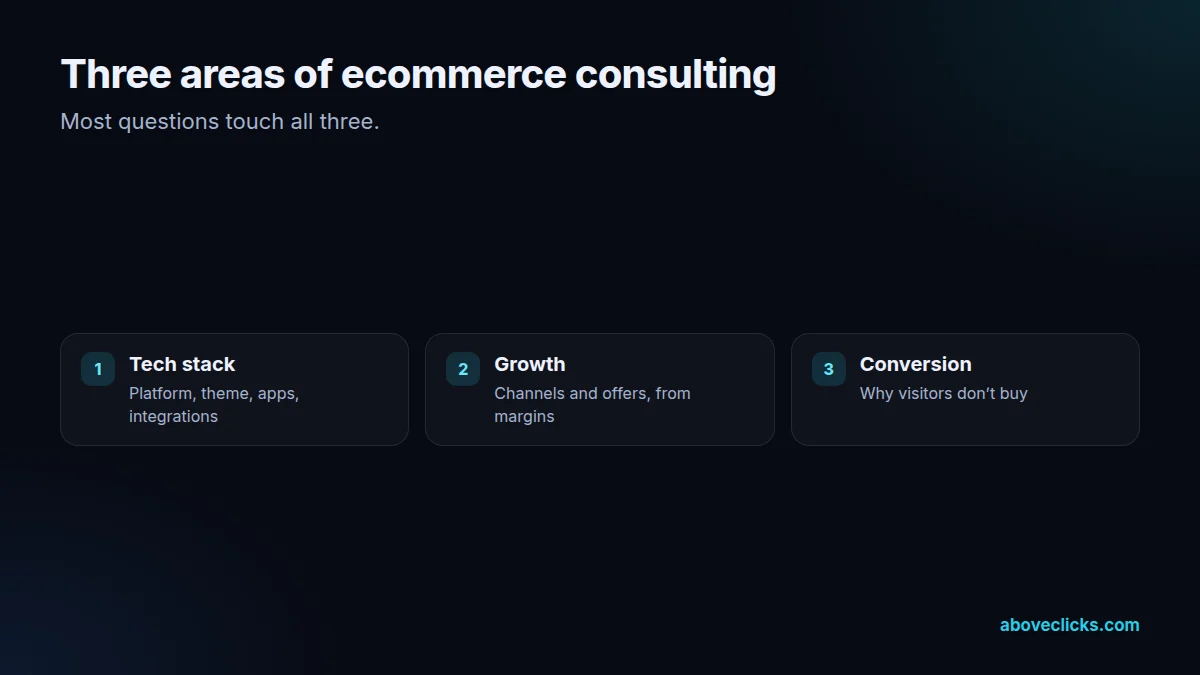
Ecommerce consulting covers three kinds of question. Tech stack: which platform, theme, apps and integrations you need, and what to remove. Growth: which channels and offers deserve the next budget, and in what order. Conversion: why visitors don’t buy, and what to change first. Most engagements touch all three, because each depends on the others.
Tech stack advice starts with an inventory: platform and plan, theme, every app and what it costs, integrations with inventory, shipping, accounting and marketing tools, and the tracking set-up. We look for overlap, speed cost and risk, and recommend what to keep, replace or remove. When a platform move is on the table, we compare the real cost and benefit before anyone commits. Kashif has worked through migrations from Wix to Shopify for a high-ticket antique jewelry store and from Squarespace to GoHighLevel for a fashion e-commerce consultancy, so the advice covers the move itself, not just the destination.
A growth roadmap starts from unit economics: contribution margin per order, break-even ROAS and what a repeat customer is worth. From there we rank the options, such as a new channel, better retention flows, a higher average order value or conversion work, by impact, cost, confidence and time. Bidding targets such as target ROAS are set from those margins. For a fixed-price version, our growth strategy sprint turns this into a 90-day plan.
Conversion audits look at evidence before opinions: funnels in GA4 measured with e-commerce events, session recordings, the main templates on real phones, page speed against Core Web Vitals, and the checkout compared with Baymard’s checkout research. The output is a ranked list of fixes and tests, not a redesign mock-up.
Ongoing advisory keeps a senior ecommerce consultant close to your team: a monthly call, a review of the numbers, a second opinion on agency proposals and campaign plans, and quick answers before decisions that are hard to undo, like a theme change, a new app or a big discount event.
We advise on the platforms we build on: Shopify first, then WooCommerce and BigCommerce. Shopify’s own analytics and Shopify Flow are often the first places we look for quick wins. Advice is written so your team, your agency or our development team can act on it.
Kashif has worked with online stores since 2021, as digital marketing strategist for a high-ticket antique jewelry store in the US, and as SEO consultant for a fashion e-commerce consultancy. The people who give the advice also build stores and run Meta, Google and email, which keeps recommendations practical.
Every recommendation comes with the reason, the expected effect, the effort and who should do it. When something is uncertain, we say so and suggest a test instead of a guess. And if the honest answer is that the store doesn’t need a change, that’s what we’ll tell you.
How we use AI here
Most stores already pay for several AI tools. Part of our ecommerce consulting is checking which ones earn their place.
Every AI app and subscription is listed with its cost, the scripts it adds and what it has measurably changed.
Customer reviews, competitor offers and store data are summarized with AI, so the roadmap starts from evidence.
Clear advice on where AI fits your store, such as product content, site search or support, and where it doesn’t yet.
Where it doesn’t help: replacing decisions about price, range and positioning. Those are yours, and our advice is built around them.
What’s included
Platform, theme, apps, integrations and costs, with what to keep, replace or remove.
A cost and benefit comparison before any replatforming, and a migration plan if it goes ahead.
Options ranked from unit economics, with budgets, targets and decision dates.
Funnels, recordings, templates, speed and checkout, with a ranked list of fixes and tests.
A second opinion on plans, proposals and results from your agency or freelancers.
A call, a numbers review and quick answers before hard-to-undo decisions.
Each with the reason, expected effect, effort and owner.
Our development and marketing teams can carry out the plan, quoted separately.

How we run it
Nothing is recommended before the numbers are read. Typical timing: discovery in the first week, the written plan within 2 weeks, and a review call at 30 days.
Step 1
Goals, constraints, the team, and read-only access to the store, analytics and ad accounts.
Step 2
Tech stack, numbers, funnels and channels reviewed.
Step 3
A written plan with ranked recommendations, presented on a recorded call.
Step 4
Monthly advisory while the plan is carried out, if you want it.

Pricing
The audit is free. Paid work starts at these prices, and your exact cost is fixed in writing before any work begins.
Free no obligation
We’ll check your store, stack and numbers and send a PDF report within 2 workdays.
Get my free auditAfter the audit
From $400 one-off
Your stack, funnel and numbers reviewed, with a growth roadmap.
From $800 monthly
A standing call and help with the roadmap.
All prices are starting prices in US dollars. Custom work beyond these options is quoted after the audit.
Advisory
Advice runs through the month, between the scheduled calls, and your report arrives in the first week of each month. Updates come by email and WhatsApp, with a call whenever you want one.
Pricing
Reviews and audits are fixed-price projects, quoted once we’ve seen the store; advisory is a monthly fee. The store review and roadmap starts at $400, one-off, and monthly advisory starts at $800.
Start with the free audit to get a quote for your store.
By industry
Jewelry stores often run many apps for reviews, try-on, engraving and financing. We check which earn their cost, and how trust and product detail show on product pages.
Fashion stores depend on filters, size data and returns. Advice covers catalog structure, returns in the margin numbers and the apps behind sizing and exchanges.
High-ticket stores sell few, valuable items after long decisions. We look at inquiry handling, financing, retargeting windows and how one-of-a-kind items are listed.
Sources
Platform rules change. These are the official pages we check the work against, so you can check it too.
FAQ
Can’t find yours? Ask on WhatsApp or by email and we’ll answer it.
An ecommerce consultant reviews how your store runs, from platform and apps to marketing and conversion, and gives you a plan for what to change and in what order. The consultant advises; your team, agency or developers do the work, unless you ask us to.
The sprint ends in a 90-day marketing plan and runs as one fixed-price project. Ecommerce consulting is wider and can be ongoing: tech stack, platform decisions, conversion and a regular advisor for big decisions.
Sometimes. We compare what you’d gain with the full cost of moving: rebuild, apps, data migration, SEO risk and team time. Often the problem can be fixed on the current platform, and we’ll tell you if so.
Yes. We review the accounts and plans on facts, settings and numbers, and give you a clear view of what’s working and what isn’t, with recommendations you can take back to them.
Shopify most often, then WooCommerce and BigCommerce. We also advise stores moving from site builders such as Wix or Squarespace.
If you want us to. Our development and marketing teams can carry out the plan, quoted separately. The written recommendations work just as well for your own team or another agency.
Project work has a kick-off and a recorded presentation. Advisory usually means a monthly call plus written answers in between, with extra time around launches or peak season if you need it.
Related guides
Buying guides
21 questions for your intro calls, grouped by topic, each with what a good answer sounds like and what should worry you.…
Buying guides
Percentage of ad spend, flat retainer, performance fee, hourly or a hybrid: what each model rewards, how it behaves as your spend…
Buying guides
In-house team, agency or freelancer? A side-by-side comparison on 7 factors, a total-cost worksheet built from US government pay data, and a…
Free growth audit
Tell us about your store. We’ll review your tracking, campaigns and SEO and send you a written audit with the top fixes, ranked by impact.