E-commerce SEO
Shopify vs WooCommerce SEO: what each platform lets you control
Is Shopify good for SEO? Yes, and so is WooCommerce: both platforms can rank. This comparison shows what you control on Shopify…
Industries · E-commerce
Ecommerce marketing is how online stores find buyers, win first orders and bring customers back, across ads, Shopping, search, email and social. E-commerce is our core work as an ecommerce digital marketing agency, and we plan it by business model, because a single-brand store and a high-ticket retailer grow differently.
200+ clients served 500+ projects delivered
Free e-commerce marketing audit
Three fields and you’re done. The PDF report shows what we found on your own pages and accounts, and the order we’d fix it in. It covers the problems we see most often:
Your PDF report comes by email. If you want to discuss going ahead after reading it, we’ll set up a video meeting. We use your details only for this audit.
Results
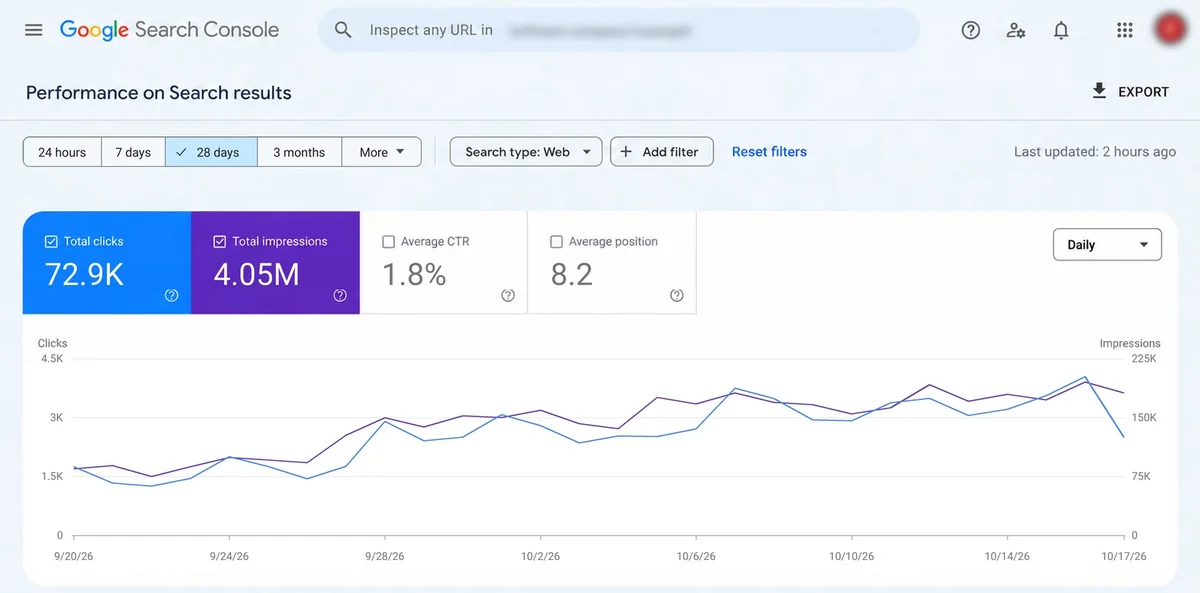
Screenshots from client accounts, anonymized and shown with permission. Each caption gives the source and the dates.


The challenges
Online stores can measure almost everything, which is exactly why they so often measure the wrong things.
Each ad platform claims credit for the same order. Adding their reports together counts sales twice and hides the true cost of a customer.
Product cost, shipping, payment fees and returns can take most of the price. A campaign profitable at 4x ROAS on one product loses money on another.
Shopping ads and free listings are built from product data. Missing GTINs, wrong categories or conflicting prices keep products out of the auctions.
Theme updates, checkout changes and consent banners stop purchase events from firing, and campaigns optimise on missing data for weeks.
Paid acquisition gets more expensive, so the stores that grow are the ones that earn the second and third order through email and retention.
Much of a store’s traffic is on phones. Slow product pages and heavy themes lose buyers who were already persuaded by the ad.
In 1:10 · animated
A short animated walk-through of the first checks in our audit. No sound needed: everything is on screen, and the transcript is below.
What we check first for an online store, an animated explainer of 1:10 with on-screen captions and controls to pause.
Our approach
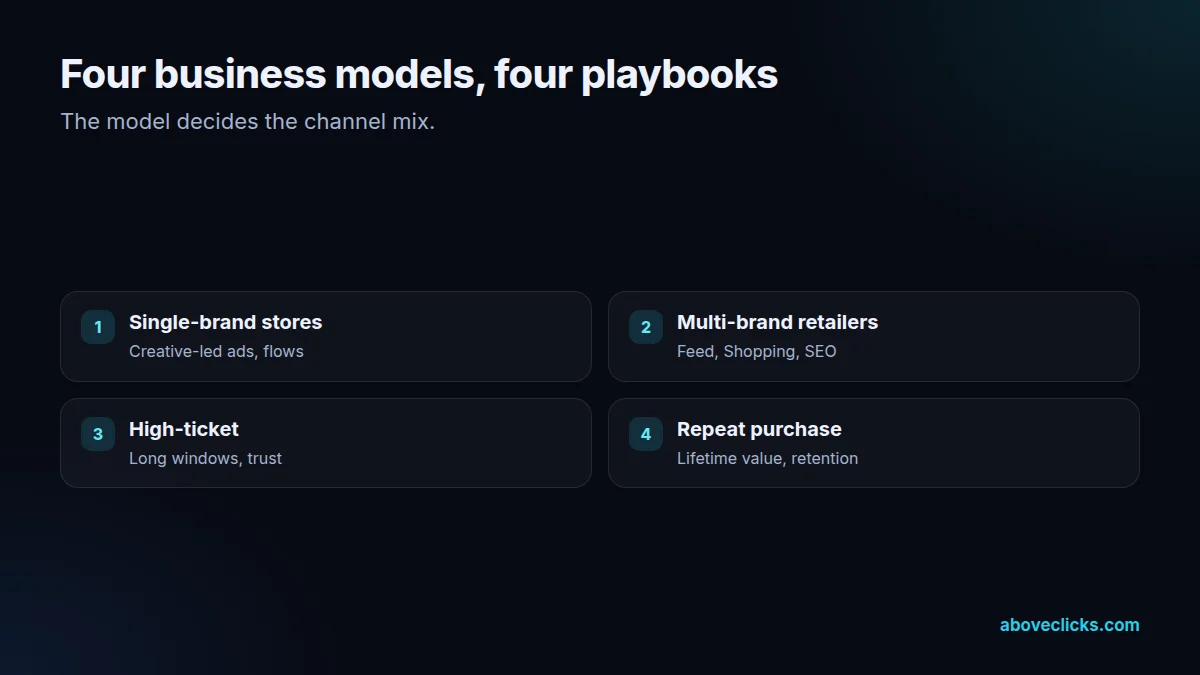
As a digital marketing agency for ecommerce, we plan ecommerce marketing from the business model and the margins, not from the channel list. Four questions set the plan: what an order is worth after product costs, shipping and returns; how long a buyer takes to decide; how often customers come back; and how big the catalogue is. Those answers point to four common models, each with its own playbook.
Single-brand stores (direct-to-consumer brands) sell their own products and own the customer relationship. Growth comes from creative: Meta and TikTok ads that show the product in use, a steady pipeline of new concepts, and landing pages that answer the questions the ads raise. Email and SMS flows turn first buyers into repeat customers.
Multi-brand retailers sell many brands across a large catalogue, often against the brands themselves and against marketplaces. The product feed decides much of their reach. Google’s product data specification lists required attributes, and missing GTINs, wrong categories or conflicting prices are among the issues it says can stop products from showing. Feed quality, Shopping campaigns and collection-page SEO usually come before new channels.
High-ticket and considered purchases (jewelry, furniture, antiques, luxury) have high order values and long decisions. Buyers visit several times, compare, read reviews and often ask a question before they buy. Longer attribution windows, retargeting that answers doubts, detailed product pages and fast replies to enquiries matter more than cheap traffic. Our jewelry and luxury and high-ticket pages go deeper on this model.
Subscriptions and repeat-purchase stores (consumables, beauty, pet, food) are judged on the customer, not the order. The first order can lose money if repeat customers stay long enough; the plan is built around customer lifetime value, onboarding emails, replenishment reminders and win-back flows.
Measurement comes before scaling in every model. Google’s GA4 ecommerce events (view item, add to cart, begin checkout, purchase, refund) and server-side tracking give a clean record; we then judge growth on blended numbers from the store’s own orders, such as marketing efficiency ratio and contribution margin, not on what each platform claims.
Email is the cheapest repeat channel and has its own rules. Google’s email sender guidelines require senders of more than 5,000 messages a day to Gmail accounts to set up DMARC and keep spam rates below 0.3%. Speed is the other quiet factor: web.dev’s Core Web Vitals set good targets of 2.5 seconds for LCP and 200 milliseconds for INP.
Reviews and testimonials sell online stores, and they carry legal weight. The FTC’s consumer reviews and testimonials rule, in effect since October 21, 2024, covers fake reviews, review suppression and incentives conditioned on a particular sentiment. We ask every buyer for a review and never filter who gets asked.
Our playbook
Every online store needs ads, search, email and tracking; the mix changes with the model.
Creative-led Meta and TikTok ads, landing pages that answer the ad, and email and SMS flows from the first order.
Feed quality, Shopping and Performance Max structure, and collection-page SEO across a large catalogue.
Longer attribution windows, retargeting that answers doubts, detailed product pages and quick replies to enquiries.
Onboarding, replenishment and win-back flows, with acquisition budgets set from customer lifetime value.

The numbers that matter
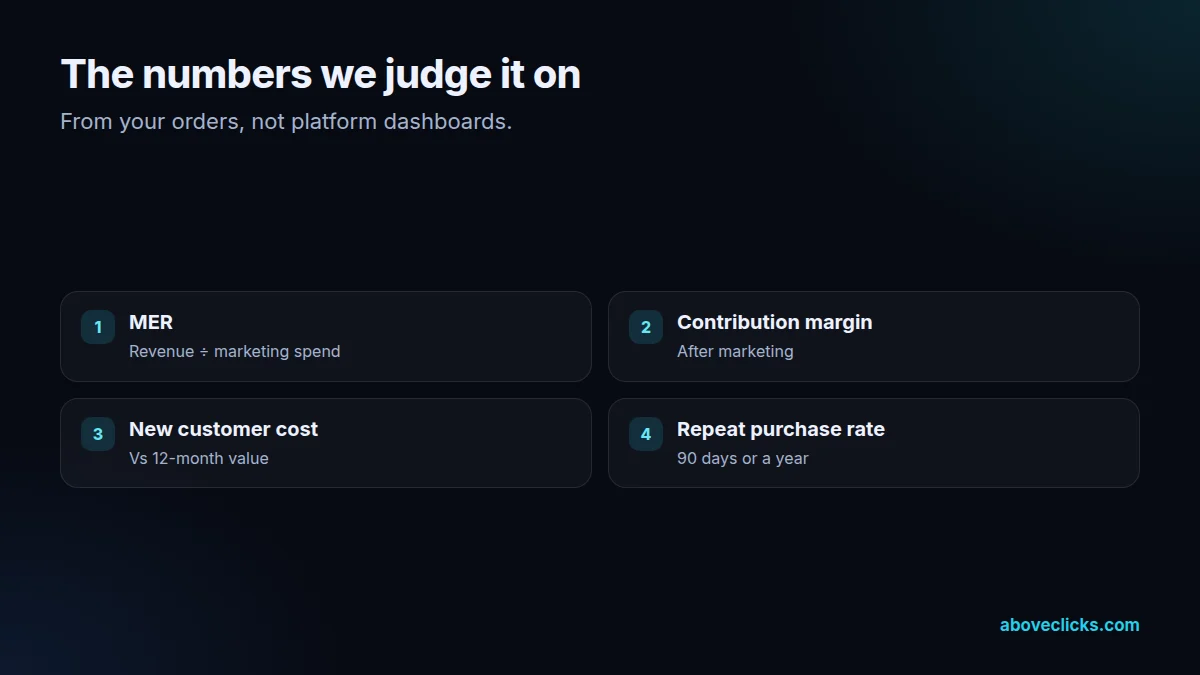
Platform dashboards report what flatters the platform. These numbers come from the store’s own orders and costs.
Total revenue divided by total marketing spend, from the store’s own orders. It can’t double-count the way platform ROAS does.
Revenue minus product cost, shipping, fees, returns and ad spend. This is the number that pays the bills.
Marketing spend divided by first-time buyers, compared with what those customers are worth over 12 months.
The share of customers who order again within 90 days or a year, depending on the product cycle.
How we use AI here
Titles and descriptions are drafted from the product data for feeds and pages; every material, size and claim is checked against the product.
Ad angles and variations are drafted from reviews and customer questions, so more ideas reach a test each month.
Order histories are grouped by buying pattern to find which customers to win back and when to send replenishment reminders.
Where it doesn’t help: product facts, prices and reviews. AI never writes reviews or invents specifications.
Where this comes from
Kashif has worked with online stores since 2021, including as digital marketing strategist for a high-ticket antique jewelry store in the US and as SEO consultant for a fashion e-commerce business, covering technical and on-page SEO and platform migrations. One store’s site went from more than 50,000 indexed pages, mostly duplicate tag and pagination pages, down to 4–5k, in line with its product count.
Above Clicks is a Google Partner (Premier), Meta Business Partner and Shopify Partner. The playbooks on this page are the ones behind our e-commerce services.
Pricing
The audit is free. Paid work starts at these prices, and your exact cost is fixed in writing before any work begins.
Free no obligation
We’ll check your store, ads and tracking and send a PDF report within 2 workdays.
Get my free auditAfter the audit
From $400 one-off
Targets set from margins and returns, tracking and feed fixed.
From $600 monthly, plus ad spend
Ads, SEO and email run as one plan for your business model.
All prices are starting prices in US dollars. Custom work beyond these options is quoted after the audit.
Sources
Platform rules change. These are the official pages we check the work against, so you can check it too.
FAQ
Can’t find yours? Ask on WhatsApp or by email and we’ll answer it.
Ecommerce marketing is the work of bringing buyers to an online store and turning them into repeat customers: paid ads, Shopping, SEO, email and SMS, social media and the tracking that measures them.
It depends on the business model. Single-brand stores usually start with Meta ads, multi-brand retailers with Google Shopping, and repeat-purchase stores with email flows. Tracking comes first in every case.
One that leaves profit after product costs, shipping, fees and returns. Work out break-even ROAS from your margins first; a store with thin margins needs a much higher ROAS than one with wide margins.
Each platform counts the orders it influenced, and several platforms often influenced the same order. That is why we judge growth on MER and contribution margin from your own orders.
No. Most of our store work is on Shopify, and we also work with WooCommerce and other platforms. The marketing principles are the same; the tracking and feed setup differ.
With email and SMS flows set up from the first order: a welcome, post-purchase care, replenishment reminders, win-back messages and a review request sent to every buyer.
Not one tied to a positive review. Under the FTC rule, incentives must not be conditioned on a particular sentiment, so ask every buyer the same way and never filter who gets asked.
MER, contribution margin after marketing, new customer cost, repeat purchase rate and revenue by channel, using the store’s own orders as the source of truth.
Latest guides
E-commerce SEO
Is Shopify good for SEO? Yes, and so is WooCommerce: both platforms can rank. This comparison shows what you control on Shopify…
Buying guides
21 questions for your intro calls, grouped by topic, each with what a good answer sounds like and what should worry you.…
Buying guides
Percentage of ad spend, flat retainer, performance fee, hourly or a hybrid: what each model rewards, how it behaves as your spend…
Free growth audit
Tell us about your store. We’ll review your tracking, campaigns and SEO and send you a written audit with the top fixes, ranked by impact.