Meta Ads
Meta Conversions API on Shopify: set it up in 5 steps, then check it works
On Shopify, the Meta Conversions API is a setting, not a coding project. Here's how to switch it on in 5 steps,…
Video & social · AI UGC ads
We make AI UGC ads for brands that want the look and pace of creator videos in larger numbers than creators can film. Our AI UGC ads combine labelled AI presenters, AI voice and your real product footage. The presenter explains and demonstrates; it never poses as a customer.
200+ clients served 500+ projects delivered
Free UGC ads review
Three fields and you are done. We look at your product and current ads, then send an AI UGC starter plan.
Your PDF report comes by email. If you want to discuss going ahead after reading it, we’ll set up a video meeting. We use your details only for this audit.
Fit
Not the right fit if you want AI “customers” giving reviews or before-and-after stories. That’s a fake testimonial under the FTC’s reviews rule, and we won’t make it. We don’t run studio or on-location shoots; real product footage comes from you, filmed to our shot list.
Problems we fix
An AI person saying “I’ve used this for a month”: a testimonial from someone who doesn’t exist.
Realistic avatars posted without the disclosure platforms ask for.
The bottle in the avatar’s hand isn’t your bottle.
The same stock avatar used by hundreds of advertisers.
Mouths and hands that give the AI away in the first second.
50 variants live at once and no idea which one sold.
In 1:10 · animated
A short animated walk-through of the first checks in our audit. No sound needed: everything is on screen, and the transcript is below.
What we check first in AI UGC ads, an animated explainer of 1:10 with on-screen captions and controls to pause.
Our approach
Part one is the role the AI plays, decided in writing. In AI UGC ads, the AI presenter is a host or explainer: “three things to know before you buy a standing desk”, “how this serum is meant to be layered”. It never claims to be a customer, never says it used the product, and never shows results. The FTC’s rule on consumer reviews and testimonials makes a testimonial from a person who doesn’t exist unlawful, and an AI face saying “I love it” is exactly that.
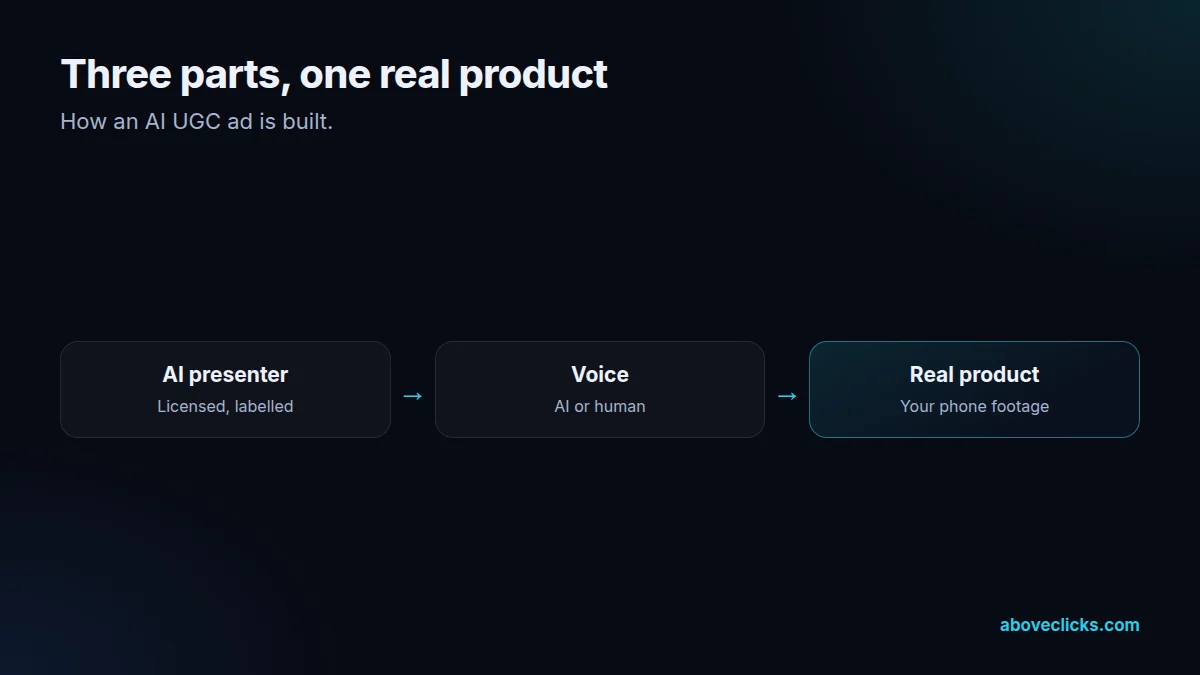
Part two is the format. UGC-style ads work because of their pace and framing: vertical, a face close to the lens, a quick hook, the product in hand, a point of view. We keep that grammar (talking-head openings, handheld product shots, captions in the creator style, a casual call to action) and build it from three parts: a licensed AI presenter, an AI or human voice, and real footage of your product filmed on a phone to our shot list or taken from your existing clips.
Part three is the tools. Avatar tools such as TikTok Symphony, HeyGen and Synthesia use the likenesses of actors who licensed them; TikTok says videos from its Symphony creative suite are automatically labelled AI-generated. We check each tool’s commercial terms for the plan used, pick presenters that suit your audience rather than the default face everyone uses, and reject takes where the lip-sync or hands give the AI away.
Part four is the label. We switch on the platforms’ AI disclosures for every realistic AI presenter: YouTube’s altered or synthetic content setting, TikTok’s AI-generated label, and Meta’s AI labelling. On-screen copy never hides it either. An unlabelled AI person tends to be spotted and called out in the comments, and that conversation is about the brand, not the product.
Part five is scale with discipline. The point of AI UGC ads is testing more angles, hooks and languages than creators can film. Each batch fixes everything except one variable (the hook, the angle, the presenter or the language), runs against a control, and is judged on cost per purchase. When an angle wins, we often brief a real creator to film it through our UGC video ads service, because a real person’s experience is the one thing AI can’t supply.
Languages are where AI UGC ads save the most time. One script can be voiced and lip-synced in several languages for new markets; a native speaker or a person fluent in the language checks every version before it runs, because a mistranslated benefit is worse than no ad. Captions follow the same check, and the product footage stays identical across languages so tests compare like with like.
Briefing matters as much in AI UGC ads as with real creators. Each script names the buyer, the one problem, the product moment to show and the call to action, and every line is checked against what the product can actually do. If a claim needs proof, such as a material, a certification or a delivery promise, we ask for the proof before the line goes in.
Our pipeline does the rest: AI presenter takes, real product inserts, captions in creator style, sound clean-up, loudness mastering and exports in 9:16 for Reels, Stories, TikTok and Shorts plus 4:5 for feeds. We keep a generation log (tool, presenter, script, date) for every ad, so if a platform or customer asks how an ad was made, you can answer. Our client video work is shown anonymously: see real campaign results in our YouTube Ads results and TikTok Ads results.

How we use AI here
Licensed AI avatars and voices that host, explain and demonstrate, labelled as AI.
Hook, angle and language versions produced quickly, each checked by a person.
Where we don’t use it: posing as customers, claiming experience with the product, showing results, or redrawing your product. Those stay real or stay out.
What’s included
What the AI presenter may say and do, and what it never claims.
UGC-style scripts with hook variants for each angle.
Licensed avatars that suit your buyers, checked for lip-sync and hands.
Your product filmed on a phone to our shot list, or from existing clips.
Platform AI disclosures set on every realistic AI presenter.
Voiced and captioned versions checked by a fluent speaker.
Tool, presenter, script and date for every ad.
How we run it
Role first, then script, presenter, label and test. Typical timing: the brief and script within 2 to 3 workdays, the first cut within 1 week, and final files within 2 workdays of your feedback.
Step 1
Host or explainer, never a customer.
Step 2
UGC grammar, your real product.
Step 3
AI presenter, captions, disclosures.
Step 4
One variable per batch.

Pricing
The audit is free. Paid work starts at these prices, and your exact cost is fixed in writing before any work begins.
Free no obligation
Tell us your product and we will plan AI UGC ads.
Get my free auditFixed scope
From $400 one-off
Five AI UGC ad creatives, ready to run.
From $600 monthly
Fresh creatives every month.
All prices are starting prices in US dollars. Custom work beyond these options is quoted after the audit.
By industry
For jewelry, an AI host can explain sizing, metals and gifting; the piece itself is always real macro footage.
For fashion, AI hosts suit styling tips and size guides, while fit and drape come from real try-on clips.
For luxury and high-ticket items, AI UGC rarely suits the brand; we may advise real creators or motion graphics instead.
Sources
Platform rules change. These are the official pages we check the work against, so you can check it too.
FAQ
Can’t find yours? Ask on WhatsApp or by email and we’ll answer it.
Ads in the style of creator videos, made with AI presenters and AI voice, combined with real product footage, so you can test many angles and languages quickly.
Yes, used honestly. An AI presenter can explain a product if it’s labelled, but an AI person posing as a customer is a fake testimonial under the FTC’s reviews rule.
Realistic AI people should be disclosed. YouTube, TikTok and Meta all have AI labels, and TikTok labels videos from its own AI tools automatically.
Yes. The product shots come from your phone footage or existing clips, never from an AI generator, so the ad matches what you sell.
For testing angles and languages quickly, it can be. For trust and real experience, creators win. Many brands test with AI and scale winners with creators.
Yes. Scripts are voiced and lip-synced in other languages, and a fluent speaker checks each version before it runs.
Tools such as TikTok Symphony, HeyGen and Synthesia, chosen per job after checking their commercial terms and how well they render your audience.
Related guides
Meta Ads
On Shopify, the Meta Conversions API is a setting, not a coding project. Here's how to switch it on in 5 steps,…
Meta Ads
Meta ads can be a store's most profitable channel or its most expensive habit. This guide puts the work in order: tracking…
Meta Ads
Most creative tests on Meta end too early to mean anything. This framework fixes that: one variable per test, a budget worked…
Free growth audit
Tell us about your store. We’ll review your tracking, campaigns and SEO and send you a written audit with the top fixes, ranked by impact.