Buying guides
Questions to ask a marketing agency before you hire one (with good answers and red flags)
21 questions for your intro calls, grouped by topic, each with what a good answer sounds like and what should worry you.…
Creative & branding · Poster design
We offer poster design for print: event, retail, campaign and wall posters for businesses, venues and schools. Each poster is designed for where it hangs and how far away people stand, set in real type, and delivered as a print-ready PDF made to your printer’s specification. You place the print order.
200+ clients served 500+ projects delivered
Free poster brief review
Three fields and you’re done. We look at what you have, say what we’d make and how, and check it against the problems we see most often:
Your plan comes by email as a PDF. If you want to discuss going ahead after reading it, we’ll set up a video meeting. We use your details only for this review.
Fit
Not the right fit if you want us to print and deliver the posters ourselves; we design and you print with the printer you choose. If speed and many visual options matter more than print detail, see AI poster design.
Problems we fix
Every detail at the same size, so nothing is read from more than a metre away.
Image, headline and logos all competing for the first glance.
Low-resolution RGB images that print soft and dull.
White slivers at the edges, or text trimmed off by the guillotine.
A poster designed for A3 stretched to A1, with type and images out of proportion.
A flattened file nobody can edit when the date or price changes.
In 1:10 · animated
A short animated walk-through of the first checks in our audit. No sound needed: everything is on screen, and the transcript is below.
What we check first in a poster, an animated explainer of 1:10 with on-screen captions and controls to pause.
Our approach
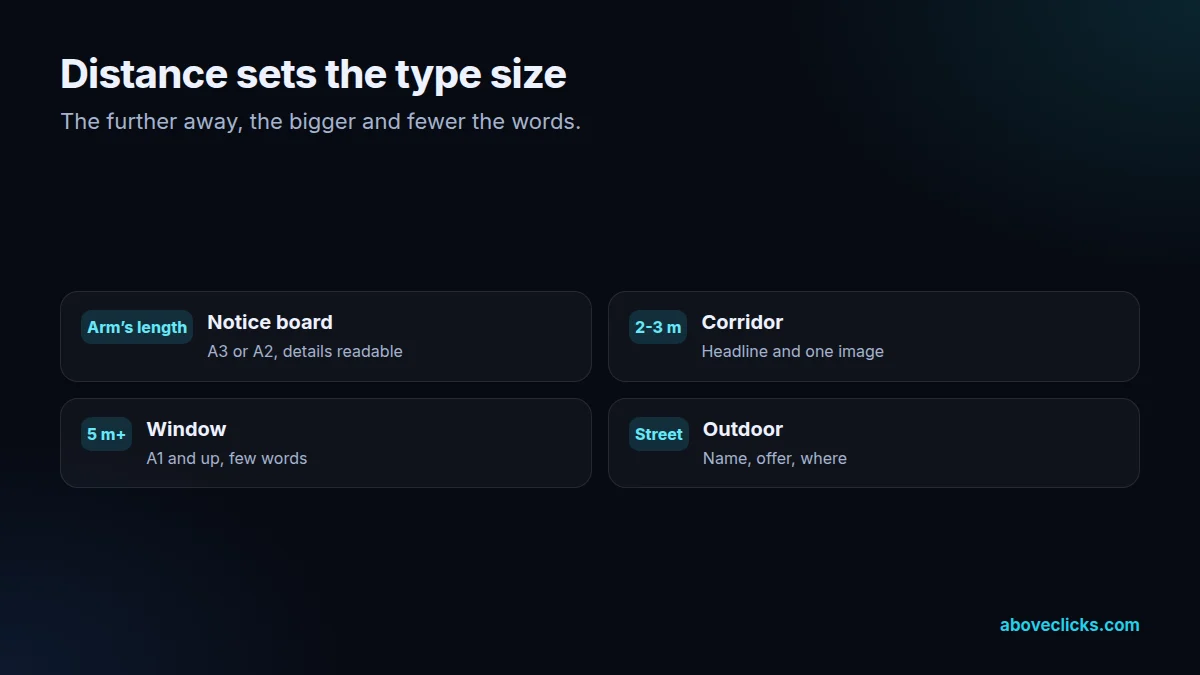
Part one is the brief, and the most useful question in it is where the poster will hang. Poster design starts from the viewing distance: a window poster read from the pavement needs a headline several times bigger than a notice-board poster read at arm’s length. We also agree the one thing the poster must make someone do (attend, buy, visit, scan) and the 3 facts it must carry, usually what, when and where. Everything else goes on the website the QR code points to.
Part two is the hierarchy. A good poster is read in three steps: the image or headline stops people, the subline tells them what it is, and the details tell them when and where. We design one clear focal point, then size every element so it’s read in that order. Logos, sponsors and small print sit at the bottom at a size that can be read by someone who has already stopped.
Part three is the size and the paper. Most printers work to ISO 216 paper sizes (A4, A3, A2, A1 and so on) or to their local sizes, such as US tabloid and 18 x 24 inches, and every A size has the same proportions, so a well-built A3 poster scales cleanly to A1. We set up the file at the final size, with bleed and a safe margin from your printer’s spec, usually 3 mm of bleed on each edge, and we keep text well inside the trim.
Part four is colour and images. Screens show colour in RGB; printers print in CMYK or extra spot inks, and some bright screen colours can’t be printed. We convert to the colour profile your printer works to, often one based on ISO 12647-2 for offset printing, and check that photos have enough resolution at the printed size. A photo that looks sharp on a phone can print soft at A1.
Part five is the print file. You get a print PDF, usually PDF/X-4, the format ISO 15930-7 defines for complete print-ready files: fonts embedded, colours defined and bleed included, as Adobe’s PDF/X guide describes. We design; you print. We deliver print-ready files made to your printer’s specification (size, bleed, colour profile and file format), and you place the print order with the printer you choose, so you see the printer’s price and proof directly. If the printer asks for a different format, we export to it.
Readability is part of print poster design too. Text meets W3C’s contrast guidance (4.5:1 for normal text, 3:1 for large text), a useful minimum for posters seen in poor light, and nothing that must be read sits over a busy part of the photo. QR codes are tested at the printed size and placed where a phone can reach them.
Where AI helps: exploring background art, extending photos to a new size and making seasonal variants. Where it doesn’t: the words. Every headline, date, price and QR code is set by a person as real type and checked before the file goes to print. You get the editable master, so the next poster in the series starts from it. Client work is shown anonymously: see real client results on our results page.
How we use AI here
AI explores textures and illustration in your brand colours.
AI extends and cleans up your own photos to fit a new size.
AI adapts a set poster style for each new event or season.
Where we don’t use it: the words and the print file. Type, dates, prices and QR codes are set by a person; print files are set up and checked by hand.
What’s included
Placement, viewing distance, the action and the 3 facts.
One focal point, a clear reading order, real type.
Final size, bleed and safe margins from your printer’s spec.
Converted to your printer’s profile, images checked at size.
PDF/X-4 or your printer’s format, fonts embedded.
A digital copy for social, email and your website.
The layered file, so dates and prices can change later.

How we run it
Poster design runs brief first, then layout, print set-up and files. Typical timing: first designs within 2 workdays of the brief, each revision round within 1 workday, and print-ready files on approval.
Step 1
Place, distance, facts.
Step 2
Focal point, hierarchy.
Step 3
Size, bleed, colour.
Step 4
Print PDF and screen copy.

Pricing
The brief review is free. Paid work starts at these prices, and your exact cost is fixed in writing before any work begins.
Free no obligation
Tell us about your event or offer and where the poster goes. You get a written plan and a fixed quote before any paid work.
Get my free reviewAfter the brief review
From $80 one-off, per design
One poster with print-ready files.
From $250 one-off, per campaign
A matching set of posters for one campaign.
All prices are starting prices in US dollars. Custom work beyond these options is quoted after the review.
Per project
On request, we can also coordinate the print order with the printer you choose.
Pricing
We quote after a short call and a look at what you use today, so the number is based on the real work. Each design project is a fixed one-off cost, agreed before work starts: from $80 per design, with two revision rounds included.
Start with the free audit to get a quote for your store.
By industry
For local businesses, window and counter posters for offers and events, with the same layout reused each season.
For education, open-day and course posters for campus boards, with dates, venues and a tested QR code to register.
For healthcare, waiting-room posters that explain a service in plain words, reviewed by a clinician before print.
Sources
Platform rules change. These are the official pages we check the work against, so you can check it too.
FAQ
Can’t find yours? Ask on WhatsApp or by email and we’ll answer it.
A brief, a designed poster with a clear reading order, set-up at the final size with bleed, a colour check and a print-ready PDF, plus a screen version and the editable file.
It depends on where it hangs and how far away people stand. A3 and A2 suit notice boards; A1 and larger suit windows and walls read from a distance.
Usually a PDF/X file at the final size, with bleed, embedded fonts and CMYK or spot colours. We check your printer’s spec and export to it.
No. We design and deliver print-ready files to your printer’s specification, and you place the order, so you see the printer’s price and proof directly.
Extra image beyond the trim edge, usually 3 mm, so no white edge shows after cutting. Your printer’s spec sets the exact amount.
Yes. We set a layout and style once, then each new poster reuses it, so the series looks consistent and later posters take less time.
For background art, extending photos and variants. Every word, date, price and QR code is set by a person and checked before print.
Yes. You get the editable master file, so dates, prices and details can be updated without redesigning the poster.
Related guides
Buying guides
21 questions for your intro calls, grouped by topic, each with what a good answer sounds like and what should worry you.…
Buying guides
Percentage of ad spend, flat retainer, performance fee, hourly or a hybrid: what each model rewards, how it behaves as your spend…
Buying guides
In-house team, agency or freelancer? A side-by-side comparison on 7 factors, a total-cost worksheet built from US government pay data, and a…
Free growth audit
Tell us about your store. We’ll review your tracking, campaigns and SEO and send you a written audit with the top fixes, ranked by impact.