Buying guides
Questions to ask a marketing agency before you hire one (with good answers and red flags)
21 questions for your intro calls, grouped by topic, each with what a good answer sounds like and what should worry you.…
Creative & branding · Brand strategy
We offer brand strategy for growing businesses: who you’re for, how you differ from competitors, what you promise and how you sound. We write it down in a short brand strategy you can use. On request, we also test the key messages with real search and ad data before they go live.
200+ clients served 500+ projects delivered
Free brand strategy audit
Three fields and you’re done. The PDF report shows what we found on your own pages and accounts, and the order we’d fix it in. It covers the problems we see most often:
Your PDF report comes by email. If you want to discuss going ahead after reading it, we’ll set up a video meeting. We use your details only for this audit.
Fit
Not the right fit if you want a long research report or a naming agency with focus groups in several countries. This is a practical brand strategy for small and growing businesses, built from your customers, your competitors and your own marketing data.
Problems we fix
A long deck of values and archetypes that never reaches the website.
A position so broad it could belong to any competitor.
Messaging chosen in a meeting, never tested with a real customer.
Internal jargon on the home page instead of the words people search.
A strategy that the designer can’t turn into a look.
A descriptive name that’s weak as a trademark and hard to find.
In 1:10 · animated
A short animated walk-through of the first checks in our audit. No sound needed: everything is on screen, and the transcript is below.
What we check first in a brand strategy, an animated explainer of 1:10 with on-screen captions and controls to pause.
Our approach
Part one is listening. A useful brand strategy starts with what customers already say: why they chose you, what they nearly chose instead, and what almost stopped them. We read reviews, sales emails and support questions, interview a handful of customers if you can introduce us, and look at the words people use when they search for what you sell. Those words often become the headline.
Part two is the competitive map. We review the brands your customers compare you with: what each promises, how it looks and how it prices. Brand positioning is then a choice about where you stand on that map, for whom and why, written as a short positioning statement. A position that any competitor could copy is noted as a risk, not a strategy.
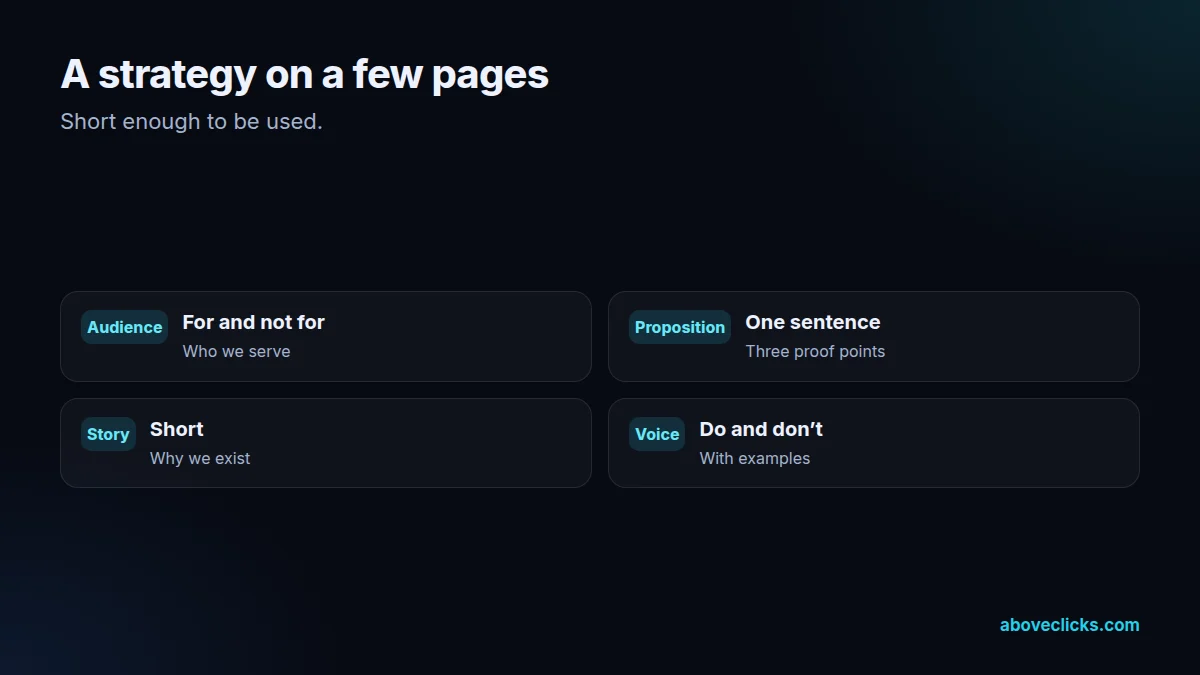
Part three is the core of the brand strategy, written on a few pages: who the brand is for and who it isn’t for, the problem it solves, the value proposition in one sentence, three proof points that back it up (real numbers and real customer words only, since the FTC’s rule on consumer reviews and testimonials bans fake or false ones), a short brand story, the personality in a few words, and the tone of voice with examples of what to say and what not to say. That’s the brief every logo, website and ad is built from.
Part four is testing, available on request, and this is where our background in performance marketing helps. Before the messaging goes on a sign or a website, we can test the main options where real customers react: as ad headlines in small paid campaigns, as alternative landing page headlines, or as email subject lines, judged on clicks and enquiries, not opinions.
Part five is turning it into words people see: brand messaging for the home page, service pages, profiles and ads, an elevator pitch for the team, and a messaging guide that shows the core message adapted for each audience. If the business needs a name or a new name, we shortlist options and keep in mind the USPTO’s note that strong trademarks are fanciful, arbitrary or suggestive while descriptive ones are weak, and that applications are often rejected for being too similar to a registered mark. Legal clearance is for a trademark attorney.
Consistency across channels is part of the brand strategy too. Your business name, description and promise should match on your website, Google Business Profile, social profiles and signage. Google’s Business Profile guidelines ask that the name reflect the real-world name used on your storefront and stationery, and its site name guidance uses signals such as your Organization markup and how other sites refer to you. Google’s Organization structured data is where your website states the official name, logo and description, so it should use the same words as the strategy.
Where AI helps: summarising reviews and survey answers into themes, grouping search terms and drafting message variants for testing. Where it doesn’t: the decisions. People choose the position and the promise, and customers decide which message works. We have worked on 100+ brand strategy projects, as strategists and, wherever required, as the team that executes the plan.
A brand strategy is only useful if it’s used, so we hand it over in working sessions rather than as a file. We walk your team through it, rewrite a few real pieces together (the home page headline, a sales email, a profile description) and leave a one-page summary that sits next to the brand guidelines. When a new campaign, hire or agency starts, that page is the brief. We suggest reviewing the brand strategy once a year, or when the business changes direction.
How we use AI here
AI groups reviews, survey answers and support questions into themes.
AI helps cluster the terms customers use when they search.
AI drafts headline variants for testing, which a person edits.
Where we don’t use it: the decisions. People choose the position and the promise, and real customers decide which message wins.
What’s included
Reviews, sales emails, support questions, interviews and search terms.
What competitors promise, how they look and price.
Where you stand, for whom and why, in a few lines.
Audience, proposition, proof, story, personality and voice.
On request: main options tested in ads, landing pages or email.
Home page, service, profile and ad messaging, plus a pitch.
What the identity must express, for the designer.

How we run it
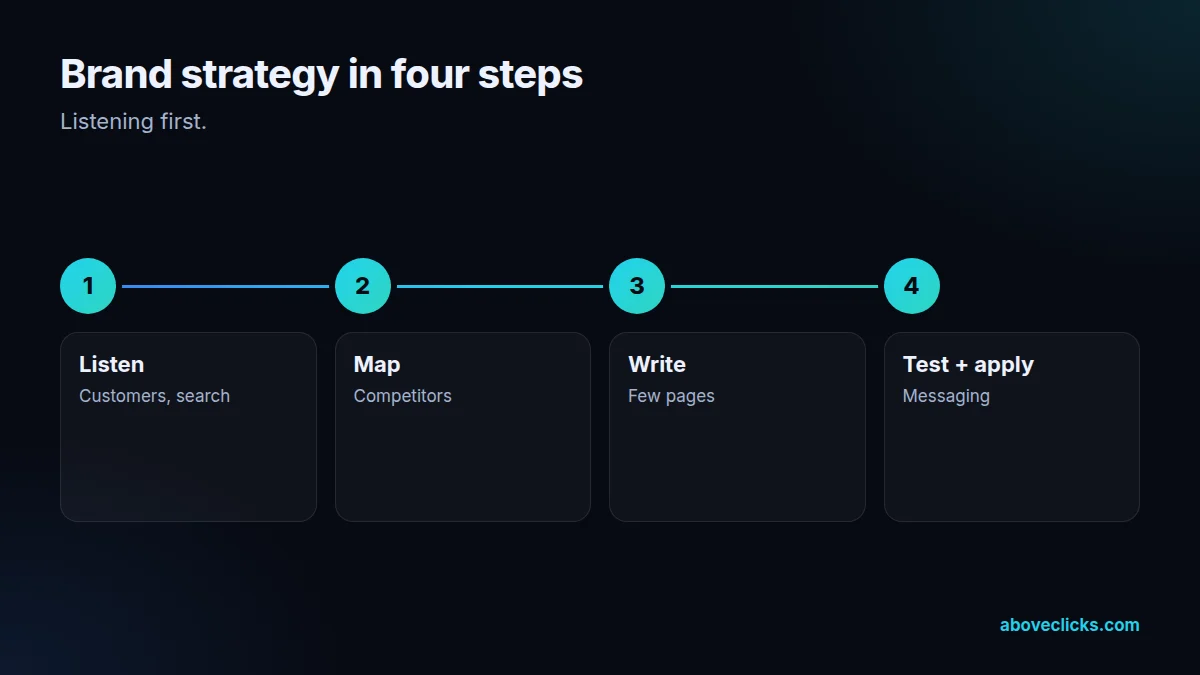
Brand strategy runs listening first, then the map, the strategy, tests and messaging. Typical timing: listening and research in the first week, the written strategy within 3 weeks, and message testing after that on request.
Step 1
Customers and search.
Step 2
Competitors, position.
Step 3
A few useful pages.
Step 4
Real reactions, messaging.
Pricing
The audit is free. Paid work starts at these prices, and your exact cost is fixed in writing before any work begins.
Free no obligation
We’ll check your brand, buyers and competitors and send a PDF report within 2 workdays.
Get my free auditAfter the audit
From $700 one-off
Research, positioning and messaging, written down.
From $250 one-off
One recorded workshop with a written summary.
All prices are starting prices in US dollars. Custom work beyond these options is quoted after the audit.
Per project
A typical project takes 3 to 4 weeks, and any ad spend for message testing is paid by you, straight to the platform.
Pricing
We quote after a short audit, once we’ve seen the account or the store, so the number is based on the real work. Each project is a fixed one-off cost, agreed before work starts: from $700.
Start with the free audit to get a quote for your store.
By industry
For luxury and high-ticket brands, a position built on provenance and service, with message testing on request before they reach the boutique.
For online stores, a value proposition that survives a comparison tab, which we can test as ad headlines and product page copy.
For education, a clear promise to students and parents, in the words they use when they search for courses.
Sources
Platform rules change. These are the official pages we check the work against, so you can check it too.
FAQ
Can’t find yours? Ask on WhatsApp or by email and we’ll answer it.
A short plan for who the brand is for, how it’s different from competitors, what it promises, how it proves it and how it sounds.
Customer listening, a competitive map, a positioning statement, the strategy pages, a messaging guide and a design brief, plus message testing on request.
The place you choose to hold in customers’ minds compared with competitors: for whom, against what and why you’re the better choice.
When you ask for it, with real customers: as ad headlines, landing page headlines or email subject lines, judged on clicks and enquiries rather than opinions.
A few pages. It has to be short enough that your team and designers actually use it.
Yes. We shortlist names and check obvious conflicts. Strong trademarks are fanciful, arbitrary or suggestive; clearance is for a trademark attorney.
If you can’t say who you’re for and why you’re different in a sentence, yes. The strategy becomes the designer’s brief.
To group reviews, cluster search terms and draft message variants. People make the decisions, and customers pick the winning message.
Related guides
Buying guides
21 questions for your intro calls, grouped by topic, each with what a good answer sounds like and what should worry you.…
Buying guides
Percentage of ad spend, flat retainer, performance fee, hourly or a hybrid: what each model rewards, how it behaves as your spend…
Buying guides
In-house team, agency or freelancer? A side-by-side comparison on 7 factors, a total-cost worksheet built from US government pay data, and a…
Free growth audit
Tell us about your store. We’ll review your tracking, campaigns and SEO and send you a written audit with the top fixes, ranked by impact.