Meta Ads
Meta Conversions API on Shopify: set it up in 5 steps, then check it works
On Shopify, the Meta Conversions API is a setting, not a coding project. Here's how to switch it on in 5 steps,…
Video & social · AI explainer videos
We make AI explainer videos for businesses that need many short explanations, not one big film. AI generates the illustrations, scenes and narration; a person writes the script, checks every frame against your documentation and approves the cut. The result is an explainer series you can extend each month and translate cheaply.
200+ clients served 500+ projects delivered
Free AI explainer brief review
Three fields and you’re done. We look at what you have, say what we’d make and how, and check it against the problems we see most often:
Your plan comes by email as a PDF. If you want to discuss going ahead after reading it, we’ll set up a video meeting. We use your details only for this review.
Fit
Not the right fit if you want one flagship film with fully custom, hand-animated characters rather than AI explainer videos. That’s our animated explainer videos service. AI explainers trade some polish for speed, volume and easy language versions, and we say so before you choose.
Problems we fix
Generated diagrams that show steps in the wrong order or buttons that don’t exist.
Each video uses a new AI style, so the series never looks like one brand.
A default AI voice that mispronounces product names and reads too fast.
The tool wrote the words, so the video answers a question nobody asked.
AI-drawn labels with spelling errors that can’t be fixed or translated.
Ten topics in one five minute explainer that nobody finishes.
In 1:10 · animated
A short animated walk-through of the first checks in our audit. No sound needed: everything is on screen, and the transcript is below.
What we check first in an AI explainer, an animated explainer of 1:10 with on-screen captions and controls to pause.
Our approach
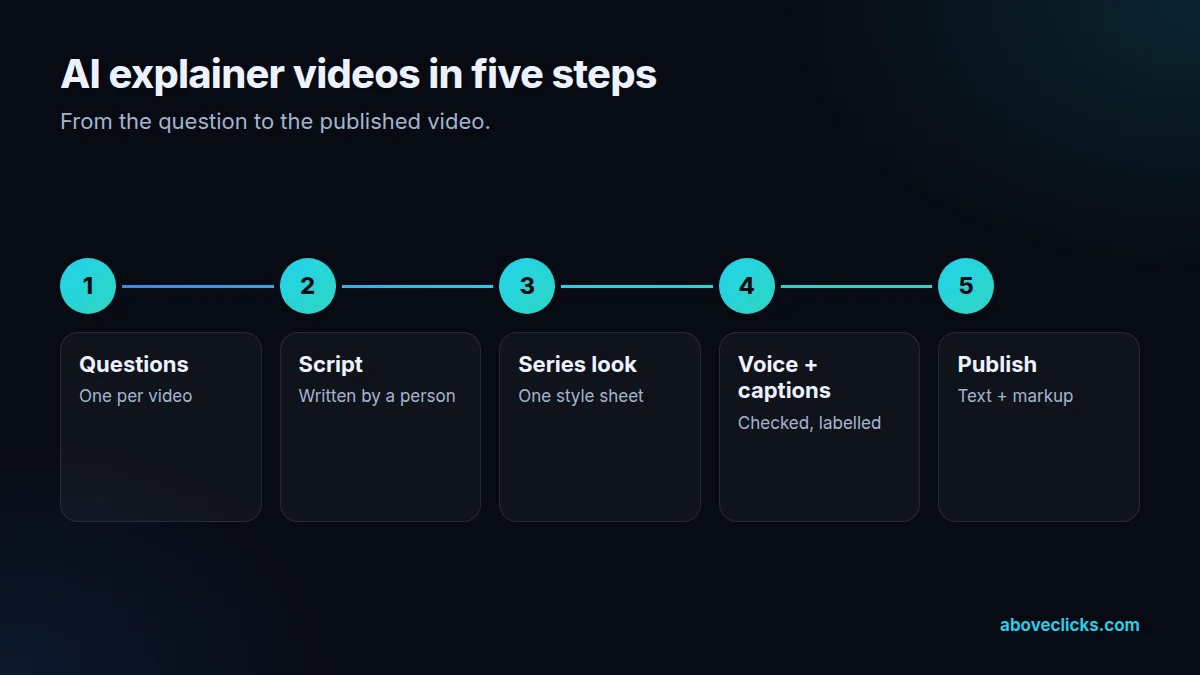
Step one is the question list. An AI explainer series starts from the questions your buyers and customers actually ask: sales calls, support tickets, search queries and reviews. We group them into one question per video and rank them by how often they come up and how much a wrong answer costs you. A typical first batch is 5 to 10 videos of 45 to 90 seconds each, because one clear answer per video beats a long tour of everything.
Step two is the script, written by a person. For AI explainer videos, AI drafts help, but every script is rewritten for speaking (about 130 to 150 words per minute), uses your customers’ words rather than internal product names, and is checked against your documentation or product team before any visual is generated. Changes are cheapest here, so you approve each script line by line.
Step three is the look, fixed once for the whole series. We build a style sheet from your brand colours and fonts, generate a small set of reference illustrations, and reuse them so video 12 looks like video 1. On-screen text is added in the edit as real, editable type, never drawn by the image model, so it’s spelled correctly and can be translated. Our motion pipeline (Remotion layouts, 2D animation, simple Blender 3D) assembles the AI images into a clean, consistent explainer.
Step four is the voice and captions. Narration is a disclosed AI voice, or a cloned voice of someone on your team who has agreed in writing, with product names and numbers checked for pronunciation by a person. Every video gets captions, which W3C’s WCAG success criterion 1.2.2 requires at Level A for prerecorded video with audio. Language versions reuse the same visuals with a translated script, checked by a native speaker.
Step five is publishing AI explainer videos where the question is asked: the product page, the help article, the onboarding email or YouTube. On your site each AI explainer gets the matching text beside it and VideoObject markup, following Google’s video structured data guide, so search engines and AI assistants can read what it explains.
We’re plain about labelling. YouTube’s GenAI disclosure policy asks creators to disclose realistic AI-generated or altered content, and says non-realistic animation and cloning your own voice for a voice-over don’t need disclosure. Most AI explainer videos are illustrated, so they usually fall on the non-realistic side; when a scene looks real, we switch the label on. Elsewhere we follow each platform’s rule and keep a record of what was generated.
Our pipeline is the same one we use for course explainer series and motion graphics: AI image generation, Remotion, AI narration with person-checked pronunciation, caption files and loudness mastering. Our client video work is shown anonymously: see real campaign results in our YouTube Ads results and TikTok Ads results. Each new batch of AI explainer videos reuses the style sheet, so the cost per video falls as the series grows.
How we use AI here
AI generates illustrations in your series style; a person picks, fixes or rejects each one.
Disclosed AI voices and translated versions, checked by a person or a native speaker.
AI turns support tickets and transcripts into draft scripts that a person rewrites and checks.
Where we don’t use it: deciding what’s true. AI doesn’t choose the steps, the numbers or the claims, and it never draws on-screen text. Your documentation and a person do.
What’s included
Your buyers’ and customers’ questions, grouped one per video and ranked.
Spoken-word scripts checked against your documentation and approved by you.
Colours, fonts, illustration style and reference images reused in every video.
45 to 90 second videos with AI illustrations, motion and narration.
Caption files in every AI explainer video, plus translated versions when you need them.
16:9 for site and YouTube, 9:16 and 1:1 for social and help widgets.
Which tool made which asset, kept for labels and future edits.

How we run it
Questions first, then scripts, the series look, and the videos. Typical timing: the brief and script within 2 to 3 workdays, the first cut within 1 week, and final files within 2 workdays of your feedback.
Step 1
One question per video, ranked.
Step 2
Written, fact-checked, approved.
Step 3
AI visuals in one series style.
Step 4
With captions, text and markup.

Pricing
The brief review is free. AI explainer videos start at these prices, and your exact cost is fixed in writing before any work begins.
Free no obligation
Tell us about your topic and where the video will run. You get a written plan and a fixed quote before any paid work.
Get my free reviewAfter the brief review
From $300 one-off, per video
Script, AI visuals and voice, fact-checked.
From $1,000 one-off, per series
A set of AI explainer videos in one style.
All prices are starting prices in US dollars. Longer AI explainer videos and custom work are quoted after the review.
Per batch
Videos come one at a time or as a series, with two revision rounds included and each video typically delivered within 1 week of the approved script.
Pricing
We quote after a short audit, once we’ve seen the account or the store, so the number is based on the real work. Each project is a fixed one-off cost, agreed before work starts: from $300 per video.
Start with the free audit to get a quote for your store.
By industry
For online stores, AI explainers answer the sizing, care and “how does it work” questions that stop orders, on the product page itself.
For education, a series of short AI explainers covers admissions steps, fee structures and visa stages, one question per video, in each language.
For healthcare, explainers cover what to expect at a visit or a procedure, checked by a clinician before publishing and never giving personal advice.
Sources
Platform rules change. These are the official pages we check the work against, so you can check it too.
FAQ
Can’t find yours? Ask on WhatsApp or by email and we’ll answer it.
Short videos that explain a product, service or process using AI-generated illustrations, scenes and narration, assembled into an edit with captions and on-screen text.
Animated explainers are hand-designed and animated frame by frame. AI explainers use generated visuals and voices, so they cost less per video and suit a series.
A person does. AI can draft from your support tickets or transcripts, but we rewrite every script for speaking and check it against your documentation before generating visuals.
Sometimes. YouTube asks for disclosure of realistic AI content but not for non-realistic animation. Illustrated explainers usually don’t need it; realistic scenes do.
Yes. The visuals are reused and only the script and voice change, so each language version is quick to make. A native speaker checks every translation.
Usually 45 to 90 seconds, answering one question. A series of short videos is watched more fully than one long video covering everything.
Yes. We fix a style sheet and reference images for the series and reuse them, so every AI explainer video looks like part of the same set.
Yes. Record the narration yourself, or let us clone the voice of a team member who agrees in writing. Cloning your own voice is common for explainer series.
Related guides
Meta Ads
On Shopify, the Meta Conversions API is a setting, not a coding project. Here's how to switch it on in 5 steps,…
Meta Ads
Meta ads can be a store's most profitable channel or its most expensive habit. This guide puts the work in order: tracking…
Meta Ads
Most creative tests on Meta end too early to mean anything. This framework fixes that: one variable per test, a budget worked…
Free growth audit
Tell us about your store. We’ll review your tracking, campaigns and SEO and send you a written audit with the top fixes, ranked by impact.