E-commerce SEO
Affordable SEO services for small business: 5 best proven
Affordable SEO is a scoping decision, not a shopping decision. This guide shows what a small budget actually buys, what to buy…
Custom solutions · Web applications
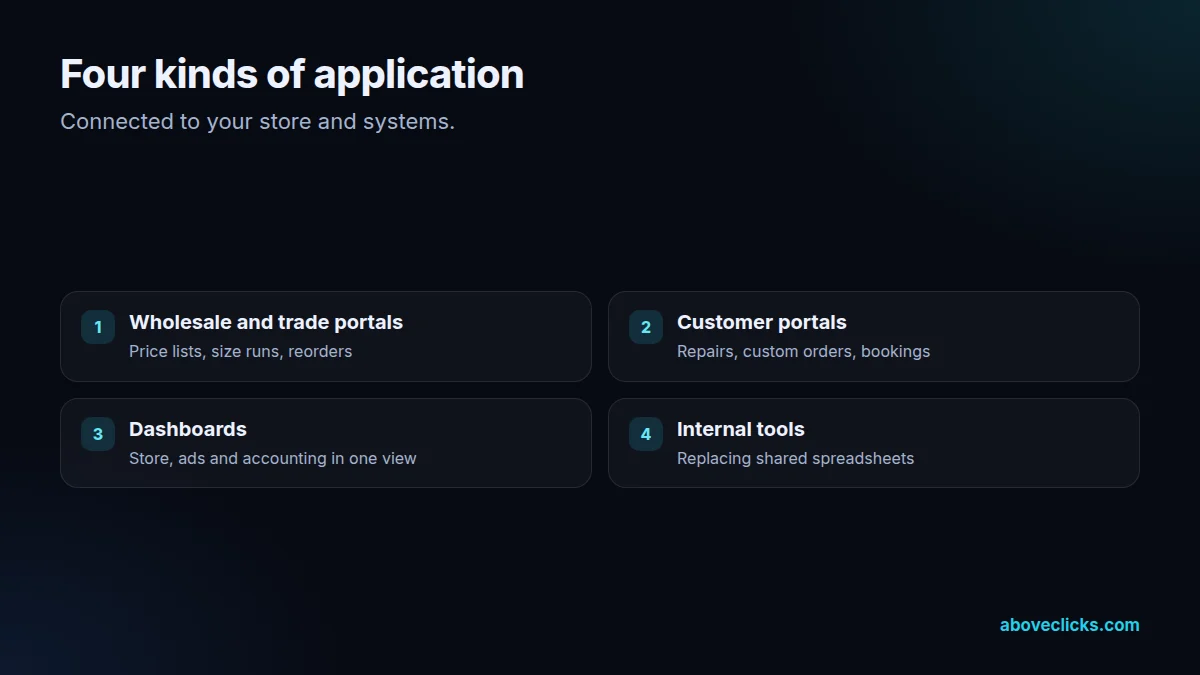
We build custom web applications for e-commerce businesses: wholesale portals for trade buyers, customer portals for repairs or made-to-order pieces, dashboards that combine Shopify, ads and accounting data, and internal tools that replace spreadsheets. Each one connects to your store and systems. A developer-led team builds them with modern AI-assisted development and delivers them the way a professional software company does.
200+ clients served 500+ projects delivered
Free review for custom web applications, no obligation. A short description of the process is all we need to start.
Free web app audit
Three fields and you’re done. The PDF report shows what we found on your own pages and accounts, and the order we’d fix it in. It covers the problems we see most often:
Your PDF report comes by email. If you want to discuss going ahead after reading it, we’ll set up a video meeting. We use your details only for this audit.
Fit
Not the right fit if an off-the-shelf tool does 90% of the job at a reasonable price. Custom software needs care for years; we’ll say when buying is smarter than building.
Problems we fix
Orders, quotes or production tracked in shared sheets, with version conflicts and no history.
Wholesale orders typed in from emails and PDFs, with pricing errors and slow replies.
Revenue in the store, spend in ad platforms, costs in accounting, and nobody sees margin in one view.
Repairs, custom orders or bookings tracked by email, so customers keep chasing updates.
Generic software forcing your team into workarounds every day.
A tool built years ago, undocumented, that everyone is afraid to touch.
In 1:10 · animated
A short animated walk-through of the first checks in our audit. No sound needed: everything is on screen, and the transcript is below.
What we check first before building a web app, an animated explainer of 1:10 with on-screen captions and controls to pause.
How we build
It starts with the work, not the technology. We sit with the people who’ll use the application, map the process as it really happens, and write a spec: users and permissions, screens, data, integrations, what happens when things go wrong, and how we’ll test that it works. You approve the spec and a fixed quote or estimate before we build.
We build in small, usable pieces. A first version that does the most valuable job goes live early, then features are added in short cycles you can see and test. It keeps the project honest: you’re never waiting months to find out whether it fits.
Our founder started as a web developer before moving into marketing, and today we build with modern AI-assisted development. AI coding tools let a small, senior team deliver what used to need a large one, at a cost that makes sense for e-commerce businesses. Every AI-written change is reviewed, tested and owned by a developer, because tools that write code quickly also make mistakes quickly.
Security is designed in. Logins and roles so each person sees only what they should, keys and passwords kept out of code, data validated, dependencies kept current, and the common risks in the OWASP Top 10 checked before launch. Applications that handle customer data follow the privacy rules your business already works under.
Integrations use official APIs: Shopify’s Admin API for orders, products and customers, the ad platforms’ reporting APIs, accounting and shipping tools. Data syncs are logged, retried when they fail and monitored, so a broken connection is noticed by us, not by a customer.
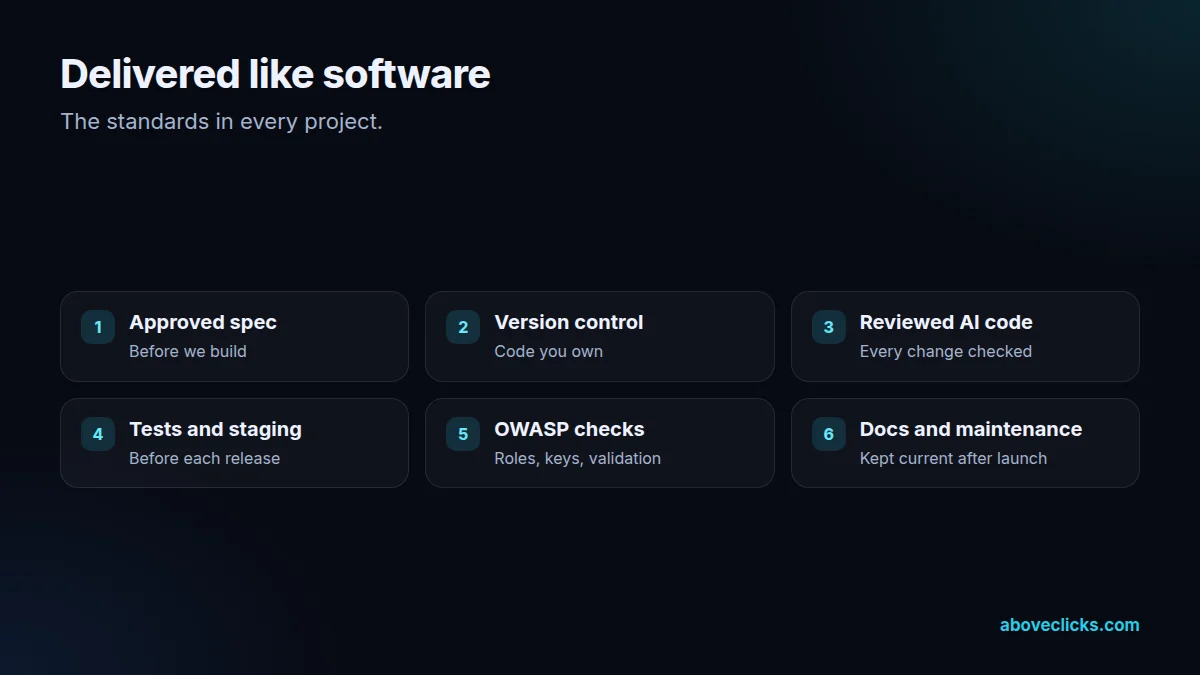
Delivery looks like any professional software project: code in version control, a staging environment, automated tests for critical paths, deployment you can repeat, error monitoring, documentation and ownership of the code. After launch, a maintenance plan keeps dependencies, hosting and integrations current. If the application needs to live inside Shopify instead, we build a custom Shopify app.
A typical example is a wholesale portal. Trade buyers log in, see their own price list and minimums, order by size run or quantity breaks, reorder from past orders and download invoices; the order lands in Shopify or your ERP with the right tags and payment terms, and your team stops typing orders from emails. A customer portal for repairs or made-to-order pieces works the same way: customers see each stage, approve quotes and upload photos, and staff update one record instead of answering the same email five times.
Custom web applications also need an owner on your side. We ask for one person who can make decisions and test each release, because software built without its users quietly drifts from how the work is really done. Short demos every cycle keep everyone looking at the same thing.
How we use AI here
AI coding tools write much of the code under a developer’s direction, which brings custom software within reach of smaller businesses.
Where it helps: summarising data, drafting replies or classifying requests, always with a person able to check and override.
Where it doesn’t help: architecture, security decisions and accountability. Those stay with a developer, and AI features never make final decisions about money, customers or access.
What’s included
The process mapped with the people who use it, written into an approved spec.
The most valuable job working early, then features in short cycles.
Shopify, ad platforms, accounting and shipping tools through official APIs, logged and monitored.
Logins, permissions, OWASP Top 10 checks and credentials handled properly.
Automated tests on critical paths and a staging environment for every release.
Plain-English docs, deployment notes and the code in a repository you own.
Updates, hosting care and integration checks after launch.
How we run it
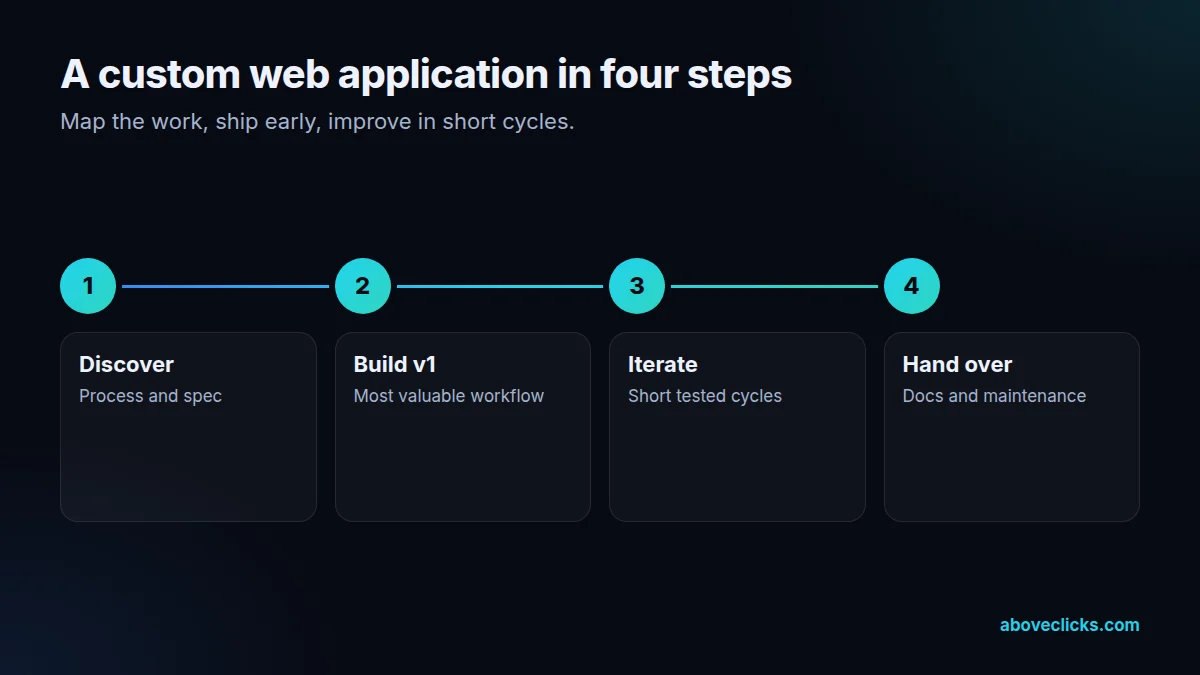
Map the work, ship the first version early, improve in short cycles. Typical timing for custom web applications: the scope within 2 workdays, the build in 2 to 4 weeks depending on size, then testing, launch and handover in the final week.
Step 1
Process mapped, users interviewed, spec written and approved.
Step 2
The most valuable workflow built, tested and released.
Step 3
Features added in short cycles, each one tested on staging first.
Step 4
Documentation, training and a maintenance plan.
Pricing
The audit is free. Paid work starts at these prices, and your exact cost is fixed in writing before any work begins.
Free no obligation
We’ll check your process and the tool you need and send a PDF report within 2 workdays.
Get my free auditAfter the audit
From $1,500 one-off, fixed scope
An internal tool or portal built to a written spec.
From $200 monthly
Hosting checks, updates and fixes.
All prices are starting prices in US dollars. Custom work beyond these options is quoted after the audit.
After launch
Pricing
We quote after a short audit, once we’ve seen the account or the store, so the number is based on the real work. Each project is a fixed one-off cost, agreed before work starts: from $1,500. Larger applications are priced per phase, each with its own spec.
Start with the free audit to get a quote for your store.
By industry
Jewelry businesses use custom portals for made-to-order and repair tracking, and trade portals for stockists.
Fashion brands need wholesale ordering by size run, line sheets for buyers and pre-order tracking.
Dealers in high-ticket goods need private catalogs for trade buyers, consignment tracking and quote workflows.
Sources
Platform rules change. These are the official pages we check the work against, so you can check it too.
FAQ
Can’t find yours? Ask on WhatsApp or by email and we’ll answer it.
Software that runs in a browser and is built for one business’s needs, such as a wholesale portal, a customer portal, a dashboard or an internal tool, instead of a general product used by thousands of companies.
Custom web development changes the storefront: features, checkout logic and integrations inside the store. A custom web application is a separate system for jobs a storefront isn’t built for, usually connected to the store.
We use AI coding tools for much of the coding, directed by an experienced developer. Every change is reviewed and tested before it ships. It shortens projects without lowering the standard.
You do: the code, the documentation and the accounts it runs on. Nothing is locked to us, and another developer could take it over.
On reliable cloud hosting in an account you own, sized for your use. We set up backups, monitoring and deployment, and can manage it for you.
A first useful version is usually weeks, not months, because we build the most valuable workflow first and add the rest in short cycles.
That’s expected. A maintenance plan covers updates and small changes, and larger features get their own short spec and quote.
Related guides
E-commerce SEO
Affordable SEO is a scoping decision, not a shopping decision. This guide shows what a small budget actually buys, what to buy…
E-commerce SEO
Email marketing cost is five bills in one: the tool, the list, the sends, the flows and the people. This guide prices…
E-commerce SEO
PPC pricing has two parts: money paid to the platform for clicks, and money paid to the person or agency managing the…
Free growth audit
Tell us about your store. We’ll review your tracking, campaigns and SEO and send you a written audit with the top fixes, ranked by impact.