Ecommerce SEO · Shopify, WooCommerce, BigCommerce

Ecommerce SEO for stores that need sales from search, not just traffic.

Our ecommerce SEO services cover Shopify, WooCommerce and BigCommerce stores: technical fixes first, then product and collection pages rebuilt around what buyers search for. Content links to the pages that sell, and progress is reported from Search Console and store revenue.

200+ clients served 500+ projects delivered

Free e-commerce SEO audit

We’ll check your store in Search Console and a crawl and send a PDF report within 2 workdays.

Three fields and you’re done. The PDF report shows what we found on your own pages and accounts, and the order we’d fix it in. It covers the problems we see most often:

  • Duplicate URLs and wasted crawling
  • Collection pages with nothing on them
  • Manufacturer descriptions
Chat on WhatsApp Prefer to talk first? Send us your URL on WhatsApp.

Your PDF report comes by email. If you want to discuss going ahead after reading it, we’ll set up a video meeting. We use your details only for this audit.

Results

Client results, from the reports themselves.

Screenshots from client accounts, anonymized and shown with permission. Each caption gives the source and the dates.

Google Search Console Performance report for an anonymized client site: 205K clicks, 12.8M impressions, 1.6% average CTR and average position 7.7 over 28 days, 20 September to 17 October 2026
Client SEO performance: 205K clicks and 12.8M impressions over 28 days (20 Sep to 17 Oct 2026). Source: Google Search Console, web search. Client anonymized, domain hidden, shown with permission.

A relevant result

Real numbers, or none at all.

We only publish results from our own reports and platform exports, with the timeframe and data source.

Case study

From Wix to Shopify: a long-term antique jewelry engagement

  • 4,283 → 118,763Search Console clicks in 28 days, 2025 vs 2026
  • 18.7 → 4.6average Search Console position, same windows
  • 180 of 180tracked keywords in Google’s top 10, all 48 priority targets in the top 3
  • $18.44M$18,444,401.31 in online net merchandise sales, Nov 2021–Sep 2026, Wix and Shopify
Industry
Antique jewelry e-commerce: period rings, lockets, brooches and diamond pieces
Market
United States
Channels
SEO, Meta Ads, Google Ads
Platform
Wix → Shopify (launched September 17, 2024, same domain)
Timeframe
November 2021–present, ongoing (almost five years)

The challenge

An antique jewelry store selling to US buyers, a client since November 2021. Buyers search for a particular era, stone, metal or item, often at a five-figure price, and unique pieces sell out. On Wix in November 2021, 14 of the 180 tracked keywords were in the top 10 and none of the 48 priority targets was in the top 3.

What we did

  • Built a consistent product taxonomy and better collection and product information, then moved the store from Wix to Shopify on September 17, 2024 (same domain, 968 canonical URLs, 1,082 permanent redirects).
  • Batch metadata optimization with individual review (period, item type, material, stone), product and collection copy, internal links and buying guides around specific search intent. Sold pieces with lasting information are assessed one by one rather than deleted.

Results

  • Search Console clicks 4,283 → 118,763 and impressions 497,623 → 5,647,813 (28 days: Sep 20–Oct 17, 2025 vs 2026); CTR 0.9% → 2.1%, average position 18.7 → 4.6.
  • All 180 tracked keywords in Google’s top 10 and all 48 priority targets in the top 3, with 72 in positions 1–3 (Ahrefs Rank Tracker, Google US desktop, October 17, 2026).
  • $18,444,401.31 in online net merchandise sales, November 2021–September 2026, including a $100,000 Victorian necklace sold online; Meta Ads ROAS 5.02 → 8.90 and Google Ads ROAS 5.76 → 8.92 (Sep 2025 vs Sep 2026).

Data source

Google Search Console (Performance report, web search), Ahrefs Rank Tracker, Google Ads and Meta Ads Manager campaign reports, Shopify Analytics and the store’s order ledger across Wix and Shopify. Money in USD; ROAS is attributed merchandise value divided by ad spend, not profit.

What’s next

Ongoing SEO, Meta Ads and Google Ads work; the engagement continues.

The Search Console windows show the later continuation (2025 vs 2026), not the start of the engagement, and the keyword figures are the fixed tracked set, not every query the store appears for.

See a sample report

Fit

Who it’s for

  • Stores whose blog traffic grows while collection and product pages stay buried
  • Catalogs with thousands of URLs, filters and variants
  • Brands selling into more than one English-speaking country
  • Stores planning a migration or redesign that can’t afford to lose rankings

Not the right fit if you need local SEO for a physical shop only. We work on online stores.

Problems we fix

Where ecommerce SEO usually goes wrong.

  • 01

    Duplicate URLs and wasted crawling

    Collection-scoped product paths, filters and tag pages create large numbers of near-duplicate URLs that compete with each other.

  • 02

    Collection pages with nothing on them

    Category pages are where buying searches land, yet most have a heading and a product grid and nothing that helps them rank.

  • 03

    Manufacturer descriptions

    The same product copy as every other retailer gives Google no reason to rank your page over theirs.

  • 04

    Content that doesn’t sell

    Blog posts rank for questions your buyers never ask and link to nothing you sell.

  • 05

    Slow mobile pages

    Apps and scripts pile up until Core Web Vitals fail on mobile and visitors leave before the page loads.

  • 06

    The wrong country in the results

    UK shoppers land on US prices and shipping, because the store has no clear setup for selling into several markets.

Comparison of a store where products, filters and tag pages create many indexable duplicate URLs and one where each product has a single canonical URL
One indexable URL per page lets Google crawl and rank the version you want.

In 1:10 · animated

Before we change anything, we check five things.

A short animated walk-through of the first checks in our audit. No sound needed: everything is on screen, and the transcript is below.

What we check first in an e-commerce SEO audit, an animated explainer of 1:10 with on-screen captions and controls to pause.

Read the transcript
  1. What we check first in an e-commerce SEO audit Five checks, starting with what Google can actually see.
  2. 1. Are the right pages indexed? We compare the pages you want in Google with what Search Console reports as indexed. Duplicate paths and filter URLs often crowd out the pages that sell. (Example store: most indexed URLs are duplicates and filters.)
  3. 2. One product, one URL A product reached through several paths should point to one canonical URL, so links and signals add up on a single page.
  4. 3. Do collection pages have something to rank? Collection pages are where buying searches land. We check for unique copy, a title written for the search, internal links and a fast product grid.
  5. 4. Is mobile fast enough? We check Core Web Vitals in Search Console and on real pages. Google’s “good” thresholds: LCP within 2.5 s, INP within 200 ms, CLS under 0.1. (Example page. Thresholds: Google Search Central.)
  6. 5. Is structured data valid and honest? Product, Offer, breadcrumb and organization markup, validated. And no fake review stars: they can earn a manual action.
  7. Then we fix them, in that order. Want this checked on your store? The free growth audit covers all five, in writing.

Our approach

Ecommerce SEO that starts with the pages that sell.

Buying searches such as “gold hoop earrings” or “linen shirts for men” land on collection pages, not blog posts. So our ecommerce SEO work starts there: every collection gets one primary search, a short intro that helps the shopper choose, links to its closest neighbors and a title written for that search. Product pages get their own copy, because a manufacturer description shared by fifty retailers gives Google nothing to rank.

Technical SEO comes before content, because content can’t rank on a broken base. On Shopify, themes often link to collection-scoped product URLs that canonicalize to the main product URL, so Google crawls two paths for every product. Filters and tag pages can multiply that again. We follow Google’s guidance on faceted navigation and canonical URLs, and fix the links in the theme code, not with an app.

Structured data tells Google what each product page sells. We add Product and Offer markup that matches the visible price, stock and shipping, following the merchant listing rules, and leave out review markup unless the reviews are real and shown on the page. Speed is measured on real mobile visits against the Core Web Vitals thresholds: LCP under 2.5 seconds, INP under 200 milliseconds and CLS under 0.1.

Guides come last and have one job: answer a real buyer question, then link to the collection that solves it. We judge the work on organic revenue and orders from your store data, not on traffic alone, and share keyword data with Google Ads so paid and organic push the same products. Clean tracking makes that split visible.

How we use AI here

How we use AI in e-commerce SEO.

As an ecommerce SEO agency, we use AI where it speeds up research and drafting, and the usual tools where accuracy matters: Screaming Frog for crawls, Ahrefs and Semrush for keywords and links, Surfer or NeuronWriter for content coverage.

  • Keyword maps

    AI helps cluster thousands of keywords by intent and match each cluster to a collection, product or guide, so pages don’t compete with each other.

  • Drafts that people finish

    Collection intros, buying guides and product description structures start as AI drafts. Facts, examples and final wording come from people who know the products.

  • Ready for AI search

    Clear answers, product structured data and clean feeds help pages appear in Google’s AI features and other AI answers. Our AI search optimization service goes deeper.

Where it doesn’t help: mass-produced pages. Google’s spam policies cover scaled content made to rank rather than to help, and a store that publishes it risks its other rankings too.

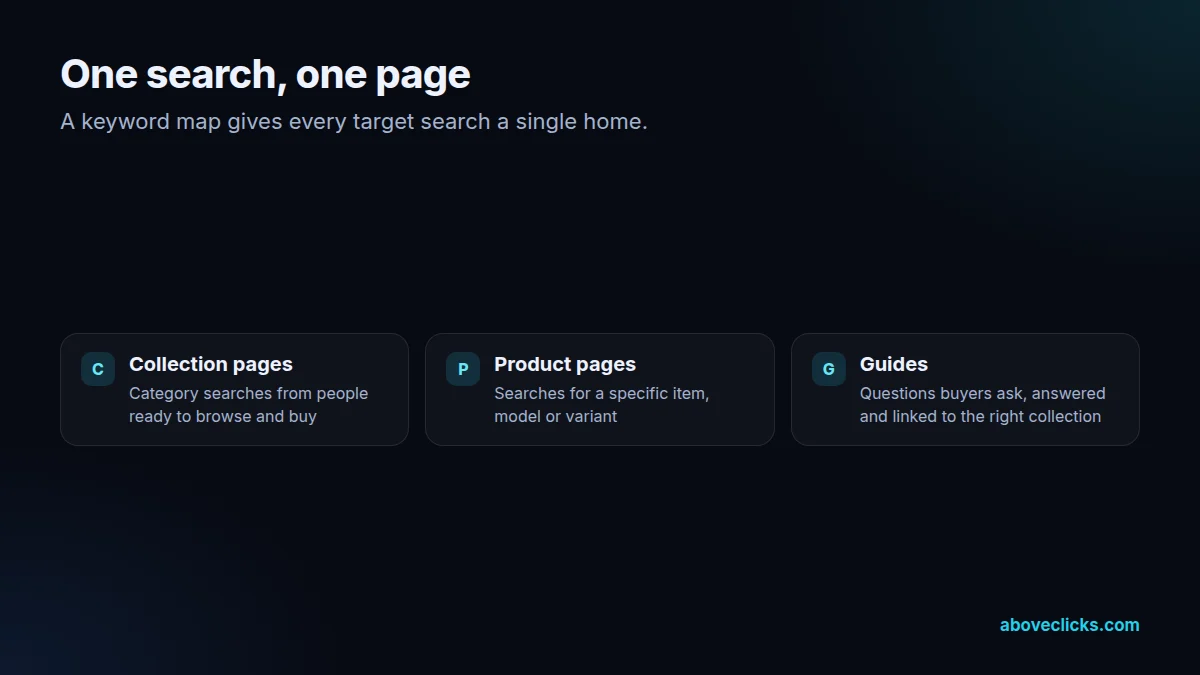
Keyword map showing buying searches assigned to collection pages, specific product searches to product pages and questions to guides that link to collections
Mapping each search to one page stops your own pages from competing with each other.

What’s included

What our ecommerce SEO service includes.

  • Technical SEO audit

    Crawl, indexing, canonicals, redirects, sitemaps, Core Web Vitals and structured data, with fixes ranked by impact.

  • Product and collection pages

    Titles, meta descriptions, on-page copy, internal links and image alt text for the pages that make money.

  • Structured data

    Product, Offer, BreadcrumbList and Organization markup, validated. No fake review markup.

  • Keyword research and mapping

    One primary keyword per page, so no two pages compete for the same search.

  • Content

    Buying guides and how-tos that answer real questions and link to the collections they belong to. Our own team writes them, and the monthly plan sets how many, typically two to four pieces a month.

  • International SEO

    Shopify Markets or WooCommerce setups, hreflang where several country versions exist, and correct currency and shipping signals.

  • Search Console monitoring and a monthly report

    Clicks, impressions, rankings for the pages that matter, and organic revenue, in plain English.

Flow from a buying guide that answers a question, through an internal link to a collection page, to a product page and an order
Every guide links to the collection it belongs to, so content supports the pages that make money.

How we run it

Four steps, in this order.

Content only scales once the technical base is fixed. Typical timing: the audit within 2 workdays, the plan and first fixes in about a week, page work from week 2, and the first monthly report after 30 days.

  1. Step 1

    Audit and keyword map

    A technical crawl, a content review and a keyword map that assigns every target search to one page.

  2. Step 2

    Fix the technical foundations

    Indexing, duplicates, redirects, speed and structured data come first, because new pages can’t rank on a broken base.

  3. Step 3

    Optimize pages and publish content

    Collection and product pages first, then guides that link to them.

  4. Step 4

    Measure and expand

    Search Console and revenue data show what’s working, and the plan moves toward the pages and topics that bring orders.

Pricing

Starting prices, in US dollars.

The audit is free. Paid work starts at these prices, and your exact cost is fixed in writing before any work begins.

  • Free audit

    Free no obligation

    Get your free audit.

    Get my free audit
  • After the audit

    Fix project

    From $350 one-off

    The issues from the audit fixed and validated in Search Console.

    • Technical SEO audit
    • Product and collection pages
    • Structured data
    • Keyword research and mapping
    Start with the free audit
  • Monthly e-commerce SEO

    From $400 monthly

    Technical fixes, collection copy and links, every month.

    • Technical monitoring: indexing, errors and Core Web Vitals
    • Page optimization and new content, agreed in a monthly plan
    • A plain-English monthly report from Search Console and your store data
    Ask about this option

All prices are starting prices in US dollars. Custom work beyond these options is quoted after the audit.

Every month

What you get each month

  • Technical monitoring: indexing, errors and Core Web Vitals
  • Page optimization and new content, agreed in a monthly plan
  • A plain-English monthly report from Search Console and your store data
  • Updates by email and WhatsApp, and a video call when you want one

SEO work runs every week, and your report arrives in the first week of each month.

Pricing

How pricing works

Pricing depends on your ad spend, the channels involved and how much setup work your account needs. We quote after the audit, once we’ve seen the account, so the number is based on real work rather than a guess. E-commerce SEO is one flat monthly amount, starting at $400, and fix projects start at $350, one-off. There’s no minimum term: plans run month to month.

Start with the free audit to get a quote for your store.

By industry

What changes for your category.

  • Jewelry

    Shoppers search by metal, stone and style, so collection pages are built around those words. Product pages need original copy and close-up images with descriptive alt text.

  • Fashion and apparel

    Sizes and colors create variant URLs and filters by the thousand. We keep one indexable URL per product and decide which filter pages deserve to rank.

  • Luxury and high-ticket

    One-off items sell and disappear. We keep sold pages useful or redirect them with care, so the links and rankings they earned aren’t lost.

Sources

The documentation we work from.

Platform rules change. These are the official pages we check the work against, so you can check it too.

FAQ

Straight answers.

Can’t find yours? Ask on WhatsApp or by email and we’ll answer it.

How long does ecommerce SEO take?

Months, not weeks. Technical fixes can show effects once Google recrawls the pages, while new content and competitive rankings take longer. We report progress monthly from Search Console, so you can see the direction early.

How much does ecommerce SEO cost?

It depends on the size of the catalog, the technical work needed and how much content the plan includes. We quote after the free audit, once we’ve seen the store, so the price is tied to real work.

Which platforms do you work on?

Shopify, WooCommerce and BigCommerce. Each has its own issues: duplicate product paths on Shopify, plugin bloat and speed on WooCommerce, and faceted navigation on all three.

Do collection pages need text?

A little, yes. A short intro above or below the grid tells shoppers and Google what the page covers, and links to related collections help both. Long blocks of keyword text pushed under the products don’t.

Will you change our theme?

Only where SEO needs it, such as heading structure, canonical tags or structured data, and with your approval and a backup first.

Do you build links?

We don’t buy links or use private blog networks, because they put your site at risk. Where links matter, we focus on things worth linking to, such as useful guides and tools.

Is SEO worth it if we already run ads?

Usually, yes. Organic sales carry no click cost, and SEO and paid search share keyword data. We plan both together, so they push the same products instead of competing for credit.

What do you need to get started?

Access to Search Console, GA4 and your store admin, or a staff account with theme access. For the free audit, a Search Console export or read-only access is enough.

Related guides

Read before you decide.

All E-commerce SEO guides

Free growth audit

Find out what’s holding your store back.

Tell us about your store. We’ll review your tracking, campaigns and SEO and send you a written audit with the top fixes, ranked by impact.

  • Written audit as a PDF, delivered within 2 workdays (see a sample)
  • A video meeting to go through it, if you want to discuss next steps
  • Free and no obligation
  • Read-only access or screenshots are enough

Free audit
Chat on WhatsApp