E-commerce SEO
Shopify vs WooCommerce SEO: what each platform lets you control
Is Shopify good for SEO? Yes, and so is WooCommerce: both platforms can rank. This comparison shows what you control on Shopify…
E-commerce SEO · International SEO
We do international SEO for Shopify and WooCommerce stores that sell in more than one country or language. You get one URL plan, working hreflang, translated pages Google can crawl, and each market’s search console data checked, so shoppers land on the right currency and language.
200+ clients served 500+ projects delivered
Free and no obligation. Your store URL and the countries you sell in are all we need.
Free international SEO audit
Three fields and you’re done. We crawl every language and country version of your store, read the hreflang tags and write up what Google is likely to show in each market.
Your PDF report comes by email. If you want to discuss going ahead after reading it, we’ll set up a video meeting. We use your details only for this audit.
Proof
Three client sites, the same 28 days. Clients are anonymized and shown with permission. These show our SEO work overall, not a multi-country project.


What the proof shows
Each report is one client site’s web search performance over the same 28 days, 20 September to 17 October 2026. They show that the sites we run SEO for earn steady traffic at average positions between 7 and 10. They don’t break traffic down by country, so they are not proof of a multi-market project.
Our own build follows the same rules we audit against. This site’s pages each carry one canonical URL, the old site’s addresses were mapped one by one before launch, and every page was checked for a single indexable version. A multi-country store needs the same discipline, repeated for each market.
What we check
Most international problems on stores come from a short list. We check each one on every market.
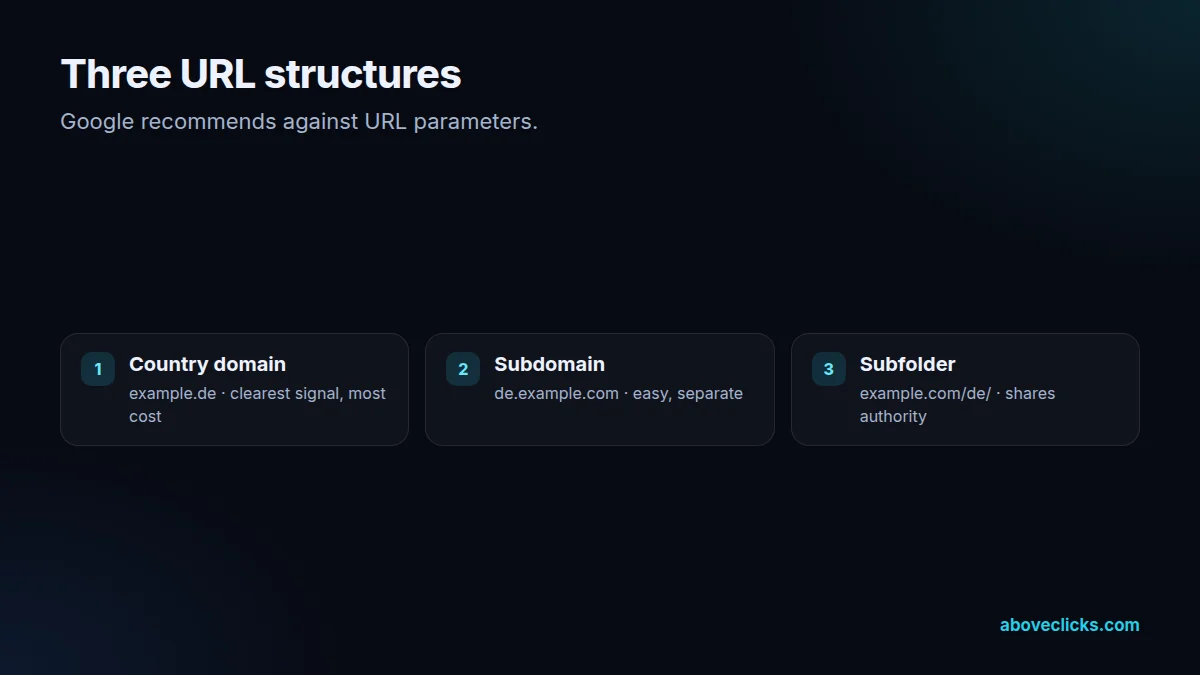
Country domains, subdomains or subfolders, and whether the choice fits how many markets you serve.
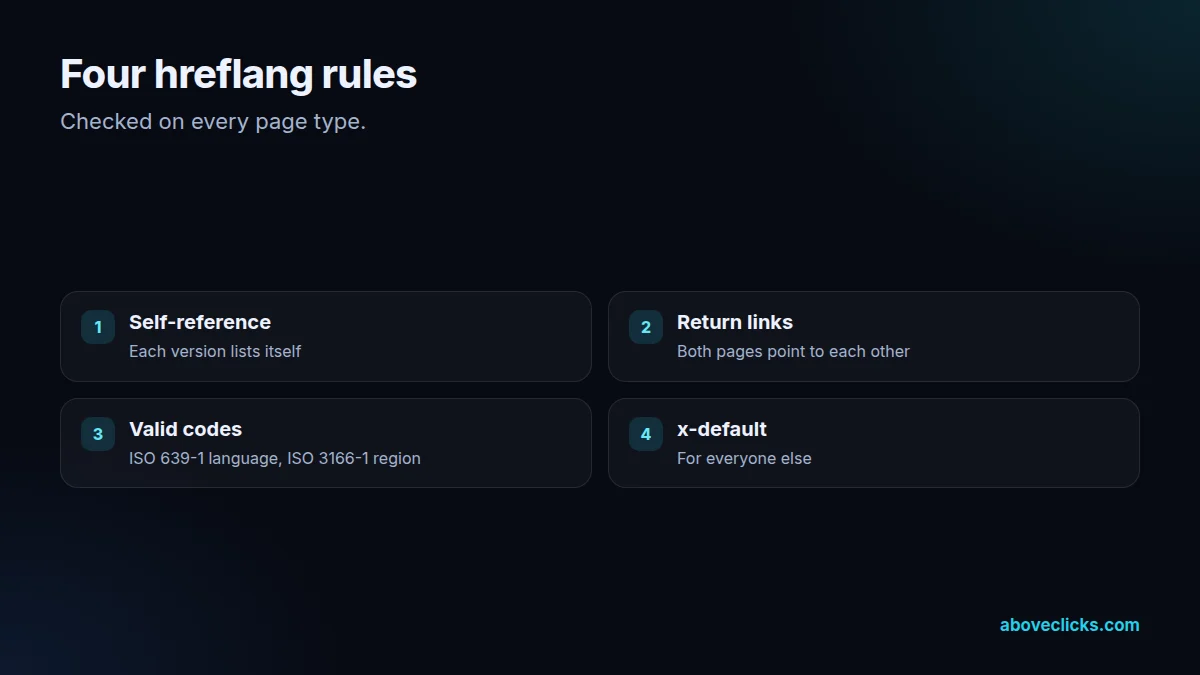
Language and region codes, self-references, return links and an x-default for everyone else.
Automatic redirects by IP or browser language, and whether Google can still reach every version.
Whether the product copy is translated or only the menu and footer, which leaves pages looking like duplicates.
Currency, prices, shipping and returns shown for each market, and local spellings in titles.
A sitemap per domain or subdomain, and each property checked for indexing errors.
In 1:10 · animated
A short animated walk-through of the first checks in our audit. No sound needed: everything is on screen, and the transcript is below.
What we check first in international SEO, an animated explainer of 1:10 with on-screen captions and controls to pause.
How we work
International SEO starts with the URL plan. Google’s guide to managing multi-regional sites compares country domains (example.de), subdomains (de.example.com), subfolders (example.com/de/) and URL parameters, and recommends against parameters. Country domains give the clearest signal but cost more and split authority; subfolders share the main domain’s strength and are the easiest to run. For most stores with two to five markets, we recommend subfolders, and Shopify’s own international domains guide suggests the same for a first setup.
Then hreflang. Google’s page on localized versions sets three rules we check on every page type: each version lists itself and every other version, every link must be returned (if two pages don’t point to each other, Google ignores the tags), and codes use ISO 639-1 for language with an optional ISO 3166-1 region. So “en-GB” works, “es-419” doesn’t, and a region code on its own is invalid. We add an x-default for the country selector or the main store.
On Shopify, Markets writes hreflang and alternate sitemaps for you when you add international domains or subfolders. That covers most of it, but we still check three things by hand: that every market really has translated content, that apps adding their own tags don’t create a second set, and that a removed market’s URLs redirect rather than return a 404. On WooCommerce, hreflang comes from the translation plugin, so we confirm that product, category and blog pages all carry it, and that the plugin’s sitemap lists every language.
Redirects need care. Google says to avoid automatic redirects based on a guess at the visitor’s language, and its page on locale-adaptive pages explains why: Googlebot mostly crawls from US addresses and sends no Accept-Language header, so a store that forces visitors by IP can hide its other versions from Google. We prefer a banner or selector that suggests the right store, and we test what a crawler from the US is served on every market.
Translation comes next. Google treats localized pages as duplicates only when the main content stays untranslated, so translating the menu and footer alone isn’t enough. We review product titles, descriptions, collection copy and meta tags in each language, with local spellings and units, and we check that prices, currency, shipping and returns match the market. A UK page that shows US sizes or dollar shipping costs loses the sale even when it ranks.
Last, each market gets its own measurement. We submit a sitemap per domain or subdomain in Search Console, compare clicks and position by country, and check the Page indexing report for each version. Because markets grow at different speeds, the plan after launch is set market by market, not for the store as a whole.
What’s included
The audit is free. If you want us to fix and grow your markets, this is the work.
Country domains, subdomains or subfolders chosen per market, with redirects mapped if anything moves.
Tags checked or added on every page type, with return links and an x-default.
Markets, domains and languages configured, or the translation plugin set up and tested.
Product, collection and meta copy reviewed in each language for completeness and local wording.
Forced redirects replaced with a suggestion banner where they hide versions from Google.
A sitemap per domain or subdomain submitted, and each market tracked in Search Console.
Clicks, position and indexed pages by country, with the next step for each market.
How we work
Nothing is charged until you have seen the problems and the plan.
Step 1
You send the store URL and markets; within 2 workdays you get the PDF report.
Step 2
URL structure, hreflang and translation scope agreed, with the cost.
Step 3
Changes made in a copy of the theme or on staging, then published.
Step 4
Each market followed in Search Console and reported in plain words.

Fit
Not the right fit if you sell in one country and one language. A single market needs e-commerce SEO, not country URLs.
Pricing
The audit is free. Paid work starts at these prices, and your exact cost is fixed in writing before any work begins.
Free no obligation
We’ll check how Google sees each country version and send a PDF report within 2 workdays.
Get my free auditFirst new market
From $600 one-off, per market
One new country or language set up the way Google reads it.
From $300 monthly
Ongoing checks and growth work across your markets.
All prices are starting prices in US dollars. Custom work beyond these options is quoted after the audit.
After the audit
The PDF report and the list of fixes are yours to keep either way.
Pricing
Every store is different, so we don’t quote before we’ve seen it. Within 2 workdays of the audit you get a fixed-scope plan with the cost and timeline. The cards above show where international SEO setup starts, in US dollars.
The audit itself is free. Send your store URL to get it.
Sources
Each rule on this page traces back to these pages, so you can check them yourself.
FAQ
Can’t find yours? Ask on WhatsApp or by email and we’ll answer it.
It is setting up a store so Google shows the right country and language version to each shopper. That means a URL plan, hreflang tags, translated pages and local prices and shipping.
For most stores with a few markets, subfolders. They share the main domain’s authority and are simple to run. Country domains send the clearest signal but cost more and start with less authority.
Yes. Shopify creates hreflang tags for every international domain or subfolder set up in Markets, and its sitemaps include published languages. We still check for duplicate tags from apps and untranslated pages.
No. Google treats localized pages as duplicates only when the main content stays untranslated. Translating only the menu and footer leaves the page looking like a copy.
Google advises against redirecting on a guess at the visitor’s language. Googlebot mostly crawls from the US, so forced redirects can hide other versions. A suggestion banner is safer.
Expect a few months per market. Google has to crawl and index each new version, and a new market starts with fewer links and reviews than the home one.
Your free audit
Same checks, same PDF report, no obligation. If your country setup is sound, the report says so and shows what to grow next.
Related guides
E-commerce SEO
Is Shopify good for SEO? Yes, and so is WooCommerce: both platforms can rank. This comparison shows what you control on Shopify…
E-commerce SEO
Product schema markup tells Google a product's price, availability and identifiers. Here's what Google requires, an example annotated property by property, and…
E-commerce SEO
Most Shopify SEO checklists are 25 items in no order. This one has 21 checks in three tiers, says what Shopify already…