Triple Whale alternatives fall into 3 groups: the Shopify and GA4 reports you already pay for, server events sent straight to ad platforms, and paid attribution suites. Whichever you pick, run it next to your current setup for 14 days and check it against Shopify’s own orders before you switch.
What is Triple Whale used for?
Triple Whale is an attribution and analytics suite for ecommerce brands: it tracks orders to their marketing source with its own pixel and adds dashboards, reporting and an AI analyst on top.
Its pricing page describes “attribution, MMM and incrementality in one measurement system”. There is a free plan with first and last click attribution, and 3 paid packages, Foundation, Automate and Enterprise, priced on a combination of the brand’s annual GMV and the package (as of October 2026). Multi-touch attribution through the Triple Pixel starts at Foundation. The paid packages are 12-month subscriptions, billed monthly or annually, and annual prepaid billing gives two months free. That term is the main reason to test any switch with care: the decision lasts a year.
Before you look at Triple Whale alternatives, write down what your team actually opens each week. For most Shopify brands it is a short list: blended return on ad spend, new customer revenue, cost per order by channel and a profit view that includes shipping and fees. Any feature outside that list is nice to have, not a reason to pay. The list also tells you which alternative fits, because each of the 3 groups below answers a different part of it.
What are the best Triple Whale alternatives?
The best Triple Whale alternatives depend on the job you need done: order truth, a journey view, better ad optimisation or one view across many channels. No single tool wins all 4.
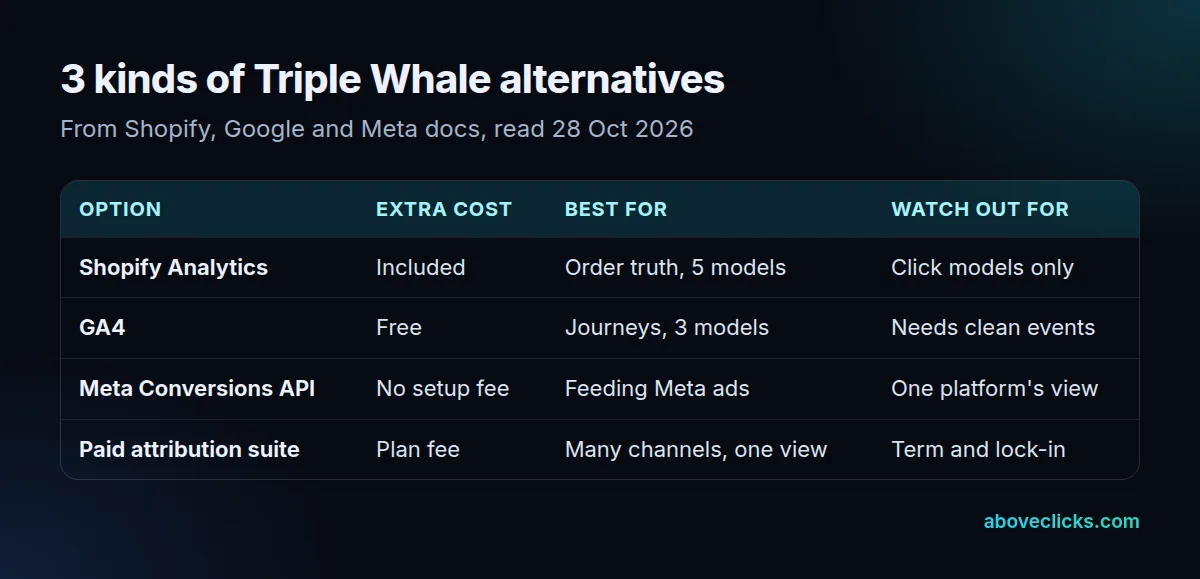
Most brands looking at Triple Whale alternatives need one of these:
- Shopify Analytics for the order and revenue figures every other tool should match.
- Google Analytics 4 for sessions, funnels and a data-driven attribution model.
- Ad-platform server events, such as Meta’s Conversions API, so the ad platform itself optimises on more complete data.
- A paid attribution suite when you spend across 4 or more channels and each platform claims the same sale.
People who compare paid suites search for names such as Northbeam, Polar Analytics, Hyros, Elevar and Lifetimely next to Triple Whale. We haven’t tested those tools for this guide, so judge each one with the test further down rather than its own claims. Counting Triple Whale’s own free plan, that makes 5 options to weigh before paying for a new contract.
Start from the job, not the tool list. If the question is “how many orders did we take and from where”, Shopify answers it. If it is “which ad set should get more budget”, the ad platform needs better data, which server events give it. Only when 3 or 4 platforms each claim the same sale, and the gap changes budget calls every week, does a paid suite pay back a 12 months term. Our measurement guides cover each of these jobs in more depth, and the same order-matching test applies to all of them.
Are there free Triple Whale alternatives for Shopify?
Yes. Shopify Analytics already includes 5 attribution models, and GA4 adds 3 more, at no extra cost. For many single-store brands that covers most of what a paid tool reports.
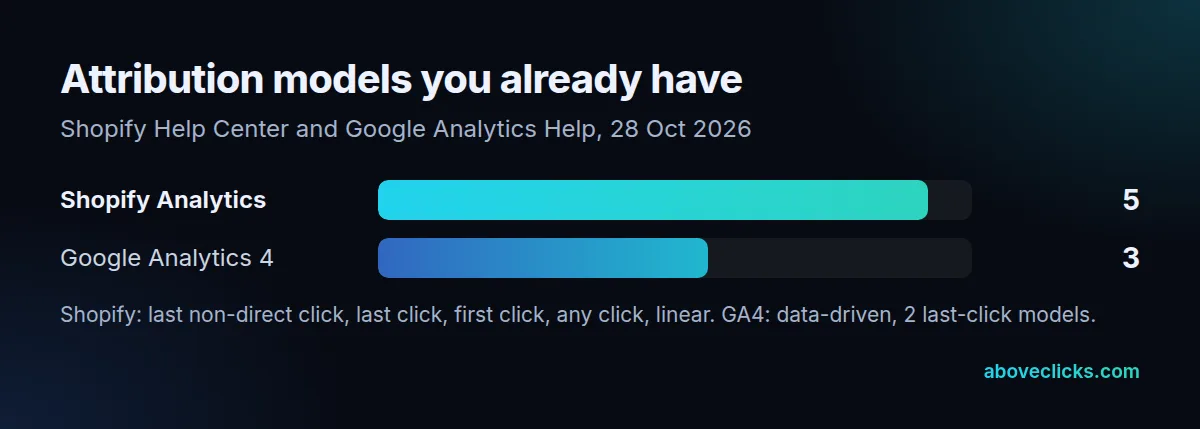
Shopify’s marketing reports documentation lists last non-direct click (the default), last click, first click, any click and linear. Any click gives full credit to every channel clicked, so it counts more credit than orders and suits one channel at a time. If a visitor doesn’t buy within 30 days of a session, the first interaction resets to the next referrer. The wider Shopify guide to analysing campaigns adds conversion reports for marketing apps and the Meta pixel. Our attribution model glossary entry explains how these rules differ.
On the ad side, Meta’s Conversions API documentation says a store with a Meta Pixel can set it up in one click from Events Manager, “with no code, configuration, or setup fees”. Server events are processed like pixel events, so they feed Meta’s measurement and optimisation. That covers much of the “pixel misses sales” problem for brands whose spend sits mostly on 1 or 2 platforms.
Is Triple Whale better than Google Analytics?
Not better, different. GA4 is free and models journeys across every channel; Triple Whale is a paid layer built for Shopify ad spend, with its own pixel and profit dashboards.
GA4 attribution reports offer 3 models: data-driven attribution, paid and organic last click, and Google paid channels last click. All 3 exclude direct visits from credit unless the whole path is direct. That alone explains many gaps with Shopify, whose last click model counts direct visits and whose first interaction resets after 30 days without an order. Data-driven attribution uses your own account’s data to estimate each click’s real contribution, which is the same promise most paid suites make; our data-driven attribution entry covers how it works.
The catch is set-up quality. GA4 is only as good as its events, and Google’s ecommerce measurement guide asks for item arrays and values on events such as add_to_cart, begin_checkout and purchase. A store with broken purchase events will see GA4 “lose” orders and blame the tool. Fix the events first, then compare. Brands that move away from Triple Whale often find GA4 plus Shopify does the reporting job once its ecommerce events fire correctly.
How do you test an alternative before switching?
Run the new tool and the current one side by side for 14 days, then compare each one’s orders and revenue against Shopify. A tool that can’t match Shopify’s order count can’t be trusted on channel credit.
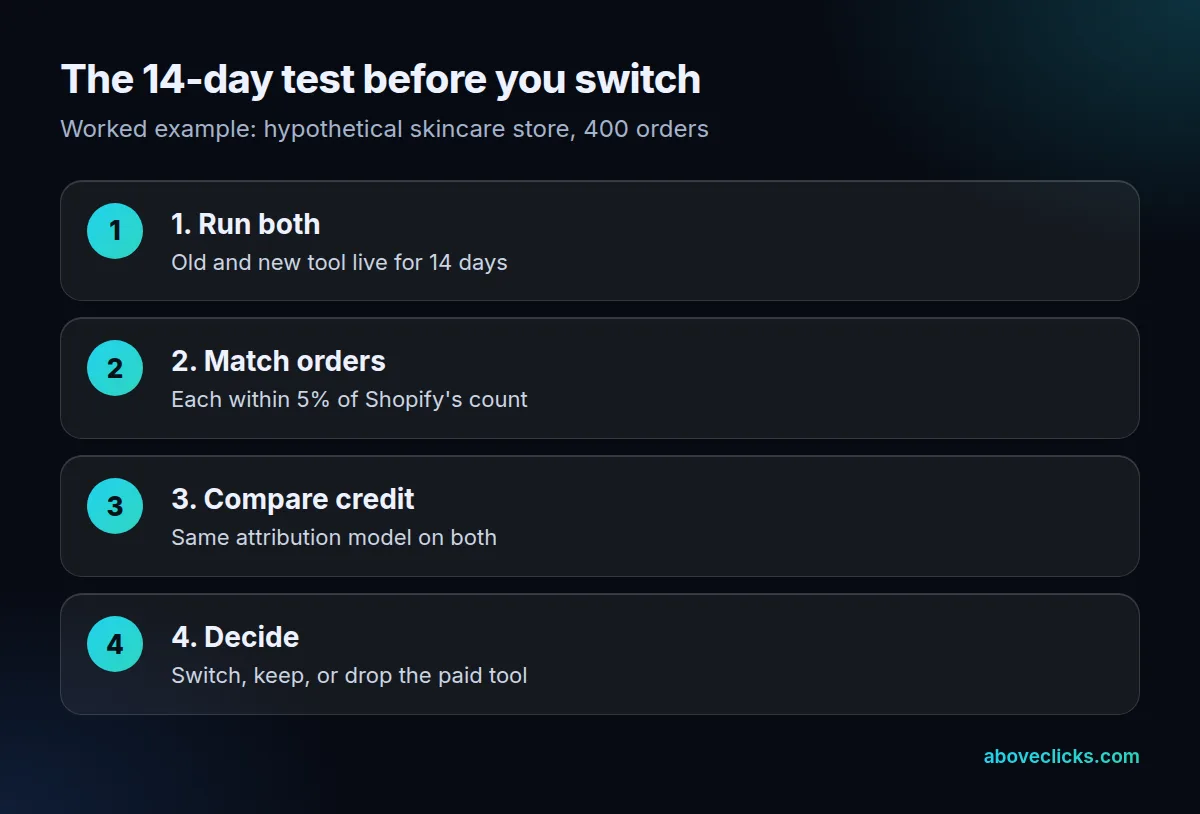
Worked example (a hypothetical skincare store, not a client): the store takes 400 orders in the 14 days. Shopify is the fixed point. The current tool reports 392 orders and the candidate reports 371. Our pass mark is within 5% of Shopify, which is 380 to 420, so the current tool passes at 2% and the candidate fails at 7%. Before blaming the candidate, check its purchase event on 10 test orders; a missing checkout extension or consent setting often explains a gap that size. Only when both pass do you compare channel credit, using the same attribution model on both, such as last non-direct click.
Write down 4 numbers per channel: orders, revenue, cost per order and the share of total credit. If the 2 tools rank channels in the same order, the cheaper one is your answer. If they disagree on a channel that takes more than 20% of spend, that disagreement is worth a deeper look before you cut a budget.
Keep the test fair. Use the same date range, the same time zone and the same order statuses in both tools, and leave out test orders, draft orders and refunds or count them the same way in each. Check consent too: if one tool only fires after a visitor accepts cookies and the other fires on every visit, the gap is a settings difference, not a tracking failure. Record the results in one sheet so the decision rests on numbers both your team and your agency can see.
Is Triple Whale worth it, and which mistakes cost the most?
Triple Whale can be worth it for multi-channel brands that will use its dashboards every week. For a one-channel store, the free Shopify, GA4 and Conversions API stack often does the same job.
These are the costly mistakes we see when brands compare Triple Whale alternatives:
- Switching off the old pixel on day 1. You lose the overlap that shows whether the new tool counts orders correctly. Keep both for the full 14 days.
- Comparing different attribution models. A first click report and a last click report will never agree. Set the same attribution model on both before you compare.
- Missing the renewal window. Paid Triple Whale packages run on 12-month terms (as of October 2026), so put the decision date in the calendar 60 days before renewal.
- Trusting platform totals. Meta and Google each claim credit for the same order. Only Shopify’s order count is fixed, so it is the one to reconcile against.
- Forgetting the data you built. Export dashboards, segments and audience syncs while you still have access.
- Moving tools to fix a tracking bug. If purchase events are broken, every one of the Triple Whale alternatives will report the same wrong numbers. Fix the events, then compare tools.
None of these mistakes needs a new tool to fix. Each needs a written plan: who owns the test, which numbers count, which date the decision is due, and what happens to the old account. Agree on that plan first and the choice between Triple Whale and its alternatives becomes a short, calm meeting instead of a rushed renewal call.
If you want a second pair of eyes, our tracking and analytics team sets up or migrates Shopify, GA4 and server-side events, and our ecommerce attribution service runs the side-by-side test for you. To start, ask for a free audit of your current setup, and we will show which of the best Triple Whale alternatives fits the data you already have.