E-commerce SEO
Shopify vs WooCommerce SEO: what each platform lets you control
Is Shopify good for SEO? Yes, and so is WooCommerce: both platforms can rank. This comparison shows what you control on Shopify…
E-commerce SEO · Audit
Our ecommerce SEO audit services are fixed-price, for Shopify and WooCommerce stores, covering indexing, filters, product and collection pages, schema and speed. You get a ranked fix list with the effort and impact of each item, from a team that can also make the fixes.
200+ clients served 500+ projects delivered
Free SEO audit
Three fields and you are done. We check technical SEO, content and links, then write up what is holding rankings back.
Your PDF report comes by email. If you want to discuss going ahead after reading it, we’ll set up a video meeting. We use your details only for this audit.
Fit
Not the right fit if you want a tool export with a logo on it. Every finding here is checked by a person. A store with a handful of pages rarely needs a full audit; a call usually covers it.
Problems we fix
Colour, size and price filters each make a new URL. Left open to crawlers, they use up crawl time and push near-duplicate pages into the index.
Shopify can link products inside collections as /collections/x/products/y, so one product lives at several URLs unless the theme links to the canonical one.
A heading and a grid of products is all many collection pages carry, so they rank for little beyond the store name.
Old products return 404s or redirect to the home page, which throws away their links and confuses shoppers who arrive from search.
Product markup with old prices, missing availability, or review stars from an app that no longer runs, so rich results drop off.
Hundreds of crawler warnings with equal weight, so the team fixes the easy ones and the indexing problems that cost traffic stay put.
In 1:10 · animated
A short animated walk-through of the first checks in our audit. No sound needed: everything is on screen, and the transcript is below.
What we check first in an ecommerce SEO audit, an animated explainer of 1:10 with on-screen captions and controls to pause.
Our approach
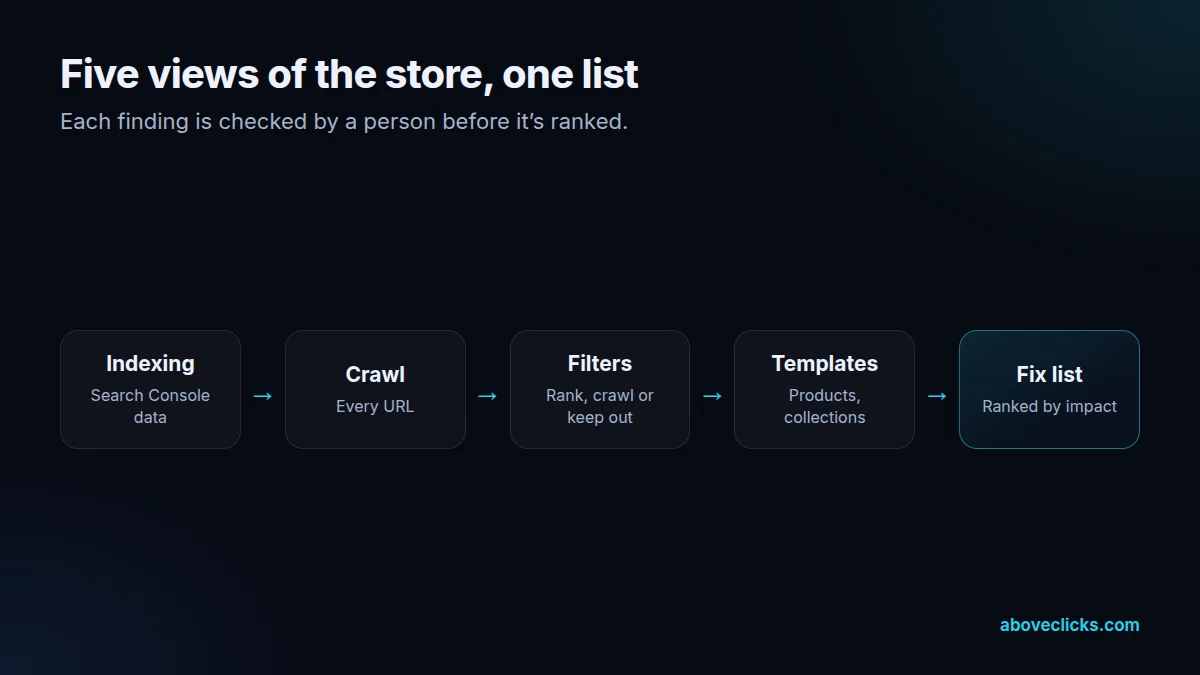
An ecommerce SEO audit starts with the data Google already gives you. We read the Page indexing report in Search Console to see which URLs are indexed, which are excluded and why. Then we compare that list with the products and collections the store actually sells. The gap between the two is usually where the first fixes are.
Next we crawl the store the way a search engine would, with Screaming Frog, and pull server or CDN logs where the host allows it. The crawl shows broken links, redirect chains, duplicate titles and thin pages. The logs show where Googlebot really spends its time. On large catalogues the two views often disagree, and that disagreement is a finding in itself.
Filters get their own section. Google’s guidance on faceted navigation says filter URLs can waste crawling, and suggests keeping unwanted combinations out of the crawl or returning a 404 when a combination has no results. We list every filter parameter the store produces, then mark which combinations deserve to rank (say, “black leather boots”) and which should stay out.
Duplicate URLs come next. For each template we check the canonical tag against Google’s advice on consolidating duplicate URLs. We also check that internal links point at the canonical version, not a variant, a tracking parameter or a collection-path copy of the product. On Shopify the fix is usually a small edit in the theme’s Liquid, and the fix list names the file.
Product pages are checked against Google’s product structured data documentation: name, image, price, currency, availability, and review markup only where real reviews show on the page. We test a sample of templates and compare the markup with what a shopper sees, because a mismatch between the two is a common reason product rich results disappear.
Speed is measured with field data where it exists. Google’s Core Web Vitals treat a page as good when Largest Contentful Paint is within 2.5 seconds, Interaction to Next Paint is under 200 milliseconds and Cumulative Layout Shift is 0.1 or less. We name the apps, scripts and images behind each failing template, rather than quoting one score for the whole site.
Everything ends up in one fix list. Each item has the affected URLs, why it matters, the fix, who should do it (a developer, a writer or you), a rough effort and an impact rating. The list is ranked, so the top items are the ones worth doing this month. A seo audit checklist with hundreds of equal warnings is a crawler export, not an audit.
Search Console results from stores we work on are on our fashion page (clicks from 13.7K to 328K) and our jewelry page (9.74K to 276K). That kind of growth starts the same way an audit does: find what holds the store back, fix it in order, then measure. Kashif builds in PHP, WordPress and Liquid, so the fixes in the list are written the way a developer needs them.
After delivery we walk through the fix list on a call. You can hand it to your own developer or ask us to make the fixes. Either way, each item is written so that someone who wasn’t on the call can follow it, and we re-crawl after the fixes go live to confirm the indexing problems are gone.
What’s included
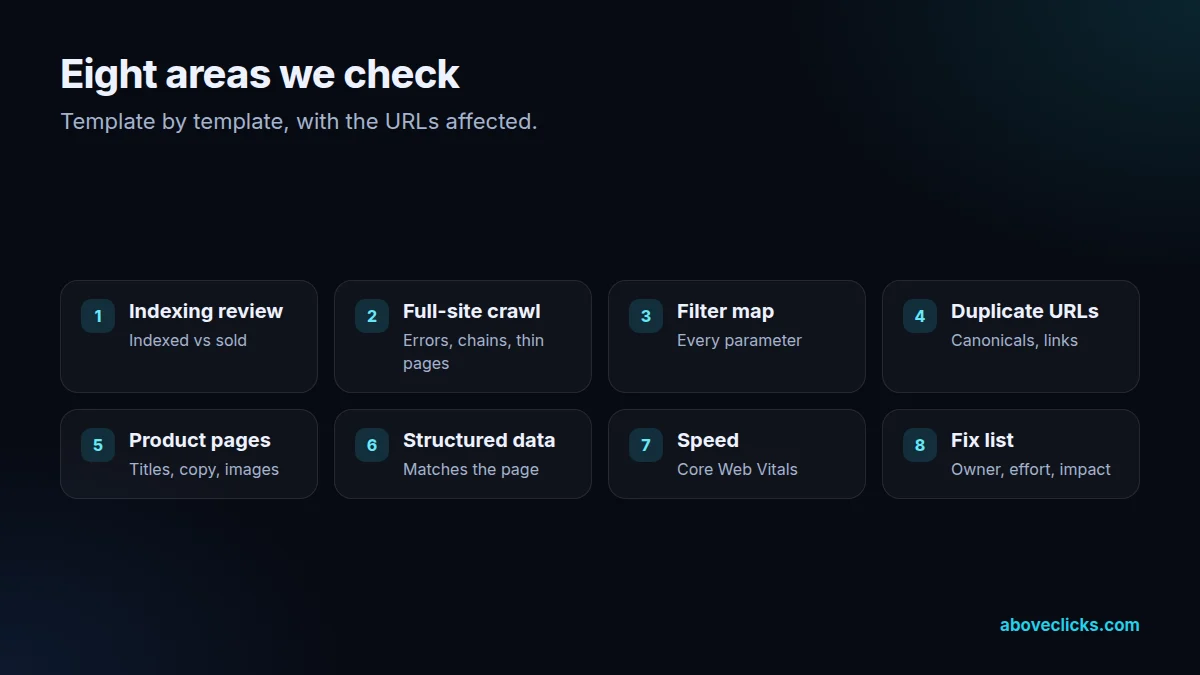
Search Console page indexing, sitemaps and robots.txt compared with the products and collections you sell.
Broken links, redirect chains, duplicate titles and descriptions, orphan pages and thin pages, each with its URL list.
Every filter and parameter the store creates, marked as rank, crawl only, or keep out.
Canonical tags and internal links checked on every template, including variant and collection paths.
Titles, headings, copy, images and alt text on a sample of each template, with what to change.
Product, Offer, BreadcrumbList and Organization markup tested against what the page shows.
Core Web Vitals per template, with the apps, scripts and images behind each problem.
Every finding with the fix, owner, effort and impact, ordered so the first items matter most.
How we run it
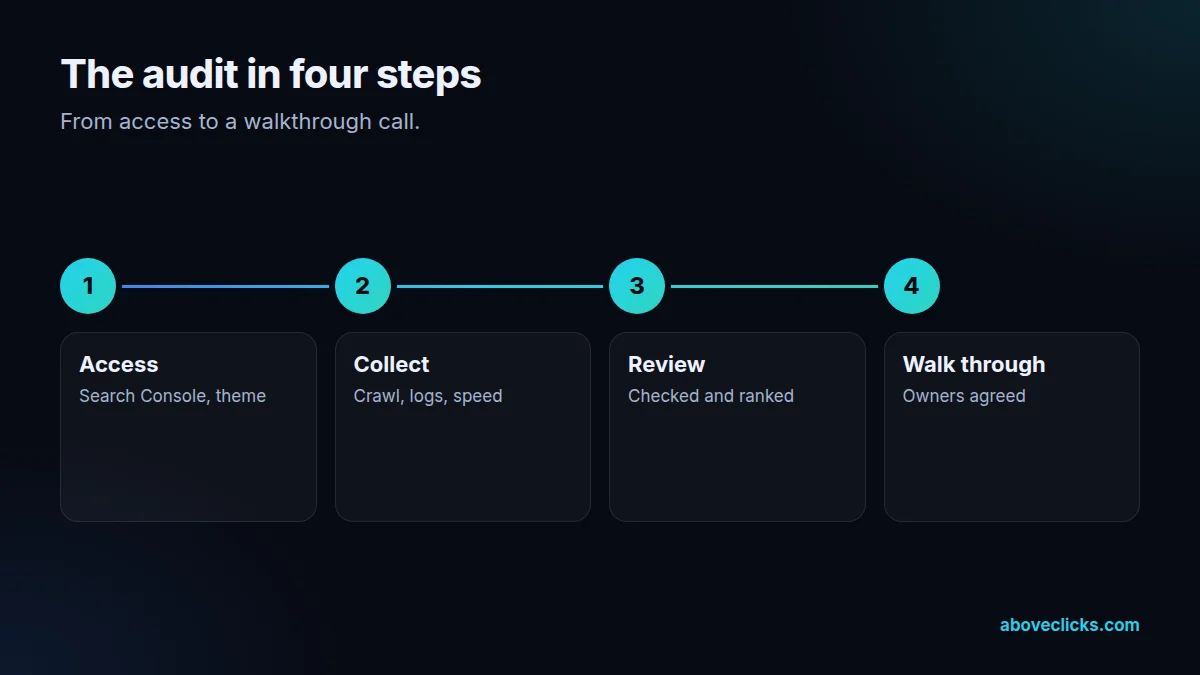
Every ecommerce SEO audit follows the same four steps, so nothing gets skipped on a big catalogue. Typical timing: access on day one, the PDF report within 2 workdays of getting access, and the walkthrough on a video meeting when it suits you.
Step 1
Search Console, analytics, read access to the store or theme, and any past audits or migration notes.
Step 2
Crawl, logs, indexing data and field speed data gathered for every template.
Step 3
A person checks each finding, removes false alarms and ranks the rest by impact.
Step 4
The fix list is delivered and explained on a call, with owners agreed for each item.
Pricing
The audit is free. Paid work starts at these prices, and your exact cost is fixed in writing before any work begins.
Free no obligation
We will audit your store SEO and send a PDF report within 2 workdays.
Get my free auditFixed scope
From $350 one-off
A deep audit with a prioritized fix list.
From $300 monthly
Fixes, content and links each month.
All prices are starting prices in US dollars. Custom work beyond these options is quoted after the audit.
By industry
Fixed /products/ and /collections/ paths, collection-path product links, the robots.txt.liquid template and app scripts. Most fixes are theme edits and settings.
Attribute and tag archives, pagination, plugin overlap and hosting speed. Fixes are split between WordPress settings, the theme and the server.
Crawl budget, server logs, sitemaps split by type and rules for out-of-stock products matter more once a store passes a few thousand URLs.
Sources
Platform rules change. These are the official pages we check the work against, so you can check it too.
FAQ
Can’t find yours? Ask on WhatsApp or by email and we’ll answer it.
It covers indexing, crawling, filters, duplicate URLs, product and collection pages, structured data and speed. You receive a ranked list with the affected URLs, the fix, the owner and the effort for every item.
It depends mostly on catalogue size and how quickly we get access. A small store is quicker to review than one with tens of thousands of variant and filter URLs, so we give you a delivery date before we start.
No. Tools are part of the work, but they give every warning the same weight. An audit checks each finding by hand, drops the false alarms and ranks what is left by the traffic and sales it affects.
Yes, if you want us to. Your own developer can work from the list, or we can make the theme, schema and redirect changes ourselves and re-crawl to confirm them.
Search Console, Google Analytics, read access to the store admin or theme, and server logs if your host offers them. We never need payment details or customer data for this work.
Once before any redesign or platform move, and about once a year otherwise. Big catalogues that add products and filters every week also benefit from a lighter monthly check of crawl errors and excluded pages.
It flags product and collection pages stuck on page two and pages that compete for the same search. Full keyword research for new collections and content is separate work, quoted on its own.
Related guides
E-commerce SEO
Is Shopify good for SEO? Yes, and so is WooCommerce: both platforms can rank. This comparison shows what you control on Shopify…
E-commerce SEO
Product schema markup tells Google a product's price, availability and identifiers. Here's what Google requires, an example annotated property by property, and…
E-commerce SEO
Most Shopify SEO checklists are 25 items in no order. This one has 21 checks in three tiers, says what Shopify already…
Free growth audit
Tell us about your store. We’ll review your tracking, campaigns and SEO and send you a written audit with the top fixes, ranked by impact.