Buying guides
Questions to ask a marketing agency before you hire one (with good answers and red flags)
21 questions for your intro calls, grouped by topic, each with what a good answer sounds like and what should worry you.…
Consulting · AI consulting
Our AI consulting helps businesses decide where AI is worth using and where it isn’t. You get an AI readiness assessment, a short list of tools to adopt, workflow automations that save real hours, and the rules your team needs to use AI safely. It comes from a developer-led team that uses AI every day to build and run its own work.
200+ clients served 500+ projects delivered
Free AI readiness audit
Three fields and you’re done. The PDF report shows what we found on your own pages and accounts, and the order we’d fix it in. It covers the problems we see most often:
Your PDF report comes by email. If you want to discuss going ahead after reading it, we’ll set up a video meeting. We use your details only for this audit.
Fit
Not the right fit if you need a custom AI model trained from scratch or a research project. We help you adopt and connect the tools that exist, and build small automations around them.
Problems we fix
Subscriptions bought because a competitor mentioned them, with no task they were meant to improve.
Staff paste customer details or contracts into consumer AI apps because nobody said where the line is.
A trial runs for months with no measure of success and no decision to roll out or stop.
A messy process made faster, so mistakes now happen at scale.
AI drafts go out to customers or onto the website without review, and errors damage trust.
Five overlapping AI products, each used by one person, none connected to the systems the business runs on.
In 1:10 · animated
A short animated walk-through of the first checks in our audit. No sound needed: everything is on screen, and the transcript is below.
What we check first in your AI plans, an animated explainer of 1:10 with on-screen captions and controls to pause.
Our approach
Every AI consulting engagement starts with an AI readiness assessment. We map the work your team does each week, note where the time goes, and look at the data and systems involved: email, documents, CRM, spreadsheets, store or booking platform. The question for each task is simple: could AI do part of this well enough, safely, with a person checking the result?
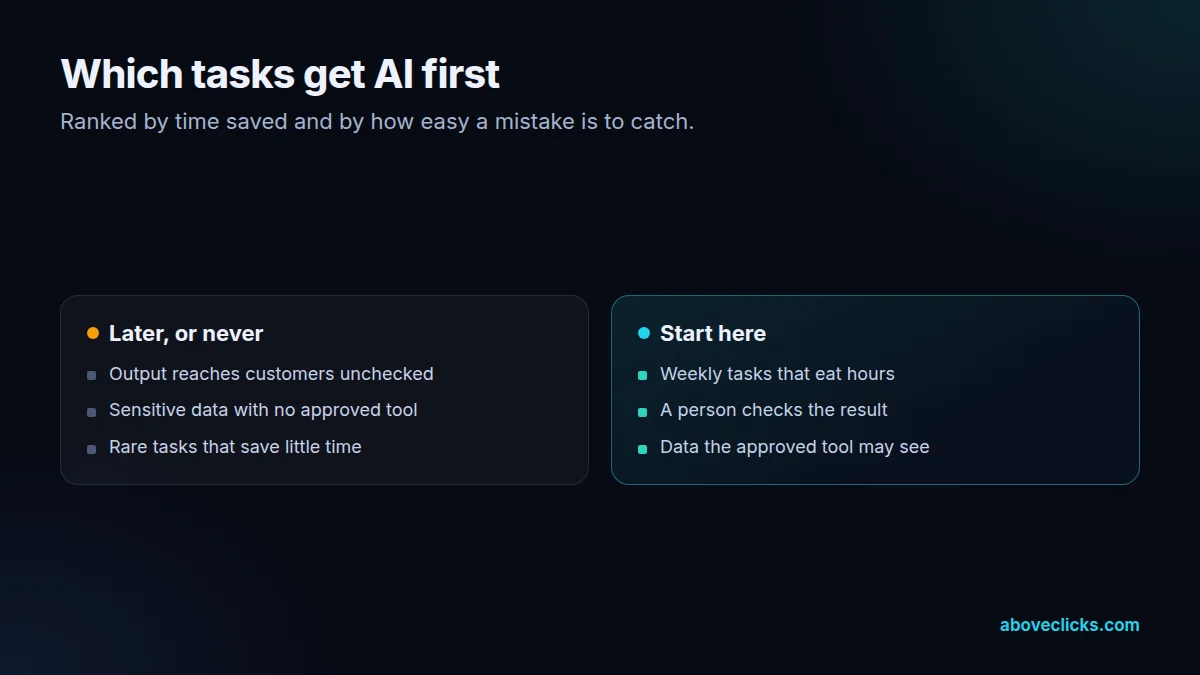
From that map we pick a short list: usually three to five tasks where AI can save real time at low risk, such as drafting replies, summarising calls, pulling data out of documents, writing first drafts of product or service copy, or tagging and routing incoming messages. Each one gets a measure of success, decided before anything is bought.
Then come the tools. In AI consulting, the right answer is often a feature in software you already pay for, such as the AI tools built into Shopify or your email platform. Sometimes it’s a business plan of a general assistant such as ChatGPT, Claude or Gemini, where the provider’s terms on training and data retention matter; OpenAI, for example, publishes its enterprise privacy commitments. We compare options on fit, cost, data handling and how well they connect to your systems.
Workflow automation connects the pieces. A lead arrives, AI classifies it and drafts a reply, the CRM is updated, and a person approves before anything is sent. We build these with Zapier, Make or small custom code, and keep a human approval step wherever a mistake would reach a customer. Our business automations service covers how we build and maintain them.
Rules matter as much as tools, so every AI consulting project includes a short AI use policy written with you: which tools are approved, what data must never go into them, who reviews AI output before it’s published or sent, and how to report a problem. The NIST AI Risk Management Framework is a useful reference here, scaled down to what a small or mid-sized business needs. If you sell into the EU, the EU AI Act adds transparency duties for some uses.
For website content, we follow Google’s guidance on AI-generated content: using AI is fine; publishing pages made mainly to manipulate rankings is not. AI drafts are edited by someone who knows the subject, and claims are checked against sources before they go live.
We use AI the same way in our own work. This website, its tools and its content pipeline were built by a developer-led team working with AI coding assistants, with automated checks and human review before anything ships. That daily use is where our advice comes from: we know where these tools save hours and where they confidently get things wrong.
Worked example, with illustrative figures for a hypothetical business (not a client result): a 12-person online furniture store answers about 250 order-status and delivery emails a week, at 6 minutes each, which is 25 hours of staff time. AI consulting for that store would connect the help desk’s built-in AI to the order data and have a person approve every draft. At 2 minutes per approved reply, the same week takes about 8 hours, saving roughly 17 hours.
Each AI consulting engagement ends with a written AI strategy and roadmap: the tasks to automate first, the tools to use, the policy, the training needed and the measures to check after 30 and 90 days. Rollouts start small, with one team or one task, and expand once the measure shows it works.
What’s included
A map of your team’s weekly work, data and systems, with the tasks where AI can help ranked by value and risk.
A short list of AI tools or features to adopt, compared on fit, cost, data handling and integrations.
The first automations designed step by step, with human approval where it matters.
Approved tools, data rules, review steps and how to report problems, in plain language.
One task piloted, with a measure of success agreed before it starts.
Practical AI consulting sessions on prompting, checking output and using the approved tools on real work.
What to roll out next and in what order, with checks at 30 and 90 days.
A review of the pilot’s results and a decision to expand, change or stop.

How we run it
In our AI consulting, every AI tool earns its place with a measured pilot. Typical timing: the assessment in the first week, priorities within 2 weeks, a pilot in weeks 3 to 6, then the roll-out.
Step 1
Interviews, a map of weekly tasks, and a review of your data and systems.
Step 2
Tasks ranked by time saved and risk, tools compared, policy drafted.
Step 3
One or two tasks piloted with a team, with the measure of success agreed up front.
Step 4
Training, a written roadmap and reviews after 30 and 90 days.

Pricing
The audit is free. Paid work starts at these prices, and your exact cost is fixed in writing before any work begins.
Free no obligation
We’ll check your workflows and where AI could save time and send a PDF report within 2 workdays.
Get my free auditAfter the audit
From $400 one-off
Where AI fits in your business, ranked by return, with a plan.
From $600 monthly
Tools set up and your team supported.
All prices are starting prices in US dollars. Custom work beyond these options is quoted after the audit.
Deliverables
A typical engagement runs 4 to 6 weeks from assessment to roll-out, and ongoing advisory is available as a monthly plan.
Pricing
We quote after a short audit, once we’ve seen the account or the store, so the number is based on the real work. Each project is a fixed one-off cost, agreed before work starts: from $400.
Not sure AI fits yet? Tell us about the work and we’ll say honestly whether it’s worth a look.
By industry
AI consulting for stores usually starts with product descriptions, review replies, support triage and product data clean-up, each with a person checking before anything is published.
Enquiry replies, appointment reminders, call summaries and quotes drafted from templates.
Admin and enquiry handling only, with strict rules: no patient or student data in tools that aren’t approved for it.
Sources
Platform rules change. These are the official pages we check the work against, so you can check it too.
FAQ
Can’t find yours? Ask on WhatsApp or by email and we’ll answer it.
An AI readiness assessment of your team’s work, a short list of tasks and tools worth adopting, a policy on data and review, a measured pilot, training and a written roadmap. The aim is a few AI uses that save real time, not a long list of experiments.
Often not, and AI consulting should save money as well as time. Many businesses already pay for AI features in their email, store, CRM or office software. We check those first and only recommend new tools when they clearly do the job better.
It depends on the tool and the plan. Business plans of the main AI assistants usually offer stronger data terms than free consumer apps. Your AI use policy states which tools are approved and which data must never go into any of them.
In our experience AI takes over parts of tasks, such as first drafts, summaries and data entry, rather than whole jobs. The time saved usually goes to work that needs a person: customers, judgement and checking.
Yes. We build workflows with Zapier, Make or custom code that connect AI models to your email, CRM, store or documents, with a person approving any step that reaches a customer.
Every AI consulting pilot starts with an agreed measure, such as hours saved per week, response time or error rate, and a recorded baseline. After the pilot, the numbers decide whether it expands, changes or stops.
Google’s guidance is that using AI is fine and that content made mainly to manipulate rankings is not. We use AI for drafts and research, then have a person who knows the subject edit and check it.
Related guides
Buying guides
21 questions for your intro calls, grouped by topic, each with what a good answer sounds like and what should worry you.…
Buying guides
Percentage of ad spend, flat retainer, performance fee, hourly or a hybrid: what each model rewards, how it behaves as your spend…
Buying guides
In-house team, agency or freelancer? A side-by-side comparison on 7 factors, a total-cost worksheet built from US government pay data, and a…
Free growth audit
Tell us about your store. We’ll review your tracking, campaigns and SEO and send you a written audit with the top fixes, ranked by impact.