Measurement
MER vs ROAS: which number to manage to
MER vs ROAS comes down to scope: MER judges all ad spend against all revenue, while ROAS judges one channel's spend against…
Tracking & analytics · Server-side
Browsers block and cut short more tracking every year, and ad platforms optimize on what they receive. We set up server-side tracking for stores: Meta’s Conversions API, Google’s enhanced conversions, TikTok and Pinterest server events, and server-side Google Tag Manager where it’s worth the hosting cost. Everything is deduplicated, consent-aware and checked against real orders.
200+ clients served 500+ projects delivered
Free tracking review
Three fields and you are done. We review your current tracking and send what server-side would fix.
Your PDF report comes by email. If you want to discuss going ahead after reading it, we’ll set up a video meeting. We use your details only for this audit.
Fit
If GA4 and basic tags aren’t working yet, start with our tracking and analytics setup; server-side work builds on it.
Problems we fix
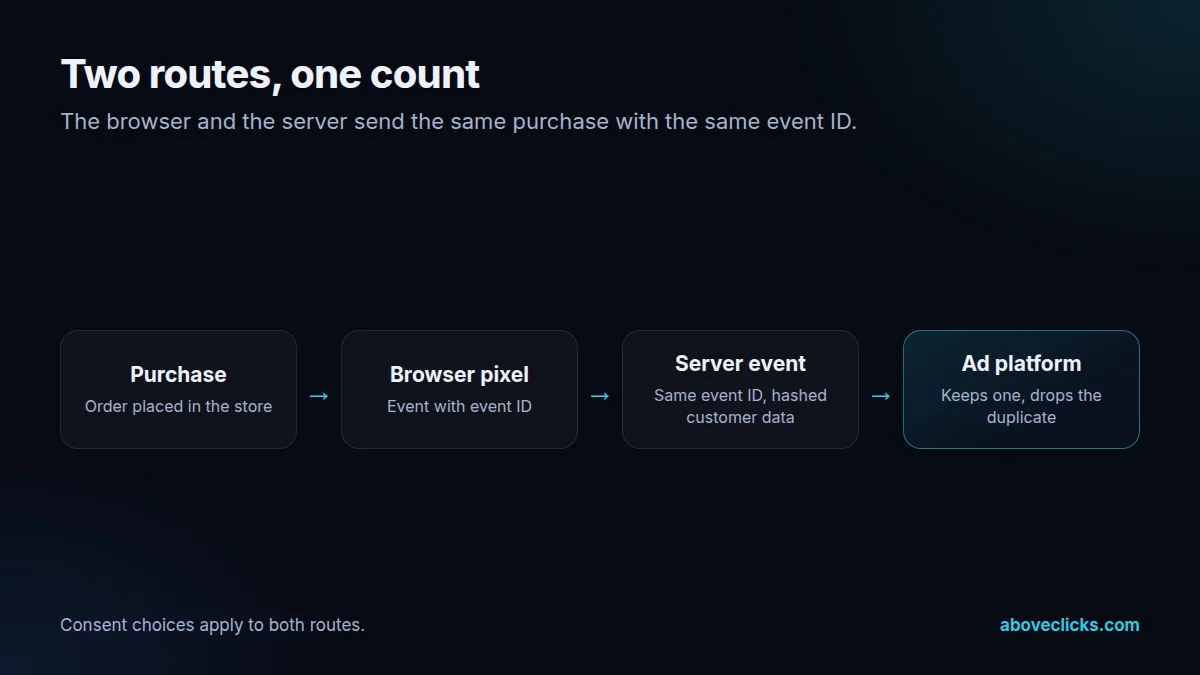
The browser pixel and the server send the same purchase without a shared event ID, so the platform counts it twice and bidding learns from inflated numbers.
Server events without hashed email, phone or click IDs can’t be matched to people, so they add little.
Server events sent for visitors who declined tracking create legal risk and break the trust the consent banner promised.
Server-side Tag Manager runs on a server you pay for. Set up without a plan, it costs money without adding much.
A platform app, a tracking app and a custom script all send purchases, each slightly differently.
Nobody compares what each platform receives with what the store actually sold, so problems last for months.
In 1:10 · animated
A short animated walk-through of the first checks in our audit. No sound needed: everything is on screen, and the transcript is below.
What we check first in server-side tracking, an animated explainer of 1:10 with on-screen captions and controls to pause.
Our approach
Server-side tracking means your store or a server you control sends conversion events directly to ad platforms, instead of relying only on code in the visitor’s browser. Each platform has its own route: Meta’s Conversions API, Google’s enhanced conversions, TikTok’s Events API and Pinterest’s Conversions API.
We start with what the platforms already offer. Store platforms and official apps often include a server-side connection, and for many stores that’s enough once it’s configured properly. We check it sends purchases with values, includes the customer details each platform accepts, hashed, and shares event IDs with the browser pixel so duplicates are removed.
Where more control is needed, we set up server-side tagging in Google Tag Manager: one stream of events from your site to your own tagging server, which then forwards them to each platform. It gives you control over what each platform receives, but it has hosting costs and needs maintenance, so we price it out with you before building it.
Consent is wired through the whole chain. We connect your consent banner to Google consent mode and make sure server events respect each visitor’s choice, so the server route doesn’t become a way around consent.
Then we check the result against orders. Purchases in each platform are compared with store orders by day, duplicates are hunted down and match quality is reviewed, so you know the platforms are learning from real sales. That’s the foundation our Meta Ads and Google Ads work relies on.
Customer data is handled with care. Platforms accept hashed email addresses and phone numbers to match events to people, and we send only what each platform documents and what your privacy policy and consent allow. Nothing is sent in plain text, and nothing beyond what the match needs.
Maintenance is planned in. Platforms change their APIs, apps update and themes get replaced, so we set up a simple check that compares platform purchases with orders each week and flags a drop before it costs a month of bidding.
Server-side tracking doesn’t replace the browser pixel. Both run together, and deduplication by event ID makes sure each sale is counted once while the server catches what the browser misses. Meta’s Conversions API accepts an event time up to 7 days before the event is sent, so a delayed order can still be matched. Speed is judged against Google’s Core Web Vitals thresholds: main content within 2.5 seconds, a response to input within 200 milliseconds and layout shift of 0.1 or less.
How we use AI here
Server-side tracking is code and configuration. AI-assisted development makes it faster to build and test.
Server container tags, Conversions API payloads and custom templates are written with AI coding tools and reviewed line by line.
Scripts compare what the browser and server send for the same order, so duplicates and missing fields are found before ad platforms learn from them.
Alerts on event volumes and match quality catch silent breaks after theme or app changes.
Where it doesn’t help: consent. What you may send, and when, is a legal and policy decision, and the setup follows it.
What’s included
What each platform receives today, compared with store orders, plus every app and script that sends events.
Server events with event IDs for deduplication, hashed customer data and match quality checked.
Hashed customer data with purchase conversions, linked to GA4 and consent mode.
Events API and Conversions API set up with deduplication where those channels are in use.
Tagging server, hosting and forwarding, scoped and priced before we build.
Consent mode and banner choices respected by browser and server events alike.
Platform purchases compared with store orders, with the remaining gaps explained.

How we run it
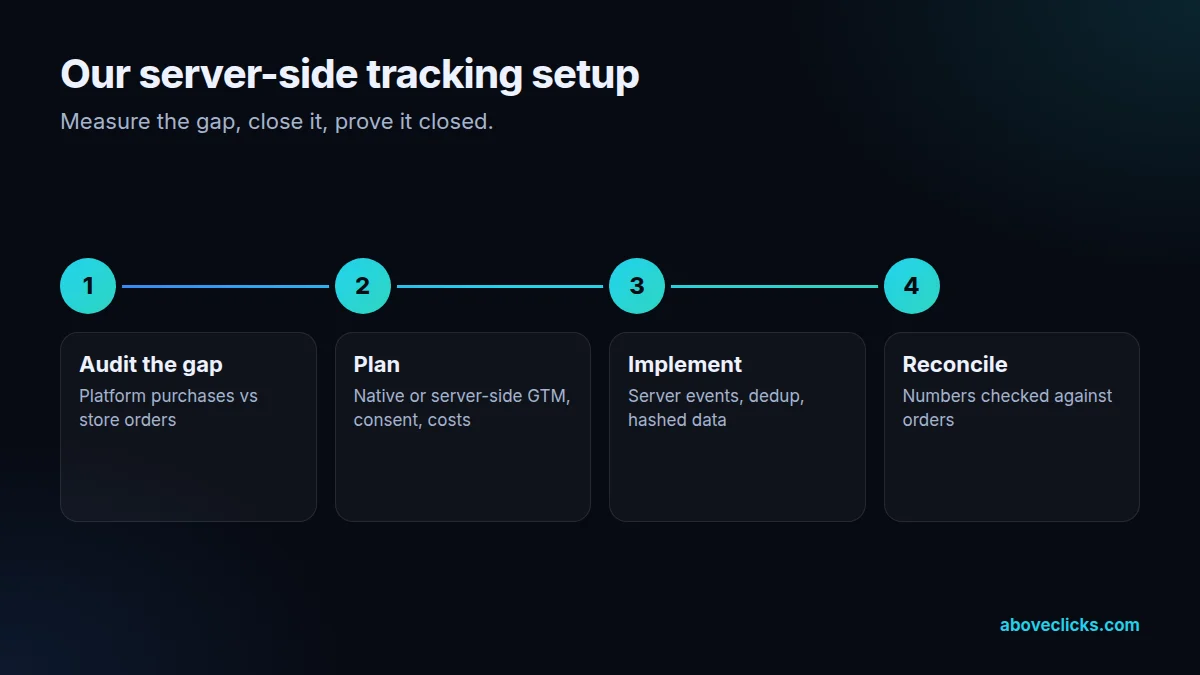
Measure the gap, close it, then prove it closed. Typical timing: the audit within 2 workdays, the build in about a week, and testing and handover within 2 weeks.
Step 1
Purchases per platform compared with store orders, and every event source listed.
Step 2
Native integrations or server-side Tag Manager, consent handling and costs agreed.
Step 3
Server events, deduplication and hashed customer data set up, tested with real test orders.
Step 4
Platform numbers checked against orders after launch, and drift fixed.
Pricing
The audit is free. Paid work starts at these prices, and your exact cost is fixed in writing before any work begins.
Free no obligation
Tell us your stack and we will map server-side tracking.
Get my free auditFixed scope
From $600 one-off
Server container, events and destinations configured.
From $200 monthly
Monitoring and fixes as platforms change.
All prices are starting prices in US dollars. Custom work beyond these options is quoted after the audit.
By industry
High order values make every missing purchase expensive for bidding. We prioritize purchase events with accurate values and customer data for match quality.
Returns are common in fashion. We send purchases with values and keep refund data in your reports, so bidding isn’t judged on revenue that comes back.
Long consideration means buyers return on different devices. Customer data in server events helps platforms connect those visits to the purchase.
Sources
Platform rules change. These are the official pages we check the work against, so you can check it too.
FAQ
Can’t find yours? Ask on WhatsApp or by email and we’ll answer it.
If ad platforms report far fewer purchases than your store records, or you spend enough that missing conversions affect bidding, usually yes. A platform’s native server-side integration is often enough to start.
The Conversions API is Meta’s way of receiving server events. Server-side Tag Manager is a server you run that can send events to Meta, Google, TikTok and others from one stream. One is a destination, the other is a route.
Not if it’s set up properly. The browser pixel and the server send the same event ID, and the platform keeps one. We test that with real test orders.
It shouldn’t, and in our setups it doesn’t. Server events follow the same consent choices as browser tags.
It depends on traffic and the hosting provider. We estimate it from your traffic before building, so you can decide whether the extra control is worth it.
A score in Meta’s Events Manager showing how well your server events can be matched to Meta accounts. Better customer data, sent hashed, usually raises it. Pinterest has a similar Event Quality Score.
It fixes missing data, which is the first step. Attribution still depends on each platform’s model, so we judge channels on store orders and MER as well as on what the platforms report.
Yes. Platforms recommend running browser and server events together. The pixel captures on-site behavior; the server fills the gaps. Deduplication keeps each sale counted once.
Meta, Google Ads and GA4, TikTok and Pinterest, on Shopify, WooCommerce and BigCommerce stores.
Related guides
Measurement
MER vs ROAS comes down to scope: MER judges all ad spend against all revenue, while ROAS judges one channel's spend against…
E-commerce SEO
Affordable SEO is a scoping decision, not a shopping decision. This guide shows what a small budget actually buys, what to buy…
E-commerce SEO
Email marketing cost is five bills in one: the tool, the list, the sends, the flows and the people. This guide prices…
Free growth audit
Tell us about your store. We’ll review your tracking, campaigns and SEO and send you a written audit with the top fixes, ranked by impact.