Buying guides
Questions to ask a marketing agency before you hire one (with good answers and red flags)
21 questions for your intro calls, grouped by topic, each with what a good answer sounds like and what should worry you.…
CRO · Split testing
We run split testing for Shopify and WooCommerce stores that want changes decided by results, not opinions. You get hypotheses from research, tests sized to your traffic, an SEO-safe setup, and a plain verdict on every test, even when traffic is too low to test.
200+ clients served 500+ projects delivered
Free and no obligation. Your store URL is all we need to start.
Free test plan
Three fields and you’re done. We look at your traffic and conversion rate, work out the smallest change a test could detect in a sensible time, and write up the three tests worth running first.
Your PDF report comes by email. If you want to discuss going ahead after reading it, we’ll set up a video meeting. We use your details only for this audit.
What we can show today
Worked example, with illustrative figures for a hypothetical store (not a client result): split testing whether delivery dates on product pages lift add to cart runs 50/50 for 3 full weeks with 26,000 visitors per variant, sized to detect a 10% relative lift from a 6% baseline. If add to cart moves from 6.0% to 6.4%, short of 95% confidence, the decision is to keep the original and test a stronger version.
We test our own work the same way. When we changed the tracking script on this site, we didn’t trust a single speed score: with several builds sharing one server, scores were noise. So we loaded the old and the new script on the same page, side by side, and compared them under the same conditions. Split testing a store follows the same rule: compare like with like, at the same time, and don’t read a result from noise.
What we check
Most failed tests were doomed before launch. These six are settled first.
What changes, for whom, and why it should help, written down from research, not taste.
Conversion rate, revenue per visitor or add to cart, chosen before the test, not after.
Visitors per variant from your baseline rate, the smallest effect worth finding and a 95% threshold.
At least one to two full weeks, and whole weeks, so weekday and weekend shoppers both count.
No flicker, no cloaking, canonical tags on variant URLs and 302s where a test redirects.
When the test ends, decided in advance, so nobody stops it the day it looks good.
In 1:10 · animated
A short animated walk-through of the first checks in our audit. No sound needed: everything is on screen, and the transcript is below.
What we check before a split test, an animated explainer of 1:10 with on-screen captions and controls to pause.
How we work
Split testing starts with research, not ideas. We read your analytics funnel, session recordings and reviews, and shop the store on a phone, to find where people hesitate. Each finding becomes a hypothesis with a reason behind it, such as “shoppers can’t see the delivery date on phones, so adding it above the button should lift add to cart”. Nielsen Norman Group’s A/B testing guide makes the same point: tests work best when qualitative research tells you what to change.
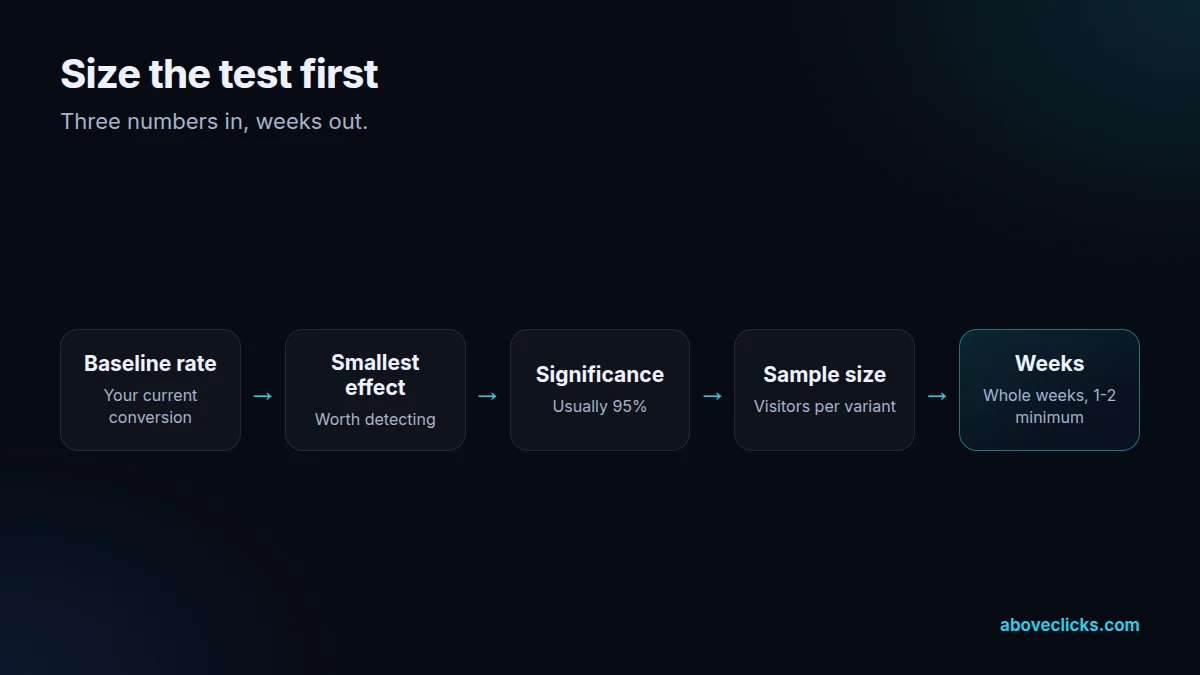
Then we size the test before it starts. Sample size depends on three numbers: your baseline conversion rate, the smallest effect worth detecting, and the significance threshold, usually 95%. NN/g’s example is a 3% baseline click rate with a 20% minimum detectable effect. We run the numbers for your pages and turn them into weeks. If a product page would need four months to reach an answer, we say so and pick a page with more traffic or a bigger change.
Duration has a floor as well as a ceiling. NN/g recommends running a test for at least one to two weeks even with enough traffic, to cover normal swings in behaviour, and we always run whole weeks so a weekend sale doesn’t tilt one side. We don’t look at the result daily and stop at the first good day; the stop date is set before launch.
Setup must not hurt SEO. Google’s page on website testing sets four rules we follow: don’t cloak (show Googlebot the same variants as people), use rel="canonical" on variant URLs pointing to the original, use 302 rather than 301 redirects for tests that send people to another URL, and run the test only as long as needed. We also check that the variant doesn’t flash the old version before switching, which skews results on slow phones.
Reading the result is where honesty matters. A test that doesn’t reach significance is an answer too: the change didn’t make a difference big enough to detect, so you keep the simpler version. We report the conversion rate for each variant with its range, the revenue per visitor, and the result for phone and desktop separately, then write down the decision and what the next test should be.
When traffic is too low to test, we don’t pretend. Small stores get the clear fixes from research shipped directly, measured before and after, and only the riskiest changes, such as a new price display or checkout flow, go into a longer test. Our CRO audit covers that research step on its own.
What’s included
The test plan is free. If you want us to run the tests, this is the work.
Funnel, recordings, reviews and phone shopping turned into hypotheses.
Sample size and weeks per test, from your own traffic and conversion rate.
Variants built in your testing tool or theme, checked on phones for flicker.
Canonical tags, 302 redirects and no cloaking, per Google’s testing rules.
Both variants tested on devices and browsers before traffic is split.
Each variant’s rate with its range, revenue per visitor and phone versus desktop.
Every test, result and decision recorded, so nothing is tested twice.

How we work
Nothing is charged until you have seen what your traffic can test.
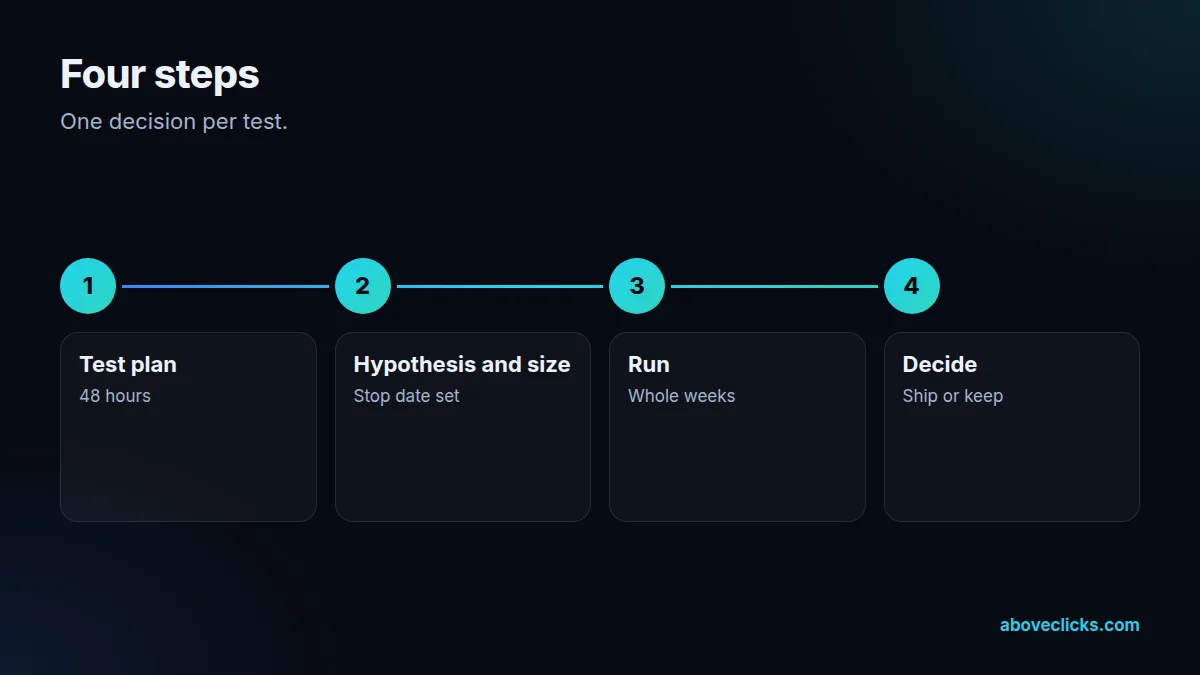
Step 1
You send the store URL; within 2 workdays you get the plan.
Step 2
Each test written down with its metric, sample size and stop date.
Step 3
Variants built, checked and run for the planned weeks.
Step 4
The result read, the winner shipped or the original kept, the next test picked.
Fit
Not the right fit if the store has very little traffic. A test there can run for months without an answer, so we will recommend shipping clear fixes and measuring them instead.
Pricing
The audit is free. Paid work starts at these prices, and your exact cost is fixed in writing before any work begins.
Free no obligation
We’ll tell you what your traffic can test and send a PDF report within 2 workdays.
Get my free auditAfter the audit
From $400 one-off
One test sized for your traffic, built, checked and reported.
From $600 monthly
A steady run of tests for stores with enough traffic.
All prices are starting prices in US dollars. Custom work beyond these options is quoted after the audit.
After the audit
The PDF report and the test plan are yours to keep either way.
Pricing
Every store is different, so we don’t quote before we’ve seen it. Within 2 workdays of the audit you get a fixed-scope plan with the cost and timeline. The cards above show where split testing starts, in US dollars.
Testing tool subscriptions are billed by the tool, not by us. Send your store URL for the free plan.
Sources
Each rule on this page traces back to these pages, so you can check them yourself.
FAQ
Can’t find yours? Ask on WhatsApp or by email and we’ll answer it.
It is showing two versions of a page to different visitors at the same time and measuring which one performs better. A/B testing is the same idea; split testing often means the versions live on separate URLs.
Long enough to reach the sample size you calculated, and at least one to two full weeks. Whole weeks matter, because weekday and weekend shoppers behave differently.
It depends on your conversion rate and the change you want to detect. Low conversion rates and small changes need many thousands of visitors per variant, which is why we size every test first.
Not if it is set up as Google asks: no cloaking, rel="canonical" on variant URLs, 302 redirects for redirect tests, and the test ended as soon as it has an answer.
The pages with the most traffic and the biggest drop-off, usually product pages and the cart. Test changes big enough to detect, not button colours.
That is a valid result: the change made no difference big enough to detect. Keep the simpler version, record it, and move on to the next test.
Your free test plan
Same sizing, same PDF report, no obligation. If a test can’t reach an answer on your traffic, the report says so.
Related guides
Buying guides
21 questions for your intro calls, grouped by topic, each with what a good answer sounds like and what should worry you.…
Buying guides
Percentage of ad spend, flat retainer, performance fee, hourly or a hybrid: what each model rewards, how it behaves as your spend…
Buying guides
In-house team, agency or freelancer? A side-by-side comparison on 7 factors, a total-cost worksheet built from US government pay data, and a…