What does CRO stand for? In marketing, CRO stands for conversion rate optimization, the work of raising the share of visitors who buy or take another chosen action. In clinical research it stands for contract research organization, and on a leadership team it usually means chief revenue officer.
This guide gives each meaning, a decoder for telling them apart, and a worked example of why the “rate” in conversion rate optimization changes from tool to tool.
What does CRO stand for?
CRO stands for conversion rate optimization when the text is about websites, stores or ads. Other fields use the same three letters for different things, so the context decides.
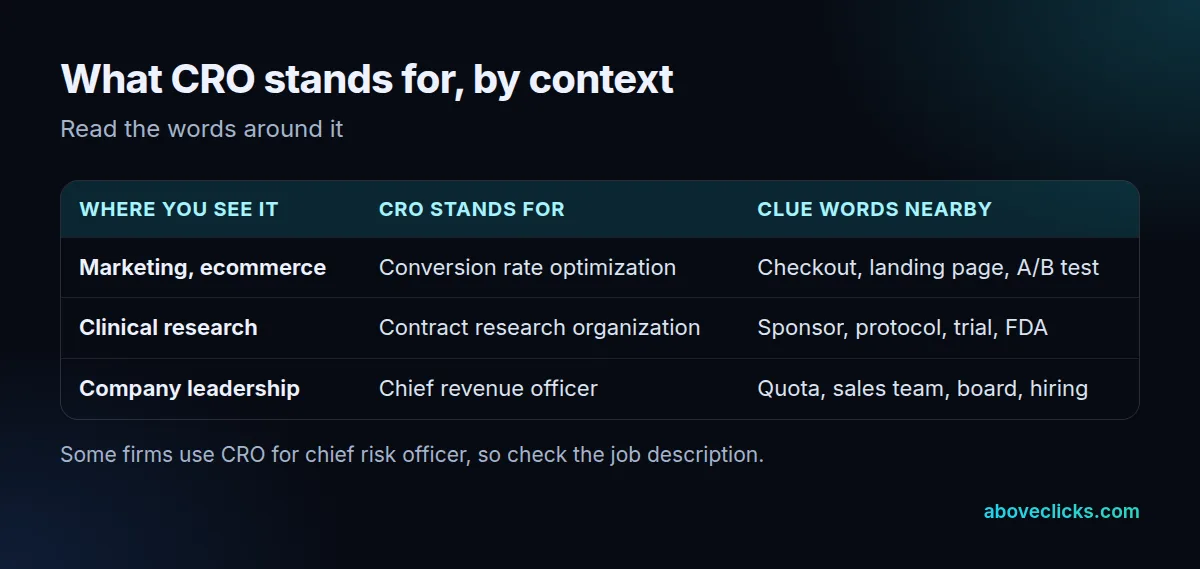
The table covers the three meanings you will meet most often. Each section below explains one, starting with the one most store owners need.
- Conversion rate optimization: a method for getting more of your visitors to act.
- Contract research organization: a company that runs parts of a clinical trial for a sponsor.
- Chief revenue officer: an executive who owns a company’s revenue number.
When a search for what CRO stands for returns all three, the surrounding words are the only reliable guide.
What is CRO in marketing and ecommerce?
In marketing and ecommerce, CRO stands for conversion rate optimization: finding where visitors drop out and testing changes that get more of them to act. The “conversion” is whatever you count as success, usually a purchase.
Google Analytics calls an important action a key event, meaning an event that measures an action particularly important to the success of your business. A purchase, a sign-up and a booked call can all be key events, and CRO tries to raise how often they happen.
Our own conversion rate optimization program works in that order: research first, a ranked list of fixes, and properly sized tests only for the changes that need proof. For Shopify stores, the same approach is on our Shopify CRO page.
What does CRO stand for in business?
In a company’s leadership team, CRO usually stands for chief revenue officer, the executive who owns sales and revenue targets. Some firms use the same letters for chief risk officer.
Three clues in a job ad point to this meaning:
- The role reports to the CEO or the board.
- It owns a revenue target, not a website metric.
- It manages the sales leads, and often marketing and customer success too.
That is why a job ad or an org chart can look confusing next to a marketing blog. A chief revenue officer manages a sales team and a revenue number, while conversion rate optimization is a method for lifting a rate on a website. The two can meet, because a revenue leader may ask for CRO work, but they are different things.
What is a CRO in clinical research?
In clinical research, CRO stands for contract research organization, a company that runs parts of a drug or device trial for the sponsor. The US Food and Drug Administration defines the term in its rules.
Under 21 CFR 312.3, a contract research organization is a person that assumes, as an independent contractor with the sponsor, one or more of the sponsor’s obligations. The rule lists 4 examples: designing a protocol, selecting or monitoring investigations, evaluating reports and preparing materials for the FDA.
If you are reading a protocol, a sponsor agreement or a trial budget, this is the meaning. It has nothing to do with web analytics.
How do you tell which CRO someone means?
Read the nouns around it, check who is speaking, and ask for the words spelled out if it is still unclear. Most cases are settled by the first step.
Three invented sentences show the method:
- “Our CRO raised checkout completion after the last test.” Checkout and test point to conversion rate optimization.
- “The CRO will submit the protocol amendment to the sponsor.” Protocol and sponsor point to a contract research organization.
- “We are hiring a CRO to run the sales team.” Hiring and sales team point to a chief revenue officer.
When an agency or a vendor uses the abbreviation in a pitch, ask once what they mean by it. A clear answer should name what is measured and how, which leads to the next question.
The same habit helps in reverse. If you write CRO in a brief, an email or a job post, spell it out the first time. Readers outside your field may otherwise assume the meaning from their own work, and a search for what CRO stands for only shows them the most common ones.
Why does the conversion rate in CRO change by tool?
Because each tool divides by something different. Shopify divides by sessions, Google Analytics 4 uses sessions with a key event, and Google Ads divides by ad interactions, so one store can show three rates in the same month.
As of November 2026, Shopify’s behaviour reports define conversion rate as the percentage of sessions that resulted in a purchase. GA4’s session key event rate is the number of sessions in which a key event happened divided by total sessions. Google Ads divides conversions by ad interactions that can be tracked to a conversion, so 50 conversions from 1,000 interactions is 5%.
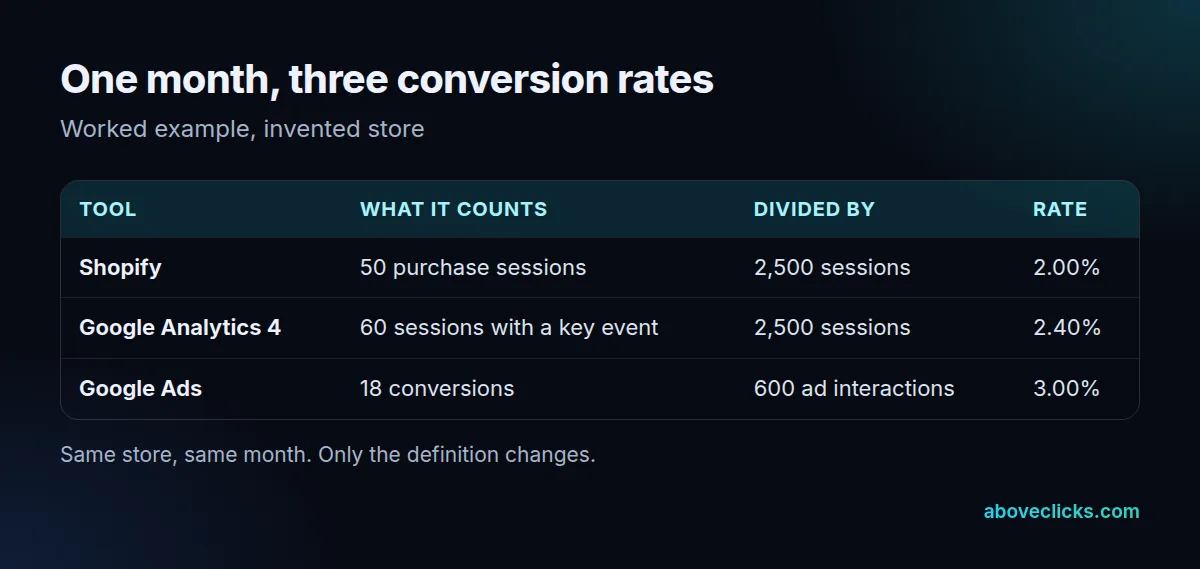
The example is an invented store, not a client result. Shopify counts 50 purchase sessions out of 2,500 sessions, which is 2.00%. GA4 also counts 10 sessions with a sign-up key event, so 60 of 2,500 gives 2.40%. Google Ads sees 18 conversions from 600 ad interactions, which is 3.00%.
None of the three is wrong. Pick one source for your CRO tracking, write down its definition, and compare it only with itself over time. Our conversion rate glossary page covers the formula in more detail.
If you test changes, Google’s guidance on website testing says small changes such as button size, color or call-to-action text often have little or no effect on ranking, and that test pages must not be cloaked. To see where your own store loses buyers, ask for our free audit. More measurement guides are in the measurement topic.