Triple Whale vs Northbeam is a choice between an analytics suite priced on your revenue and an attribution platform priced on your data and ad spend. Compare how each is billed and how long each contract runs before you compare features.
This guide uses each vendor’s own pages, dates every plan detail and tests nothing for you. We haven’t run either tool, and we don’t resell either one. We set up and check tracking for online stores, so we judge both against the order data a store already holds.
Triple Whale vs Northbeam: what is the real difference?
In a Triple Whale vs Northbeam comparison, both tools track an order back to the ads that earned it and show the result in a dashboard. Triple Whale wraps that in a wider suite with reporting and an AI assistant, while Northbeam is built around multi-touch attribution. A feature grid hides five differences that change the bill or the workload, and each is a costly trap in a Triple Whale vs Northbeam decision:
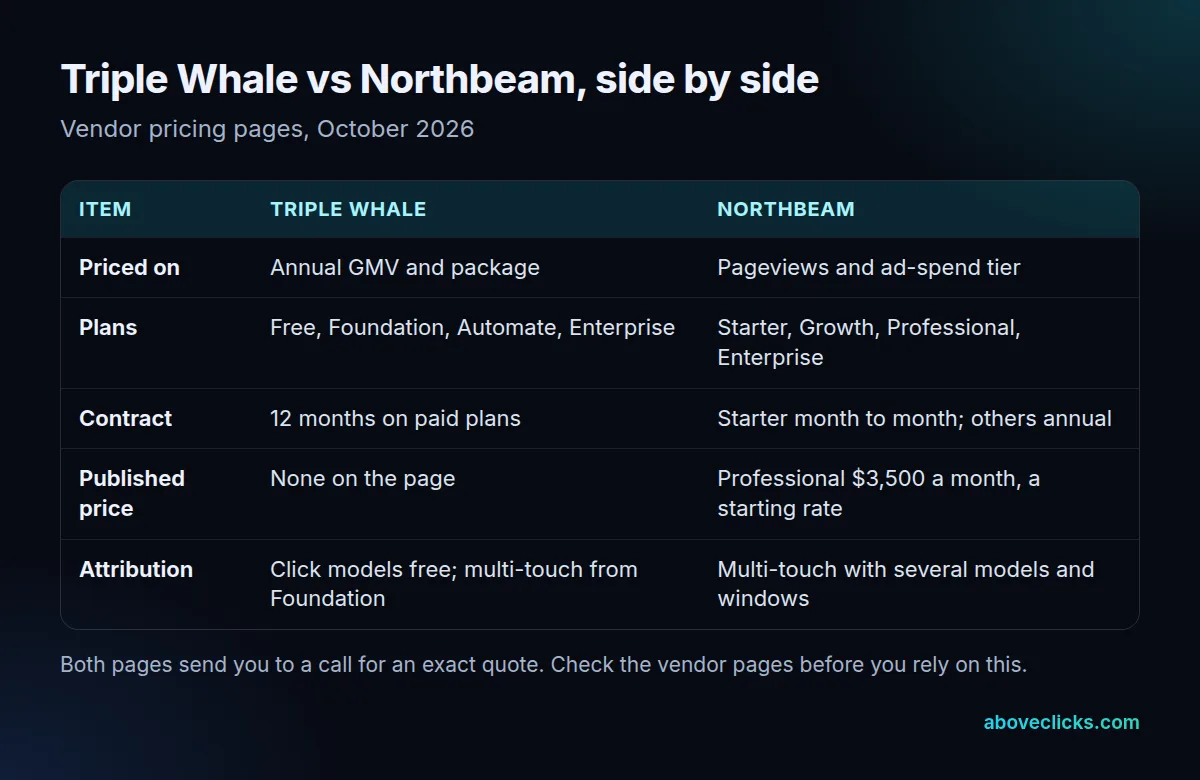
- Pricing basis: Triple Whale prices on annual GMV and the package you pick; Northbeam prices on pageview volume and your ad-spend tier.
- Contract: Triple Whale’s paid plans are 12-month subscriptions; Northbeam’s Starter plan is month to month, and its other plans are annual.
- Free tier: Triple Whale has a free plan with click-based attribution; Northbeam’s pricing page lists no free plan.
- Numbers: Northbeam says its numbers will not match Meta Ads Manager, by design.
- Data sent back: both can feed data to ad platforms, which can double up with the events you already send.
In this Triple Whale vs Northbeam comparison, the table shows the first four side by side. The vendor pages are the source for every cell, as of October 2026: the Triple Whale pricing page and the Northbeam pricing page.
Is Triple Whale or Northbeam better for a Shopify brand?
It depends on spend, team and the question you need answered. Northbeam positions itself for brands with real ad budgets across several channels; Triple Whale suits a brand that wants one reporting layer and may start free.
Northbeam’s pricing page, as of October 2026, sorts its plans by ad spend. Starter is for brands spending under $1.5 million a year on ads, Professional for up to $500,000 a month, and Enterprise above that. A Growth plan targets seven-figure brands under $200,000 a month that want agency support. Triple Whale sorts by revenue instead. Its free plan includes first and last click attribution and the Triple Pixel, so a small store can try the tracking before paying anything.
That difference shapes the Triple Whale vs Northbeam decision more than any feature. A brand with $2 million a year in revenue and three ad channels is not the buyer Northbeam’s higher plans describe, while a brand spending $400,000 monthly on ads is not the buyer a free plan serves. Both examples are invented, so run the numbers for your own store.
Use this quick filter on a Triple Whale vs Northbeam shortlist:
- Under about 3 ad channels: Shopify and Google Analytics reports probably cover you. Start there.
- Several channels and a media buyer: a Northbeam vs Triple Whale test is worth running.
- A team that wants reports, dashboards and an AI assistant, not only attribution: look at Triple Whale first.
- A non-Shopify store: check Northbeam’s plan notes, which say Professional works with any ecommerce platform.
How does Northbeam pricing compare with Triple Whale?
Neither publishes a full price list, so you compare billing logic first. Northbeam pricing starts from listed rates and then moves with your data volume, while Triple Whale pricing moves with your revenue and the package.
Northbeam’s pricing page shows Professional at $3,500 a month, as of October 2026, and its FAQ says plans “start at” the listed rates. The monthly price is informed by your pageviews, and an exact quote needs a call. The Starter card shows $1,500 without a clear billing period, so ask what it covers before you plan around it.
Triple Whale’s pricing page states that every price depends on annual GMV and the package: Foundation, Automate or Enterprise. Paid plans include unlimited users. They are 12-month subscriptions billed monthly or annually, and annual prepaid billing gives two months free and locks your tier for the year. If your revenue grows, you move up a tier.
The term is the trap. A 12-month term with a tier that rises as you grow is a bigger commitment than a month-to-month plan, so ask for the renewal and tier-change rules in writing.
What belongs in a Triple Whale vs Northbeam quote request?
Ask both vendors the same five questions, whichever way round you read Triple Whale vs Northbeam: the price at your GMV and pageviews, the term length, what moves you to the next tier, what happens at renewal, and whether data export is included. Put the answers in one sheet. A quote that cannot answer all five is not ready to compare.
How do Northbeam attribution models compare with Triple Whale’s?
Northbeam markets multi-touch attribution with flexible windows and several models. Triple Whale gives click-based attribution on its free plan and adds multi-touch from Foundation up. Both answer a different question than the reports you already have.
Northbeam’s multi-touch attribution page lists limitless lookback windows, multiple attribution models and flexible accounting modes. Its Apex feature sends its first-party data to Meta and AppLovin ad algorithms, and the vendor claims it could lift performance by as much as 30%. That figure is the vendor’s claim, not an independent test.
Compare that with what you already own. Shopify’s marketing reports offer 5 attribution models, with last non-direct click as the default. If a visitor does not buy within 30 days of a session, Shopify resets the first interaction to the next referrer. Google’s attribution overview lists 3 models in Analytics and says direct visits get no credit unless the whole path is direct. Our attribution model glossary entry explains how the rules differ.
So the paid question in Triple Whale vs Northbeam is narrow: do you need a view across channels that these free reports cannot give you? If your answer is “not yet”, a Triple Whale vs Northbeam contract can wait.
Why will neither tool match Meta or Shopify?
Because each one counts orders its own way, and the ad platforms count them again. Northbeam’s FAQ says your performance “will look different and may not line up” with Meta Ads Manager. Treat any gap as a question to settle, not proof that one number is wrong. That is true of every Triple Whale vs Northbeam test you run.
Here is a worked example with an invented store. Shopify recorded 80 orders in a week. Meta claimed 52 and Google Ads claimed 41. Added together, the platforms claim 93 orders, which is 13 more than the store took, so at least 13 orders were counted by both.
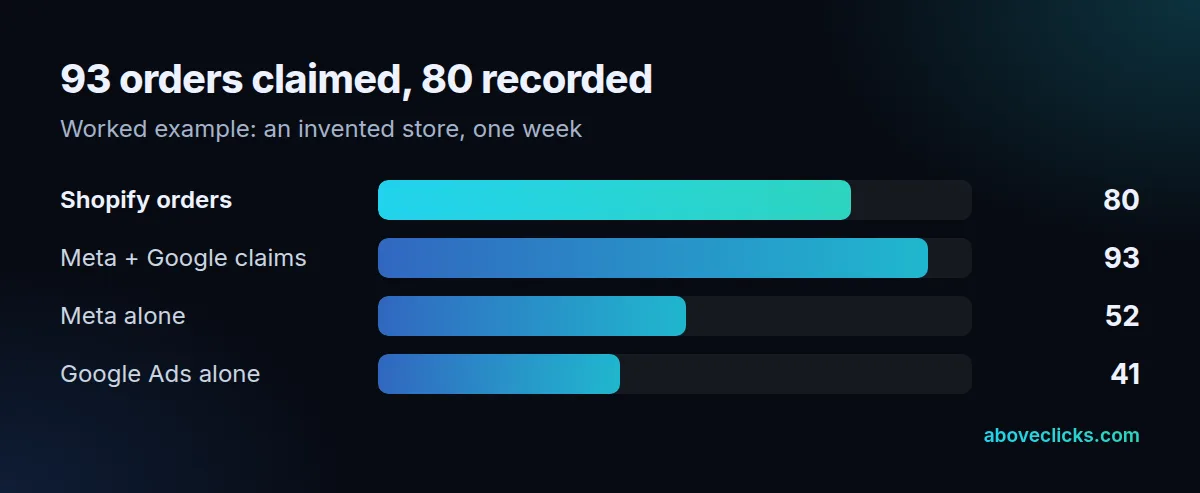
We see the same shape in real accounts. On our tracking page, one store’s September 2026 report shows Meta with 14 orders and Google with 19, with 5 shared, so 28 distinct orders and not 33.
Tools that send data back to ad platforms add a second risk. Meta’s deduplication guide says it matches a browser event and a server event by event ID and name. A server event is kept if no matching browser event arrived in the past 48 hours. So a new tool that sends purchases must reuse the same event ID, or the order is counted twice. Our Conversions API for Shopify guide shows how to set that up.
What are the alternatives to Northbeam and Triple Whale?
Start with the free options, then move to a paid suite only when they fall short. The main alternatives sit in three groups: native reports, server events and other paid suites.
- Native reports: Shopify Analytics for orders and Google Analytics for sessions, both included in what you already pay.
- Server events: Meta’s Conversions API, which for a store with a Meta Pixel can be set up in one click from Events Manager with no setup fees, per Meta’s documentation.
- Other paid suites: our Triple Whale alternatives guide lists the groups, and Triple Whale vs Hyros compares a tracking service with a self-serve suite.
Between them, Shopify’s 5 attribution models and Google’s 3 give you 8 free views of the same orders. Run those free views for 14 days before you pay for a ninth. Which paid option wins depends on how many channels you buy and how much a wrong budget call costs you. In a Triple Whale vs Northbeam review, the honest first step is to see what those 8 views already tell you.
How do you test both before you sign?
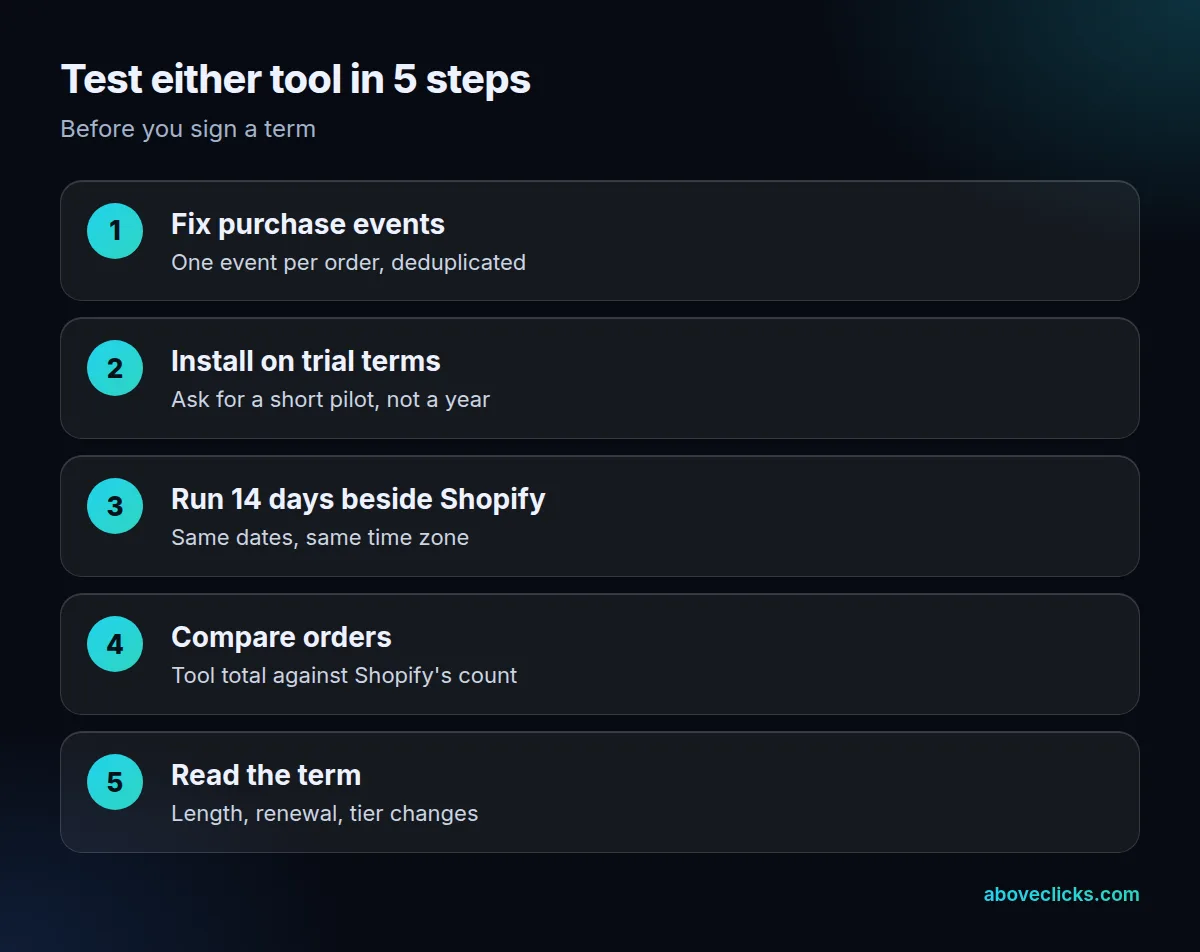
Run each tool beside your current setup for 14 days, then compare its orders with Shopify’s count. A tool that cannot reconcile to your own store orders is not ready to guide your budget.
What should a Triple Whale vs Northbeam test result look like?
Decide the pass mark before you look at any dashboard. For example, you might accept a tool whose order total sits within 5% of Shopify’s count and can explain the rest. That threshold is an example, not an industry standard.
Keep it simple. Use the same dates and the same time zone in every report. Write the order total of each source in one row, and note the gap in percent. If a tool’s total is higher than Shopify’s, find out why before you trust its revenue figures. Northbeam also sells a model that credits ads people view but do not click, so ask which orders in its total come from views and which from clicks. A fair Northbeam vs Triple Whale test compares like with like: click-based orders against click-based orders first.
Then read the term. A 12-month Triple Whale term or an annual Northbeam plan is a commitment, so ask whether a shorter pilot is possible. Northbeam’s Starter plan is the one month-to-month option on either pricing page, as of October 2026.
If you want a second opinion before you commit, our tracking and analytics service fixes purchase events and reconciles them with your orders, and the free audit reviews your current setup. More measurement guides are in the measurement section.