Triple Whale vs Hyros comes down to how much of the work you want done for you. Triple Whale is a self-serve analytics and attribution suite for ecommerce brands with published prices; Hyros is an ad tracking service with a set-up team and custom pricing.
This guide compares the 7 Triple Whale vs Hyros differences that decide it, shows why the same order gets different credit in different reports, and gives a 5-step test to run against your own orders before you sign. We haven’t run either tool for this guide, so treat each vendor’s accuracy claims as claims.
Triple Whale vs Hyros: what is the difference?
Who they are built for and who does the work. Triple Whale is a dashboard suite your team runs for an ecommerce brand; Hyros sets up and tunes its tracking for you, across several business models.
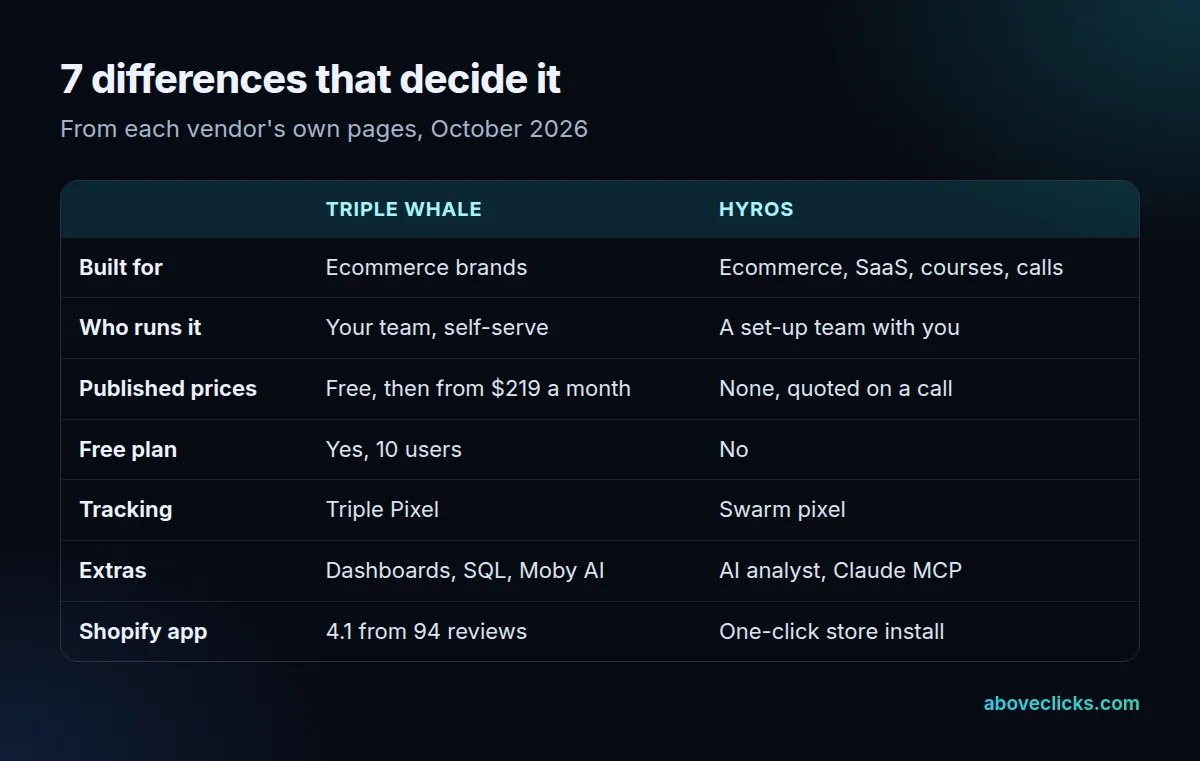
Triple Whale’s pricing page describes, as of October 2026, a free plan, then Foundation, Automate and Enterprise packages, with paid plans priced on your annual GMV and including unlimited users. Its focus is the whole store: ads, email, subscriptions, products and cohorts in one place, with an AI assistant called Moby on top.
Hyros’s pricing page describes 1 plan with no tiers or add-ons, a set-up team and an AI analyst on every account, and a price quoted on a 15-minute set-up call, as of October 2026. Its focus is narrower: which ad caused each sale, fed back to the ad platforms.
What is Triple Whale used for?
Seeing a Shopify brand’s whole performance in one place: ad spend, revenue, attribution, products and customers. Its own pixel tracks sessions and orders, and paid plans add multi-touch attribution.
Triple Whale’s Shopify listing shows, as of October 2026, that the free plan includes 10 users, a 12-month lookback, first- and last-click attribution and the Triple Pixel. Foundation adds multi-touch attribution, custom dashboards, a SQL editor, cohort analysis and Moby; Automate adds scheduled Moby automations and creative generation.
So Triple Whale is as much a reporting tool as an attribution tool. If your team mostly wants one dashboard instead of 5 browser tabs, that is the part you are paying for. If you want marketing mix modelling and holdout tests, its pricing page puts those in Enterprise.
Foundation also includes Sonar Optimize and Sonar Send, which push first-party data back to the ad platforms and into email flows. That overlaps with what Hyros sells, so on a Triple Whale vs Hyros shortlist, compare the two on that one job: which purchases each sends back to Meta and Google, and how fast.
How does Hyros tracking work?
Hyros adds its own tracking pixel, joins each visit to signals such as an email, a cookie, an ad click ID and an IP address, and sends the matched sales back to Meta and Google. A Hyros set-up team installs it.
Hyros’s ecommerce page says it tracks repeat purchases and reorders for the life of the customer and lists Shopify, WooCommerce, Klaviyo and Triple Whale among the tools it plugs into, as of October 2026. It also claims Hyros finds 30% more sales than Meta reports and lifts ROAS by 10–20% across 1,500+ ecommerce clients. Those are the vendor’s own figures, not an independent test.
Ask the set-up team which events it will send back to Meta and Google, and how it avoids counting an order twice when your Shopify apps already send the same purchase. That one answer tells you more about the setup than any case study.
Hyros sells to more than stores. Its home page lists ecommerce, SaaS, courses and coaching, booked calls and agencies, so it suits a business where a sale happens on a call or a week after a webinar. That is the main reason a non-Shopify business ends up on the Hyros side of Triple Whale vs Hyros.
How does Hyros pricing compare with Triple Whale pricing?
Triple Whale pricing is published; Hyros pricing isn’t. As of October 2026, Triple Whale’s App Store listing shows Foundation from $219 a month and Automate from $749 a month, while Hyros quotes each account on a call.
On the Shopify listing, Foundation is $219 a month or $2,190 a year and Automate is $749 a month or $7,490 a year, a 17% saving for paying yearly, as of October 2026. Triple Whale’s pricing page adds that the price rises with your annual GMV, and that a dedicated customer success manager is for brands with GMV of $10M+.
Hyros’s pricing page says the price is sized to the revenue Hyros tracks for you and is quoted in the first minutes of a 15-minute call, as of October 2026. Hyros pricing therefore isn’t comparable until you have a written number.
Triple Whale vs Hyros: what to ask for in a quote
Get these 5 points in writing, so a Hyros quote can be set against Triple Whale pricing:
- the monthly price and the revenue band it is based on
- what happens to the price when revenue grows
- contract length, notice period and any set-up fee
- what the set-up team does, and for how long
- the conditions of the results promise on the pricing page
Then put both on a yearly basis. At the entry Foundation price on its Shopify listing, Triple Whale costs $2,190 a year paid upfront, as of October 2026; set a 12-month Hyros quote beside it, plus the staff time each one needs. Triple Whale pricing assumes your team does the analysis, while Hyros pricing includes a set-up team and an analyst, so the lower number isn’t always the cheaper option.
Is Triple Whale free?
Yes, there is a free plan with no credit card needed, as of October 2026. It covers dashboards, the Triple Pixel and first- and last-click attribution; multi-touch attribution needs a paid plan.
That makes the free plan a fair first step in any Triple Whale vs Hyros test. Install it, let the pixel collect for 30 days, and compare its revenue with your store’s own reports for the same 30 days. Hyros has no free plan, so a Hyros trial means a sales call and a contract. If cost is the main question, our Triple Whale alternatives guide covers the free options, including GA4 and server-side tracking, before any paid suite.
Is Triple Whale accurate, and is Hyros?
Neither is accurate in the abstract, because attribution is a choice of rules. The same order gives different answers under different models, so test each tool against your own store orders.
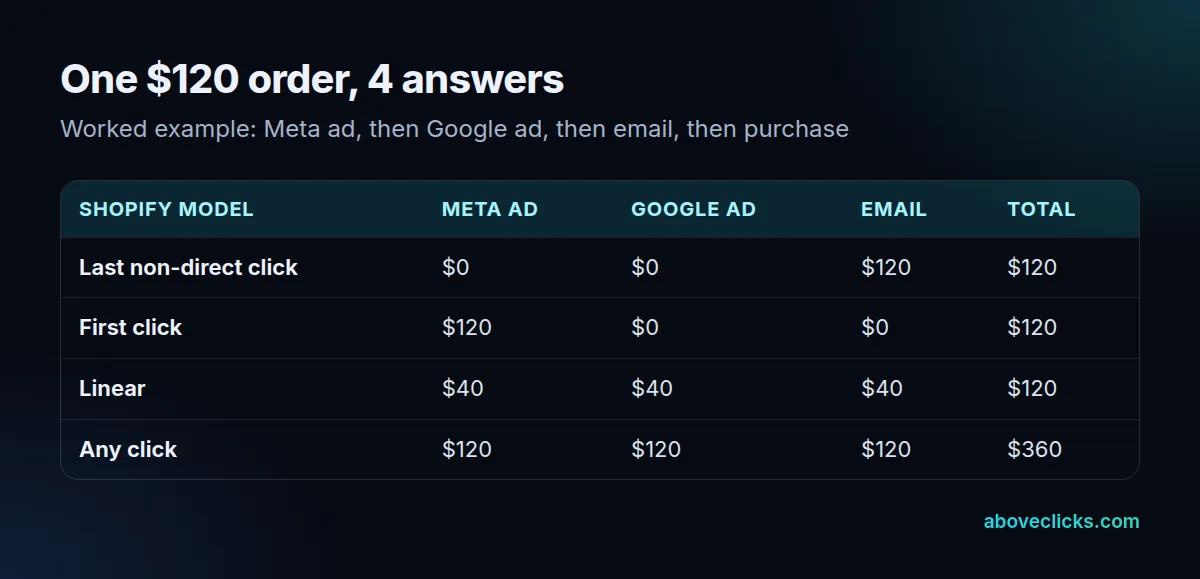
Take an invented $120 order: the shopper clicked a Meta ad, then a Google ad, then an email, then bought. Shopify’s attribution help documents 4 models, as of October 2026. Last non-direct click, the default, gives the email $120. First click gives the Meta ad $120. Linear gives each click $40. Any click gives each one $120, so $360 is reported for a $120 sale, and Shopify warns that this model allocates more credit than orders received.
Google Analytics has its own 3 attribution models, and each ad platform credits its own ads. That’s why adding up what every platform reports usually comes to more than the store took. A paid tool picks one more rule; it can’t make the total add up to more than your orders.
What a tool can fix is missing data. Google’s enhanced conversions send hashed first-party data such as an email address with each conversion, and Meta’s deduplication guide matches pixel and server events by event ID within 48 hours. If those are broken, fix them first: our server-side tracking service and the free tracking health check start there.
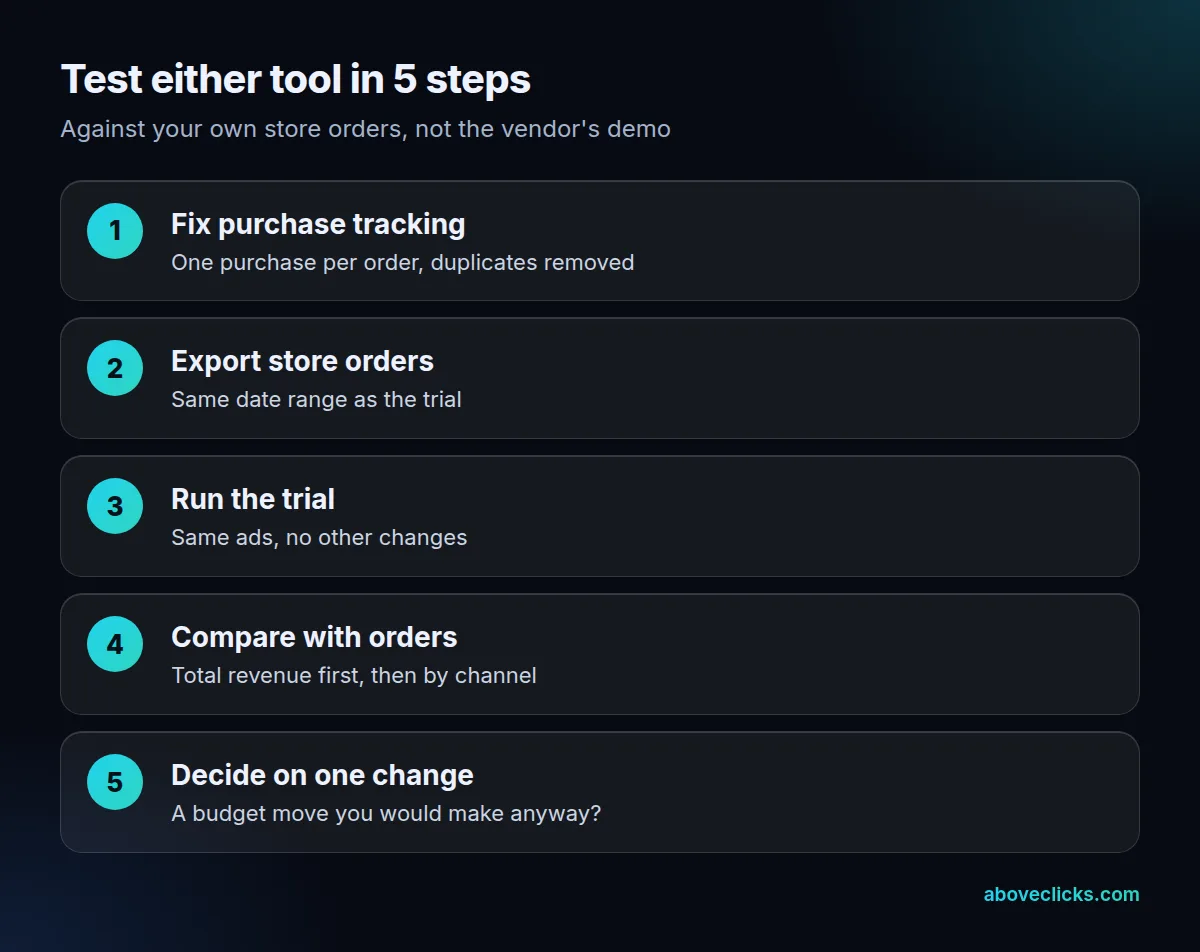
Our ecommerce attribution audit works the same way: we line up a month of store revenue with what GA4, Google Ads and Meta each claim, and send the comparison as a PDF within 2 workdays. Run the same test on any tool’s trial before you trust its numbers.
Does Hyros work with Shopify?
Yes. Hyros lists a one-click Shopify store install and also supports stores on other platforms. Triple Whale is built around Shopify and its app has been listed since December 4, 2020.
Triple Whale’s app rates 4.1 from 94 reviews on the Shopify App Store, as of October 2026, and it also connects Amazon, email and SMS tools. Hyros’s pricing page reports 4.9 from 600+ Trustpilot reviews and 5,000+ clients across all business models. These scores come from different review sites and different buyers, so read them as a sense of scale, not a ranking.
For a Shopify brand, the Triple Whale vs Hyros choice usually turns on two questions: do you want to run the reporting yourself, and do you sell anything off the store, such as calls or courses? If the answers are yes and no, Triple Whale fits; the reverse points to Hyros. Avoid running a Triple Whale vs Hyros trial side by side in the same month: two new pixels and two sets of server events make it hard to tell which change moved the numbers. If you’d rather start with what your current setup already shows, our tracking and analytics team offers a free audit, and more guides are in measurement.