Find what keeps your store out of Google’s results.
Our technical SEO audit checks 25 points on your Shopify or WooCommerce store, from crawling and indexing to speed and structured data. You get a PDF report within 2 workdays that shows each problem on your own pages and the order to fix them in.
Free and no obligation. We only need your store URL to start.
Technical SEO auditScanning
SEOChecked
CrawlingGood
IndexingCheck
CanonicalsFix
Core Web VitalsCheck
Structured dataGood
✓ Report ready
Illustration: 25 checks, ranked by the traffic they touch.
Free technical SEO audit
We’ll check 25 technical points and send a PDF report within 2 workdays.
Three fields and you’re done. We crawl the store, read what Google sees and write up what we find, with the fixes ranked by impact.
25 checks across crawling, indexing, speed, structured data and site health
A PDF report on your own pages with the ranked list of fixes, plus a video meeting if you want one
No logins needed; Search Console read access is optional and asked for in the chat
Chat on WhatsAppPrefer to talk first? Send us your store URL on WhatsApp.
Your PDF report comes by email. If you want to discuss going ahead after reading it, we’ll set up a video meeting. We use your details only for this audit.
Results
Technical SEO audit results, each with its source and date.
A jewelry client’s Search Console reports, one fashion store’s technical SEO audit from findings to follow-up, what we found on well-known store sites, and the same checks on our own site. Client data is anonymized and shown with permission.
Client result · four reports
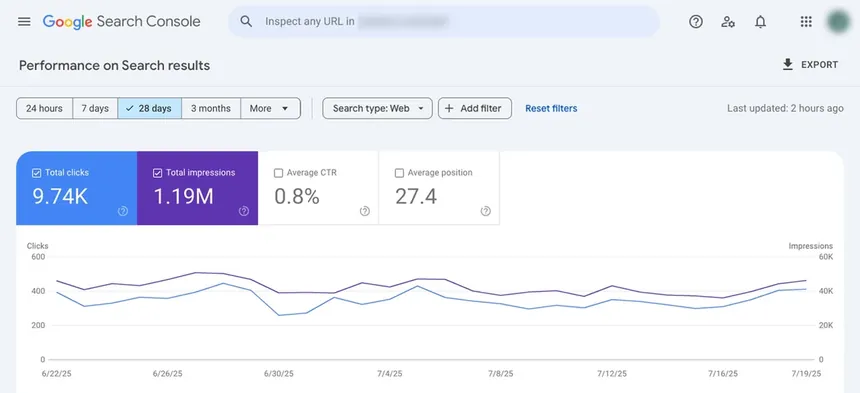
Jewelry store: from 9.74K to 276K clicks per 28 days
An anonymized jewelry e-commerce client we do SEO for. Web search, four 28-day reports from June 2025 to October 2026.
9.74K→276KClicks, 28 days
27.4→4.5Average position
Search Console · jewelry clientReal reports
Jun–Jul 2025Jul–Aug 2026Aug–Sep 2026Sep–Oct 2026
Clicks, 28 days9.74K89.4K163K276K
Avg. position27.48.46.14.5
9.74K
89.4K
163K
276K
Source: Google Search Console, 22 Jun 2025 to 17 Oct 2026, cropped from the reports. Anonymized, shown with permission. Sixteen months of ongoing SEO work sit behind this curve.
Client result · technical SEO audit
Fashion store: four ranked fixes, then 1,719 of 1,786 intended pages indexed
An anonymous US fashion and accessories store on Shopify. Seasonal product drops had accumulated old URLs, inconsistent theme rules and app code. The audit turned those findings into an ordered implementation plan, rather than an undifferentiated list of warnings. Audit August 26–28, 2026; fixes August 29 to September 12; follow-up October 19, 2026. Scope: 1,786 intended canonical pages (1,482 products, 176 collections and 128 content pages) within 13,706 known URLs.
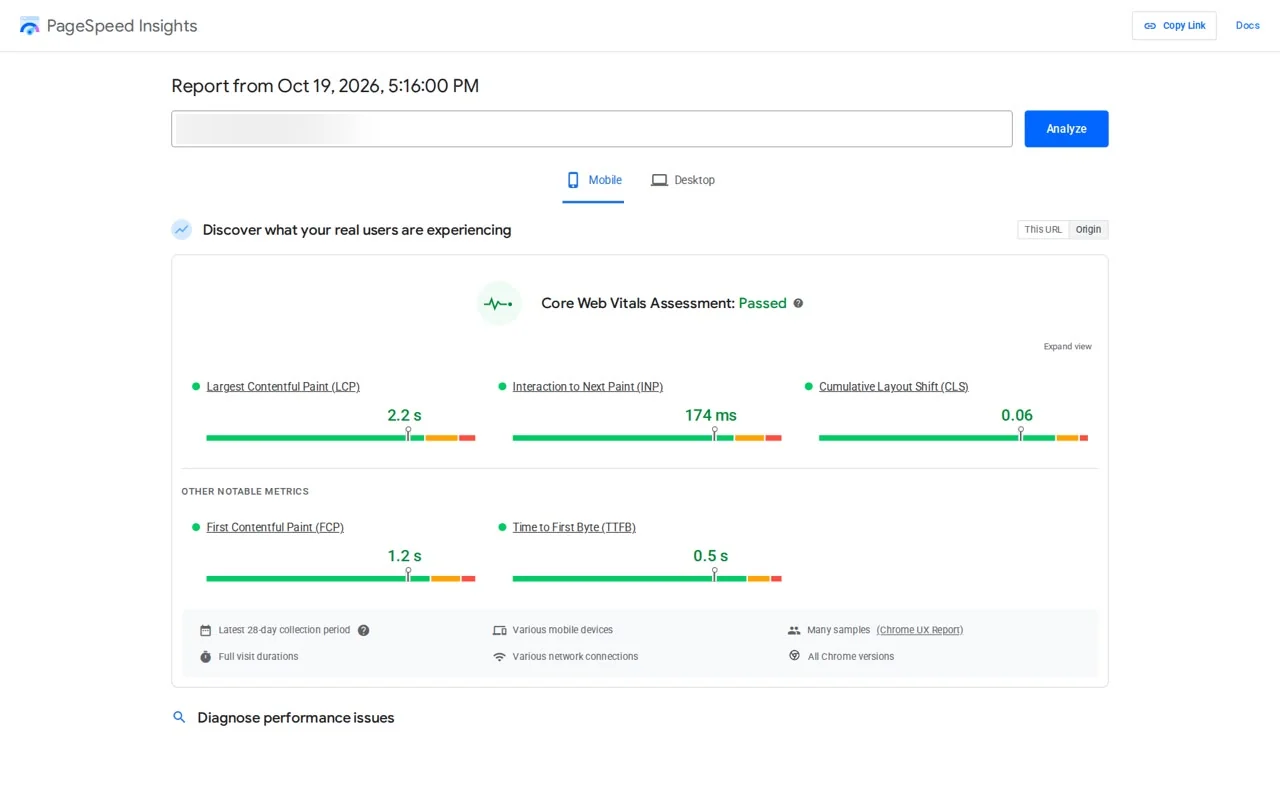
For a US fashion Shopify store, our Shopify technical SEO audit service ranked the work in four stages: restore indexability and canonical signals; repair internal links and relevant redirects; improve mobile Core Web Vitals; then correct product structured data. The fixes removed accidental noindex from 286 intended pages, repaired 178 broken internal links and corrected missing Offer currency on 218 product pages. By the October 19 follow-up, 1,719 of 1,786 intended pages were indexed, and mobile origin Core Web Vitals passed across all three metrics.
1,224→1,719Indexed intended pages, of 1,786
286→0Intended pages with accidental noindex
4.3 s→2.2 sMobile LCP, origin field data (p75)
The technical SEO audit’s ordered repair plan, with the follow-up check for each fix. Implementation review, October 19, 2026. Client identity withheld; shown with permission.
The audit made it clear what needed fixing first and why. We worked through the indexing issues, broken links and slow mobile pages in a sensible order, and the explanations were easy to follow.
Simon M.Owner, US fashion Shopify store
The four fixes, in the order the technical SEO audit ranked them
Indexability and canonical signals
Finding: a custom theme condition applied noindex to 212 published products and 74 collections, 286 intended pages. Another 4,618 collection-scoped product aliases declared themselves canonical instead of pointing to the primary product URL. Filter links kept exposing unwanted parameter combinations.
Change: we corrected the theme condition, restored indexability to those 286 pages and made the 4,618 aliases point to the primary product URL. Product cards now link directly to that primary URL. Unneeded filter-link combinations were removed from crawlable navigation, while useful collection landing pages remained available. Existing parameter pages that needed noindex stayed crawlable, so Google could read the directive.
Why this rank: later improvements cannot compensate for an important product being excluded from indexing. The aim was to index the useful catalog, not every URL the theme could generate.
Internal links and legacy product URLs
Finding: 178 internal links led to 404 responses across 96 old product URLs with relevant live replacements. Another 48 intended pages lacked a crawlable internal link.
Change: we updated the 178 links to live destinations, added 96 direct permanent redirects and linked all 48 orphaned pages from appropriate collections or content. The other 402 removed-product URLs had no relevant replacement and continued returning 404.
Why this rank: shoppers and crawlers needed reliable routes to the live catalog. Old URLs were redirected only when there was a relevant destination.
Mobile loading, interaction and layout
Finding: oversized hero images delayed the largest visible element, app scripts competed for the main thread, and late-loading widgets shifted the page.
Change: we served properly sized responsive images, prioritized the main product image, deferred nonessential app code, removed two unused storefront embeds and reserved dimensions for review and recommendation widgets.
Why this rank: these changes improved the shared product and collection templates after the indexing and discovery problems were addressed.
Product structured data
Finding: 218 of 1,482 product pages using a custom template omitted offers.priceCurrency while declaring an offer price.
Change: we repaired the Product/Offer template and mapped USD, prices and stock status to the same product data used by the visible page. Required-field checks covered all 1,482 product pages, and missing Offer currency fell from 218 pages to zero. Variants were checked against the selected offer rather than assigned invented review ratings.
Why this rank: accurate product markup helps eligibility for product search features once the underlying pages can be found. Eligibility does not mean a rich result will show.
Technical SEO audit follow-up, October 19, 2026
Metric
Before
After
Intended pages with accidental noindex
286
0
Product aliases with incorrect declared canonical
4,618
0
Broken internal links in the identified set
178
0
Unlinked intended pages in the identified set
48
0
Indexed intended pages
1,224/1,786
1,719/1,786
Intended-page indexing coverage
68.53%
96.25%
Product pages missing Offer currency
218
0
Core Web Vitals, mobile origin field data (p75), 2026
Metric
Jul 29–Aug 25
Sep 22–Oct 19
Largest Contentful Paint (LCP)
4.3 s
2.2 s
Interaction to Next Paint (INP)
318 ms
174 ms
Cumulative Layout Shift (CLS)
0.19
0.06
Core Web Vitals assessment
Failed
Passed
These are two separate 28-day mobile origin windows. They describe field experience across the origin; they are not a Lighthouse score or an individual page’s lab result.
Indexed intended pages increased by 495. The remaining 67 intended pages, 18 discovered but not indexed and 49 crawled but not indexed, stayed on the monitoring list. Search Console still shows 11,987 not-indexed URLs at follow-up. That total includes 6,804 deliberately excluded parameter URLs, 4,618 correctly canonicalized product aliases, 96 redirects, 402 retired URLs and those 67 intended pages. Those categories sum to the displayed total; they are not 11,987 unresolved technical defects.
PageSpeed Insights, mobile, origin field data
Before: Core Web Vitals assessment Failed, LCP 4.3 s, INP 318 ms, CLS 0.19. Source: PageSpeed Insights, mobile, origin, report from August 25, 2026 (28-day window to August 25). Store URL blurred.After: Core Web Vitals assessment Passed, LCP 2.2 s, INP 174 ms, CLS 0.06. Source: PageSpeed Insights, mobile, origin, report from October 19, 2026 (28-day window to October 19). Store URL blurred.
What we found on real store sites in October 2026
30of 36
store homepages had images without width and height, a cause of layout shift
every image gets its size, so nothing moves while the page loads.
Our raw-HTML read of 36 homepages, 18 Oct 2026
18of 36
store homepages loaded 100 or more script tags
scripts left behind by old apps are removed, so phones respond to taps sooner.
Our raw-HTML read of 36 homepages, 18 Oct 2026
17of 36
homepages marked 3 or more elements as high fetch priority
only the main hero image gets high priority, so it loads first.
Our raw-HTML read of 36 homepages, 18 Oct 2026
8of 15
stores had breadcrumb structured data on the collection or product page we fetched
breadcrumb markup is added to product and collection templates.
Our read of 15 stores’ collection and product pages, 18 Oct 2026
Well-known stores, mostly on Shopify, one fetch each from one location. Raw HTML misses what scripts add later, so script counts are a floor. Full method in our test logs.
The same checks on our own site
Before launch, a background on our inner pages moved when the web font loaded. We fixed it and measured again. Later, PageSpeed Insights showed a mobile layout shift of 0.132 from our cookie banner, so it now opens only after fonts load. This site scores 99 for mobile performance in Lighthouse 12.
0.23→0Layout shift (CLS) on our inner pages, after the fix
1.9 sLargest Contentful Paint, home page, mobile lab run, 17 Oct 2026
Brands we’ve worked with
How we measure
How we check a fix worked, in Search Console.
Rankings move with Google updates, seasons and competitors as much as with fixes. So every fix is dated, validated in Search Console and read against a fixed window on each side.
28 days before: clicks, impressions, indexed pages and Core Web Vitals status
Fix goes live, date logged, validation started in Search Console
28 days after: the same reports, with the same filters
Validated by Google
The Page indexing and Core Web Vitals reports let us ask Google to check a fix. It then rechecks the affected URLs, and we share the pass or fail it reports.
Same filters each time
Web search, the same country, the same device split and the same pages, so the two windows compare like with like.
Updates flagged
A Google core update, a sale or a site launch inside either window is written next to the result, since it can move rankings on its own.
Indexing before traffic
We read indexed pages first and clicks second, because a page has to be crawled and indexed before it can earn a click.
The 25 checks
What our technical SEO audit checks, in five groups of five.
Every store gets the same 25 checks, so nothing is skipped because it looked fine at a glance. Each card names what the group protects.
01
Crawling, checks 1 to 5
Moves Pages Google can reach
Robots.txt rules and what the XML sitemap lists
Status codes, server errors and redirect chains
Pages no internal link reaches
02
Indexing, checks 6 to 10
Moves Pages Google keeps
The Page indexing report’s reasons and stray noindex tags
Canonical tags and duplicate product URLs
Indexable filter and sort pages
03
Speed, checks 11 to 15
Moves Real visits on phones
Failing URL groups in the Core Web Vitals report
The LCP image, its priority and images without dimensions
Layout shift sources and heavy app scripts
04
Structured data, checks 16 to 20
Moves Rich results
Product markup with price and availability
Review, breadcrumb and organization markup
Errors in the Rich results report
05
Site health, checks 21 to 25
Moves Trust and clean results
HTTPS, mixed content and soft 404s
Discontinued and out-of-stock products
Duplicate titles and descriptions, and content that needs JavaScript
What you get back: a PDF report on your own pages, with each failing check shown, why it matters and its fix, ranked by the traffic it touches.
In 1:10 · animated
Before we change anything, we check five things.
A short animated walk-through of the first checks in our audit. No sound needed: everything is on screen, and the transcript is below.
What our technical SEO audit finds first, an animated explainer of 1:10 with on-screen captions and controls to pause.
Read the transcript
What our technical SEO audit finds first Five of the 25 checks that fail most often on stores.
1. Why aren’t pages indexed? The Page indexing report lists a reason for every URL Google left out. We sort them by how many product and category pages each one hides. (Example store, from the Search Console Page indexing report.)
2. Are filter pages being crawled? Colour, size and sort parameters turn one category into thousands of crawlable URLs with the same products. (Example store, from a crawl and server logs.)
3. Do product pages pass Core Web Vitals? We read real-visitor data per URL group in Search Console. Google’s “good” thresholds: LCP within 2.5 s, INP within 200 ms, CLS under 0.1. (Example product template. Thresholds: Google Search Central.)
4. Is the product markup complete? Price and availability in Product markup, with no errors in the Rich results report and no duplicate markup from an app. (Example product page. Source: Google Search Central, product structured data.)
5. Where do old products go? Discontinued products that return a soft 404 or redirect to the home page waste their links. A close match keeps them.
Then we fix them, in that order. Want this checked on your store? The free growth audit covers all five, in writing.
How we work
How the technical SEO audit works on your store.
We start where Google starts: crawling. We crawl the store with Screaming Frog the way a search engine would, then compare what we find with the sitemap and with robots.txt. Google’s robots.txt guide says the file manages crawling and is not a way to keep a page out of search; a blocked page can still be indexed if other sites link to it. So we check both directions: pages blocked that should be crawled, and pages left open that waste crawling on filters and internal search.
Indexing comes next, because most indexing issues on stores are duplicates. One product can live at several URLs on Shopify (its own URL and one per collection), and filter, sort and pagination parameters multiply collection pages. Google’s guide to consolidating duplicate URLs explains how canonical tags, redirects and internal links tell it which version to show, and its page on faceted navigation covers filter URLs. If you give us read access, we also read the Page indexing report, which lists each reason Google left pages out.
For speed we use two sources. Lighthouse shows what a phone loads in a lab test, and the Search Console Core Web Vitals report shows real visits. A URL group passes core web vitals when LCP is 2.5 seconds or less, INP is 200 milliseconds or less and CLS is 0.1 or less, at the 75th percentile. When we read the raw HTML of 36 store homepages on 18 October 2026, 30 had images without width and height, and 18 carried 100 or more script tags. Those two causes come up in almost every audit, and our Core Web Vitals optimization work fixes them.
Then structured data. Product pages should tell Google the price, the currency and whether the item is in stock, using the fields in Google’s Product structured data guide. We test a sample of products, collections and the home page, and check that the markup matches what the page shows. A theme update or a new reviews app can change one without the other, so a price or stock status in the markup can drift from the visible one.
Last, we write the PDF report. Every failing check is shown on your own pages, with why it matters and the fix, in order of the traffic and revenue it touches. The work is done by Kashif and the team, the same people who build and fix Shopify themes for clients, so every fix in the report is one a developer can act on. If the store needs more than the 25 checks, such as a keyword and content review, the full e-commerce SEO audit covers it, and technical SEO for stores keeps the fixes in place month to month.
Five groups, five checks each, the same on every store.
Process
From free audit to fixed issues, in five steps.
Nothing is charged until you’ve seen the problems and the price.
Day 0
Send your store URL
Three fields above, or a WhatsApp message. Nothing to install.
You get a reply by email or WhatsApp within 24 hours on workdays
Within 2 workdays
PDF audit
We run the 25 checks and write up what fails on your own pages.
You get the PDF report with the ranked list of fixes
2 workdays after the video meeting
Plan and price
The fixes you choose, scoped around your theme and apps.
You get a fixed price and timeline
As agreed in the plan
Fix on a theme copy
Changes made on a copy of your theme, tested, then published together.
You get your old theme kept as a backup
28 days after the fixes
Validate
Fixes validated in Search Console, with clicks and indexed pages compared with the 28 days before.
You get a short report in plain words
Pricing
Three ways to work with us, priced before we start.
The audit is free. The paid options start at these prices in US dollars, and yours is fixed once we’ve seen the store.
Free PDF audit
Freeno obligation
The 25 checks on your store, written up within 2 workdays.
Crawling, indexing, speed, structured data and site health
All prices are starting prices in US dollars. No retainer is needed for a one-off fix project.
Fit
Who the audit is for
Shopify and WooCommerce stores whose organic traffic has dropped or stalled
Stores with many pages Search Console lists as not indexed
Owners about to migrate, redesign or change theme who want a baseline first
Stores that tried an SEO app and still don’t know what is wrong
Not the right fit if you need content or links more than fixes. The report will say so if that is what we find, and our e-commerce SEO service covers both.
Sources
The documentation we audit against.
Each check traces back to Google’s own documentation, so you can verify what the report says.
Can’t find yours? Ask on WhatsApp or by email and we’ll answer it.
What is a technical SEO audit?
A check of how search engines crawl, index and render your store, separate from content and links. Ours covers 25 points, from robots.txt and canonical tags to Core Web Vitals and product markup.
Is the technical SEO audit really free?
Yes. The 25 checks, the PDF report and the video meeting cost nothing and come with no obligation. You only pay if you then ask us to fix the issues, at a fixed price agreed first.
What do you need from me?
Your store URL, your work email and the main problem in a few words. A WhatsApp number is optional. Read access to Search Console helps us see indexing data, and we ask for it in the chat only if you want it.
How long does a technical SEO audit take?
The PDF report arrives within 2 workdays of your request. Larger stores with tens of thousands of URLs can take longer to crawl, and we tell you if so.
Do I get a PDF report or a video meeting?
Both. The PDF report shows each failing check on your own pages, why it matters and its fix, ranked by impact, so you or your developer can act on it. If you want to discuss going ahead after reading it, we set up a video meeting to walk you through the findings.
How often should a store run a technical SEO audit?
Before and after any migration, redesign or theme change, and about twice a year otherwise. Apps and theme updates add new issues without anyone noticing.
Will fixing technical issues increase my traffic?
It removes what blocks pages from ranking, but it can’t promise more clicks by itself. Content and links still decide where pages rank once Google can crawl and index them.
Your free audit
Send your store URL. The PDF report follows in 2 workdays.
Same 25 checks, same PDF report, no obligation. If nothing technical is holding the store back, the report says so, and that’s useful to know too.
Problems ranked by the traffic and revenue they touch
If you want us to fix them: within 2 workdays of the video meeting, a fixed-scope plan and price
Chat on WhatsAppQuestions first? WhatsApp is the fastest way to reach us.
Product schema markup tells Google a product's price, availability and identifiers. Here's what Google requires, an example annotated property by property, and…
Cookies on this site.We’d like to use optional analytics and advertising cookies to see what works and measure our ads. They stay off unless you accept.We use analytics and advertising cookies to see what works and measure our ads. You can opt out at any time.Cookie policy


 Jun–Jul 2025Jul–Aug 2026Aug–Sep 2026Sep–Oct 2026