Klaviyo vs Salesforce comes down to fit: Klaviyo suits online stores that send from order data, while Salesforce suits companies that run sales and service on its CRM. Compare what each product bills for and what year one costs before you compare features.
This Klaviyo vs Salesforce guide uses each vendor’s own pages, dates every price, and says where Salesforce is the better choice. One note first: we set up and migrate Klaviyo accounts for online stores, so that is the platform we know best.
What is the real difference between Klaviyo vs Salesforce?
Klaviyo is an email and SMS platform built around store data, and Salesforce is a CRM suite with marketing editions on top. They overlap on email, but they start from different records: orders and browsing for Klaviyo, accounts and opportunities for Salesforce.
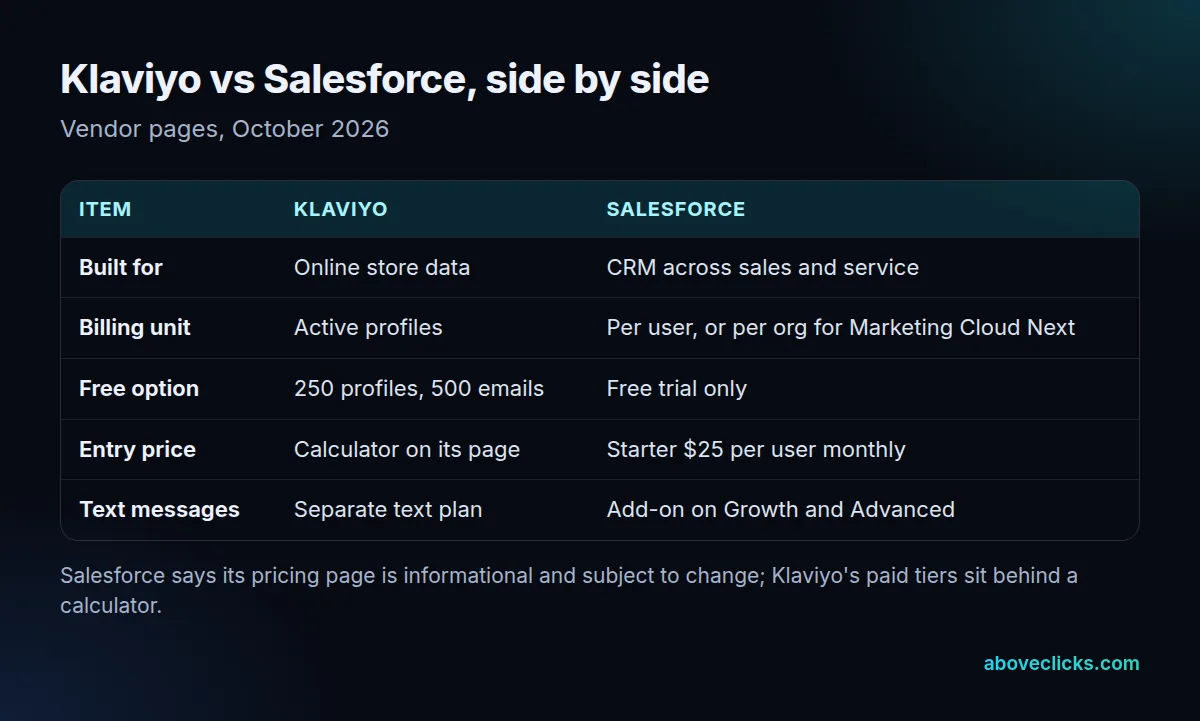
A feature grid makes the two look closer than they are. In a Klaviyo vs Salesforce decision, five mismatches change the bill or the workload, and each one can become a costly trap:
- Built for: Klaviyo calls itself the B2C CRM on its pricing page; Salesforce’s Starter lists lead, account, contact and opportunity management.
- Billing unit: Klaviyo bills active profiles; Salesforce bills per user, or per org for its Marketing Cloud Next editions.
- Free option: Klaviyo has a free plan of 250 active profiles and 500 emails a month; Salesforce offers trials.
- Entry price: as of October 2026, Salesforce publishes $25 per user monthly for Starter and $1,500 per org monthly for Growth.
- Text messages: Klaviyo bills text on a separate plan; Salesforce lists SMS as an add-on on Growth and Advanced.
Start your Klaviyo vs Salesforce comparison from your own store, not the grid. Write down how many contacts you hold, which system holds their orders, who will build the flows and whether you plan to text customers within 12 months. Those four answers settle most of the choice before you open a pricing page.
The same holds for any Klaviyo vs Salesforce Marketing Cloud search: reviews that rank the two on features alone skip the question of who runs the system each week. A tool that needs an admin or a partner for every new flow costs more than its license, and a tool your marketer can edit in an afternoon costs less.
Is Klaviyo a CRM?
Yes, in the sense that matters for a store: it keeps one profile per customer with orders, browsing and message history. It is not a sales CRM with deal stages, quotes and forecasts, which is where Salesforce is strong.
Klaviyo’s billing page says it connects with 400+ apps, and its Shopify guide describes bringing customer profile and order data into Klaviyo to target messages. That is the core of the product: a segment such as “bought twice in 90 days” comes from order data without a developer.
Salesforce reaches the same place from the other side. Its customer record starts as a lead or contact in sales or service, and marketing editions attach to that record. If your business sells to companies through a sales team and also runs a store, that shared record is the reason to look at Salesforce.
In a Salesforce Marketing Cloud vs Klaviyo test for a store, ask each vendor to build the same 3 flows from your real data: a welcome series, an abandoned checkout reminder and a win-back after 90 days. The time it takes and who has to be involved show the true cost of each.
How much does Salesforce Marketing Cloud cost?
As of October 2026, Salesforce lists Marketing Cloud Next Growth at $1,500 per org per month and Advanced at $3,250, both billed annually, on its editions pricing page. That page also says to contact sales for detailed pricing.
Salesforce Marketing Cloud pricing has three layers that a Klaviyo vs Salesforce Marketing Cloud comparison should count:
- The edition: as of October 2026, Starter is $25 per user monthly and Pro is $100 per user monthly, billed annually with a contract, while Growth and Advanced are per org.
- Add-ons: as of October 2026, SMS and WhatsApp are add-ons on Growth and Advanced, and the Campaign Agent starts at $60,000 per org per year.
- Help to run it: Salesforce lists its Standard Success Plan in all licenses; Premier is included with Core, Advanced and Max licenses.
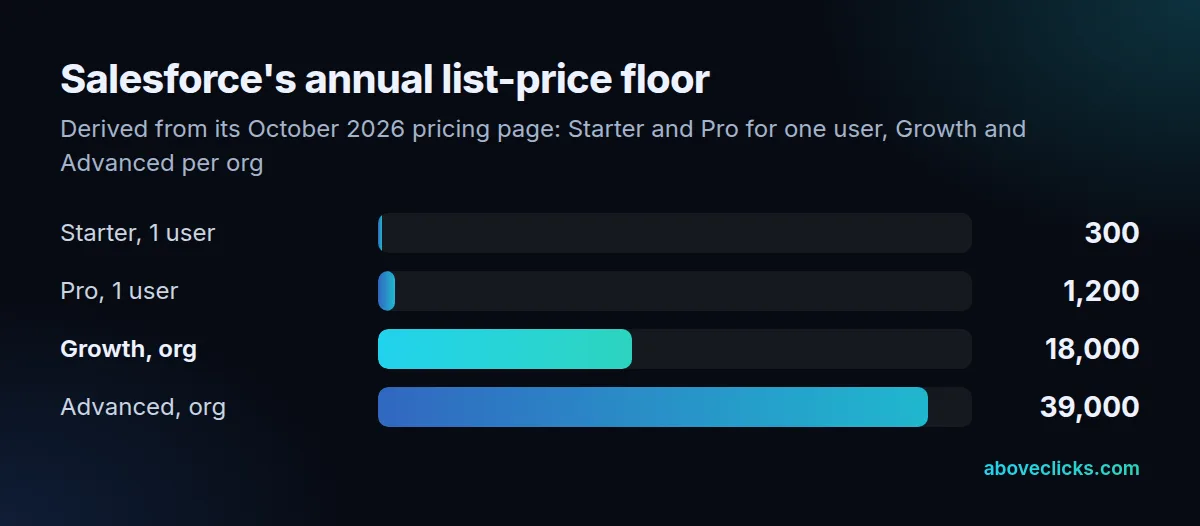
As of October 2026, the bars show the annual floor derived from Salesforce’s list prices: $25 times 12 is $300 and $100 times 12 is $1,200 for one user, while Growth is $1,500 times 12, or $18,000, per org. They are floors, not quotes, because add-ons, extra users and setup come on top. That floor is the first number in any Klaviyo vs Salesforce budget.
Here is a worked example with an invented store. Say email brings $9,000 of revenue a month. Growth at $1,500 monthly is 16.7% of that revenue ($1,500 divided by $9,000) before add-ons or setup. The same sum for your store tells you quickly whether Salesforce Marketing Cloud pricing fits your volume.
How does Klaviyo pricing work?
Klaviyo bills email plans on active profiles, with send capacity included. Its billing page says unsubscribed and suppressed contacts do not count, and text messaging is committed spend on a separate text plan.
The free plan, as of October 2026, covers up to 250 active profiles and 500 emails a month, plus $5 of mobile messages monthly, according to Klaviyo’s pricing page. Paid tiers sit behind a calculator that needs JavaScript, so we do not quote dollar figures; run your own profile count through it.
Because the unit is the reachable audience, list cleaning lowers the bill. Suppress 2,000 long-inactive profiles from a 12,000-profile list and the profile count that sets your tier drops. A per-org price such as Growth’s does not move when your list shrinks, which is the main difference in how the two scale.
For a wider view of what email costs a store, see our guide to email marketing cost. In the Klaviyo vs Salesforce price comparison, remember that Klaviyo’s number moves with your list each month, while the Salesforce edition price stays flat for the contract year.
Can Klaviyo and Salesforce work together?
They can run side by side, but we could not verify the connector for this guide. Klaviyo’s help search was blocked when we tried, and Salesforce’s Shopify integration page returned a 404, so we make no claim about which fields sync. Check the current documentation before you rely on it. A Klaviyo vs Salesforce setup with both systems live needs a named owner for the sync, or the two lists drift apart within weeks.
What matters more is the design. When both systems hold customers, pick one as the source for each fact: Salesforce for sales stage and account owner, Klaviyo for orders and email engagement. Keep one consent record per contact and copy it with the contact, so an unsubscribe in one place reaches the other.
A store that already pays for Salesforce for a B2B sales team often keeps Klaviyo for the consumer email and SMS program. A store with no sales team rarely needs both. Our Klaviyo vs HubSpot guide covers the same question for another CRM.
Which one fits a Shopify store?
For most Shopify stores, Klaviyo is the shorter path, because its Shopify integration is designed to bring profile and order data in from day one. Klaviyo’s Shopify guide says to disconnect any prior email service from Shopify first, or existing subscribers could receive double opt-in emails.
Abandoned checkouts show why the data feed matters: Shopify’s abandoned checkout help describes how a store recovers them, and a reminder flow needs that checkout event inside the email platform.
Salesforce can connect to a store too, but expect a partner or an admin to build the data model. We found no Salesforce page describing a Shopify integration for this guide, so ask for a written scope before you sign.
Deliverability matters on either platform. Google’s sender guidelines require senders of more than 5,000 messages a day to Gmail to authenticate with SPF and DKIM, keep the spam rate below 0.30% and offer one-click unsubscribe. Neither platform fixes a list that people did not agree to join. The FTC’s CAN-SPAM guide requires honoring opt-outs within 10 business days, so a switch must carry every unsubscribe across.
If you are weighing smaller tools too, our Brevo vs Klaviyo comparison and the list of Klaviyo alternatives cover them.
Which should you pick?
The short Klaviyo vs Salesforce answer: pick Klaviyo if your orders live in a store platform, a small team builds the flows and you want to pay for the reachable audience. Pick Salesforce if sales and service already run there and you need marketing on the same records.
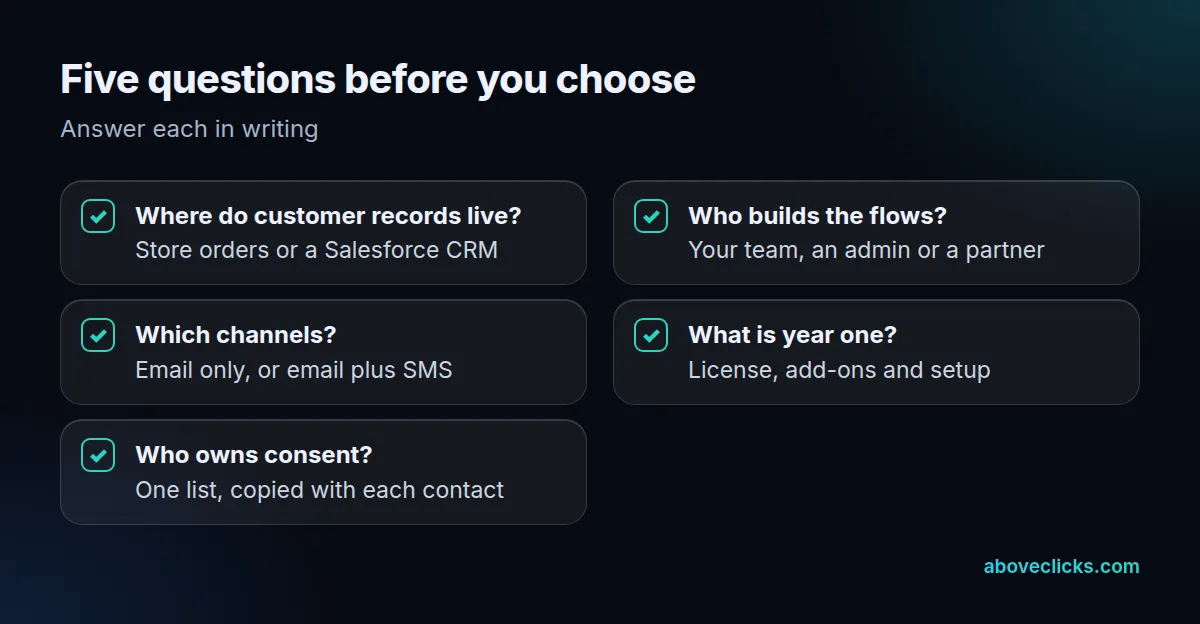
Weigh the Klaviyo vs Salesforce trade-off with a pilot, not a demo: ask each vendor for a written first-year quote and a 30-day test of one flow on your own data. Run the five questions in the checklist for your own Klaviyo vs Salesforce decision, then total year one: license, add-ons, setup and the hours of whoever builds the flows. A $18,000 license for Growth is a different decision from a plan sized to a few thousand profiles, even before either one sends a message.
If you are stuck between Klaviyo vs Salesforce, or already pay for both, our free audit reads it read-only and tells you what to fix first, and our Klaviyo email marketing service covers setup and migration. More comparisons are in the buying guides.