Real estate developer marketing is the work of selling a development’s units in phases, from a pre-launch waitlist to the last unsold homes. Plan it by phase, and set the budget by working back from units still to sell to the leads you need.
This guide covers the four phases, the digital channels that fit each, the project website, the advertising rules that limit targeting, a worked budget and the tracking that connects ads to reservations.
What is real estate developer marketing?
It is marketing for a project with a fixed number of units, a build timeline and a sales office, not for a single listing. The goal is reservations on a schedule, so the plan is judged on site visits and reservations, not only on enquiries.
That makes real estate developer marketing different from agent marketing. An agent can post a new listing every week; a developer has one product, one launch and one set of units that sell down, such as 48 units in a single building. Our guides on luxury real estate marketing and PPC for real estate cover listings and agents; this one covers the project.
One rule applies from the start. The Fair Housing Act protects people who are buying or renting a home from discrimination on 7 grounds: race, color, national origin, religion, sex, familial status and disability. Every ad, email and project page used in real estate developer marketing falls under it.
What does a real estate developer marketing strategy cover?
Four phases: a pre-launch waitlist, the launch, steady sales and final inventory. Each phase has one job, and a real estate developer marketing strategy that gives all four the same message and budget wastes most of it, and a strategy for a small project can fit on one page.
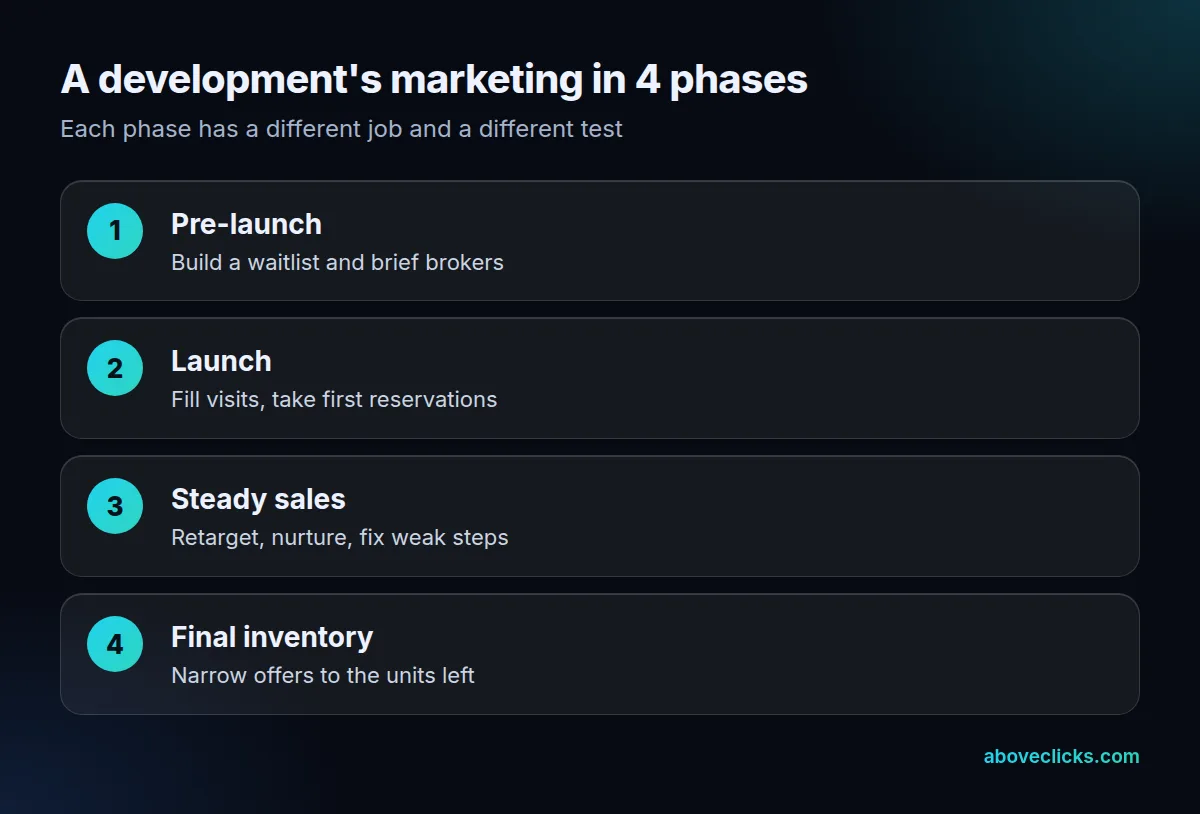
Pre-launch: build a list of interested buyers and brief the brokers who will sell alongside you. In the worked example below, 12 of 48 units are reserved before the public launch.
Launch: fill the first weeks of site visits and take the first reservations. This is where most of the budget goes.
Steady sales: retarget visitors, nurture older enquiries and fix the weakest step in the funnel. Sales slow here, and the cause is usually follow-up, not traffic.
Final inventory: narrow the offer to the units that are left, such as a corner unit or a floor plan that hasn’t sold.
The costly mistake in real estate developer marketing is judging every phase on lead volume. We check five things first on a property business: how many months pass between enquiry and booking, whether leads are qualified, whether housing ad rules are followed, whether site visits reach the ad platforms, and whether your own site offers something a portal doesn’t. A buyer may enquire in March and book in September, so a campaign judged on its first 30 days looks worse than it is.
Which digital marketing for real estate developers fits each phase?
Search and the project website suit pre-launch and launch demand, Meta lead ads suit launch and steady sales, and email and calls suit the long gap between enquiry and decision. Digital marketing for real estate developers works best when each channel has one phase and one test.
- Google Search: captures people already looking for homes in your area. Review the search terms report weekly: it shows the real searches that triggered your ads and gives ideas for page content.
- Meta lead ads and retargeting: reach people before they search. Meta says an ad set usually exits the learning phase after about 50 results in the week after its last significant edit, so avoid editing a launch campaign every few days.
- Email and messaging: keep the waitlist warm. Send what changed: construction progress, units released, a visit weekend.
- Broker and partner materials: a one-page project sheet and a shared availability link, so brokers don’t ask your sales team for the same details.
A project with 8 homes does not need all four. Digital marketing for real estate developers can start small: begin with the project page, Search and follow-up, and add Meta when the waitlist stops growing. Our real estate digital marketing page shows how we plan this by segment.
What does a real estate developer website need?
A project page that answers the buyer’s next question and a way to act on it: availability, floor plans, location, timeline and a visit booking. It has to give a buyer something a portal listing does not, such as live availability and construction updates.
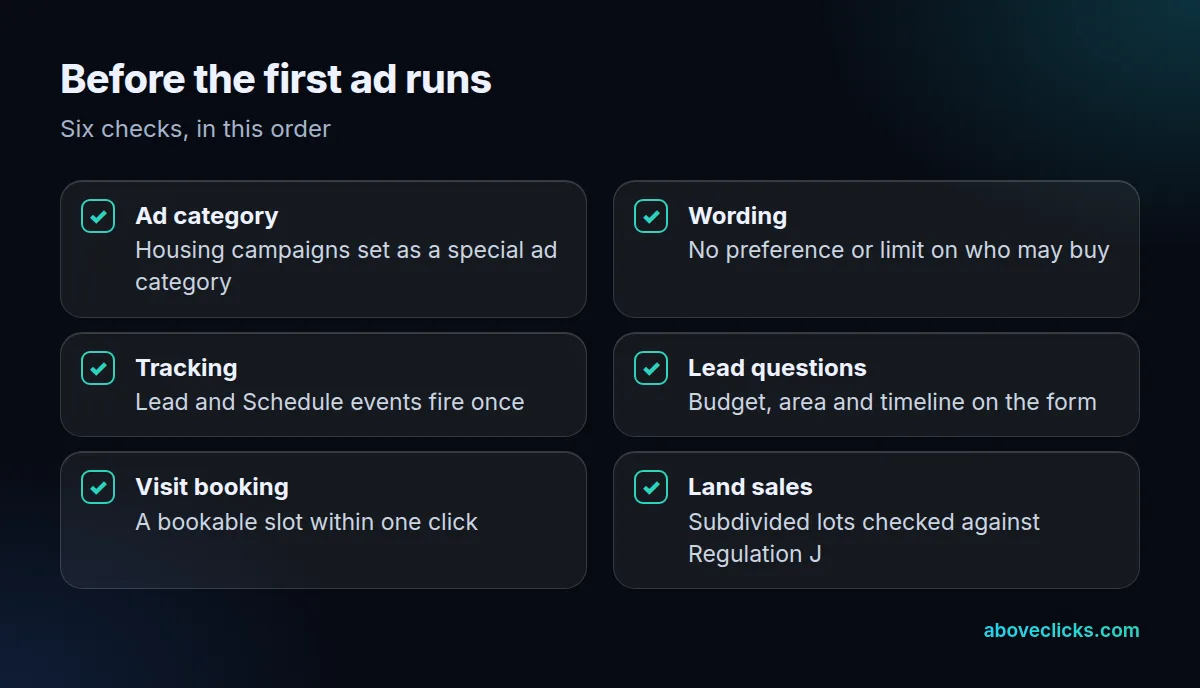
A real estate developer website should keep the enquiry form to 5 to 7 fields, short but not empty. Ask for budget, preferred unit type and move-in timing, because instant forms make enquiries cheap and a sales team can spend a day calling people who were never in the market.
Fire two events on the site. Meta’s Pixel reference defines Lead as a completed sign-up and Schedule as a person booking an appointment to visit one of your locations. Use Lead for the form and Schedule for the site visit, and fire each once.
Use one page per project, with its own address, instead of one page for the whole company. Buyers search for a project by name and area, and a page of its own can answer that search. Digital marketing for real estate developers starts with that page, because every ad and email sends people to it.
Which advertising rules apply to a new development?
Fair housing rules apply to the wording and the audience of any real estate developer marketing, and Meta limits targeting for housing ads. Subdivided land sales can add a federal registration rule.
Under 24 CFR 100.75, it is unlawful to publish an advertisement for the sale of a dwelling that indicates a preference or limitation based on race, color, religion, sex, handicap, familial status or national origin. The rule also covers selecting media or locations in a way that denies parts of the housing market information about the homes.
On Meta, you have to declare the campaign as a special ad category. For housing ads reaching the US, age, gender, ZIP code, exclusion targeting, lookalike audiences and saved audiences are unavailable, and city or pin-drop locations get an expanded radius. Plans built for ordinary ads break these limits, so build the audience around the project’s area and a broad reach.
Selling lots rather than finished homes? The CFPB’s Regulation J sets registration, disclosure and anti-fraud requirements for non-exempt lots in a subdivision, and it applies to developers and their agents. Ask your lawyer whether your lots are exempt before the first ad runs. This is general information, not legal advice.
How do you set a real estate developer marketing budget?
Work backwards from units still to sell. Divide the reservations you need by the lead-to-reservation rate to get the leads required, then multiply by your cost per lead, which is the sum most real estate developer marketing plans skip. A real estate developer marketing budget set this way can be checked against your own funnel.
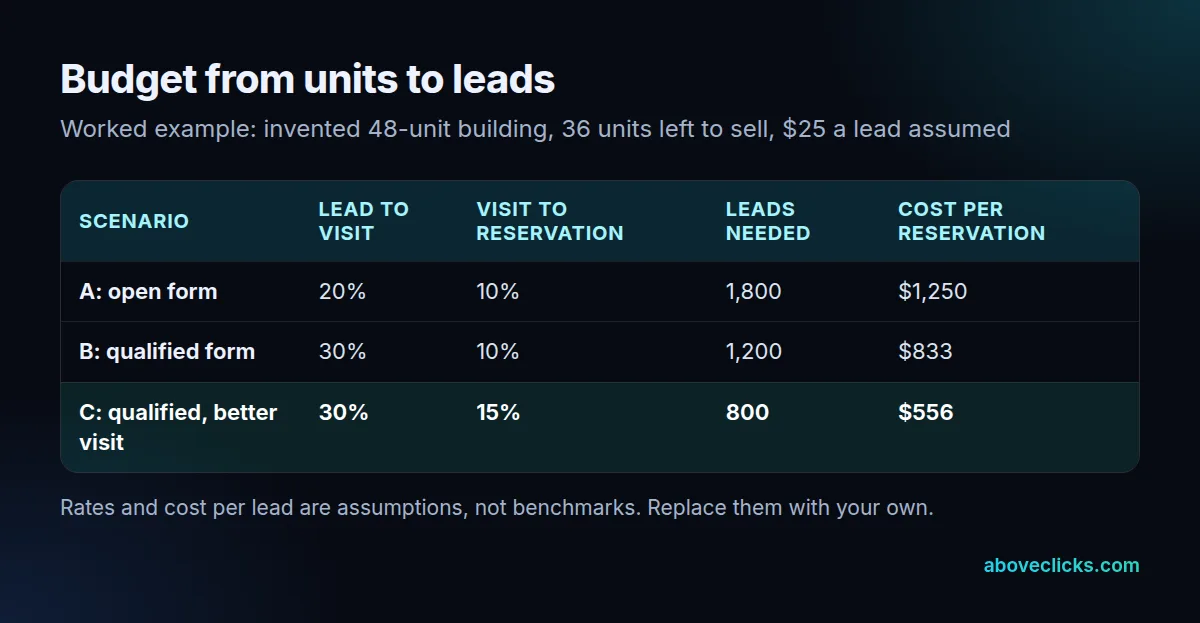
Example: an invented 48-unit building has 12 units reserved before launch, so 36 remain. We assume a cost of $25 a lead. In scenario A, 20% of leads book a visit and 10% of visits reserve, so 2 leads in 100 become reservations and 1,800 leads are needed: $45,000, or $1,250 per reservation.
Qualify the form so that 30% book a visit, and the same project needs 1,200 leads. Improve the visit itself so that 15% of visits reserve, and it needs 800 leads: $20,000, or $556 per reservation. The rates are assumptions, not benchmarks.
The point is where money is best spent. In this example, raising the visit rate saves more than buying cheaper leads, because every later step multiplies the leads you already have. Replace the three rates with your own after 30 days of data.
How do you track leads through to a reservation?
Give every lead a stage, and send the stage changes that matter back to the ad platforms. Without that, campaigns optimize for form fills while the sale happens in a sales office or on the phone.
Use five stages: lead, contacted, visit booked, visit held and reservation. Report each month how many leads reached each stage and how many days it took. That shows where buyers drop out, which a lead count alone can’t.
Then pass back the events you can trust. A booked visit is the Schedule event; a reservation can be uploaded as an offline conversion, or logged for your own reports if the platform setting is not available. Keep the lead-to-reservation rate on a dashboard next to cost per lead, because that pair sets the budget in the section above.
Reply speed matters too. Assign every new enquiry to a named person, aim to contact it within 24 hours, and review uncontacted leads each morning. Slow follow-up is the most common leak in real estate developer marketing, and no ad budget fixes it. Need a second opinion on the plan? Our free audit reads your project page, ads and lead quality, and our real estate marketing service covers the lead engine behind it. More guides are in industry marketing.