The cost to migrate Magento to Shopify is the migration quote plus the costs the quote leaves out: payment fees, overlap, replaced extensions and your team’s time. Add them all, then test the total with a break-even formula.
This guide lists the six lines, shows how Shopify’s third-party fee changes by plan, and works out the month the move pays back. The cost to migrate Magento to Shopify is easiest to judge once it is one number you can compare with what you pay today. For the hours budget behind the quote itself, see our Magento to Shopify migration cost guide.
What does the cost to migrate Magento to Shopify include beyond the quote?
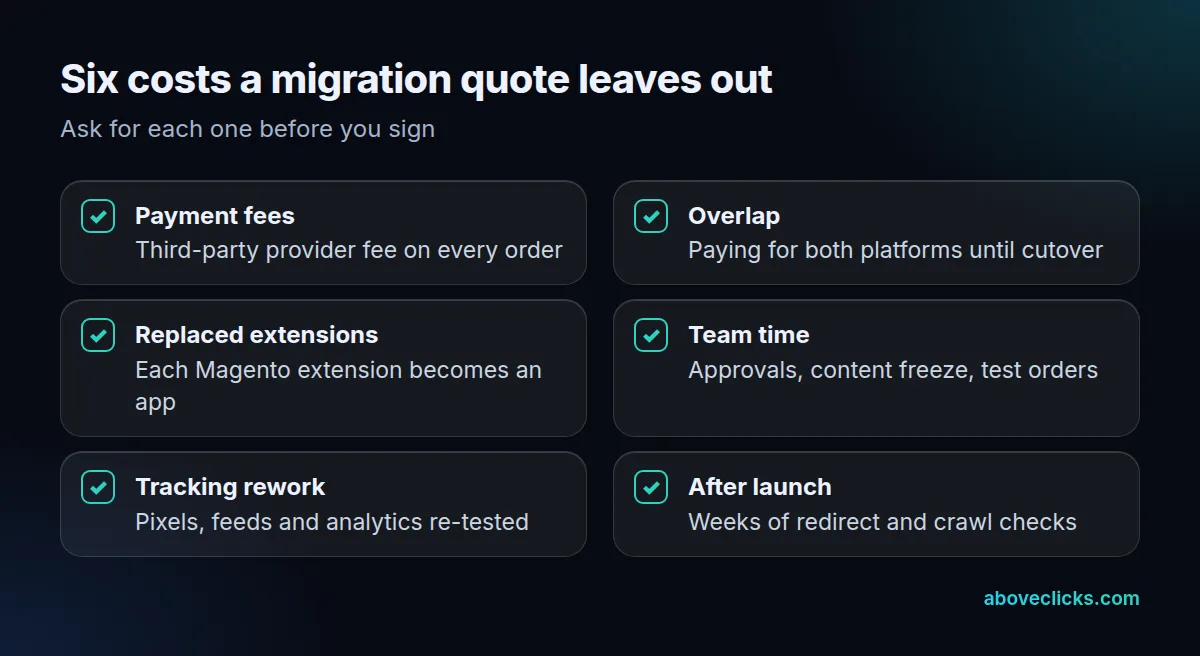
Six lines a quote usually leaves out: payment fees, overlap, replaced extensions, team time, tracking rework and post-launch checks. The quote covers the build; the rest comes from running a store on both sides of the move.
Start with scope, because it sets every line of the cost to migrate Magento to Shopify. Shopify’s migration guide suggests a migration is a good time to purge old, low-performing content, and says a catalog of 250 products likely needs a CSV file or an app. Every product or page you drop is one less line to build and test.
Then ask the provider to price the other six in writing. Many quotes cover data, theme and launch, and say nothing about the monthly bill that follows. The cost to migrate from Magento to Shopify is easy to under-count if you only read the first page of the quote.
Here is what each line means in practice:
- Payment fees: a monthly percentage of sales if you keep an outside provider, covered below.
- Overlap: the weeks when you pay for the new platform while the old one still runs.
- Replaced extensions: Magento extensions do not move over. Each one you rely on, such as reviews, subscriptions or wholesale pricing, needs a Shopify app or custom work, and most apps bill monthly.
- Team time: someone on your side approves designs, freezes catalog changes before the data move and places test orders.
- Tracking rework: ad pixels, product feeds and analytics have to be rebuilt and tested on the new store, or your ad reporting goes blind for a while.
- After launch: the weeks of redirect checks and crawl-error reviews, plus a possible short dip in sales.
Add a number to each line, even a rough one, and the cost to migrate Magento to Shopify stops being a surprise on the first invoice. The “replaced extensions” line is the one owners miss most often, because the old extensions were bought years ago and do not show up in any monthly bill. List every extension in your Magento admin and mark each one as keep, replace or drop.
A short dip in sales is a real cost too. Take an invented store with $50,000 of monthly sales that sees sales 10% lower for one month after launch. That is $5,000 of sales not made, which belongs in the one-time cost next to the quote.
How much do third-party payment fees add after you move?
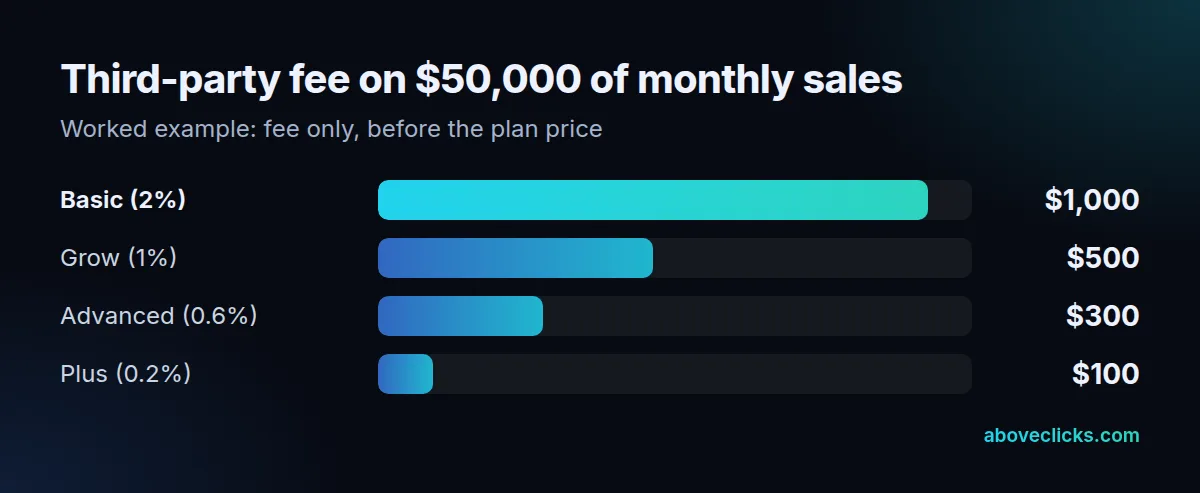
Shopify charges a transaction fee of 2% on Basic, 1% on Grow, 0.6% on Advanced and 0.2% on Plus when you keep an outside payment provider, as of November 2026, according to its pricing page. It is a monthly cost that grows with sales, so it belongs in any honest view of the cost to migrate Magento to Shopify.
Shopify’s payments documentation says you are not charged third-party transaction fees on orders processed through Shopify Payments, Shop Pay and Shop Pay Installments. It adds that fees do apply if you use Shopify Payments alongside a third-party provider. Availability depends on your country and business, so check before you assume the fee is zero.
Here is a worked example for an invented store with $50,000 of monthly sales that keeps its current gateway. The table adds the fee to the plan prices on Shopify’s pricing page, in its yearly view as of November 2026. It leaves out the gateway’s own card rates, which stay the same whatever the plan.
| Plan | Plan price per month | Fee on $50,000 | Total per month |
|---|---|---|---|
| Basic (2%) | $29 | $1,000 | $1,029 |
| Grow (1%) | $79 | $500 | $579 |
| Advanced (0.6%) | $299 | $300 | $599 |
| Plus (0.2%) | from $2,300 | $100 | from $2,400 |
In this example Grow is the cheapest, because its 1% rate saves $500 a month against Basic for $50 more on the plan, using the same figures as of November 2026 from Shopify’s pricing page. At $10,000 of monthly sales the fee on Basic is only $200, and Basic wins. The cost to migrate Magento to Shopify therefore depends on your sales, so rerun the table with your own figure. Switching plans later is possible, but the cheapest plan on day one is the cheapest only for the sales you have on day one.
What does running two platforms at once cost?
The overlap is part of the cost to migrate Magento to Shopify: you pay for both platforms until cutover: the Shopify plan during build and testing, and Magento hosting and support until the old store is safe to switch off. The overlap is short if you plan the cutover date early.
Shopify’s pricing page lists a free 3-day trial, then $1 a month for the first 3 months, as of November 2026. Its trial page says the length of a trial can vary, so check the current offer when you sign up. A build that takes longer than the trial simply moves onto a paid plan.
The old side is the larger line in the cost to migrate Magento to Shopify. Magento hosting, support contracts and developer retainers usually bill monthly, and some bill annually. Ask the dates of each, and set the launch so the old contracts end at a renewal date instead of a month after it.
Keep a read-only copy of Magento data until orders, redirects and tracking have been checked on Shopify. Budget those checks as a line: team time to place test orders, confirm tax and shipping, and review email flows. Shopify’s migration guide lists placing test orders as one of its seven steps, so it is not optional work to cut when the budget is tight. A store that takes 2 weeks to build and 2 more weeks to test pays for 4 weeks of overlap, not 2.
How long should you wait before judging the move?
At least a few weeks before you judge the cost to migrate Magento to Shopify against results. Google’s site move guide says to expect temporary ranking fluctuation, and that for medium-sized sites it can take a few weeks or more for Google to show the new URLs instead of the old ones.
Two rules from that page save money. First, change one thing at a time: if you also want a new domain or a new layout, do them as separate steps, not in the same launch. Second, plan the redirects before launch, because they carry the old addresses to the new ones. Our migration steps guide covers the order of work.
For the cost, the point is timing. If you judge the move in week one, a normal dip looks like a failure, and you may pay for rescue work you did not need. The dip is also why the sales-loss line in the cost to migrate Magento to Shopify uses one month of lower sales, not a permanent drop. Agree a review date 4 to 6 weeks after launch, and compare against the same weeks last year, not the week before. That gives Google the few weeks it says medium sites need, and keeps the cost to migrate from Magento to Shopify from being judged on a dip it already expected.
How do you work out the break-even month for the cost to migrate Magento to Shopify?
Divide the one-time cost by the monthly saving; the result tells you how long the cost to migrate Magento to Shopify takes to earn back. The one-time cost is the quote plus every line it leaves out; the monthly saving is what the old platform costs each month minus what the new one costs.
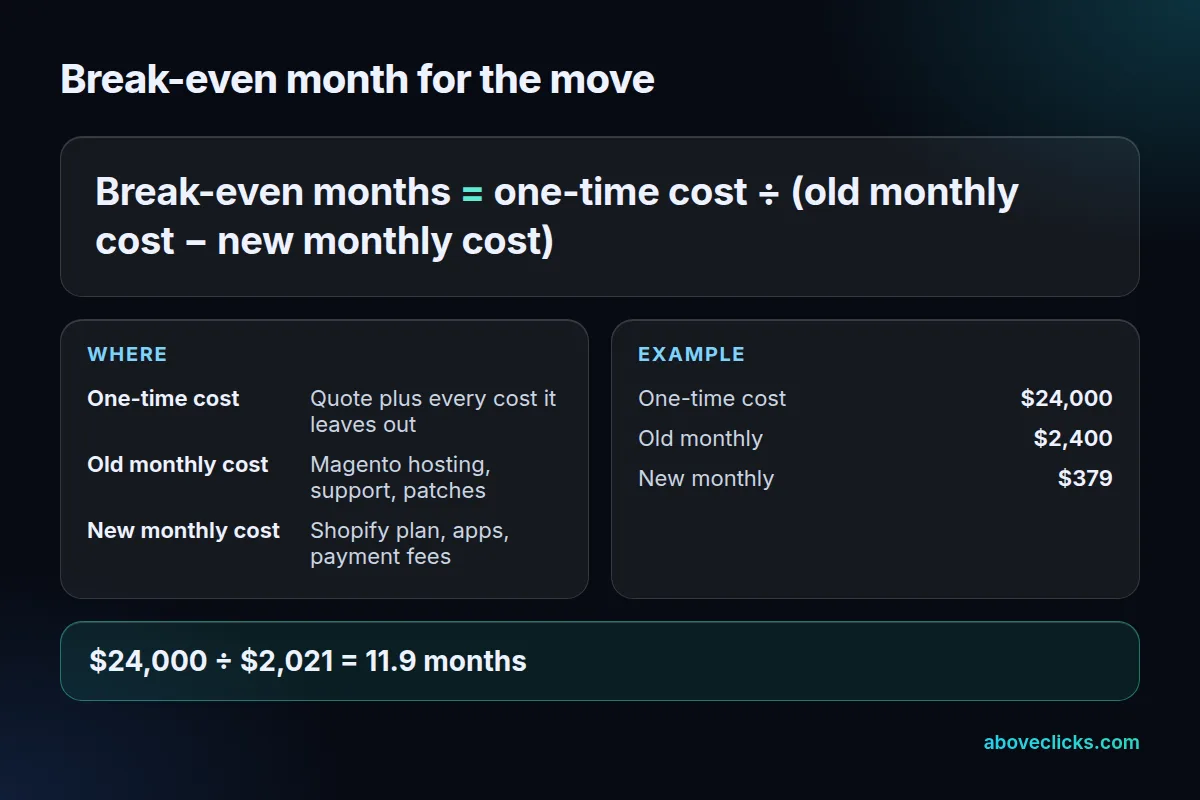
Take an invented store. The quote is $18,000, and the other lines add $6,000, so the one-time cost is $24,000. Magento hosting, support and patch work run $2,400 each month. On Shopify it pays $79 for Grow plus $300 for apps, and nothing extra for payments because it uses Shopify Payments, so $379 each month.
The saving is $2,400 − $379 = $2,021 each month, and $24,000 ÷ $2,021 is 11.9 months. If the same store kept a third-party gateway on Basic at $50,000 of monthly sales, the new monthly cost would be $1,029 plus apps, using the plan and rate figures from Shopify’s pricing page as of November 2026, and break-even would take much longer.
These numbers are invented to show the arithmetic. Your old monthly cost is the hard one, so pull twelve months of hosting, support, extension renewals and developer invoices before you start. If the saving is small, the case for moving rests on growth or on risk, not on cost, and that is a fair thing to say out loud. A break-even beyond 24 months deserves a hard look at what else the move buys. A break-even under 12 months, as in the example, makes the cost to migrate Magento to Shopify easy to defend to a partner or a board.
Does the end of Adobe Commerce support change the cost to migrate from Magento to Shopify?
It can change the timing, not the arithmetic of the cost to migrate from Magento to Shopify. Adobe says it offers a three-year standard support window from general availability for each Adobe Commerce version, and that the security-only period is migration time, not a long-term support tier.
The dates on Adobe’s lifecycle policy page show how close some versions are:
| Adobe Commerce version | End of standard support | End of extended support |
|---|---|---|
| 2.4.6 | August 11, 2026 | August 31, 2027 |
| 2.4.7 | May 31, 2027 | May 31, 2028 |
| 2.4.8 | May 31, 2028 | TBD |
That page covers Adobe Commerce. We have not checked Magento Open Source against it, so confirm your own edition and version with your host or developer.
If your version is near the end of support, the cost to migrate Magento to Shopify has to be set against the alternative, and the choice is not “migrate or stay free”. It is “migrate on your schedule or upgrade under a deadline”, and an upgrade has its own cost. Put the upgrade quote next to the migration total before you decide.
What should you do next?
Write the six lines into your quote request, rerun the fee table with your sales, and compute the break-even month from 12 months of real invoices. Doing this before you sign is the cheapest way to cap the cost to migrate Magento to Shopify. If the total looks wrong, ask the provider which lines are missing, not which line to cut.
If you want a second pair of eyes on the cost to migrate Magento to Shopify, our Shopify migration service starts from a written plan, and the free audit is an option if you are weighing a move at all. For the platform comparison itself, read Magento vs Shopify. More guides are in buying guides.