Brevo vs Klaviyo comes down to fit: Brevo suits low-volume senders and simple automation, while Klaviyo suits stores that run flows from order data. Compare what each platform bills for and caps before you compare features.
This guide uses each vendor’s own pricing and help pages, dates every plan detail, and says plainly where Brevo is the better fit. A note before we start: we set up and migrate Klaviyo accounts for online stores, so that is the platform we know best.
Brevo vs Klaviyo: what is the real difference?
Brevo began as an email sender and grew into a multichannel suite with email, SMS, chat and a sales tool. Klaviyo was built around store data, so its flows and segments start from orders and browsing. Both send campaigns, run automations and connect to Shopify.
A feature grid makes the two look closer than they are. In a Klaviyo vs Brevo decision, four differences change the bill or the workload, and each can turn into a costly trap:
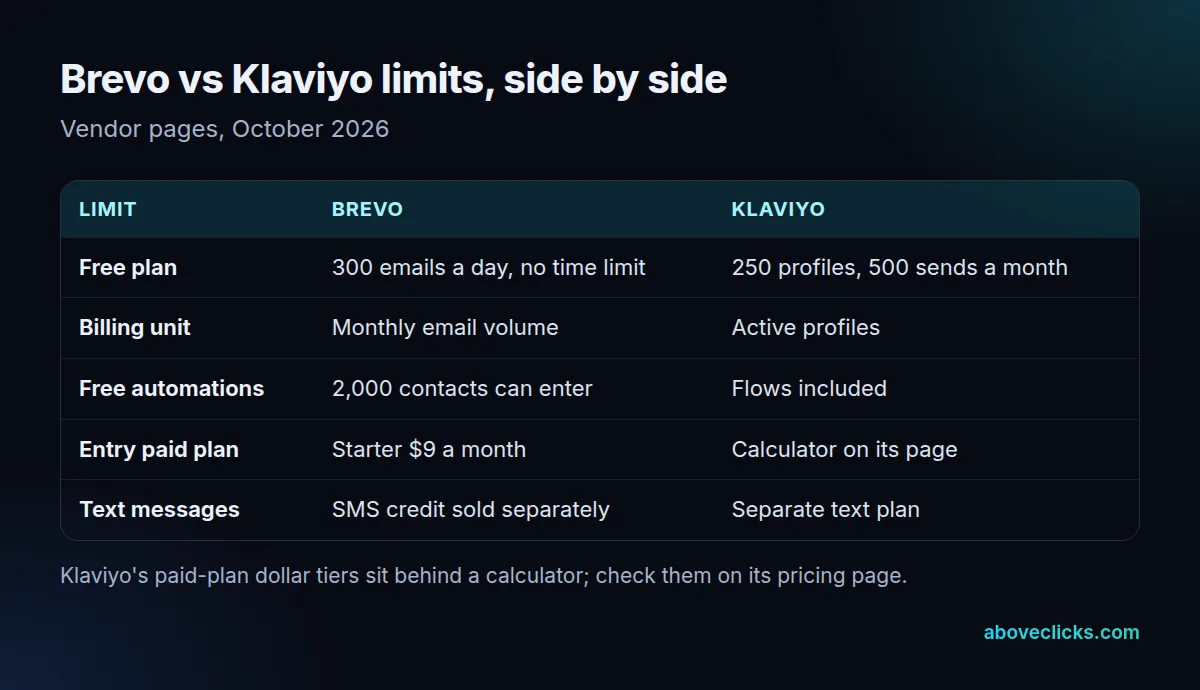
- Billing unit: Brevo’s plan is chosen by monthly email volume; Klaviyo bills active profiles with send capacity included.
- Free-plan cap: Brevo Free allows 300 emails a day; Klaviyo’s free plan allows 500 sends a month.
- Automation limits: Brevo Free lets 2,000 unique contacts enter automations; Klaviyo includes flows on every plan.
- Text messages: Brevo sells SMS credit separately; Klaviyo bills texts on a separate text plan.
Start the Brevo vs Klaviyo decision from your own store, not the grid. Write down how many contacts you hold, how many emails you send in a month, how much of last quarter’s email revenue came from automated flows, and whether you plan to text customers within 12 months. Those four answers settle most of the choice before you open a pricing page.
How do the Brevo and Klaviyo free plans compare?
They are built differently, as of October 2026. Brevo’s Free plan has no time limit and allows 300 email sends per day. Klaviyo’s free plan allows up to 250 active profiles and 500 email sends a month, according to its pricing page, with $5 of mobile messages a month.
In the Brevo vs Klaviyo free-plan comparison, read both carefully, because the Brevo free plan counts sends per day and the Klaviyo free plan counts them per month. Three details on the Brevo side matter for a store:
- A campaign to more than 300 recipients reaches only 300 contacts on the scheduled day. You resend with the Requeue option for the rest.
- You cannot schedule a campaign for the next day once you hit the daily limit.
- Up to 2,000 unique contacts can enter your active automations; after that, no new contacts enter.
On Klaviyo’s side, email support covers the first 60 days after sign-up, and sending is restricted once you pass 250 profiles or 500 sends. So the Brevo free plan suits a small, steady sender and the Klaviyo free plan suits a store that wants to build and test flows before it has a list.
How does each platform bill you?
Brevo’s pricing page sets the plan by monthly email volume, from 5,000 emails upward. As of October 2026 it lists Starter at $9 a month and Standard at $18 a month on monthly billing, with 10% off for yearly billing, and Professional at $499 a month from 150,000 emails.
Klaviyo works the other way round. Its billing page says plans are priced by active profiles, the people you can actually reach, with email send capacity included. Unsubscribed and suppressed contacts do not count toward billing. Text messages are committed spend on a separate text plan.
Here is a worked example with an invented list: 5,000 contacts, of which 800 have unsubscribed over the years. Klaviyo bills against 4,200 active profiles. On Brevo, a list that large costs the same until your monthly sends move into the next volume tier, so what you send matters more than who is on the list.
That is why a Brevo vs Klaviyo quote taken at one list size can mislead. Price both tools at the same contact count and the same monthly sends. We don’t state paid-plan dollar figures for Klaviyo, because its calculator is interactive and changes often. Our email marketing cost guide shows how to build that comparison for any platform.
Is Klaviyo better than Brevo for Shopify?
For most stores that rely on flows, yes, because its Shopify data is the foundation. For a store that mostly sends newsletters and a few automations, Brevo can be enough and costs less on its entry plans.
Brevo’s Shopify page lists real-time sync of customer data, purchase history and order status, abandoned cart recovery, post-purchase flows and segmentation by purchase history and lifetime value. So the gap is not that Brevo lacks the basics. It is how deep the order-data flows go, and which plan holds them.
The checkout flow is the test in any Brevo vs Klaviyo for Shopify comparison. Shopify treats a checkout as abandoned when it stays incomplete for more than 10 minutes after the customer gave an email address, per its abandoned checkout guide. Decide which tool sends the first recovery email and turn the other off, or customers receive the same reminder twice.
Connection steps matter when you move. Klaviyo’s Shopify guide tells migrating stores to disconnect the prior email app from Shopify first, because leaving it connected could send double opt-in emails to existing subscribers.
Which limits will you hit first?
In Brevo vs Klaviyo, the limits that matter are the ones you hit in month 3. On Brevo Free it is the 300-a-day cap. On Klaviyo it is the 250-profile ceiling.
Here is a worked example with an invented store: 4,000 contacts and 10 emails each a month, 40,000 sends. Thirty days of the Brevo free cap allow 9,000 emails (300 x 30). The store would be about 31,000 sends short, so it needs a paid plan before it sends anything meaningful.
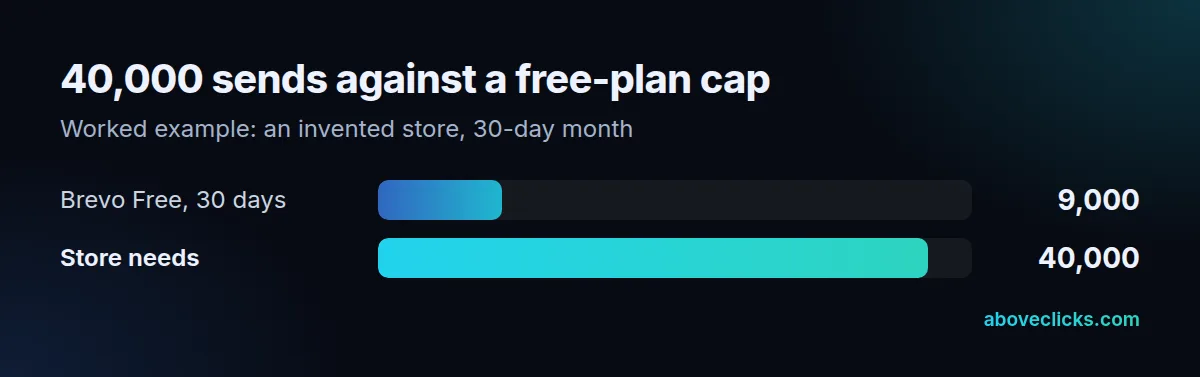
Use this formula for your own list: contacts x emails per contact per month, compared with your plan’s volume. Include flow emails, because welcome and checkout flows send every day.
Then test the feature you most want in your Klaviyo vs Brevo shortlist. Write down the segment you need, such as customers who ordered twice in 90 days and have not opened an email in 30 days. Check which plan builds it and whether it sits inside a flow. On Klaviyo that is a standard order-history filter. On Brevo, confirm the plan includes the automation and the A/B testing you expect, because the Free plan excludes email A/B testing, landing pages and popups.
Does the choice change your Gmail deliverability?
Not by itself: both platforms send through authenticated domains, and the rules below apply to you as the sender. In a Brevo vs Klaviyo comparison, deliverability depends mostly on your list quality and your domain setup, not on the logo in the footer.
Google’s sender guidelines say that if you send more than 5,000 messages a day to Gmail accounts you must set up SPF, DKIM and DMARC, keep the spam rate reported in Postmaster Tools below 0.30%, and support one-click unsubscribe in marketing messages. Google’s sender FAQ adds that one-click unsubscribe is required only for marketing and promotional messages, not for transactional ones such as password resets.
Most small stores sit below 5,000 messages a day, so these Brevo vs Klaviyo rules start as a checklist for later. They still shape the Klaviyo vs Brevo choice in two ways:
- A free or low plan on either tool often sends from shared infrastructure, so a few bad senders can affect everyone. Ask each vendor how it separates senders, and what a dedicated IP costs (Brevo lists dedicated IPs as not included on Free).
- Authenticate your own sending domain before the first campaign on either platform, so mailbox providers see your brand and not the vendor.
Clean your list before you move it. Send the first campaigns on the new tool to your most engaged subscribers, grow volume over 2 to 4 weeks, and watch bounces and complaints in the first sends before you mail the whole list.
Should you switch from Brevo to Klaviyo?
In the end, Brevo vs Klaviyo points to a switch when flows, order-based segments or texts would earn more than the move costs. Stay when you send mostly newsletters to a small list and your automations are a welcome email and little else.
A store with 400 contacts that sends once a month gains little from moving, and the migration time is better spent on the product pages. If the honest answer to “is Klaviyo better than Brevo for us” is “not yet”, revisit it when your list or your flows grow. For other pairs, see Omnisend vs Klaviyo and our Klaviyo alternatives.
If you move, order the work consent first, and allow more time for rebuilding and testing each flow than for importing the list:
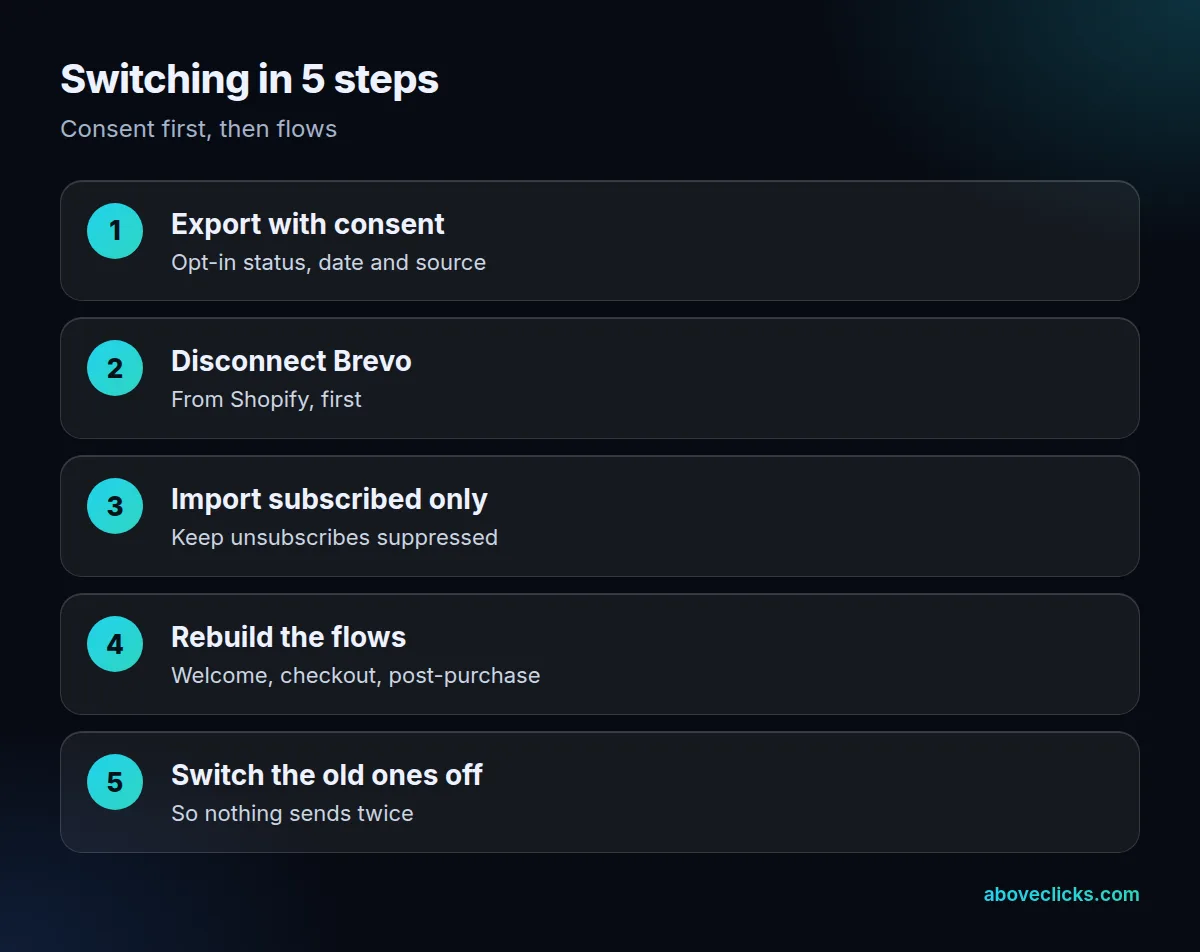
One rule applies on either platform. The FTC’s CAN-SPAM guide requires honoring opt-outs within 10 business days, with penalties up to $53,088 per violating email, so never re-import an address that has unsubscribed.
If you want a second opinion before you commit, our Klaviyo email marketing service covers setup and migration, and the free audit reviews your current setup. More comparisons are in buying guides.