Is Klaviyo a CRM? Yes by its own label, and no by the sales-team definition: it does the customer-record jobs a store needs but lists no deals or pipelines. Judge it job by job, not by the label.
This guide, which answers is klaviyo a crm in plain terms, tests 8 CRM jobs against Klaviyo’s own pages, works through a store example, and says when to add a second tool.
Is Klaviyo a CRM?
By Klaviyo’s own definition, yes. It launched its B2C CRM on February 20, 2025, bringing marketing, service and analytics onto one data layer.
Its CRM page lists 4 areas: marketing, service, analytics and a data platform. That is a customer-data CRM, built around shoppers. A sales CRM is a different thing: it tracks deals that a person moves through stages, as in HubSpot, where deal records carry Pipeline and Stage properties.
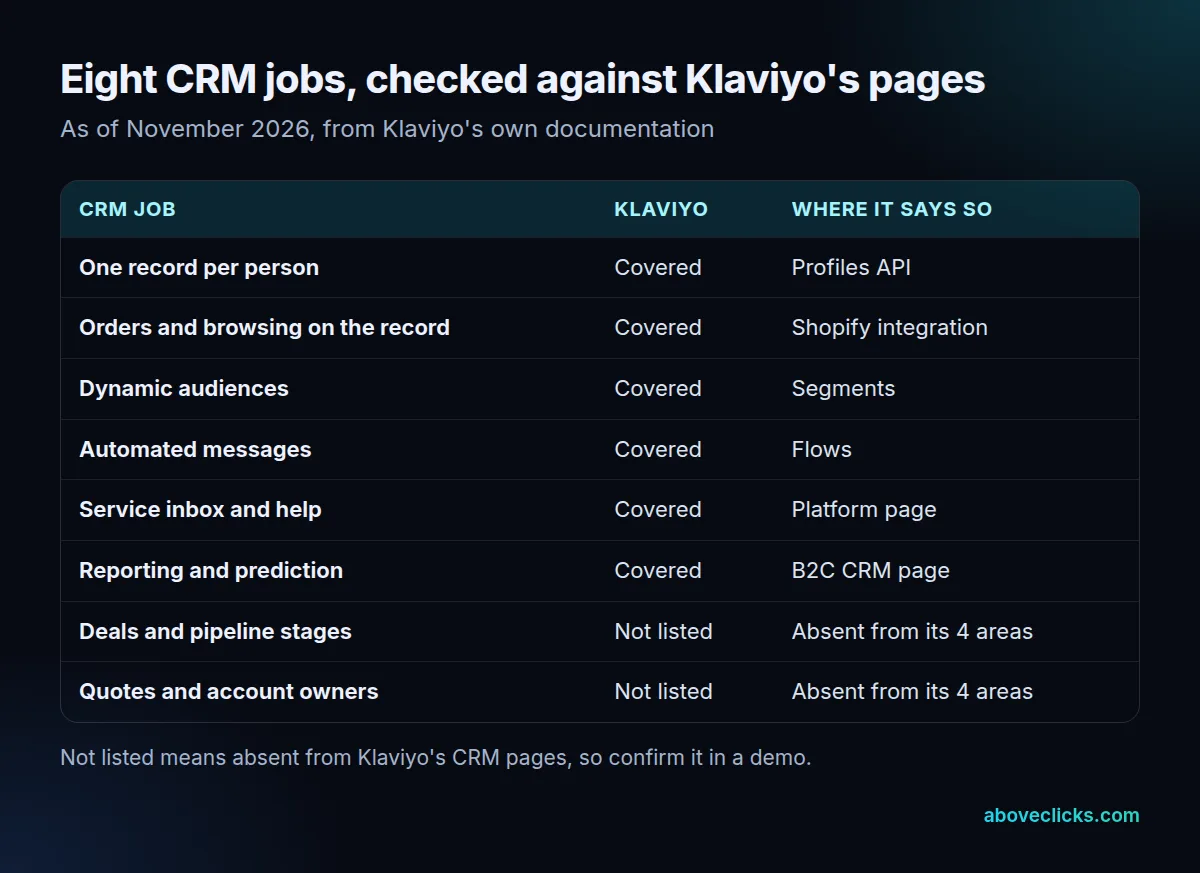
The table shows the split: 6 of the 8 jobs are covered, and the 2 that are not listed both belong to a sales team. If you searched is klaviyo a crm because a vendor said it was one, this is the practical answer. For a store with no sales team, is klaviyo a crm? Yes.
Here is what the six covered jobs mean in a store:
- One record per person: the profile holds the email, phone and custom fields, so a shopper is not split across tools.
- Orders and browsing: purchases and site activity are added to that profile as events.
- Dynamic audiences: segments such as “bought twice in 90 days” refresh on their own.
- Automated messages: flows send on triggers such as a started checkout.
- Service inbox: Klaviyo lists a Helpdesk, so support sees the same history.
- Reporting and prediction: its analytics area covers performance and likely repeat buyers.
The two jobs that are not listed, deal stages and quote ownership, only matter if a person closes your sales. Many online stores never need either, so answering is klaviyo a crm for your store starts with how your orders close.
Is Klaviyo a CRM or an ESP?
Both, so the question of is klaviyo a crm or an ESP has no either-or answer. It started as an email and SMS platform (an ESP), and the profile behind each message is the CRM part. Klaviyo keeps one record per person, so every email, text and order lands on it.
Klaviyo’s Profiles API shows how that record works. A profile needs at least 1 of 3 identifiers: an email (up to 100 characters), a phone number or an external ID. You can add custom fields and use them for segments, flows and personalization.
Two features make the record useful:
- Segments are dynamic groups. Klaviyo says they update in close to real time, unlike static lists.
- Flows are automated sequences. Klaviyo’s flows guide says a trigger can be a sign-up, a started checkout or a birthday.
An ESP only sends. A CRM keeps the history and decides who gets what, and Klaviyo does both for store customers. Whether is klaviyo crm enough for you depends on the jobs outside the table, so keep that list in front of you while you read on.
Is Klaviyo a CRM or a CDP?
It says it is a CRM that contains its own CDP, so the is klaviyo a crm or a CDP question gets one answer: both, in one product. Klaviyo’s launch post calls the data layer the Klaviyo Data Platform and describes it as embedded, unlike standalone customer data platforms.
That data layer is fed by integrations. Klaviyo says it has 350+ pre-built integrations. The one most stores use is Shopify: Klaviyo’s Shopify guide says it brings customer profile and order data in, and it can create customers in Shopify for Klaviyo profiles.
Shopify keeps its own list too. Its customer article says a profile is created when someone signs up, places an order or abandons a checkout, with one email per profile. So a store has 2 customer lists, and the sync settings decide which one is the master. Pick the master before launch, because merging 2 lists later is slow.
Is Klaviyo a good CRM?
For a store whose orders close at the checkout, yes. Is Klaviyo a good CRM there? It covers the jobs that store has. For a team that closes sales through calls and quotes, it is only half of what they need.
Worked example, with an invented store: a skincare brand has 12,000 customers and sells only online. Its jobs are repeat orders, replenishment reminders and support questions. Klaviyo covers all three, so a second CRM would add cost and a second list. Now add a wholesale arm with 30 salon accounts that order by quote. Those accounts need deal stages and a named owner, which are the 2 jobs the table marks not listed.
Klaviyo also lists a service side. Its platform page names a Helpdesk and a Customer Agent that answer from the same profile data, which covers the support job for many stores. Treat the vendor’s speed claims as its own, and test the inbox with a few real tickets before you rely on it.
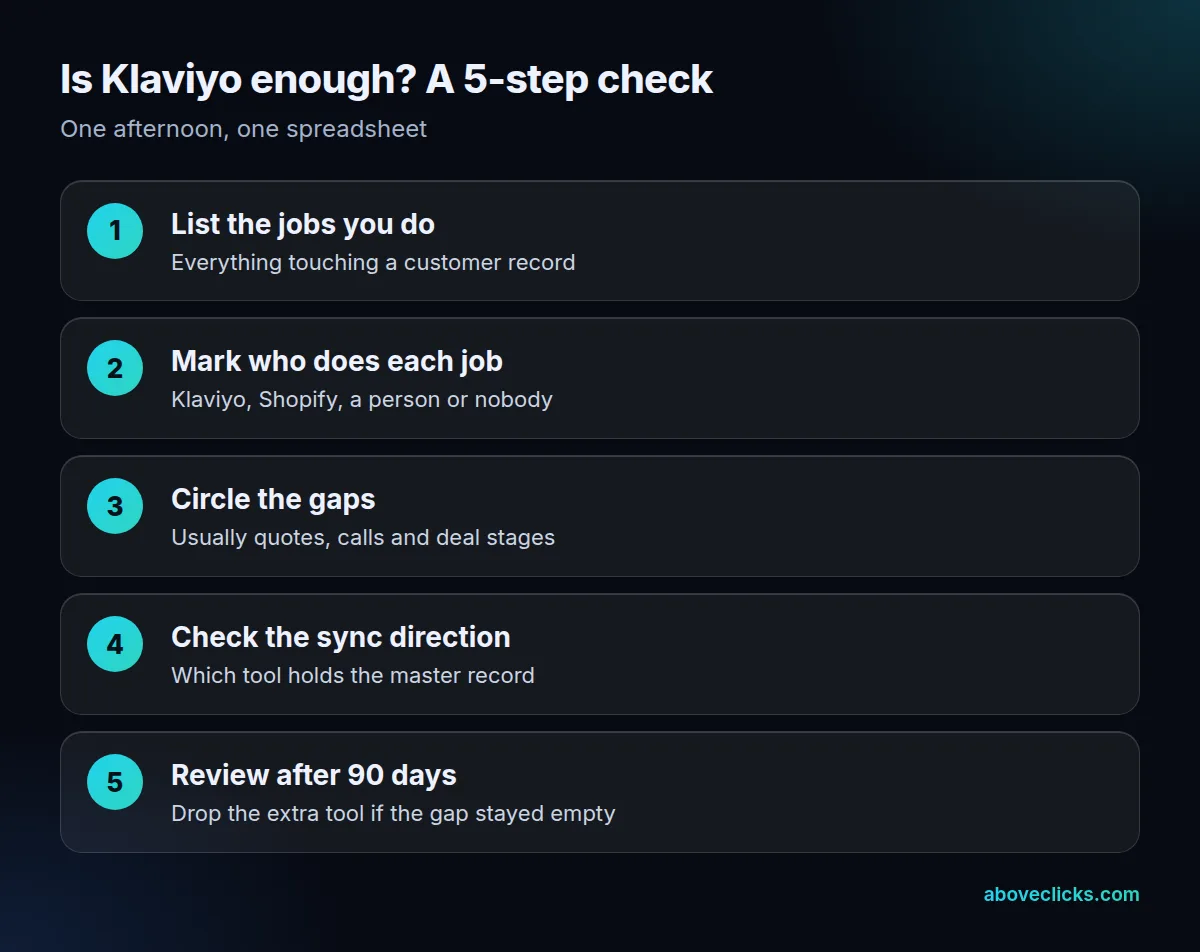
Run the check in one afternoon; it shows whether Klaviyo CRM is enough for your own store. We follow the same order when we audit a Klaviyo account: the Klaviyo service page lists the audit within 2 workdays, fixes and first flows in 1 to 2 weeks, and the first monthly report after 30 days.
Does Klaviyo have a CRM for B2B stores?
Partly. Is Klaviyo a CRM for business buyers? Klaviyo describes its CRM as built for consumer brands, so a business-to-business store gets the customer record and the messaging but not the sales tools.
A wholesale buyer can sit in Klaviyo as a profile with custom fields, such as company name and account tier. Segments can then send trade offers to those profiles only. What Klaviyo’s four listed areas do not include is a place to log a quote, assign an account owner or move a deal from stage to stage.
Worked example, with an invented store: a hardware seller has 4,000 retail customers and 150 trade accounts. Klaviyo holds all 4,150 profiles and sends the trade catalog to the 150. The sales lead keeps quotes in a sales CRM. The two tools share only the email address and the order total.
How does Klaviyo CRM pricing work?
By active profiles, not by users. Klaviyo’s billing article counts any profile that can be emailed and is not suppressed, whatever its consent status.
That includes a shopper who typed an email at checkout and never opted in. A phone number alone does not count toward the Profiles and Email plan. The article’s own example: with 7,000 active profiles, your plan must allow at least 7,000.
Is Klaviyo CRM pricing tied to list size? Yes, so your CRM data is your bill, and a bigger customer list always costs more. Before you load old contacts into Klaviyo, clean the list; suppressed email profiles stop counting once suppression is processed. We don’t quote plan prices here because they change, so read Klaviyo’s page on the day you decide.
When do you need a second CRM?
When people close orders through a person, not a checkout, a second CRM earns its place. If quotes, terms or account managers are part of your sales, add a sales CRM and let Klaviyo keep the marketing record.
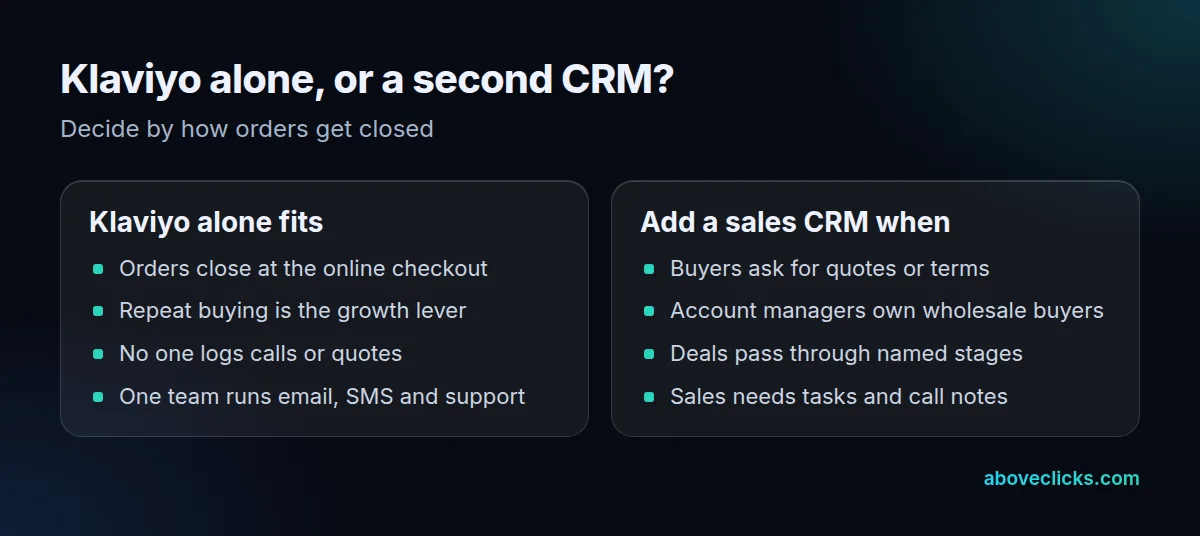
Pair them with a plan for the sync. Decide which tool owns each field, send orders and consent from Klaviyo or Shopify to the sales CRM, and send deal stages back only if flows need them. Klaviyo says its integrations connect to other CRMs, but check field-level sync in a demo first.
Our guides compare Klaviyo against both big sales suites: Klaviyo vs HubSpot covers contacts and send limits, and Klaviyo vs Salesforce covers per-org pricing. If you are still asking is klaviyo a crm for your store, or is klaviyo crm enough for your jobs, our free audit reviews your Klaviyo setup in writing. More choices are in buying guides.