Email marketing cost has five parts, and the cheapest plan price is usually the smallest of them. The tool, the list, the sends, the flows and the people each add to the monthly total. This guide to email marketing cost prices all five, so you can compare tools and help on equal terms.
Most guides to email marketing cost quote one number for email marketing cost: the starting price of a tool. That number misleads because it assumes a small list, few sends and no help. A growing list changes the tool price, a weekly campaign changes the send price, and a set of flows changes the tier you need. Before you pick a tool or hire help, price the whole job on email marketing cost, not the headline plan. The five drivers below show you how.
What makes up the cost of email marketing?
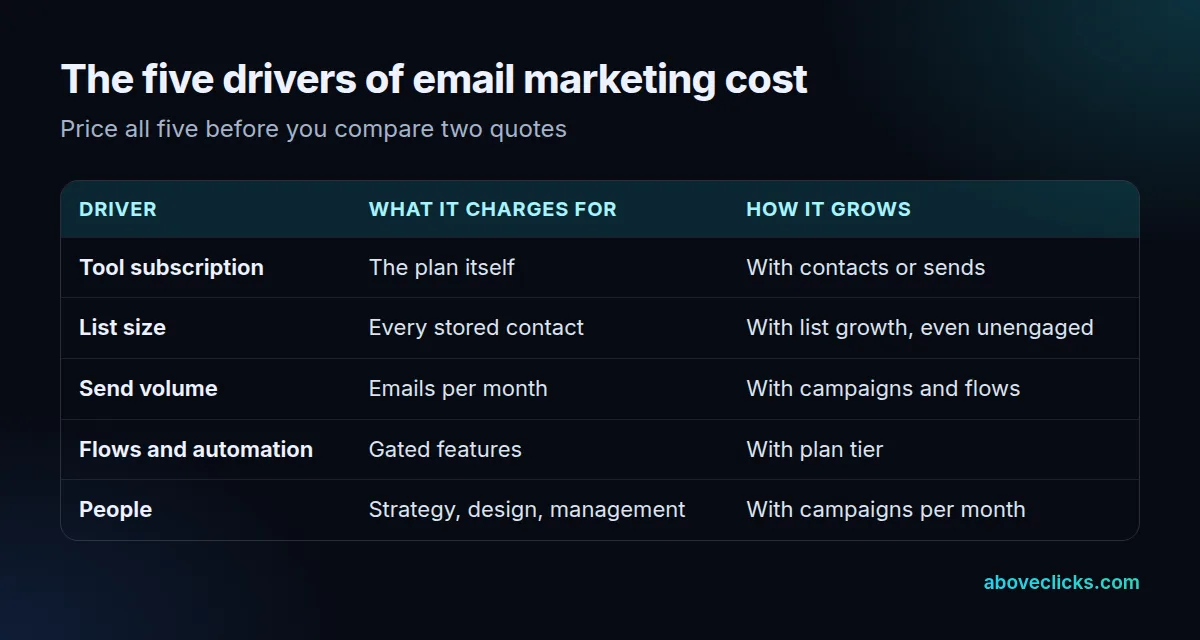
The cost of email marketing is made of the tool, the list, the sends, the flows and the people, and each driver grows differently, as of October 2026. (Guide)
The tool subscription is the first driver of email marketing cost. Every major tool sells tiers: a free tier with hard limits, then paid tiers that open up sends, flows and support. The tier you need depends on the other four drivers, which is why comparing starting prices alone tells you little.
A $9 plan that caps automation can cost more in lost sales than a $20 plan that includes the flows that earn. Treat those starting prices as planning figures, as of October 2026, and check how the tool itself bills before buying: Klaviyo, for example, bills by active profile, as its billing guide explains, and its flows guide lists welcome, abandoned cart and post-purchase flows as the ones to set live first.
List size is the second driver, and the one that surprises most buyers. Contact-based tools charge for every stored contact, profile-based tools charge for every emailable profile, and send-based tools charge for emails sent regardless of list size. That difference means the same audience can sit in different price bands on different tools, which is the heart of email marketing cost. A list that grows by 1,000 contacts a month will outgrow its tier on a contact-based tool even if its campaigns never change. On a profile-based tool the same growth is measured in active profiles, as Klaviyo’s active profile guide explains.
Send volume is the third driver. Some plans cap monthly sends at a multiple of your contacts: ten times on one tier, twelve times on another, fifteen times on a premium tier. A store that mails daily will hit that cap long before a business that mails monthly, even on the same list size. Flows add sends on top of campaigns: a welcome series, an abandoned cart series and a post-purchase series send emails every day without anyone pressing send. At high volume, sender rules also bite: Google treats a sender as a bulk sender at close to 5,000 messages a day to personal Gmail accounts, as its sender guidelines FAQ explains.
Flows and automation are the fourth driver of email marketing cost. Basic tiers cap flow steps or flow counts, while higher tiers give access to unlimited steps, branching and predictive segments. If your revenue depends on flows, the tier that includes them is the honest starting point, not the cheapest tier that excludes them. People are the fifth driver: the strategist, copywriter, designer and manager, whether in-house, freelance or agency. For most growing businesses, people cost more than the tool, and that gap widens as campaigns multiply.
How much does an email tool cost at your list size?
An email tool costs $13 to $20 a month at 500 contacts on the major contact-based tools, rising to about $110 to $150 at 10,000 contacts, as of October 2026. (Pricing)
Start with the best-documented ladder in email marketing cost. Mailchimp’s pricing page sets the structure: a free plan of 250 contacts and 500 sends a month, Essentials with sends up to ten times your contacts, Standard with twelve times, and Premium with fifteen times, as of October 2026, according to its pricing page.
The dollar figures did not render on the vendor page during our check, so the prices below are corroborated across two October 2026 pricing summaries that agree: Essentials starts at $13 and Standard at $20 for 500 contacts, rising to $75 and $100 at 5,000 contacts, and $110 and $135 at 10,000 contacts, as of October 2026, according to the pricing summary. Treat those as indicative vendor prices to confirm on the live page before buying.
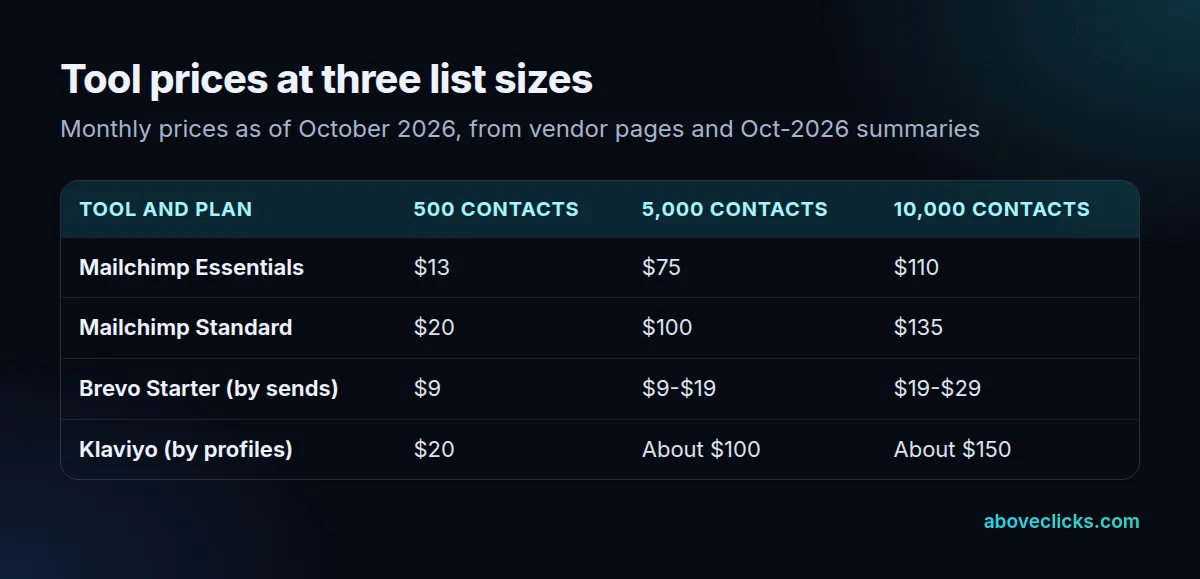
Brevo prices the other way, which is why it belongs in any email marketing cost comparison. Its pricing page lists Starter at $9 a month for 5,000 emails and Standard at $18, with SMS credits sold separately, as of October 2026, according to its pricing page. Because Brevo bills by sends rather than contacts, a large list mailed rarely can cost far less here than on a contact-based tool, while a small list mailed daily can cost more. That inversion is the point: the cheapest tool depends on your send pattern, not on the starting price.
Klaviyo prices by active profile, and its pricing page confirms the free plan: up to 250 profiles, 500 emails a month, $5 of mobile messages and $5 of Composer usage, as of October 2026, according to its pricing page. Corroborated October 2026 summaries put its paid price near $20 at 500 profiles, about $100 at 5,000 and about $150 at 10,000, as of October 2026, according to a pricing check that read vendor pages on 20 October 2026. Use those figures as indicative, and confirm the live price for your profile count before committing, since Klaviyo’s calculator prices vary by profile band.
Worked example, labelled illustrative: a business with 5,000 contacts sending one campaign a week, about 20,000 emails a month plus flows. On a contact-based Standard plan at $100, the sends fit within twelve times contacts, or 60,000 sends. On a send-based Starter plan, 20,000 emails a month needs a larger send bundle than the 5,000-email base. That comparison is the whole of email marketing cost in one paragraph: the same business, the same campaigns, and a different bill on each billing model, as of October 2026. Klaviyo’s campaigns library shows the same split in practice, with campaign templates organised by channel and goal.
Why does the same list cost different amounts?
The same list costs different amounts because tools count different people: subscribed, unsubscribed, non-subscribed and bounced contacts are treated differently, as of October 2026. (Pricing)
Mailchimp’s contact count is the clearest example in email marketing cost. Its pricing structure counts contacts in the audience toward the plan limit, and unsubscribed contacts count unless you archive them, as of October 2026, according to its contacts help page. A list of 10,000 names with 2,000 unsubscribed therefore bills as 10,000, while only 8,000 can receive mail. Archiving the unsubscribed drops the billed count, and that single housekeeping job can drop the tier. Keeping unsubscribed contacts out of sends is also a deliverability rule, not just a billing one: Google’s bulk email best practices advise getting clear consent and giving recipients a way to unsubscribe.
Klaviyo counts active profiles instead, which is a different rule with a different effect. Profiles that no longer provide value can be suppressed so they stop counting, as of October 2026, according to its pricing page. Klaviyo’s own help says the same thing directly: suppressed profiles do not count toward the email plan’s active profile limit, as its suppressed profiles guide explains. The practical difference for email marketing cost is this: on a contact-based tool, list hygiene saves money by archiving; on a profile-based tool, it saves money by suppressing. Both jobs are free, both take an afternoon, and both are skipped by most businesses until the bill jumps a tier.
Send-based billing adds a third rule. Brevo’s Starter plan covers 5,000 emails a month, and larger send volumes move you to larger bundles, as of October 2026, according to its pricing page. A list that doubles but mails half as often may cost nothing extra here, while the same growth doubles the bill on a contact-based tool. Before you compare email marketing prices, count three numbers: billed contacts, reachable contacts, and emails per month. Any quote that uses only one of them is incomplete.
What does an email agency or freelancer cost?
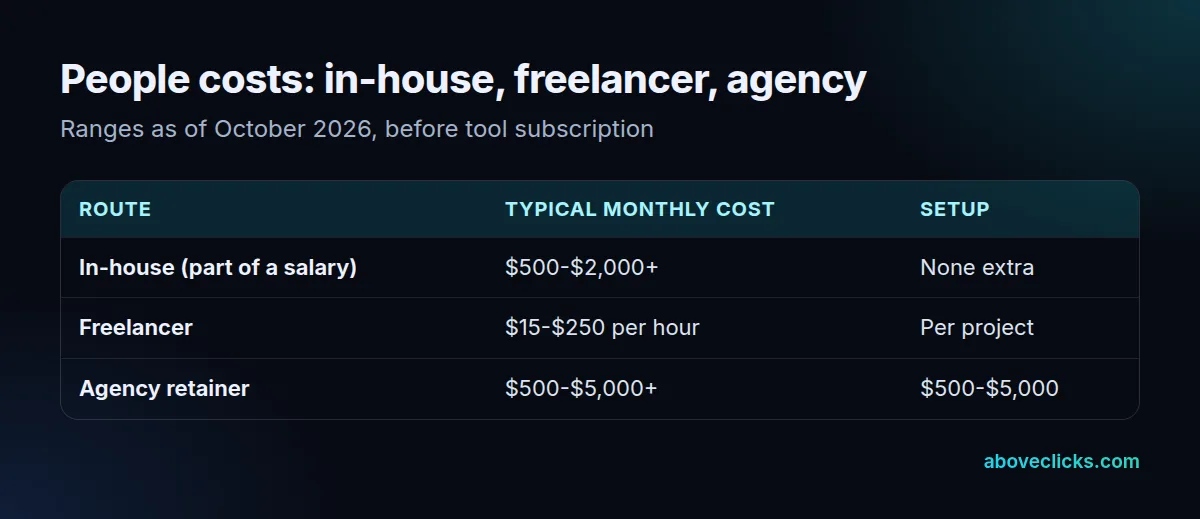
An email agency typically costs $500 to $5,000 a month plus a setup fee, while a freelancer charges $15 to $250 an hour, as of October 2026. (Guide)
Agency retainers in email marketing cost guides cluster in that $500 to $5,000 range, with smaller businesses often paying $1,000 to $3,000 a month, as of October 2026, according to the pricing guide. A second guide puts setup fees at $500 to $5,000 depending on campaign complexity, monthly retainers from $500 to $5,000 or more, and one-off campaigns at $1,000 to $10,000, as of October 2026, according to its pricing guide. The range is wide because the scope is wide: a retainer may cover strategy, design, flows, campaigns and reporting, or only campaigns.
A freelancer suits a narrower job in email marketing cost, and that is where email marketing cost stays lowest for a single project: one flow build, one template set, or one campaign a month.
Hourly rates from $15 to $250 reflect experience and scope, as of October 2026, from the same pricing guide. At $100 an hour, eight hours a month costs $800, which is close to a small agency retainer but buys one person instead of a team. In-house cost is the salary slice: a marketer who spends a quarter of their time on email costs a quarter of their loaded salary, plus the tool subscription. That route is cheapest when email is one channel among several, and most expensive when it needs a specialist the team does not have.
Choose the route by volume, not by hourly rate, for email marketing cost. One campaign a month fits a freelancer. Weekly campaigns plus flows fit a retainer or a dedicated in-house owner. Daily campaigns across segments fit an agency team. The wrong route costs twice: once in fees, and once in campaigns that never get built because no one owns them.
What hidden costs push the bill up?
Hidden costs that push the bill up are overages, add-ons, SMS credits and branding removal, and they appear after the plan price, as of October 2026. (Pricing)
Overages are the first hidden driver of email marketing cost. Passing a contact or send limit triggers extra charges on paid plans, or pauses sending on free plans. A campaign that goes viral, a list import that pushes you over a tier boundary, or a flow that sends more than expected can each trigger an overage in the same month.
Set an alert at 80 percent of your contact and send limits, as of October 2026, to control email marketing cost, and treat an overage as a signal to clean the list or move tier, not as a one-off charge to absorb. Cleaning the list is a defined job on a profile-based tool too: Klaviyo’s list cleaning guide walks through building a never-engaged segment and suppressing its members.
Add-ons are the second hidden driver. SMS credits are sold separately on several tools: Brevo’s pricing page lists SMS credits as sold separately, with branding removal as a $10.80-a-month add-on on Starter, as of October 2026, according to its pricing page. Transactional email, extra seats, dedicated sending domains and advanced reporting are also commonly add-ons. Price them before you pick a tier, because a $9 plan with $30 of add-ons is a $39 plan. SMS and email can also run together in one account: Klaviyo’s email and SMS guide shows SMS campaigns sent ahead of email, or with exclusive content, for subscribers who consented to SMS.
Branding removal deserves its own line in email marketing cost. Free and starter tiers often add the tool’s branding to your emails, and removing it is a paid add-on. That is a fair trade for a free plan, but it means the cheapest plan price is not the price of a professional-looking email. If branding matters to you, add the removal fee to every starter-tier comparison before you judge it.
How do you cut email marketing cost without cutting results?
You cut email marketing cost without cutting results by cleaning the list first, then matching the billing model to your send pattern, as of October 2026. (Guide)
Here is the method we use when costing email before recommending a tool or a retainer: first, billed contacts versus reachable contacts; second, sends per month including flows; third, flows live today; fourth, SMS need. That audit order matters, because it finds the cheapest cut first. Cleaning the list can drop a tier without changing a single campaign, while switching tools without cleaning it carries the same inflated count to the new tool. Two Klaviyo help guides cover that cleaning step directly: one on removing suppressed profiles from a list and one on identifying an inactive segment.
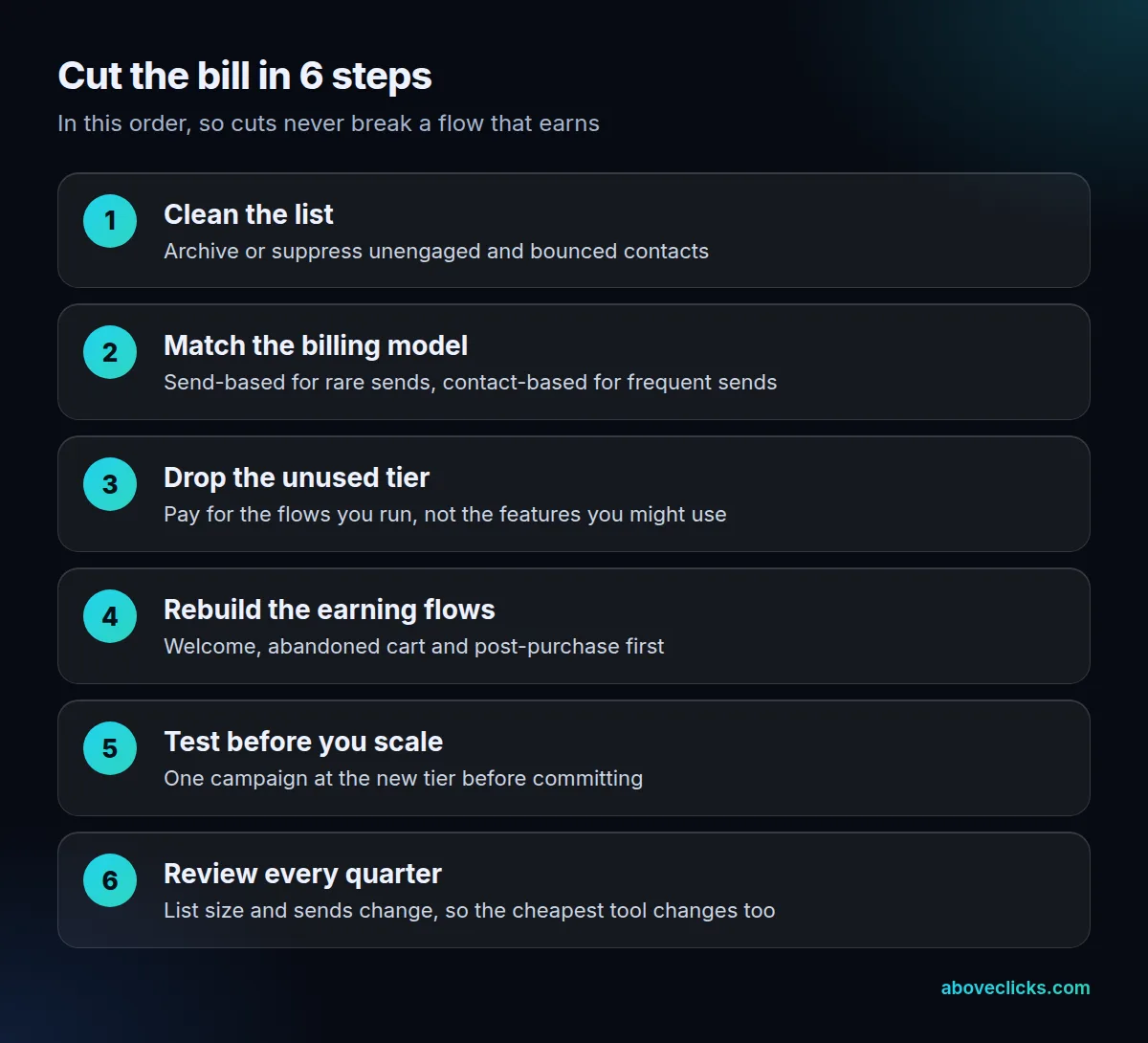
- Clean the list: archive unsubscribed and bounced contacts, suppress profiles with no value.
- Match the billing model: send-based for rare sends, contact-based for frequent sends.
- Drop the unused tier: pay for the flows you run, not features you might use one day.
- Rebuild the earning flows first: welcome, abandoned cart and post-purchase.
- Test before you scale: one campaign at the new tier before committing, and test the content itself with an A/B test, as Klaviyo’s A/B test guide explains.
- Review every quarter: list size and sends change, so the cheapest tool changes too.
Then measure the cut by revenue per recipient, not by the monthly bill alone. A $20 plan that earns $2,000 a month from flows is cheaper than a $9 plan that earns nothing because its flows are capped. Post-purchase flows are where that revenue per recipient comes from, as of October 2026, according to Klaviyo’s post-purchase flow guide.
That is the final rule of email marketing cost: the cheapest tool is the one that earns the most per recipient after its fee, not the one with the lowest plan price. That rule holds, as of October 2026, because the flows that earn are the ones that send at the right moment: Klaviyo’s post-purchase flow guide describes post-purchase messages as building repeat purchase, which is where revenue per recipient comes from.
To see how that rule applies to a store’s email setup, read the email marketing service page, or ask for a free audit of the list and flows you have today. More guides are in general.