Global SEO packages are SEO packages that cover more than one country or language. Judge them by the number of markets and locales they have to serve, not by the word “global” in the name.
This guide shows what global SEO packages add to a normal package, which URL structure Google supports, how hreflang multiplies the workload, and what a quote should say for each market.
What are global SEO packages?
They are SEO packages sold for a site that serves several countries, several languages, or both. Most global SEO services from a global SEO agency are a normal package with extra layers for each market, so international SEO packages and global SEO packages usually mean the same thing.
Google separates two cases in its multi-regional guide. A multilingual site offers more than one language, such as English and French versions. A multi-regional site targets different countries, such as the USA and Canada. A site can be both, with US English, Canadian English and Canadian French pages.
That difference matters for a quote. Three languages sold in one country is a translation job. Three countries sold in one language is mostly a local-intent job. Both together multiplies each. Example: an invented store with 40 priority pages in 3 locales has 120 URLs to build, check and report on, before any new market is added. Our guides on custom SEO packages and ecommerce SEO packages cover what a single-market package contains; this one covers only what changes when you add markets.
What do global SEO packages add to a normal package?
Five layers: market research, URL structure and hreflang, localized page work, local content and links, and reporting by market. Three of them repeat for every market you add.
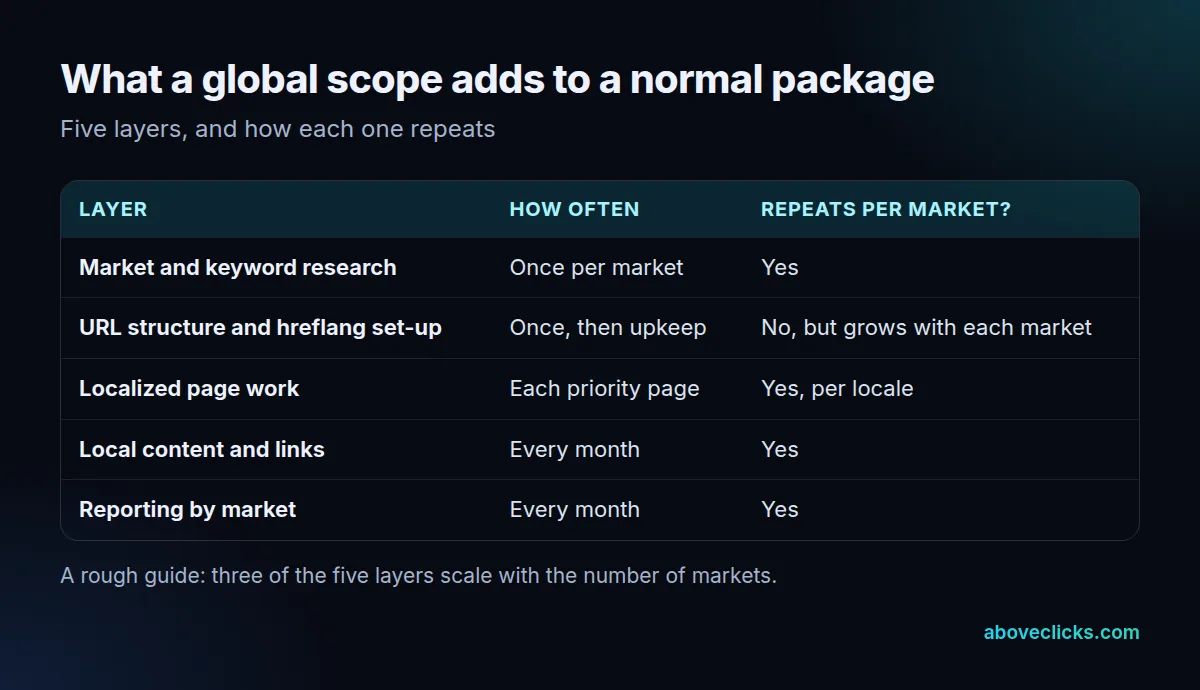
Market research happens once per market, because the words buyers in Germany use are not a translation of the words buyers in Texas use. The URL and hreflang set-up is built once, but it needs upkeep every time a page is added or a market opens.
The other three layers repeat. Localized page work is done for each priority page in each locale. Local content and links are monthly work, and reporting should be split by market so a strong home market can’t hide a weak new one.
Ask for each layer as its own line in the scope. Global SEO packages that say only “international SEO included” haven’t told you which of the five they cover. If you also want a retainer on top, the monthly SEO package guide explains how to read one over 12 months.
Which URL structure should global SEO packages use?
One of three: a country domain, a subdomain or a subdirectory. Google doesn’t recommend URL parameters. The choice sets how much infrastructure the work needs, so settle it before any page is localized.
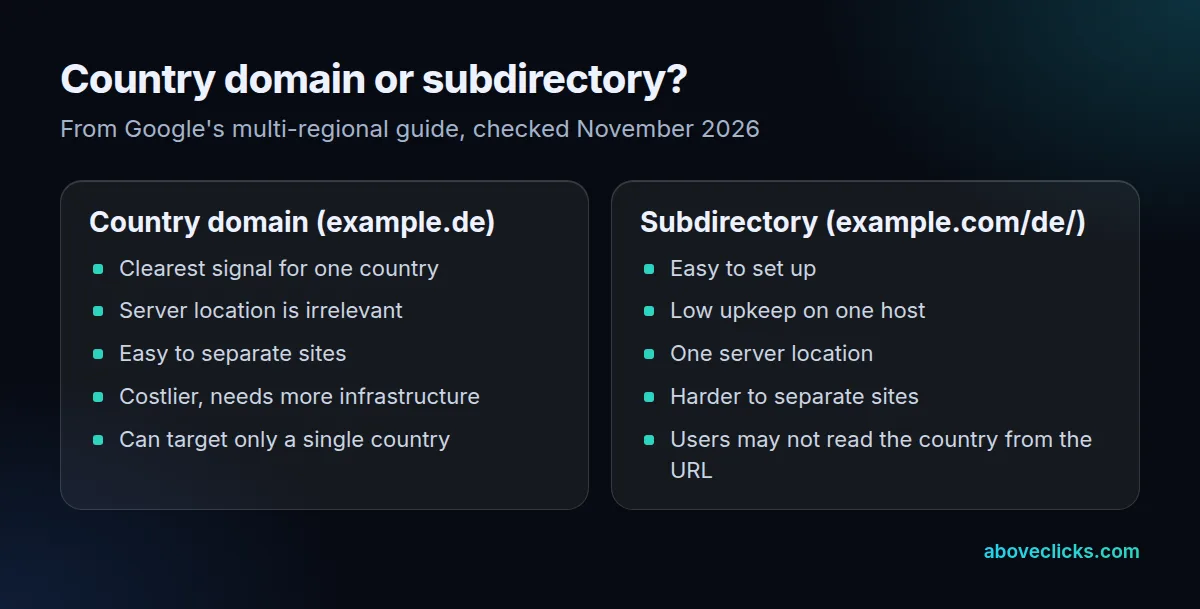
Google supports three structures, and the choice shows up in the workload:
- Country domain (example.de): one domain to buy and run for every country.
- Subdomain (de.example.com): one domain, one subdomain per market.
- Subdirectory (example.com/de/): one domain and one host, one folder per locale.
Example: 12 locales means 12 country domains to buy, renew and set up, or 1 domain with 12 folders. Google’s trade-offs for each are below. A country domain such as example.de gives the clearest signal and an easy separation of sites, but it costs more, needs more infrastructure and can target only a single country. A subdomain such as de.example.com is easy to set up, though users may not know whether “de” means a language or a country. A subdirectory such as example.com/de/ is the easiest to run on one host.
Google also says what it doesn’t do. It doesn’t use IP analysis to adapt content, and it ignores geo meta tags such as geo.position. Most of its crawls come from the USA and send no Accept-Language header, so content that changes by visitor location or browser language may never be seen. Give each version its own URL.
Google uses four kinds of signal to pick a target locale: a country domain, hreflang, server location and other clues such as local addresses, currency and links from local sites. A good set of global SEO packages covers each signal the agency controls.
How does hreflang work for several markets?
Each version of a page lists itself and every other version, using a language code and an optional region code. If two pages don’t point at each other, Google ignores the tags.
Google’s localized-versions guide sets the rules. Use fully qualified URLs. Take the language from ISO 639-1 and the optional region from ISO 3166-1 Alpha 2, so en-GB works and es-419 isn’t supported. You can’t give a country code by itself. Add an x-default entry as the fallback for searchers no version fits.
Here is what that does to the workload. Example: an invented store has 40 priority pages and sells in the US, the UK, Canada (English and French) and Germany. That is 5 locales.
- 40 pages times 5 locales gives 200 URLs.
- Each URL lists itself plus 4 others, which is 5 links.
- 200 URLs times 5 links gives 1,000 hreflang links to build and keep correct.
Adding a sixth locale takes the example to 240 URLs and 1,440 links. A single sitemap holds up to 50,000 URLs or 50MB, so this store stays far under the limit. A catalog with thousands of products won’t.
Check the return links first when something looks wrong. A missing link back from one locale is the most common reason a set of tags is ignored, and it is easy to introduce when a page is renamed, merged or removed in just one market. Ask whether global SEO packages include a monthly hreflang check, because this layer breaks quietly.
Localized versions count as duplicates only if the main content stays untranslated, according to the same Google page. Translate the main content, not only the menu and footer.
What drives the cost of global SEO packages?
The number of locales times the number of priority pages, then the depth of localization and how much local content each market needs. The shared technical layer changes the cost far less.
We don’t publish market ranges; they move too fast to stay true. Use the hours split instead; hours are the honest unit for global SEO services, because markets differ. This worked example is for a store with 4 markets, as shares of the month.
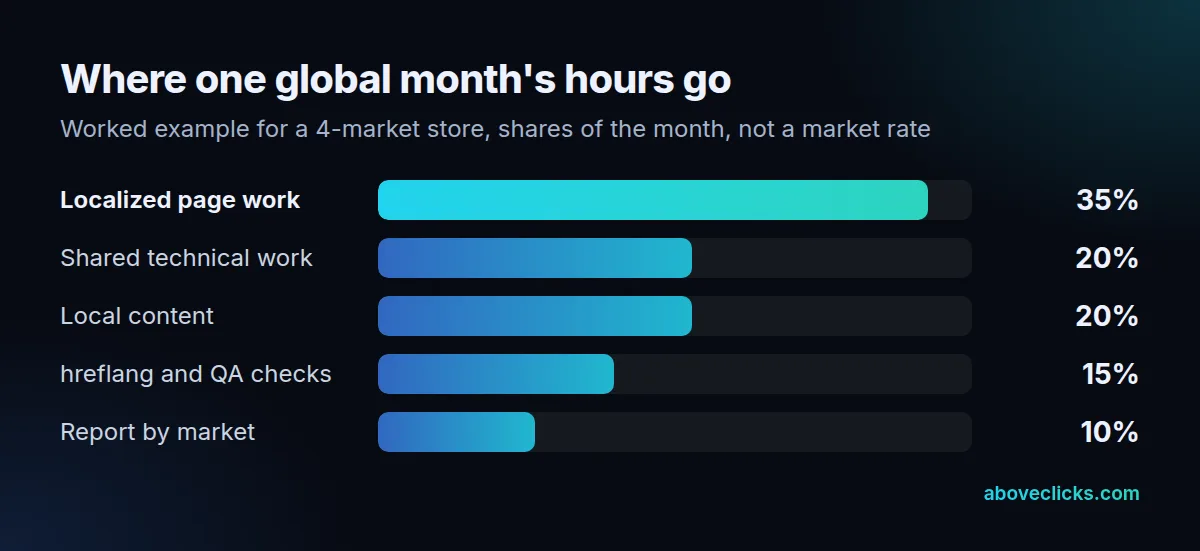
Localized page work takes the largest share, so it moves the total most. Adding one locale adds roughly one more page-work stream and one more report. A quote that stays the same when the market count goes from 2 to 5 is hiding something: fewer pages per market, thinner localization or less reporting.
Translation quality sets the other cost. Google’s spam policies list scaled content abuse, including pages made by automated translating where little value is provided. Machine output with a native-speaker review of each key page is slower, but it is the work that keeps a market from being a liability.
Timing also costs. Crawling can take from a few days to a few weeks, according to Google’s recrawl guide, and every new locale starts that clock again.
What should a global SEO quote say for each market?
It should name the market, the locale codes, the number of pages, who translates, and what is reported. Repeat the same lines for every market so quotes can be compared.
Use this checklist for each market in the quote:
- Which locales (for example en-CA and fr-CA) and which URL structure?
- How many priority pages, listed or counted?
- Who writes the local version, and who reviews it in that language?
- Is the hreflang set-up, including x-default, in scope, and who keeps it correct?
- Which local content or links are planned each month?
- What does the monthly report show for this market on its own?
Start from a clear baseline. Our own check for an online store is a free 25-point audit with a PDF report within 2 workdays; see ecommerce SEO for what it covers. For a global quote, ask any global SEO agency for an equivalent first deliverable, per market, before the monthly work begins.
Be careful with one flat fee across global SEO packages. It can hide a smaller scope in each market than the home market gets. Split it into market lines and compare the lines.
When should you start with one market instead?
When your home market isn’t yet working, when you can’t write or review the local pages, or when a single new market would be enough to learn from. One new market is a cheaper test than five.
A quick test before you buy global SEO packages:
- Does the home market already bring orders from search? If not, fix that first.
- Can you review pages in the new language, or pay someone who can?
- Are there orders, enquiries or shipping data that show people in that country already want the product?
In the example above, one market with 40 pages is 40 URLs instead of 200, and one set of reports instead of five. You learn what the work costs per market, then repeat it with real numbers. If you want a second opinion on your current setup before you commit, our free audit is the place to start, and more guides are in buying guides.