A custom SEO package is a set of SEO work chosen module by module for one site, instead of a fixed tier with a set price. Judge one by whether each module answers a problem your site has and whether you can check the result.
This guide lists the eight modules a package can be built from, shows how to choose them from your site’s own symptoms, gives you a scope sheet to write down and explains how to test any quote.
What are custom SEO packages?
They are agreements where you and an agency choose which SEO work you buy, how much of it and when, rather than taking a ready-made tier. The agency prices the modules you pick, not a bundle.
A standard tier suits a site that looks like the average site the tier was built for. Custom SEO packages suit sites that don’t, and only a diagnosis of the site tells you which kind you have: a store with healthy pages and no links, a site that was just migrated, or a business that already has a writer in house.
As a rule of thumb, of the 8 modules below most sites need 3 or 4 at a time, not all 8, and a custom SEO package that lists all 8 for a 20-page site deserves a question. That is the case for choosing modules instead of buying a bundle.
The trade-off is effort. A tier is easy to compare and hard to fit; a custom SEO package fits but needs a written scope, or “custom” turns into “whatever the agency feels like this month”. The rest of this guide is about writing that scope, and each custom SEO package we describe uses the same 8 modules.
What can a custom SEO package include?
Eight modules: audit, technical fixes, page work, new content, links and mentions, local or marketplace work, AI search readiness and reporting. Only reporting belongs in every package.
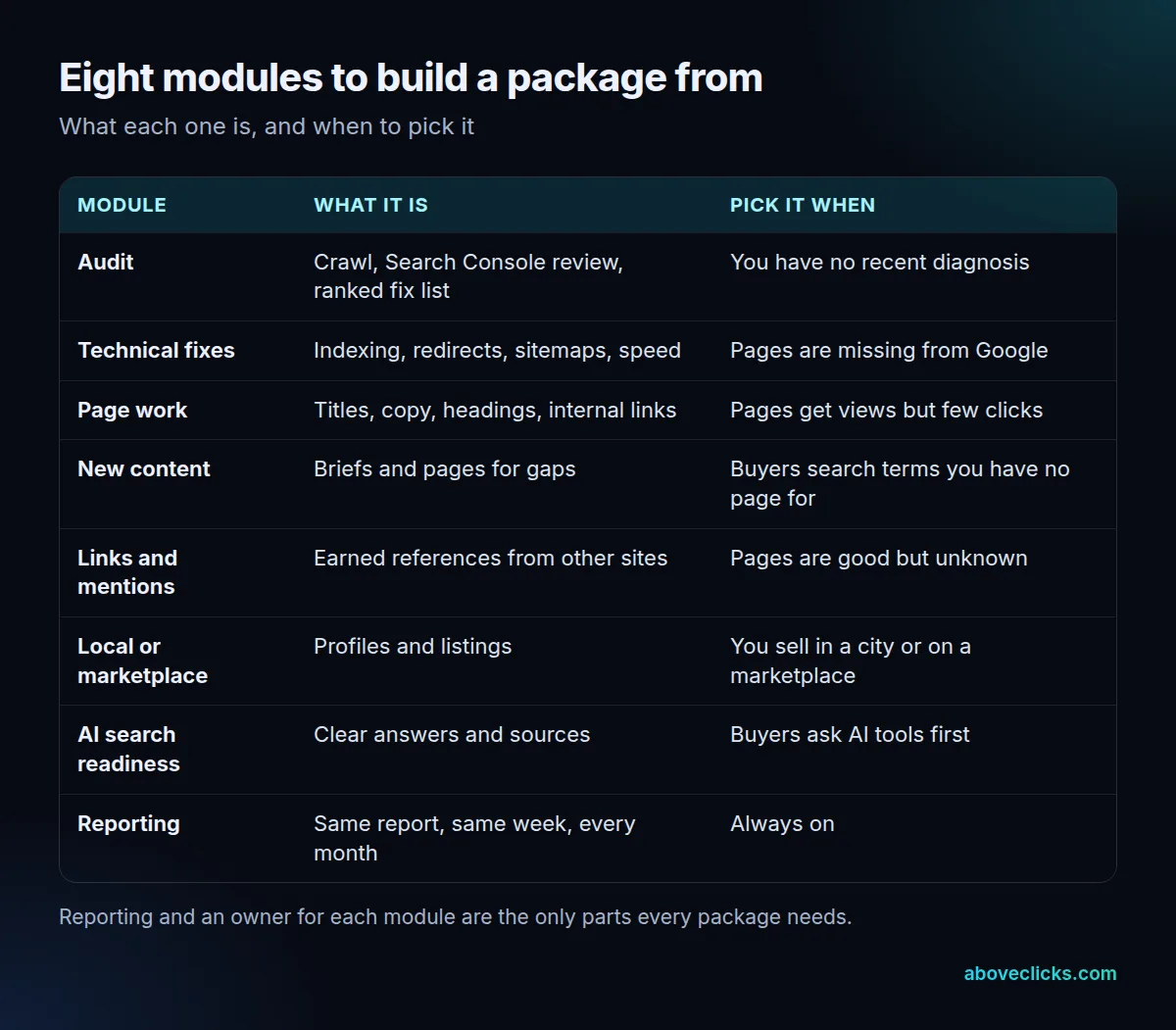
The menu for custom SEO packages follows what Google itself says an SEO can do. Its guide on hiring an SEO lists a review of your content or structure, technical advice, content development, keyword research, training, market expertise and optimizing for generative AI. We split those into eight parts you can buy one by one.
Technical fixes are the module with the most hidden detail. As of November 2026, a single sitemap is limited to 50,000 URLs or 50MB uncompressed, so a store with 120,000 product URLs needs at least 3 sitemaps and an index file. Ask whether a custom SEO package’s fix list covers that kind of detail or only a generic checklist.
In a custom SEO package, page work is usually the module that moves the numbers soonest, because it improves pages Google already knows. Google’s SEO starter guide says a good title is unique to the page, which is why page work starts with a list of duplicated or missing titles.
How do you choose the modules for your site?
Start from symptoms. Each thing you can see in Search Console or a crawl points to a module, and a module without a symptom is the first thing to cut from a quote.
Use this order, which covers 6 common symptoms. A page with 1,000 views and 4 clicks, for example, is a page-work case, not a content case:
- Pages missing from Google: buy technical fixes first. New content on pages Google can’t index is wasted.
- Pages with views but few clicks: buy page work. The pages exist; their titles and copy don’t earn the click.
- No page for what buyers search: buy new content, with a brief per page and a named writer.
- Good pages that nobody links to: buy links and mentions, and ask for the list of sites before you pay.
- A shop in one city, or sales on a marketplace: buy local or marketplace work.
- No diagnosis at all: buy the audit first, and treat the rest as a plan that the audit may change.
Not every site needs every module, which is the point of custom SEO packages. Google says that a small local business can probably do much of the work itself, and that a great time to hire is during a redesign or a new site launch, so the work is built in from the start. Both are reasons to leave modules out.
Timing matters too. As of November 2026, the starter guide says some changes take effect in a few hours while others take several months, and that you should wait a few weeks before judging a change, so plan a review at week 4 and again at month 3. Put a review date in the scope for each module instead of asking whether “SEO is working”.
What should the scope of work say?
One line per module: the deliverable, the count, the finish date, how you can check it, who holds access and how scope changes. A module that lacks one of those six is where costly gaps hide.
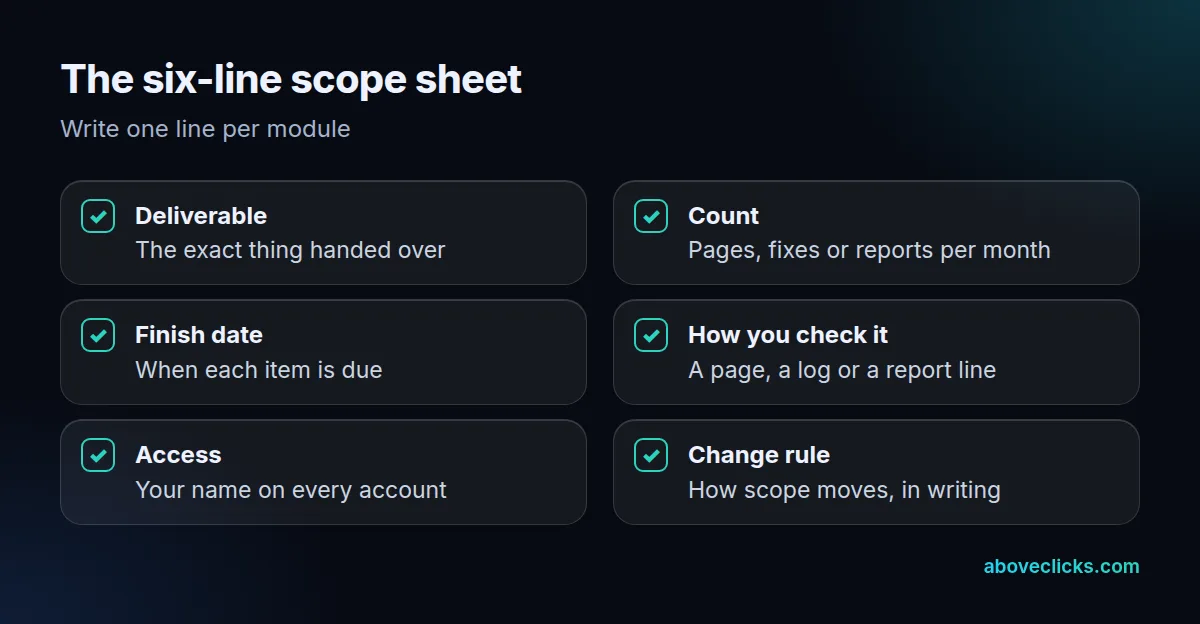
Here’s what that looks like in practice. For a hypothetical 300-product store with healthy indexing but weak titles, a custom SEO package could put most of the month into page work and new content, and keep technical fixes to upkeep.
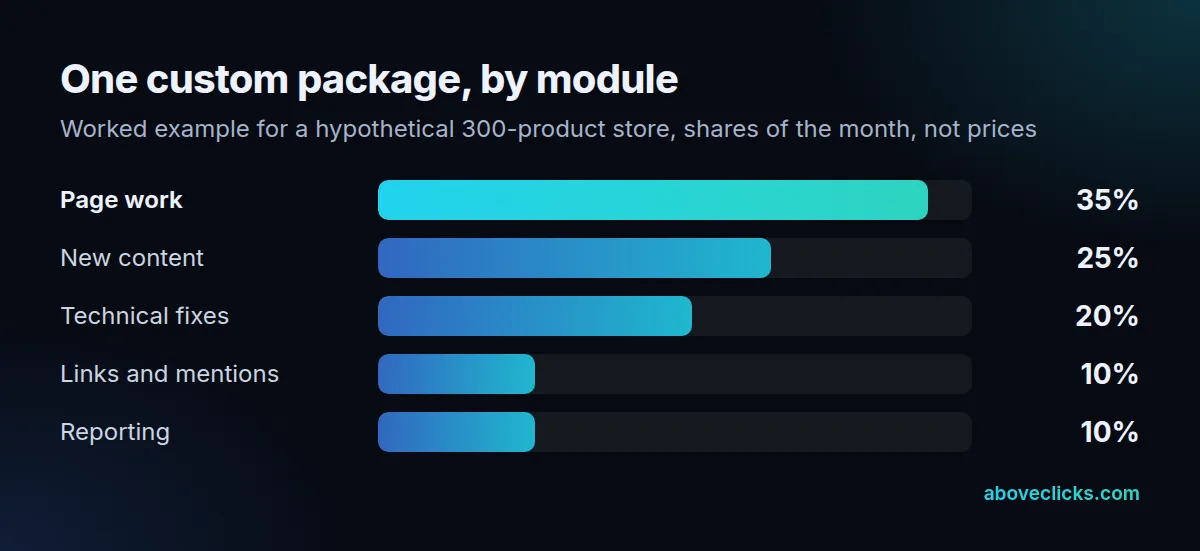
This is a worked example, not a market rate: it shows shares of the month. In the scope sheet, the page work line might read “40 product and collection pages rewritten per month, a list of changed titles in the monthly report”. That line can be checked; “ongoing on-page optimization” can’t.
Two lines of any custom SEO package scope deserve more care than the rest:
- How you check it. Ask for the Performance report set to the last 16 months, as Google suggests, so seasonal swings aren’t mistaken for results. Our sample report shows the format we use.
- Access. Keep your own login as the top-level admin. In Search Console, a property must have at least one verified owner, and a delegated owner can be added or removed in the user list without a token. If the agency verified the site with its own token, removing that token belongs in the handover.
If you want to see how we begin, our ecommerce SEO service starts with a store check in Search Console and a crawl, and we send a PDF report within 2 workdays. That report is the kind of diagnosis a scope can be built on.
What should you ask an agency before you buy?
Ask what they will change, how they will show it and what they need from you. Google’s own hiring advice gives you the questions, and a vague answer to any of them is a reason to wait.
Five questions to put in writing before you sign a custom SEO package. Google’s hiring page lists 8 interview questions; these 5 are the ones that change a scope. Treat a reply that skips any of them as a warning:
- Can you show examples of previous work, and which modules did they cover?
- Will you share every change you make to my site, with the reasoning?
- What results do you expect, in what timeframe, and how do you measure success?
- Do you cite official Google documentation for your recommendations?
- What do you need from my side, and by when?
The same page warns that no one can promise a first place in search results, and that you should be careful with a company that is secretive about what it intends to do. It also says that if an SEO offers an audit, you should grant read access to Search Console only. Hold back write access until the scope is signed, and ask for the answers to all 5 questions in the same email, because a 10-minute call leaves nothing to check later.
What drives the cost of custom SEO packages?
The number of modules, how much of each, and how much of the work is writing. A package with one module and a short list costs less than one with five, but the fee per module is the figure to compare.
We don’t publish market ranges here; they move too fast to stay true. Instead, test any custom SEO package quote with this formula: quote divided by the number of modules and items in the scope. A low total that buys 1 rewritten page a month can be dearer per page than a higher total that buys 20.
Three things push a custom SEO package quote up or down, and a discount for signing today is not one of them:
- Site size and state. A site that needs an audit and heavy fixes carries more work early; a clean one carries less.
- Writing. New content takes the most hours and needs someone who knows your trade.
- Who is already on your side. If your team writes and publishes, you can buy planning and review instead of production, as SEO consulting does.
Our starting prices are on the ecommerce SEO page, in US dollars. Ask any agency for the same: a starting figure per module, not a single “custom” number you can’t take apart.
When is a standard package enough?
When your site looks like the one the tier was built for, and every module in it matches a symptom you have. In that case a standard tier is cheaper to compare and faster to start.
A short test: lay the tier’s contents beside your symptom list, all 6 symptoms from the choosing section. If you’d keep at least 75% of its lines, buy the tier. If you’d remove 2 or more lines, or you need something it lacks, ask for a custom SEO package built from the modules above.
If the work is repeated every month, also read our guide to the monthly SEO package for what each quarter should deliver and which contract terms matter. For a smaller site, SEO packages for small business explains which parts a small business can leave out. For a second opinion on a quote, our free audit reads your Search Console with read-only access. More guides are in buying guides.