A monthly SEO package is a fixed scope of SEO work repeated every month, usually after a one-off audit: technical upkeep, page improvements, new content and a report. Judge one by what each quarter of the year delivers, because single months are too short to show results.
This guide walks through a monthly SEO package across its first 12 months, shows how the hours in a month are usually split, explains how to read the report, and lists the contract terms that decide what leaving costs.
What is a monthly SEO package?
An ongoing agreement where the same agency does an agreed amount of SEO work every month for a fixed fee. It differs from a project, which ends when a defined list of fixes is done.
Monthly work makes sense because search results keep moving. Google’s guide to helpful content says some changes take effect in a few days, while it could take several months for its systems to confirm that a whole site is helpful. A one-off project fixes problems; a monthly SEO package keeps adding and testing pages over that longer stretch.
Not every site needs it. A 10-page site with a short fix list is often better served by a project, followed by a check every 6 months. Monthly SEO packages pay off when you keep adding products, services or locations, or when competitors keep publishing.
What does a monthly SEO package include each month?
A fixed core of technical upkeep and reporting, plus a rotating share of page work, content and links that shifts as the year goes on. The split should change by quarter, not stay frozen.
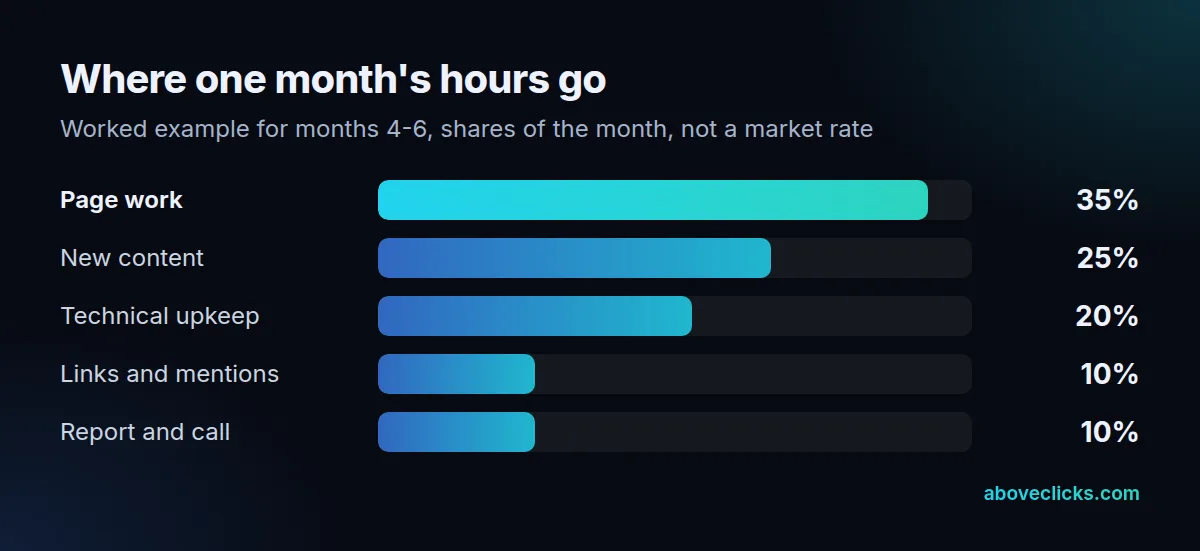
The worked example above is for months 4 to 6, when page work leads. It shows shares of the month, not prices, so you can hold any quote against it. In months 1 to 3, technical work takes the biggest share instead.
What belongs in the fixed core every month:
- Technical upkeep: new indexing errors, broken links and redirects, and checking the sitemap still lists every page that should rank. A single sitemap can hold up to 50,000 URLs or 50MB, so large stores split theirs.
- Reporting: the same metrics, in the same format, in the same week each month.
- A short call or written update: what was done, what’s next, and what’s blocked on your side.
Some agencies sell a seo monthly package as a block of hours, others as a list of items. Hours suit work that’s hard to predict, such as a site with recurring technical problems; items suit steady page and content work. Either way, the report should show what the hours or items turned into.
The rotating part is where monthly SEO plans differ most. Ask for it as a list of items per month, such as 4 pages rewritten or 2 new guides, rather than “ongoing optimization”.
What happens in months 1 to 12?
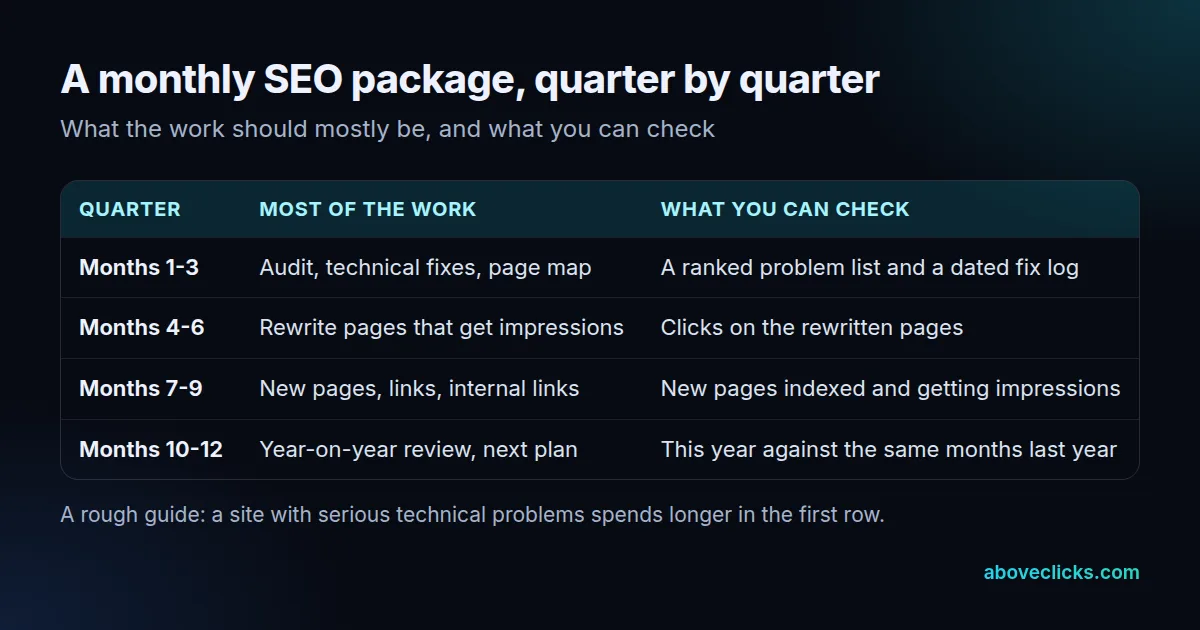
Quarter 1 is audit and fixes, quarter 2 is page work, quarter 3 is expansion and quarter 4 is a year-on-year review. A monthly SEO package that skips the first quarter builds new pages on a broken base.
Here’s the timing we publish for our own ecommerce SEO work: the audit within 2 workdays, the plan and first fixes in about a week, page work from week 2, and the first monthly report after 30 days. Each report then arrives in the first week of the month. Whoever you hire, ask for a timeline that specific.
A clear timeline also makes the first invoice easier to judge. If the audit and the first fixes haven’t arrived by the end of month 1, the rest of the monthly SEO package is already running late, and it’s fair to ask why before month 2 is billed.
Months 1 to 3 should end with a written problem list, a dated fix log and a map that assigns each target search to 1 page. Months 4 to 6 rewrite the pages that already get impressions but few clicks. Months 7 to 9 add new pages and earn links to them. Months 10 to 12 compare the year with the one before and set the next plan.
The plan should also say who does what on your side. A monthly SEO package often stalls on approvals: pages wait 3 weeks for sign-off, or a developer ticket for a redirect sits in a queue. Ask the agency to list, every month, what is waiting on you, so a slow month can be traced to its cause.
Expect the quarters to blur. A site with 2,000 product URLs and indexing problems may spend 5 months on the first row; a clean 15-page site may reach page work in week 3.
How should you read the monthly report?
Against the same weeks last year, not just last month. Seasonal businesses rise and fall every year, and a monthly SEO package shouldn’t get credit or blame for the calendar.
Google’s guide to traffic drops recommends setting Search Console’s Performance report to the last 16 months, so you can see whether a drop happens every year around the same date. Ask for that view in every report, plus a comparison of the last 3 months with the same 3 months a year earlier.
Three more checks keep the report honest:
- Core updates: Google suggests waiting at least a full week after a core update finishes before analyzing the change, then comparing with a week before it started.
- Recrawl time: after a fix, recrawling can take from a few days to a few weeks, according to Google’s recrawl guide. A fix logged on the 28th won’t show in that month’s numbers.
- Leads, not only rankings: clicks and positions come from Search Console; enquiries and orders come from your own tracking. A good report shows both.
Our sample report is built that way.
What drives the SEO monthly cost?
The amount of work in the rotating part: how many pages are rewritten, how much is written from scratch and how many sites have to be contacted for links. Technical upkeep and reporting change the SEO monthly cost far less.
We don’t publish market ranges here; they move too fast to stay true. Instead, test any quote with 3 questions:
- What exactly is delivered each month, as a list?
- Who writes the content, and do they know your products or trade?
- What changes when the work grows: more items, or a new tier?
A lower monthly charge that buys one page a month can cost more per page than a higher one that buys six. Divide each quote by its delivered items before you decide. The SEO monthly cost of a package with the audit built in also looks higher in the first month than in the next 11 months, so compare quotes over 3 months rather than 1. The pricing models guide explains retainers and the other ways monthly fees are billed, and in-house vs agency compares the cost of hiring someone instead. Our own starting price cards are on the ecommerce SEO page.
Which contract terms matter in monthly SEO plans?
The ones that decide what leaving costs: minimum term, notice period, what you own when it ends, and how access is handed back. Read them before you compare fees.
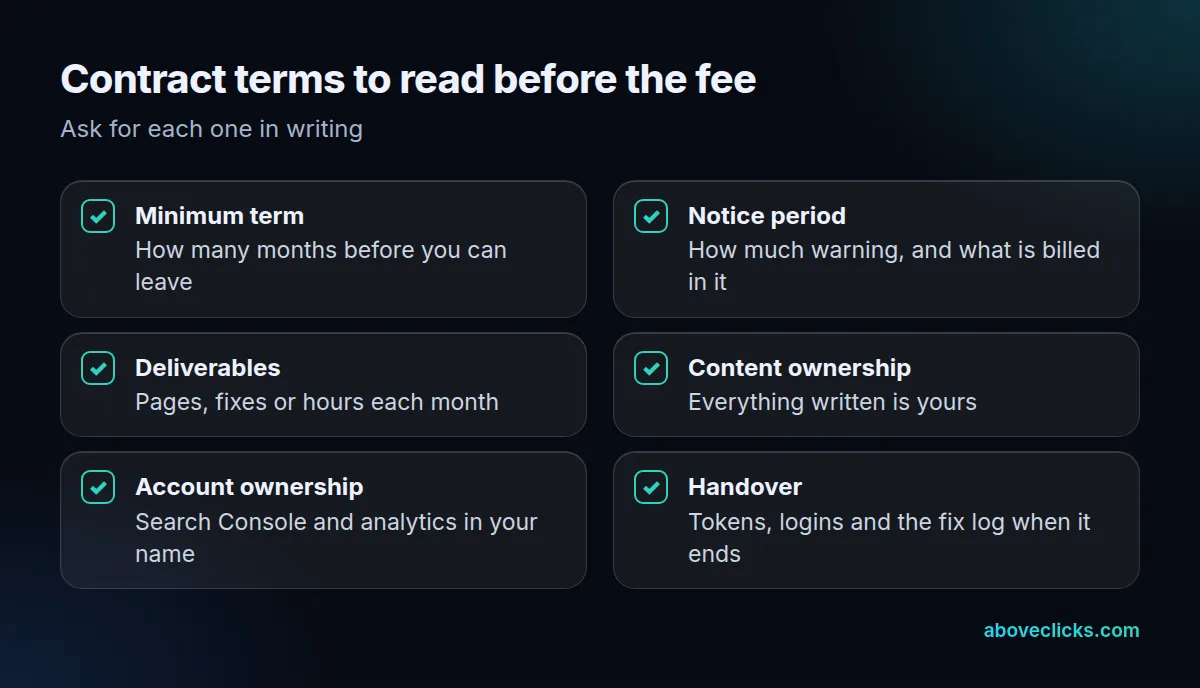
Ownership is the term people forget. In Search Console, a verified owner proves ownership with a token such as an HTML file on the site, and a property must always keep at least 1 verified owner. If the agency verified the site with its own token, removing that token is part of the handover. A delegated owner can simply be removed from the user list.
The same goes for analytics and your Business Profile: keep your own login as the top-level admin and add the agency as a user. When a monthly SEO package ends, you remove one user instead of chasing a password.
Also ask, in writing:
- Do all pages, briefs and images written for you belong to you, even if you leave in month 2?
- Is there a notice period of 30 days or more, and is the last month billed in full?
- Is the fix log handed over when the work ends?
When should you stop or change a monthly SEO package?
When 6 months pass without the checks in the first 2 rows of the plan being met, and the report doesn’t explain why. That’s long enough for fixes and rewritten pages to pick up impressions.
A quick month-6 test:
- Is there a dated fix log and a written problem list? If not, stop.
- Have the rewritten pages gained clicks against the same months last year? If not, ask for a written diagnosis.
- Does the agency recommend cutting work that isn’t paying back? If it never does, change agency.
Google’s helpful-content guide adds one caution: if a site has made real improvements and seen no effect after a few months, the effect may only show at the next core update. That’s a reason to keep the fixes, not to keep paying for work that hasn’t been delivered. If your team already writes its own pages, SEO consulting may suit better than a full monthly package. For a second opinion on the work so far, our free audit reads your Search Console with read-only access. More guides are in buying guides.