Aggressive SEO packages promise more or faster SEO work than a standard plan. They are safe when the extra effort goes into useful pages and earned links, and risky when it relies on tactics that Google’s spam policies name.
This guide explains what aggressive SEO packages can mean, what Google says about the risk, how aggressive SEO differs from black hat SEO, and which 5 claims to test in any quote before you sign.
What are aggressive SEO packages?
Packages sold on pace and volume: more pages, more links or faster results than a normal monthly plan. The word describes how hard the provider pushes, not what work is done, and it appears on sales pages with no standard meaning.
Providers use the word in 2 ways. Some mean more of the ordinary work, such as 8 pages written each month instead of 4, or fixes done in the first 2 weeks. Others mean shortcuts that try to trick search engines. From the outside both read the same, which is why aggressive SEO packages need a closer look than a standard plan.
A package of ordinary SEO work done faster is a fair thing to buy. If you want the basics first, our guide to SEO packages for small business lists what a normal plan includes, and the guide on how to buy an SEO package covers tiers and terms. This guide covers only the word “aggressive”.
Is aggressive SEO safe for your site?
It depends on what the word covers. More useful work is safe. Tactics that Google’s spam policies name are not, and they can lower your rankings or remove your pages from results.
Google’s spam policies say that sites that violate them may rank lower in results or not appear at all. Violations are found by automated systems and by human review, and human review can result in a manual action. Google’s advice on hiring an SEO adds that some unethical SEOs have used overly aggressive marketing efforts or techniques that break the spam policies, and that this may lower your site’s presence in Google or remove it from the index.
A manual action is also slow to undo. Google’s manual actions report says that some or all of a site will not be shown in results, and that fixing the issue on just some of the affected pages will not earn a partial return. Picture an invented site where a provider spent 3 months buying 200 links. If a manual action follows, the clean-up has to cover every affected page, and the 3 months of work is lost along with the links.
There is a second risk, and it is commercial rather than technical. Google says you are responsible for the actions of any company you hire. If an SEO creates deceptive content on your behalf, it is your site that is penalized. That is why aggressive SEO packages deserve the same questions as any other contract, plus a few more.
How is aggressive SEO different from black hat SEO?
Aggressive describes the pace of the work. Black hat SEO describes methods that break search engine rules. A package can be one, the other, both or neither.
Black hat SEO is the common name for techniques that go against a search engine’s rules. Google does not use that label; its spam policies name the practices one by one, such as link spam, keyword stuffing and scaled content abuse. So the useful test is not the label but the list of tasks.
Apply it in 3 steps:
- Ask the provider for the task list behind the package, not the sales page. A provider that cannot send one within 5 days is selling a label.
- Check each task against the spam policies page, which lists the practices by name.
- Mark any task that appears there as black hat SEO, whatever the package is called.
If no task appears, aggressive SEO simply means a bigger or faster plan. Our own view is that a bigger plan is only worth paying for when there is a real queue of useful work to fill it. Google’s SEO starter guide says there is no magical word count target, so a plan that sells pages by the thousand word has no support in Google’s guidance.
What can an aggressive SEO package safely include?
More of the work Google endorses: site fixes, useful pages, updates to pages that already rank, earned mentions and a monthly report. Turn the volume up in that order.
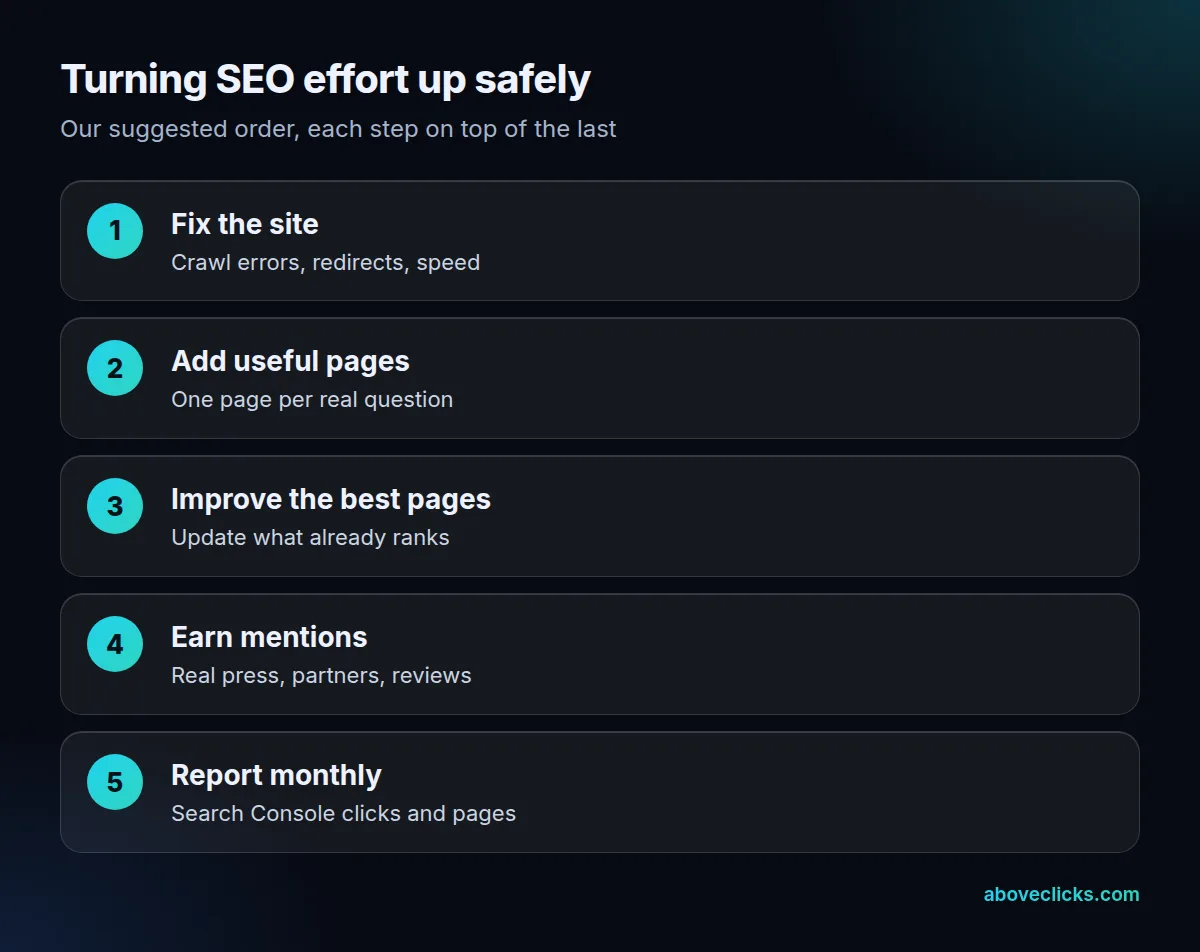
The order above is our own advice, not a Google rule. It follows dependency: new pages on a site with crawl errors waste effort, and earned mentions work best when there is a page worth mentioning. Here is what each step means in practice:
- Fix the site: broken redirects, blocked pages and slow templates come first because everything else depends on them.
- Add useful pages: one page for each real question a customer asks, written for that reader.
- Improve the best pages: update the pages that already earn clicks before writing new ones.
- Earn mentions: real press, partners and reviews. If you buy a placement, the link should be marked as paid.
- Report monthly: clicks and pages from Search Console, so you can see which step is working.
Take an invented plan of 8 new pages a month. Over 6 months that is 48 pages. If the provider cannot name the reader question behind each of the 48, the plan is volume for its own sake. Doubling it to 16 pages a month makes the problem 2 times bigger, not better.
Pace also has a floor that no package can change. Google’s starter guide says some changes take effect in a few hours and others could take several months, and that you should wait a few weeks before judging whether your work helped. A provider that promises a result in 7 days is promising something the platform does not offer.
How do you spot red flags in an aggressive SEO quote?
Test each promise against Google’s rules. Five claims come up most often, and each one touches a named policy.
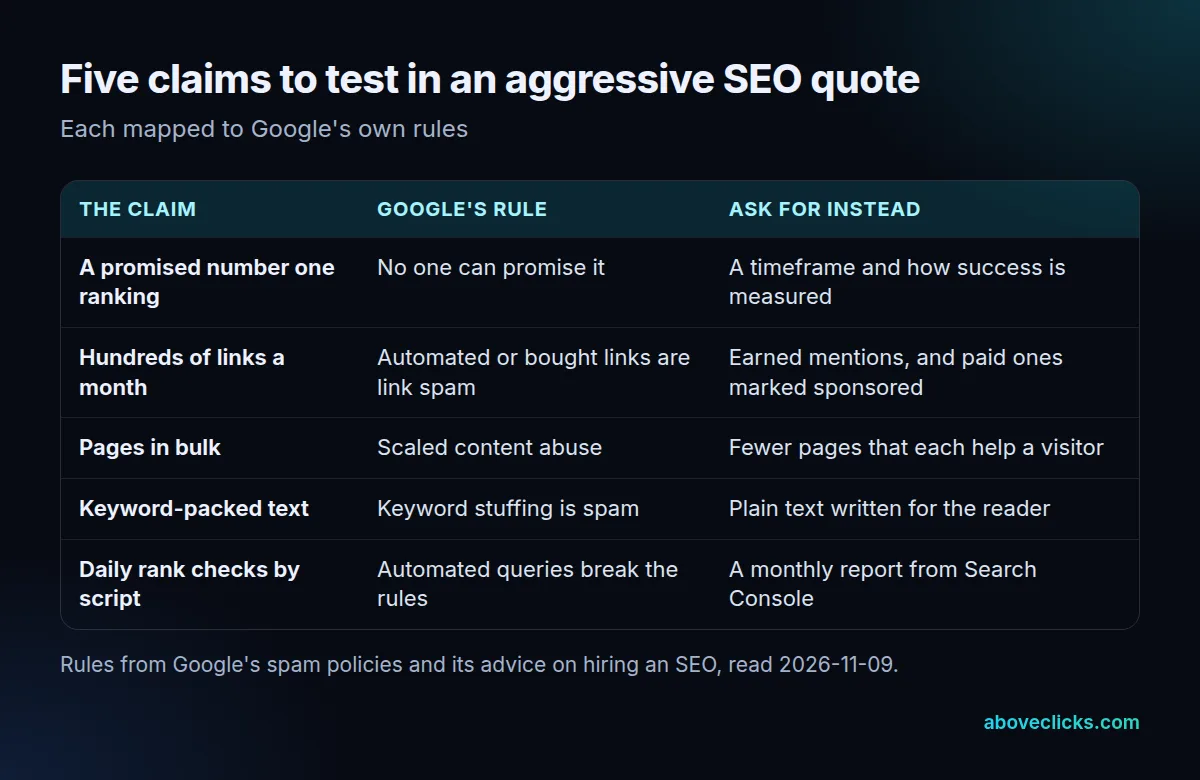
Here are the 5 in detail:
- A promised number one ranking. Google says no one can promise a number one ranking, and warns against anyone who claims a special relationship with Google or a priority submit.
- Hundreds of links a month. Even 100 links a month, if bought or built by software, is link spam. Link spam includes buying links for ranking purposes, using automated programs to create links, and guest posts or press releases with optimized anchor text. Google’s outbound link guidance says paid placements should carry the sponsored value, and that nofollow is still acceptable.
- Pages in bulk. Scaled content abuse is creating many pages mainly to manipulate rankings, including with generative AI tools that add no value for users.
- Keyword-packed text. Keyword stuffing, filling a page with keywords unnaturally, is also on the spam list.
- Daily rank checks by script. Google lists scraping results for rank checking as machine-generated traffic, which breaks its spam policies. Ask how the provider measures rank. A script that checks 30 keywords every day adds up to 900 automated queries a month, all of them outside the rules.
Google adds one more line that is easy to miss: you should never have to link to an SEO. If a package requires a link to the provider on your site, ask why before you agree.
What should you ask for instead of aggressive SEO?
Ask for more output of useful work, a timeframe and a monthly report. Those 3 give you speed without the risk, and the first report should arrive within 30 days.
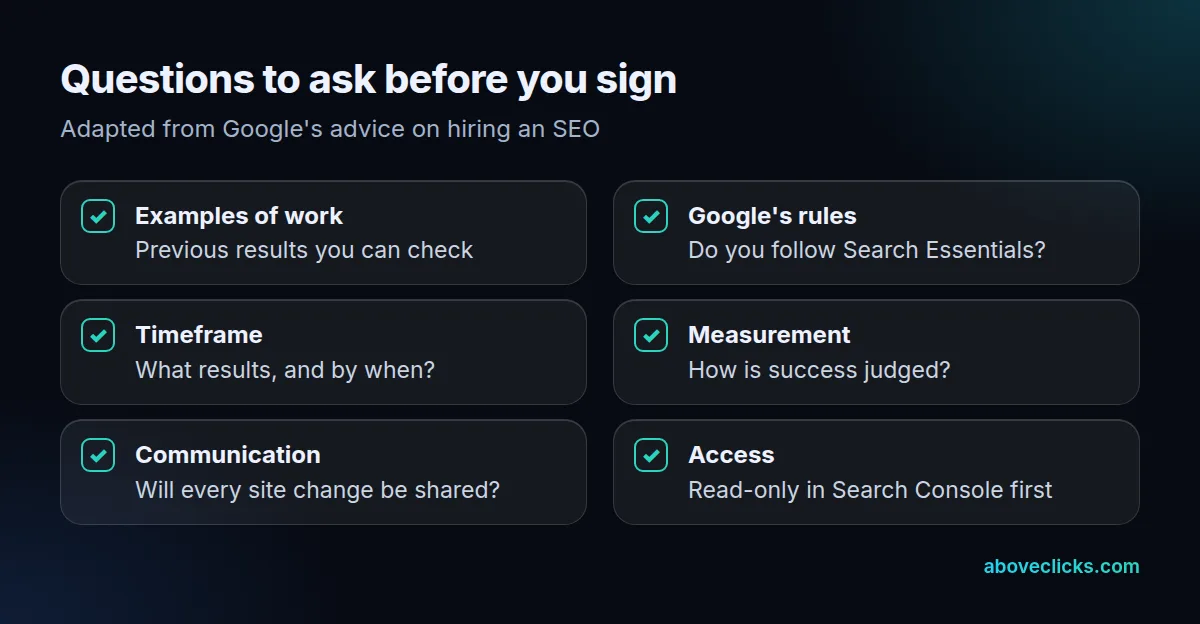
Google’s own list of interview questions is a good start. It has 8 questions, among them examples of previous work, whether the provider follows Google Search Essentials, what results to expect and in what timeframe, and how success is measured. It also asks how the provider will communicate and whether you will see every change made to your site. If an SEO offers an audit, Google says to grant only read access to Search Console at that stage and to expect realistic estimates of improvement and of the work involved.
Account ownership is the last check. Keep Search Console and analytics in your own name and add the provider as a user, so that the data stays with you if the plan ends. Google’s hiring advice says that if an SEO has FTP access to your server, the SEO should be willing to explain every change made. Ask for a dated change log with each report, and compare it with the task list you agreed at the start. A change you did not agree to is a reason to pause the plan, however fast the work is moving.
Ask for a 30 minute walk-through of the first report and a review point after 3 months, so you can stop or change the plan. We prefer to start with a look before a sale. Our free audit is a written review of your site, and the sample report shows the layout, so you can judge the format before you share anything. If you are comparing agencies as well as packages, our guide on how to evaluate a marketing agency covers the wider checks. For help with an online store, see our ecommerce SEO service, and for more comparisons browse the buying guides.