Ecommerce SEO packages are fixed bundles of SEO work for online stores: technical fixes, collection and product page work, product data, content and a report. Choose one by your catalog size and the parts it includes, not by the headline fee.
This guide lists the 6 parts a store package needs, shows which package shape fits which catalog, explains what moves ecommerce SEO cost, and ends with a checklist for testing any quote.
What is an SEO package for an online store?
They are bundles of SEO tasks sold as one scope for an online store, usually after an audit, either as a one-off project or as a monthly plan. A generic SEO package is built around a website; ecommerce SEO packages are built around a catalog, its templates and its filters.
That difference matters because a store has hundreds of near-identical pages.
Worked example: a store with 3 page templates (home, collection, product) and 800 products has 800 product pages generated by one template, so one template fix changes 800 pages at once. Google’s own ecommerce guide has separate pages for product data, structured data, URL design and site structure, which is a fair list of what ecommerce SEO packages have to cover. For a view across all kinds of businesses, see our guide to SEO packages for small business. For how a retainer runs over a year, read the monthly SEO package guide. This one is about the store-specific parts, and about how ecommerce SEO packages differ from the generic kind.
What should ecommerce SEO packages include?
Six parts: a technical base, collection pages, product pages, product data, content and a report. A package that drops the first part builds new pages on a broken base.
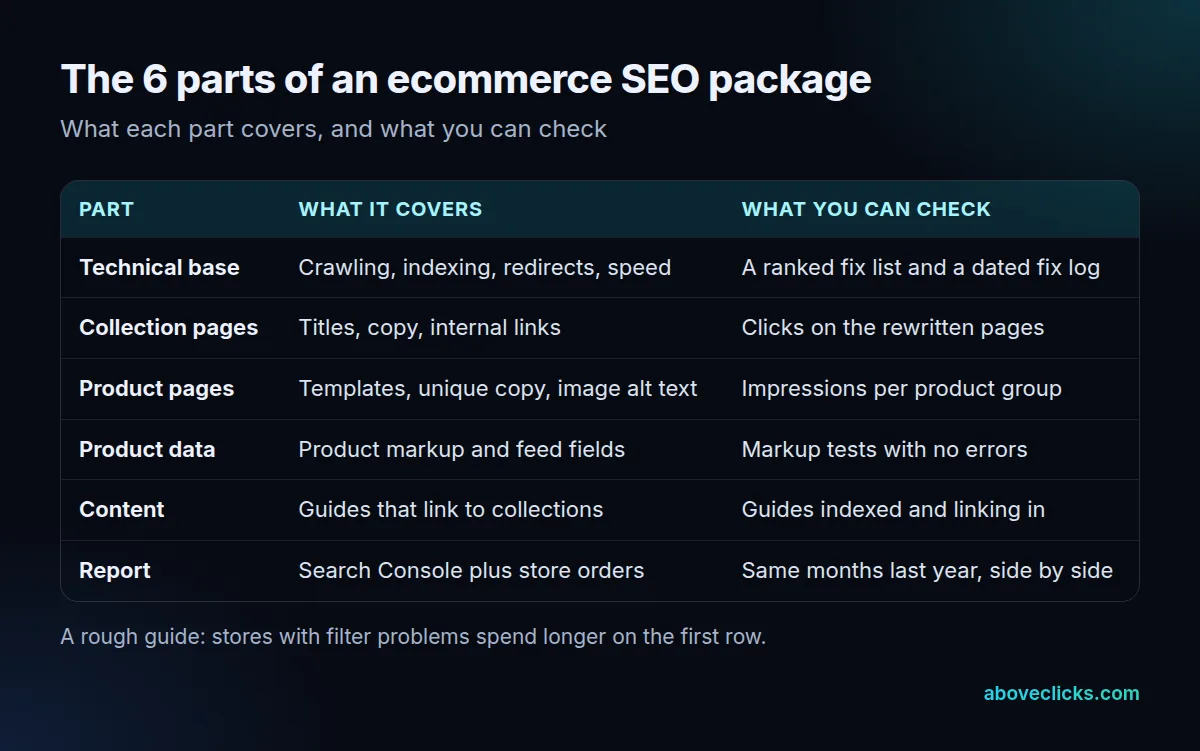
The table above is the shape of the ecommerce SEO package we use for our own ecommerce SEO work. Here is what each part means in practice:
- Technical base: crawling, indexing, redirects and speed. As of October 2026, Google’s Core Web Vitals guidance asks for largest contentful paint within 2.5 seconds, interaction to next paint under 200 milliseconds and layout shift under 0.1. A single sitemap holds up to 50,000 URLs or 50MB, so a big catalog needs several.
- Collection pages: these usually carry the broad searches, so titles, copy and internal links go here first.
- Product pages: template-level fixes beat page-by-page edits, with unique copy for the products that matter most.
- Product data: Google says product markup can show price, availability, review ratings and shipping in results. Only pages where a shopper can buy are eligible for merchant listings.
- Content: buying guides that link to the collections they belong to.
- Report: Search Console clicks next to orders from your store.
Where do canonical tags fit?
In the technical base. Google uses canonical URLs to consolidate signals for similar or duplicate pages, which is exactly what color and size variants create. Ask whether the package includes checking them.
Which of the ecommerce SEO packages fits your store size?
Small catalogs usually fit a fix project, mid-sized ones a monthly package, and large ones a monthly package with template-level work. The right ecommerce SEO package follows the number of templates and URLs, not your revenue.
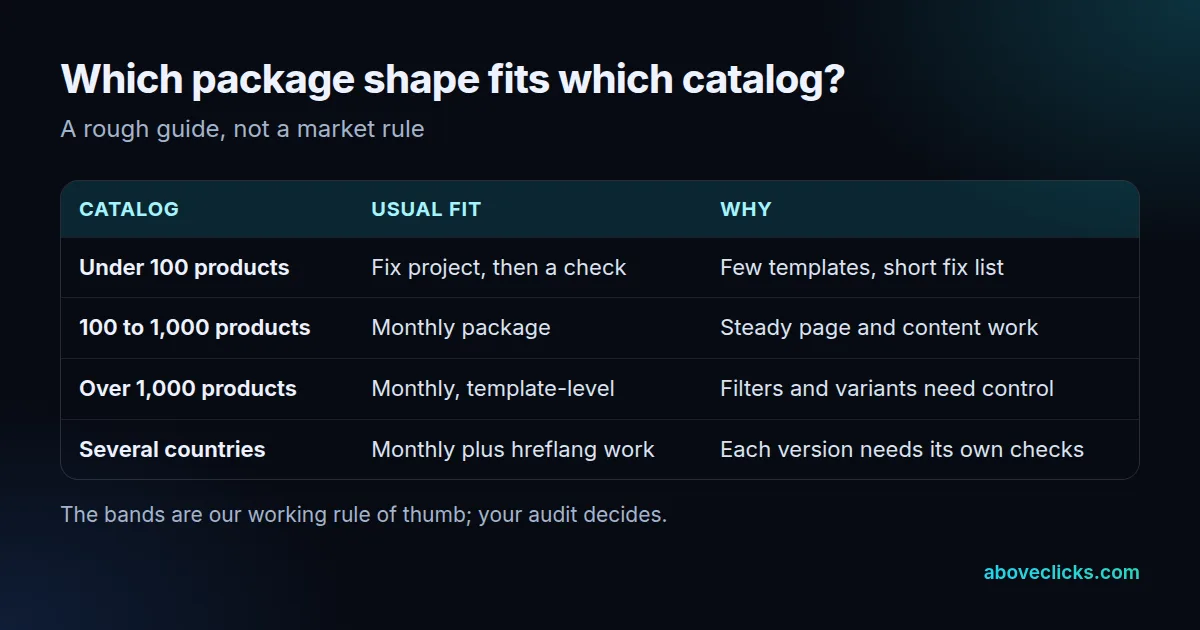
The bands in the table are our working rule of thumb, not a market statistic. A store with 60 products and a broken redirect map may still need months of work, while a clean store with 150 products may need only quarterly checks. Your audit decides, and our one time SEO package guide covers when a fixed project is enough.
Two signals push you up a row. The first is filter and sort URLs. The second is several country versions of the store, which add hreflang and currency checks to every audit. Neither shows up in a product count, so say so when you ask for a quote.
A second worked example: a store with 40 products, one language and clean URLs needs a fix project of perhaps 10 to 15 fixes, then a check every 6 months. A store with 2,500 products and 5 filters has a different problem entirely, because each fix has to be made once in a template and then verified across thousands of URLs. The ecommerce SEO package for the second store should name those templates.
What drives ecommerce SEO cost?
The amount of page work and the filter and variant problems to solve, more than the tier name. Technical monitoring and reporting change ecommerce SEO cost far less than the number of pages touched each month.
We don’t publish market ranges here, because they move too fast to stay true. A worked example shows why the headline number misleads:
- Quote A covers 40 pages a month. Quote B covers 400.
- Divide each fee by its pages: that is the cost per page.
- If quote B’s fee is only three times quote A’s, it is the cheaper one per page, but only if all 400 pages get real work and not a bulk title template.
The same sum works for any ecommerce SEO package that bills by fixes: divide by the number of fixes in the audit list. If you want a ready comparison, our average price of SEO guide explains how market averages are worked out, and our own starting prices are on the ecommerce SEO page.
Ecommerce SEO cost also rises when the audit is bundled into month one. Compare each ecommerce SEO package quote over 3 months, not 1.
Two more things move it. The first is who writes the content: a package where the agency writes 2 guides a month is a different product from one that only edits titles. The second is how many platforms and countries are in scope, because each extra country version adds checks to every audit. Ask the seller of any ecommerce SEO package to list those as separate lines, so you can see which line is driving the total.
Do Shopify and WooCommerce stores need different packages?
The six parts are the same on every platform; the work differs in where the fixes are made. On Shopify most changes live in the theme and settings, while WooCommerce adds plugin and hosting checks.
What does not change is the filter problem. Worked example: 5 filters with 4 values each can produce 1,024 filter combinations on one collection page (4 to the 5th power), and a store with 30 collections multiplies that again. Google warns that URL-parameter filters can generate infinite URL spaces, which causes overcrawling and slower discovery of new URLs. Its options are blocking the filter URLs in robots.txt, using URL fragments, or canonical and nofollow signals, which it calls less effective over the long term.
So an ecommerce SEO package should state, for your platform, which filter pages stay indexable and which are blocked. Platform pages: Shopify SEO and WooCommerce SEO.
How do you check a quote for ecommerce SEO packages?
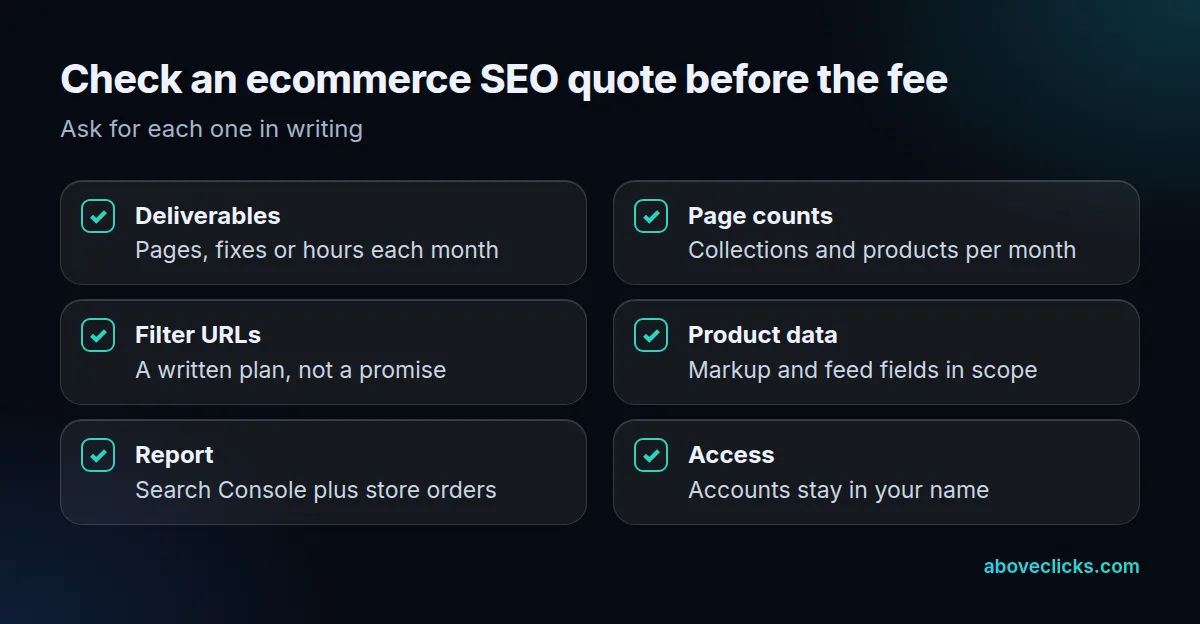
Test it against 6 written items: deliverables, page counts, a filter-URL plan, product data, the report and account access. A quote that cannot answer all six is a price, not a plan.
Our own published timing is a useful benchmark for ecommerce SEO packages. For our ecommerce SEO work the free audit arrives as a PDF within 2 workdays, the plan and first fixes in about a week, page work from week 2, and the first monthly report after 30 days. Whoever you hire, ask for a timeline that specific.
Then check the three most common costly mistakes:
- Vague deliverables. “Ongoing optimization” cannot be checked. A list of 4 collection rewrites and 2 guides can.
- No filter plan. If the quote never mentions filter, sort or variant URLs, the largest crawl problem in a store is untouched.
- Rankings-only reporting. A report with keyword positions but no orders hides whether the work paid back.
Product data is the item owners skip. Ask whether the package covers product markup and the fields Google reads, and whether those pages are tested after each template change. An ecommerce SEO package that names product data as a deliverable, with a test after each release, is easier to hold to account than one that lists “schema” as a bullet.
Access is the last item. Search Console and analytics should sit in your name, with the agency added as a user, so that ending the work means removing one user instead of chasing a password. The same applies to your store admin: use a staff account with limited permissions.
For a quote built on your own crawl rather than a tier name, the free audit gives you the list to compare against.
How long before the results show?
From a few days for small changes to several months for a whole store, and the report should say which is which. Google’s helpful content guide says some changes take effect in a few days, while it could take several months for its systems to confirm a site is helpful.
Three checks keep the report of any ecommerce SEO package honest, all as of October 2026:
- Recrawl time: recrawling can take a few days to a few weeks, so a fix logged on the 28th rarely shows in that month’s numbers.
- Core updates: Google suggests waiting at least a full week after an update finishes before analyzing the change.
- Seasons: set the Performance report to the last 16 months, as Google’s traffic drops guide suggests, and compare with the same months last year.
If 6 months pass with no dated fix log and no gains on the rewritten pages, ask for a written diagnosis. More comparisons are in buying guides.