A marketing agency with no hidden fees puts every charge in writing before you sign: the work, tools, creative, one-off fees and where ad spend is billed. You can test that claim with seven checks.
This guide gives you the fee lines every quote from a marketing agency with no hidden fees should list, a way to check ad spend against the platform’s own numbers, a checklist for who owns the accounts, and a routine for a charge that shows up later.
What is a hidden fee in a marketing agency quote?
A hidden fee is any charge you could not see in the quote you signed, such as a setup fee, a tool markup or an exit charge. A fee that is written down and explained is not hidden, even if you dislike it.
Hidden does not always mean dishonest, and a marketing agency with no hidden fees is one that closes these gaps before you sign. Often the quote simply left a line out, and the invoice filled it in. The result is the same for you: the bill is higher than the number you agreed to.
Marketing agency fees that go unmentioned tend to turn up in the same 5 places:
- A one-off setup or onboarding fee on the first invoice.
- Tool subscriptions billed on top of the monthly fee, sometimes at a markup.
- Creative, landing pages or video billed per item.
- Ad spend paid to the agency, which then pays the platform. In the worked example below, a $300 gap on $3,000 of spend is the kind of difference this causes.
- Exit costs, such as a fee to hand back your own accounts or files.
The marketing agency fees you see in a quote are only part of the bill. Our guide to digital marketing agency fees splits a bill into its layers and gives a formula for the true monthly fee. This guide covers the next step: proving that the quote you were given has no gaps.
Which fee lines should a marketing agency fee structure list?
Seven: the management fee, setup, ad spend, tools, creative, reporting and leaving. Each line needs an amount or the word none, written by the agency.
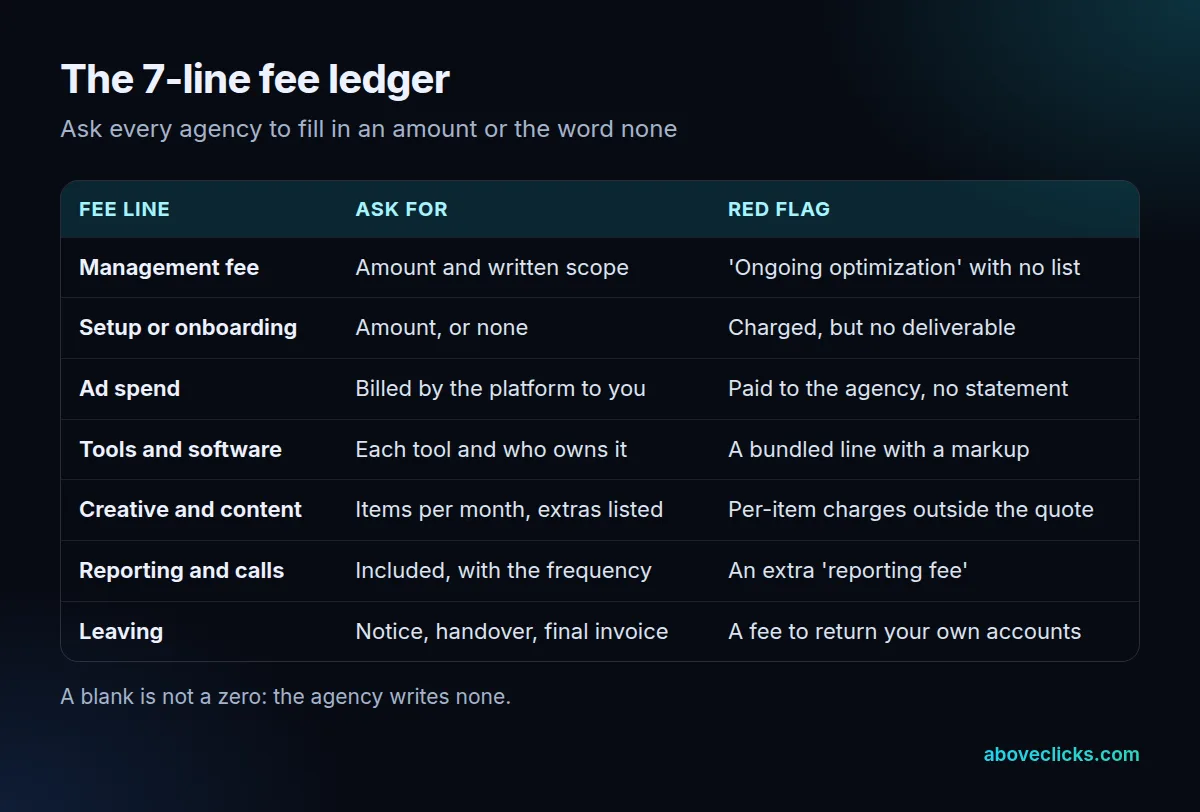
Send the same table to every agency you are considering. A clear marketing agency fee structure lets you add the seven lines and get one monthly figure. If a line comes back blank, treat it as an open question, not as zero. Ask for the reply within 7 days, so every agency answers on the same timetable.
Compare the first 3 months of marketing agency fees, not the first invoice. A low monthly figure with a setup charge can cost more over 3 months than a higher figure with none, and a quote that folds setup into the monthly fee can look dearer in month one and cheaper by month four.
Two lines cause most of the trouble. The first is scope: a management fee that says “ongoing optimization” does not tell you what you get each month. Ask for a list of deliverables, because a marketing agency fee structure without one cannot be checked. The second is leaving, because the cost of exit is rarely mentioned until you try to go.
Tools and creative are the next two. For tools, ask which subscriptions the agency uses on your account, whether you or the agency hold them, and whether they are billed at cost. For creative, ask how many items a month are included and what an extra item costs. Without those answers, a fixed fee can quietly turn into a variable one.
The way the management fee itself is billed, as a percentage of spend, a flat retainer or something else, is covered in our marketing agency pricing models guide. Check that first, then use the ledger to find the lines around it.
How do you check that ad spend is not marked up?
Compare the agency’s ad-spend line with the billed cost in the ad platform for the same dates. They should match, or the difference should be a fee you agreed to in writing.
Google Ads gives you a ceiling to test against. As of November 2026, Google says that for most campaigns the monthly spending limit is 30.4 times the average daily budget, and the daily limit is two times it. Its daily budget guide shows the same arithmetic backwards: divide a monthly amount by 30.4 to get the daily budget.
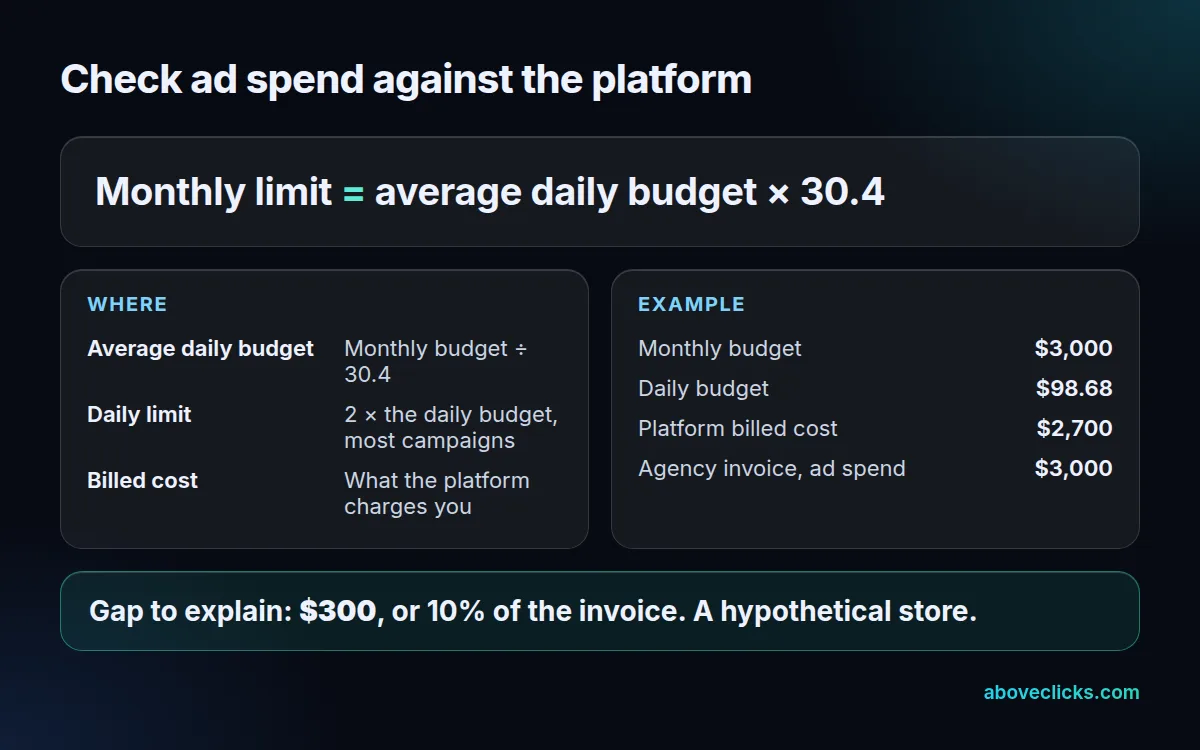
Here is a worked example for a hypothetical store, using the average daily budget rules as of November 2026. It plans $3,000 a month, so the daily budget is $98.68 and the monthly limit comes back to $3,000. The platform’s billed cost for the month is $2,700, but the agency invoice says $3,000 for ad spend. The $300 gap is 10% of the invoice, and the agency should explain it in writing.
Use billed cost, not served cost. Google explains that served cost is what the clicks or impressions were worth, while billed cost is what you owe after adjustments such as invalid activity. In rare cases served cost can pass the limits, but you do not pay more than the limits.
Do this once in month one, then every quarter, because ad spend is the largest part of the marketing agency fees you pay in total. As of November 2026, Meta shows the same data in a different place: people given finance access in a business portfolio can view transactions, invoices and account spend, according to Meta’s permissions guide.
Who should own the accounts in a marketing agency contract?
You should. The ad accounts, payment method and data belong in your name, and the agency should be added as a user with the access its work needs.
When we audit an existing setup, who owns the ad accounts is the first thing we check, using read-only access. It decides how easy it is to leave, and it is the part of a marketing agency contract owners read least.
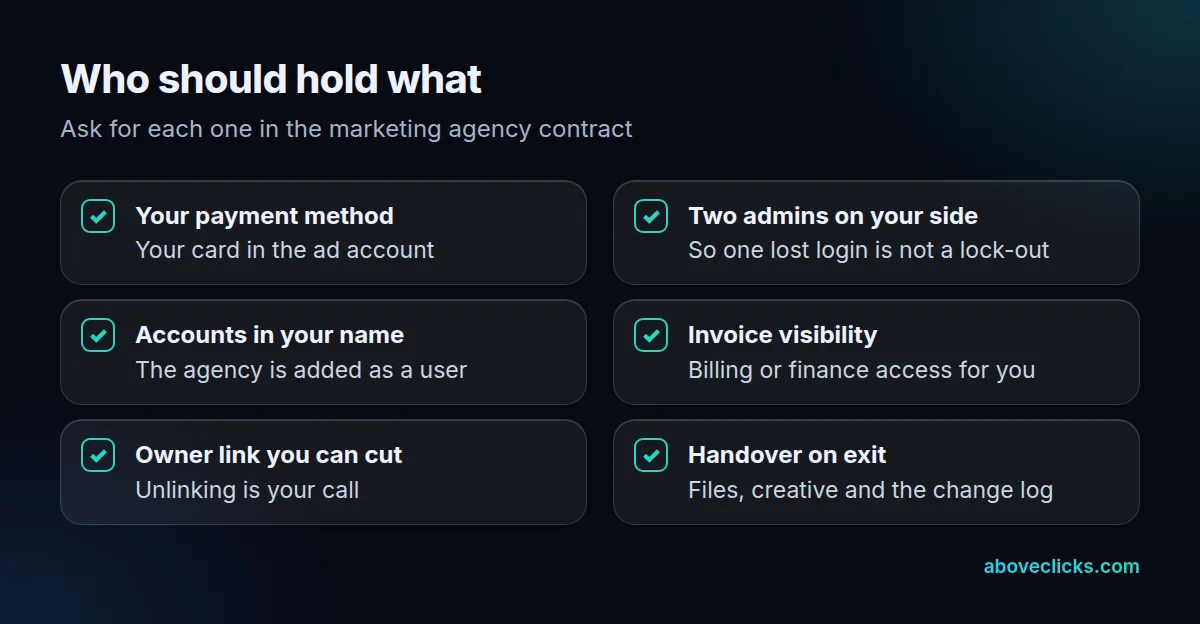
Google’s access levels make the split clear. Users with Billing or Admin access can add or edit forms of payment, while Standard access can edit campaigns but not the payment methods. So the agency can run campaigns without holding your card.
Keep at least 2 users with Admin access on your side. Google notes that an account with only one administrator can lose access to its tags if that user becomes unavailable.
If the agency uses a manager account, read how ownership works. A client account can have only one owner manager, but the client account keeps its data and can remove ownership by unlinking. Google also advises making a manager the owner only if it needs those privileges. In practice, link the agency and leave ownership off unless it is required. Even then, a manager account cannot change a client account’s sign-in information.
What should a marketing agency contract say about leaving?
It should say how you leave, what you get back and what the last invoice includes. Ask for these in writing before the first payment, and keep a copy with the signed quote.
Here are example terms to ask for. They are not our terms:
- Notice of 30 days, with no automatic renewal.
- A handover of all accounts, creative files and the change log within 14 days of the end date.
- A final invoice that lists each line against the signed quote.
- A statement that the work, accounts and data belong to you.
Read the clause on changes in the marketing agency contract too. A contract that lets the agency add fees with a short notice message turns a clear quote into a moving target. Ask that any new charge needs your written approval first.
How do you find a marketing agency with no hidden fees?
Ask three agencies for the same seven-line ledger, then compare what comes back in writing. The agency that answers all seven lines within 7 days is the one making a testable claim, so a marketing agency with no hidden fees should find this easy.
A short process keeps it fair:
- Send the ledger to three agencies and give them the same date to reply.
- Ask for a sample invoice and a sample report. Ours is the sample report, if you want to see what a report looks like.
- Ask where ad spend is billed, and who owns each tool.
- Count the lines answered in writing. If fewer than five of the seven are, do not sign.
- After month one, run the ad-spend check against the platform, and again every 3 months.
For the wider list of things to ask before you hire, our questions to ask a marketing agency guide has a scorecard. If you want a written plan for your own store to hold quotes against, the free audit is a starting point.
What should you do if a fee appears after you sign?
Compare it to the signed quote, ask for an explanation in writing and hold payment on that line until you get one. This is general guidance, not legal advice.
A routine that keeps it calm:
- Find the line in your signed quote. If it is there, the question is about the amount.
- Ask the agency in writing what the charge covers and when you agreed to it. Ask for a reply within 14 days.
- For ad spend, pull the platform’s billed cost for the same dates and compare it.
- Ask for the charge to be removed or credited if the quote never listed it.
- If it is not resolved, use the notice clause and plan the exit while you keep your accounts and admin rights.
Platform billing pages also help with disputes that concern account fees, because they show what the platform itself charged.
Finally, fix the cause. Add the missing line to the ledger and to the next marketing agency contract, so the same charge cannot arrive twice. More comparisons are in our buying guides.