The most effective real estate marketing is whatever books the most qualified appointments for each dollar and hour spent, not whatever brings the most leads. Judge every channel by that one number, and the order of what to do first becomes clear.
This guide to real estate marketing ranks five channels by the job each one does, works through an example where the cheaper lead is the dearer appointment, and lists the advertising rules to check before you launch.
What is the most effective real estate marketing?
The one that turns into signed listings and closed sales at the lowest cost per appointment. For most agents that is past-client follow-up and a verified Google Business Profile first, with paid ads added and measured after that.
The reason is who you are selling to. In the National Association of REALTORS’ 2026 Profile of Home Buyers and Sellers, 90% of buyers used an agent or broker, and 92% of sellers did. Only 5% of sellers went for-sale-by-owner. Most people have already decided to hire an agent, so real estate marketing mostly decides which agent they choose, and the most effective real estate marketing makes you the easy choice.
That changes what you measure. Followers, impressions and even raw lead counts are inputs. The outputs are conversations held, appointments booked and listings signed. Every channel below is ranked by how well it produces those, and the rest of the guide shows how to compare them.
The answer also depends on who you are. An individual agent with a small past-client list gets the most effective real estate marketing from referrals and local search. A developer selling 40 units needs paid search and social to fill a project, plus a fast follow-up team. The channels are the same; the order changes. Our real estate digital marketing page shows how that plays out by segment.
What is the best way to market real estate?
There’s no single best channel, only a best channel for each job. Referrals and your Business Profile win trust, search ads catch people ready to talk now, and paid social builds awareness. Fast follow-up turns any of them into a visit.
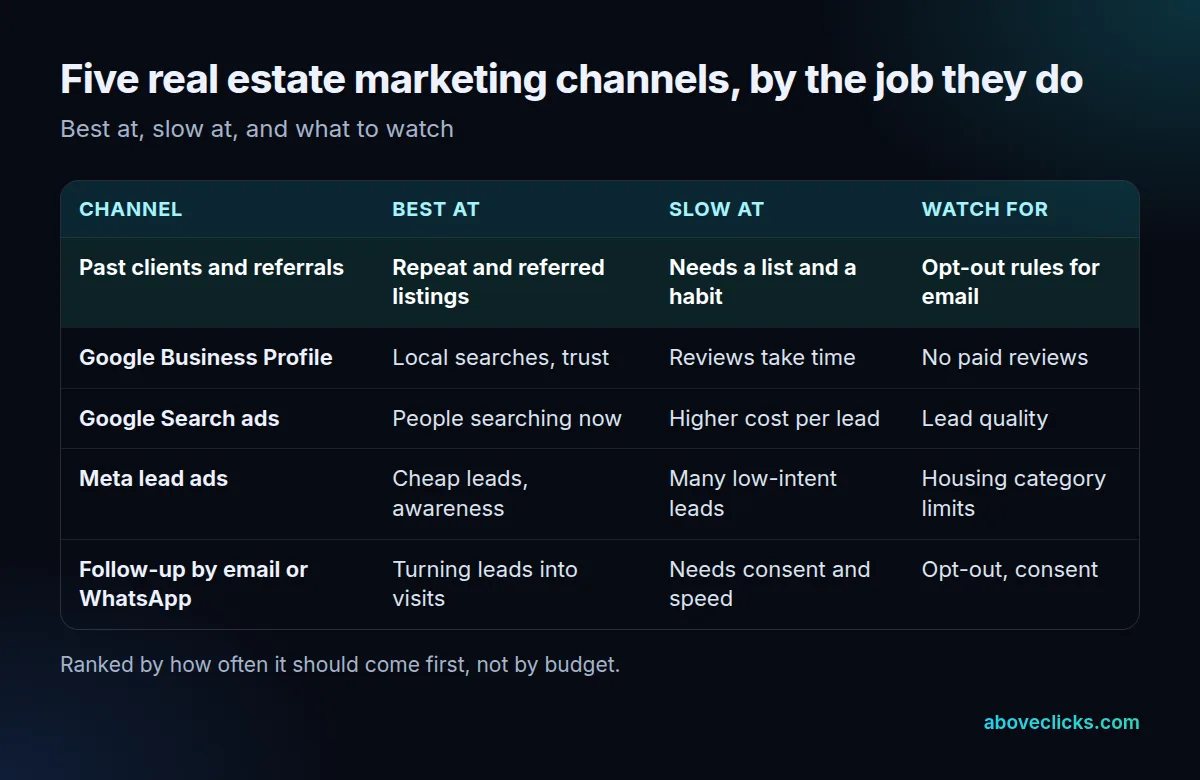
Read the real estate marketing table by job, not by row. If you have no list of past clients, build one before you buy a single ad. If you already hear from past clients each year, a Business Profile and follow-up routine will do more than a new paid channel.
A simple order for a new agent with 3 to 5 hours a week:
- Week 1: list past clients and claim your Google Business Profile.
- Weeks 2 to 4: send a first note to the list and ask 3 happy clients for a review.
- Month 2: start one paid channel with a small test budget.
- Month 3: compare cost per appointment and keep, fix or stop it.
These real estate marketing strategies also stack, and 5 channels is plenty to manage. A Meta ad creates the first contact, a WhatsApp message books the visit, and a happy client later refers a neighbor. The rest of this guide takes the channels one at a time.
How do you advertise a real estate listing on Facebook?
Run it as a Meta lead or traffic campaign with the housing special ad category selected, and write copy that works for anyone. Meta limits the targeting options on housing ads, so a listing ad can’t be aimed as tightly as a shoe ad.
Meta’s Special Ad Category guide says that for housing ads in the US, Canada and certain European countries, these options are limited or unavailable: age, gender, ZIP or postal code, exclusion targeting, lookalike audiences and saved audiences. City and pin-drop audiences also get an expanded radius. Meta encourages advertisers to broaden, not restrict, the audience.
In practice you win on the creative and the offer, not the targeting. Our own real estate marketing campaigns follow the same rule: one listing, 2 or 3 creative versions, and a single clear next step. Show the property, the price range or the neighborhood, state the next step, and make it easy to book a viewing. Test 2 or 3 versions of a photo and headline for at least 7 days, then keep the one that books appointments, not the one with the cheapest click. Real estate marketing on Meta works best when the whole audience can see the offer.
How do you generate real estate leads?
Pair a channel that finds interested people with a form or call that captures them, then follow up within minutes. Real estate lead generation fails mostly after the form is filled, when nobody replies fast enough. Good real estate lead generation is a loop, not a form.
Google lets you add lead form assets to Search and Performance Max campaigns, so people can leave contact details without visiting a site. Meta has lead forms of its own. Both usually deliver more leads than a plain landing page, and often lower-intent ones. Treat the form as the start of a conversation: ask 2 or 3 short questions, such as budget range and timing, so you can sort the 10 serious leads from the 40 casual ones.
Our published numbers show the gap. For September 2026, anonymized real estate accounts on our real estate industry page show 486 Meta leads at $10.03 each, while a Google Search account recorded conversions at $60.32 each. Judging real estate lead generation by cost per lead alone, Meta wins. Cost per appointment can say the opposite.
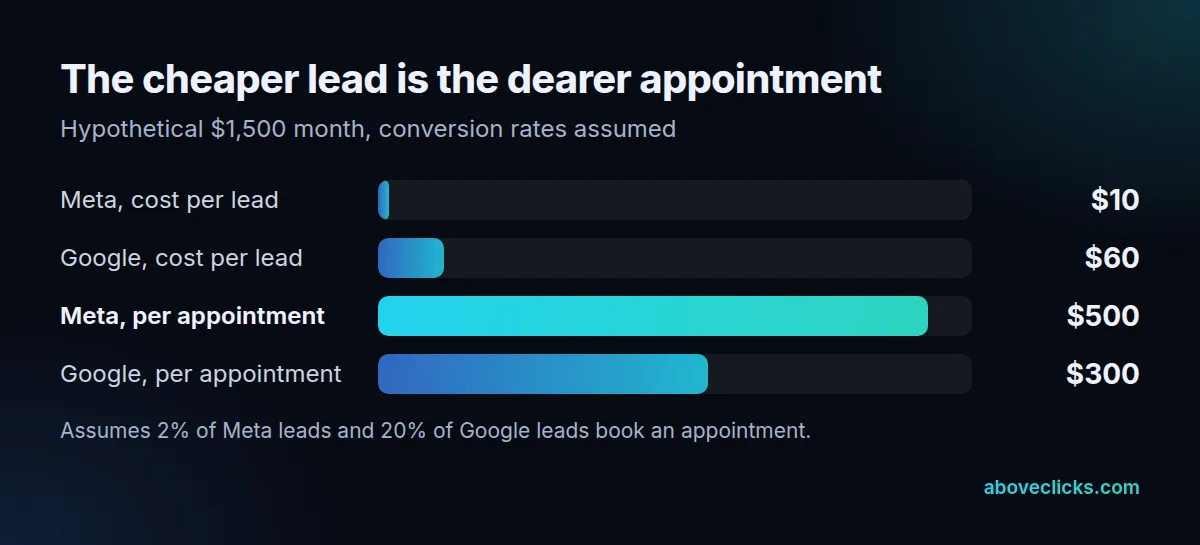
Here is a hypothetical $1,500 month. Meta at $10 a lead buys 150 leads. If 2% book an appointment, that is 3 appointments, or $500 each. Google at $60 a lead buys 25 leads. If 20% book, that is 5 appointments, or $300 each. The rates are assumed, not measured, so replace them with your own.
Two habits make the comparison honest. First, record what happened to each lead: reached, booked, visited, signed. Second, call or message fast. Our lead generation ads service is built around that loop, and a cost per acquisition calculation gives you the same number for any channel.
How does real estate referral marketing work?
By staying in touch with people who already trust you, so you are the agent they think of and mention. It costs little money and a steady routine, which is why it ranks first for agents who already have clients. Among real estate marketing strategies, it is the one a competitor can’t copy by buying more ads.
NAR’s 2026 data explains why it compounds. Home sellers have now owned their home for a median of 12 years before selling, an all-time high, and buyers and sellers who are happy with their agent are more likely to recommend them or use them again. A client you helped 12 years ago is a future listing, so you need a way to reach them.
A simple real estate marketing routine works:
- Keep a list of every past client with an address, an email and the date you worked together.
- Send a short, useful note a few times a year, such as a local market update.
- Ask satisfied clients for a review and an introduction, once, at a good moment.
- Reply to every referral within the hour and tell the referrer what happened.
Email carries its own rules, covered in the real estate advertising rules section below. For quick replies to leads and past clients, WhatsApp automation can send the first answer while you are at a showing.
Can a real estate agent have a Google Business Profile?
Yes, if you serve customers at a location or in an area you can verify, and a complete, verified profile helps you appear in local searches. Check Google’s current rules for your business type and area before you set one up.
Google’s local ranking tips list four things to do: verify the business, keep information complete and accurate, respond to reviews, and add photos and videos. Businesses with complete and accurate information are more likely to show up in local results, and verification tells Google you are authorized to represent the business.
A profile with 4 jobs done well is a better asset than a half-filled one with 40 photos. Reviews are the part agents get wrong. Google’s review guidance says offering free or discounted goods or services in exchange for reviews is prohibited, so ask for honest reviews and never reward them. Replies should be short, specific and professional rather than the same thank-you every time.
What are the real estate advertising rules?
The federal Fair Housing Act, each ad platform’s housing policy, email law and your state licensing rules all apply together. This is general information, not legal advice, so confirm details with your broker or a lawyer.
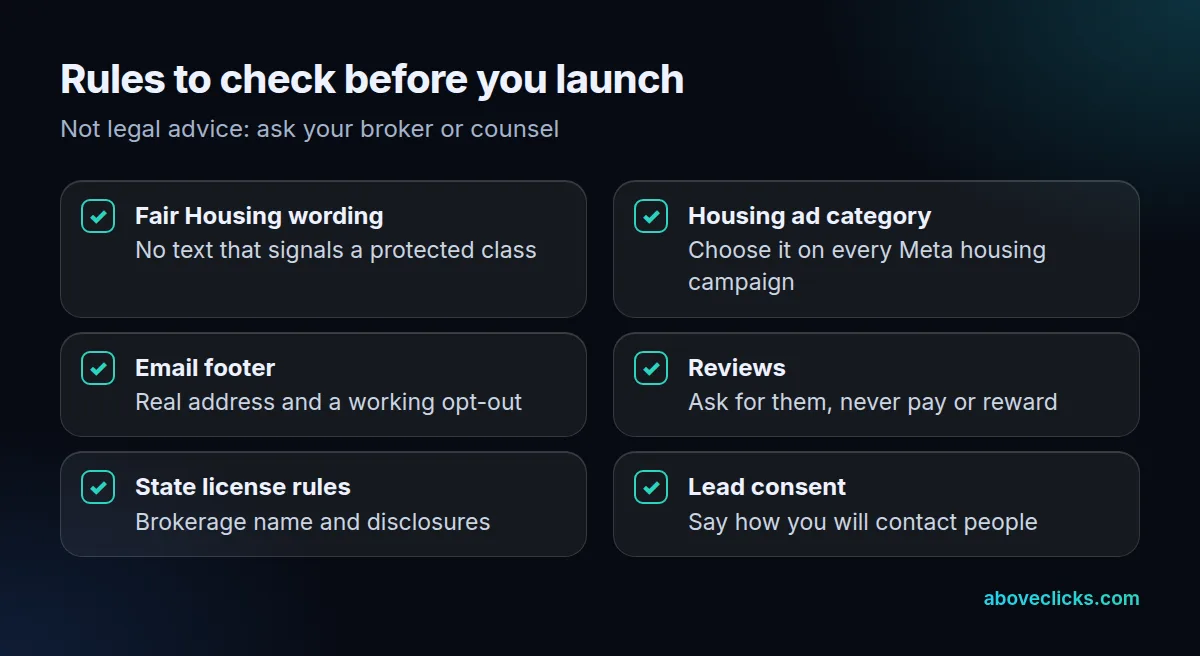
The Fair Housing Act prohibits housing discrimination because of 7 things: race, color, national origin, religion, sex, familial status and disability. Ad copy, photos and targeting should not signal a preference or limit based on any of them. Meta adds its own housing category limits, described above.
Email has a federal floor too. The FTC’s CAN-SPAM guide requires accurate header information, a valid postal address and a clear way to opt out, and says opt-out requests must be honored within 10 business days. State regulators also set their own advertising rules, such as how your brokerage name appears, so ask before you publish.
Two habits keep real estate advertising rules from becoming a late surprise. Keep a one-page copy checklist next to every ad template, so wording is checked once instead of per listing. And save the final version of each ad and email with its date, so you can show what ran if anyone asks.
What is a good return on real estate marketing?
A good return on real estate marketing is one where cost per appointment falls over a quarter and some of those appointments become signed listings. There’s no universal benchmark, because it depends on your market, price range and how fast you follow up.
Track three numbers every month for each channel: spend, appointments booked and listings or sales signed. Divide spend by appointments, then by signed deals, and compare channels on the same lines.
For example, if a $1,200 month books 4 appointments and signs 1 listing, that is $300 per appointment and $1,200 per signed listing. If a second channel spends $600, books 1 appointment and signs nothing, its $600 per appointment looks worse even though it spent less. The most effective real estate marketing is the line that keeps both numbers falling. A channel that looks poor in month 1 may be filling a pipeline that signs in month 4, so judge it over at least 3 months.
A quick decision rule for real estate marketing strategies: keep a channel if its cost per appointment is stable or falling and the appointments are the kind you want. Pause it if leads pile up unanswered, and fix the follow-up before adding budget. If you want a second opinion on where your numbers stand, our real estate marketing team offers a free audit of your ads, pages and lead quality, and you can read more in Meta ads guides.