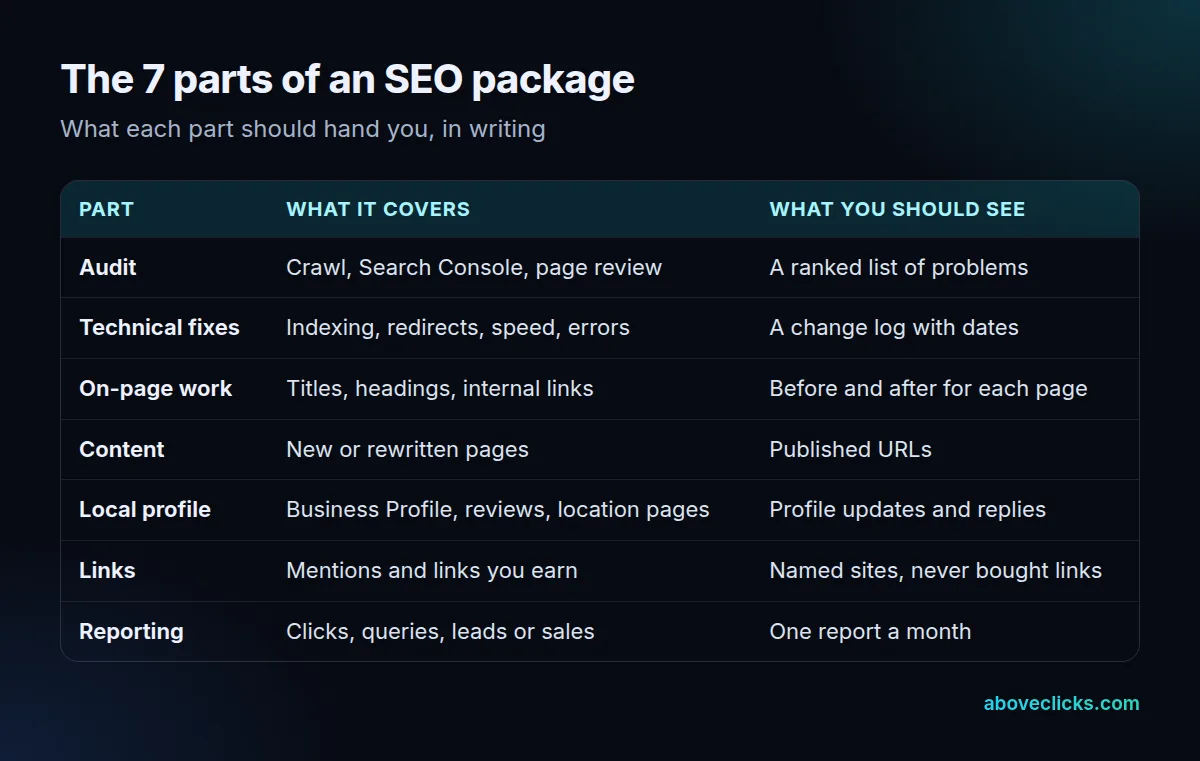
SEO packages for small business bundle up to 7 kinds of work: an audit, technical fixes, on-page changes, content, a local profile, links and reporting. The right small business SEO package is the one whose parts match how your customers find you, not the one with the longest list.
This guide breaks small business SEO packages into those parts, shows which ones a local service business, an online store and a B2B firm need, and ends with a worksheet for comparing two quotes. There are no prices here on purpose: the worksheet works with whatever a quote says.
What do SEO packages for small business include?
Most include 4 or 5 of these 7 parts: audit, technical fixes, on-page work, content, a local profile, links and reporting. The package name tells you little; the monthly list of delivered items tells you a lot.
Google’s own page on hiring an SEO lists 8 kinds of help a professional can offer, from a review of your site’s content and structure to keyword research, content development, SEO training and advice on generative AI features. A small business SEO package is usually a fixed slice of that list, repeated every month.
- Audit: a crawl of the site, a look at Search Console and a ranked list of problems, usually in the first 30 days. Good audits rank problems by how many pages or visits they affect.
- Technical fixes: indexing problems, broken redirects, error pages and slow templates. Each fix should appear in a dated change log.
- On-page work: titles, headings, internal links and the copy on the pages that already get impressions.
- Content: new pages or rewrites aimed at the questions buyers search for.
- Local profile: your Google Business Profile, review replies and location pages.
- Links: mentions and links earned from real sites, such as suppliers, local press or trade bodies.
- Reporting: 1 report a month showing clicks, search queries and the leads or sales they brought.
Which parts matter for your kind of business?
The parts that match how buyers reach you: the local profile for a service business, product and category pages for a store, content for a B2B firm. Everything else in SEO packages for small business is useful, but it can wait for month 3 or 4.
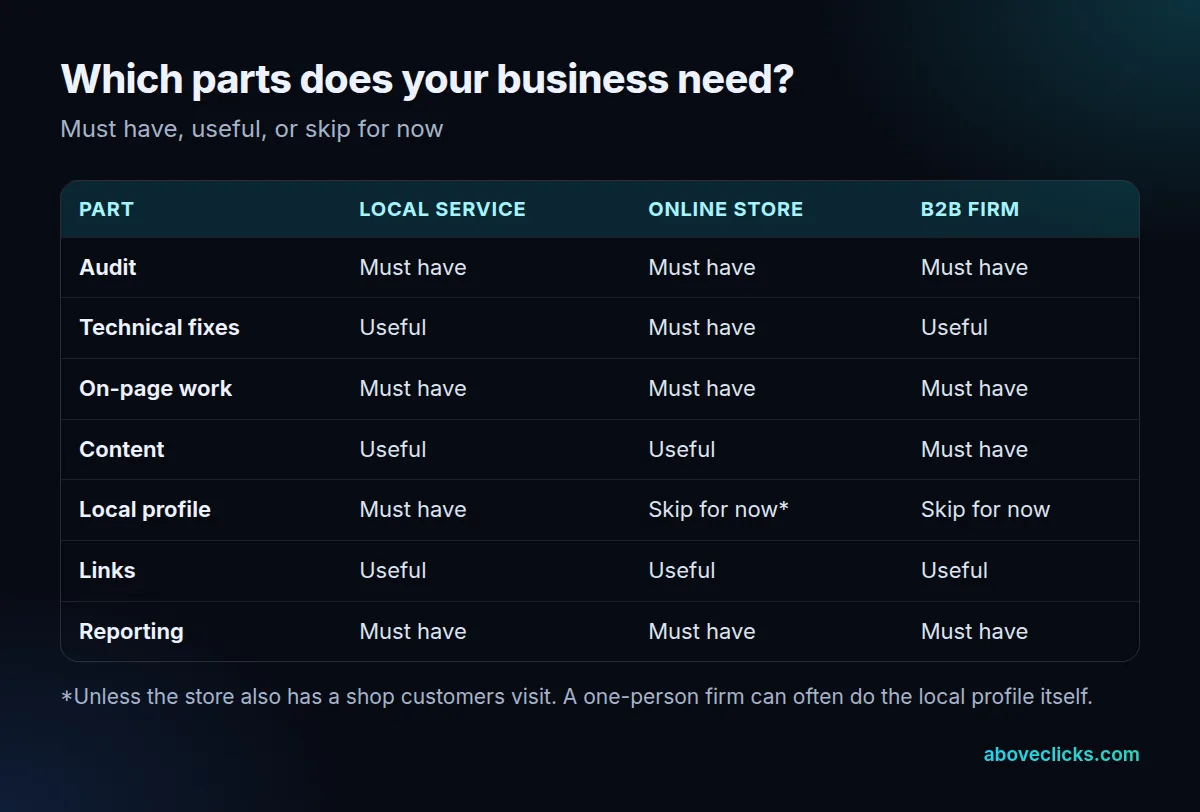
A plumber, dentist or salon competes in the map results. Google says local results are mainly based on relevance, distance and popularity, so a complete profile, real reviews and accurate hours do more than a monthly blog post. Our retail local SEO work starts there for the same reason, and a local small business SEO package should too.
An online store lives on its category and product pages. Technical fixes matter more here, because filters and sorting on a store with 500 products can create far more URLs than there are products, and they compete with each other. A B2B firm sells to people who research for weeks, so it needs pages that answer their questions, and fewer location signals.
Use the scorecard to cross out parts you don’t need, and bring it to the first call so the agency explains any part you’ve marked as skip. A small business SEO package that charges for a local profile you already manage well, or for blog posts when your 20 category pages are thin, spends your budget on the wrong 2 lines.
How much does SEO cost for small business owners?
It depends on how many pages, locations and competitors the work has to cover, and on who does it. We don’t quote figures here: a number without your scope attached is a guess, and published ranges age within months.
So the honest answer to “how much does SEO cost for small business” is a question back: how much work does your site need? Three things move a quote more than the package name:
- Scope: a 10-page service site and a store with 2,000 products are different jobs, even under the same tier name.
- Locations: each extra location usually means another profile, more reviews to answer and its own page.
- Who writes: content written by a specialist who knows your trade costs more per page than templated text, and usually earns more.
Remember what you’re not paying for. Google says it never accepts money to include or rank sites in its organic results, and appearing there costs nothing. What small business SEO packages sell is the work. The pricing models guide explains retainers, hourly and project fees, and our ecommerce SEO page shows its starting price cards with what each one covers.
What should one month of work produce?
A list you can check: pages changed, fixes logged, content published and a report that ties them to clicks and enquiries. If a month ends without that list, ask what was done before the next invoice.
Results lag behind the work. Google’s starter guide says some changes take effect in a few hours and others can take several months, and suggests waiting a few weeks before judging a change. So month 1 of most SEO packages for small business is audit and fixes, and the report in month 3 is the first fair test.
What a good monthly report shows:
- Clicks and impressions from Search Console. Its Performance report shows the past 3 months by default, so ask for the same window each time.
- The 10 to 20 queries that moved most, up or down.
- Every page changed that month, with the date.
- Leads, calls or orders from organic search, if your tracking records them.
Ask, too, how the agency decides what to work on next. A good answer points at the report: pages with many impressions but few clicks get new titles first, and pages that lost clicks get checked for technical problems before anything new is written. A vague answer, such as “ongoing optimization”, gives you nothing to check at the end of the month.
Our sample report uses that format.
Are affordable small business SEO packages worth it?
Some are: a small, honest scope at a low fee can be good value. The affordable small business SEO packages to avoid are the ones that reach their low price by promising rankings, buying links or buying reviews.
| Red flag | Why it costs you | Source |
|---|---|---|
| “Number 1 on Google, promised” | Google says no one can promise a #1 ranking | Google’s hiring advice |
| “500 backlinks a month” | Buying links for ranking is link spam | Google spam policies |
| “We’ll get you 50 five-star reviews” | Paid or incentivized reviews are removed from Maps and banned by the FTC rule | FTC 2024 rule, Maps policy |
| “Submission to 1,000 search engines” | Google calls this a useless exercise | Google’s hiring advice |
The link line matters most. Google’s spam policies name buying or selling links for ranking purposes as link spam, and a site caught doing it can lose its rankings rather than gain them.
Reviews carry legal risk too. On 14 August 2024 the FTC announced a final rule that bans buying fake reviews and paying for reviews that express a set sentiment, with civil penalties for knowing violators. Google’s Maps policy removes reviews that were paid for or traded for discounts. Asking every real customer for an honest review is fine; paying for 5 stars is not.
What can you do yourself before you buy?
More than most packages admit: Google says the owner of a small local business can probably do much of the work, starting with its SEO starter guide. Doing the basics first also makes any later small business SEO package cheaper, because the audit finds less.
A 4-step start that takes a few hours:
- Claim and complete your Business Profile: category, hours, services, photos.
- Verify your site in Search Console, so you own the data before anyone else touches it.
- Give each service or product group its own page with a clear title.
- Ask your last 10 customers for an honest review.
If you hit something technical, such as pages missing from Google or a redesign on the way, that’s the point where paid help earns its fee. Google even names a redesign as a great time to hire, the earlier the better.
How do you compare two package quotes?
List what each one delivers every month, then divide the fee by those items. Two SEO packages for small business with the same name can deliver very different amounts of work.
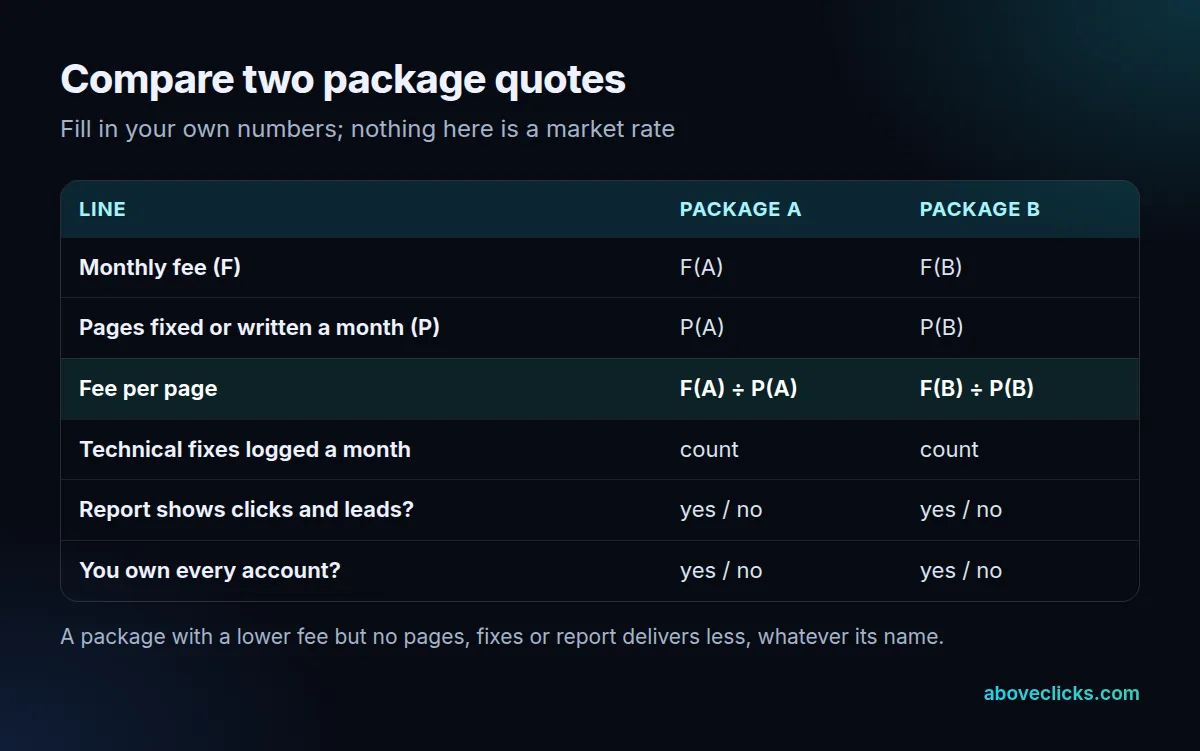
- Write each package’s monthly fee next to its delivered items: pages, fixes, posts, profile updates.
- Divide the fee by the pages fixed or written. That’s the fee per page. Work it out over 3 months, because month 1 is mostly audit.
- Mark whether the report shows clicks and leads, or only rankings.
- Check who owns the accounts. In Search Console, keep yourself as owner and add the agency as a full or restricted user you can remove.
- Ask what happens in month 1: an audit with a written list, or “setup”.
When we run an audit, we ask for read-only Search Console access plus a crawl, never passwords, and send a PDF report within 2 workdays. That matches Google’s advice to grant read access only at the audit stage. Any agency selling small business SEO packages should be comfortable with the same limits. If you’d like ours, the free audit is that report. More guides like this one are in buying guides.