A one time SEO package is a fixed SEO project with a set list of fixes and an end date, paid once. Judge one by what it hands over, because a report that lists problems without fixing them is not a finished project.
This guide explains what a one time SEO package should include, how long the work and the results take, what moves the price, the costly gaps to check for, and when a monthly arrangement fits better.
What is a one time SEO package?
A single, scoped SEO project: an audit, a defined set of fixes and a handover, after which the agency stops working on the site. You pay for the project, not for months of time.
Most one time SEO work falls into one of three shapes:
- Audit and fixes: technical problems found and corrected, such as broken links, missing titles, duplicate pages and indexing errors.
- Redesign or migration support: a redirect map and checks before and after a new site or platform goes live.
- Page rewrite batch: a fixed number of existing pages rewritten around the searches they already get impressions for.
Google’s own guide on hiring an SEO names a redesign or a new site launch as a great time to hire, and adds “the earlier, the better”. That is exactly where a one time SEO package earns its fee: a fixed piece of work with a clear finish line.
Scope decides whether the work fits a single project. A worked example: a 40-page service site with 25 missing meta descriptions, 12 broken internal links and 3 pages competing for the same search is a short, well-defined list, and a one off SEO project can clear it. A store with 3,000 product URLs and new items every week has a list that never ends, which points to ongoing work instead. Count the pages and the open problems before you ask for quotes, so every agency prices the same job.
What should a one time SEO package include?
Five deliverables, in writing: a ranked problem list, a log of the fixes actually made, a page map, a redirect map when URLs change, and a re-check report after the work ends. If any of them is missing, the one time SEO package is only partly done.
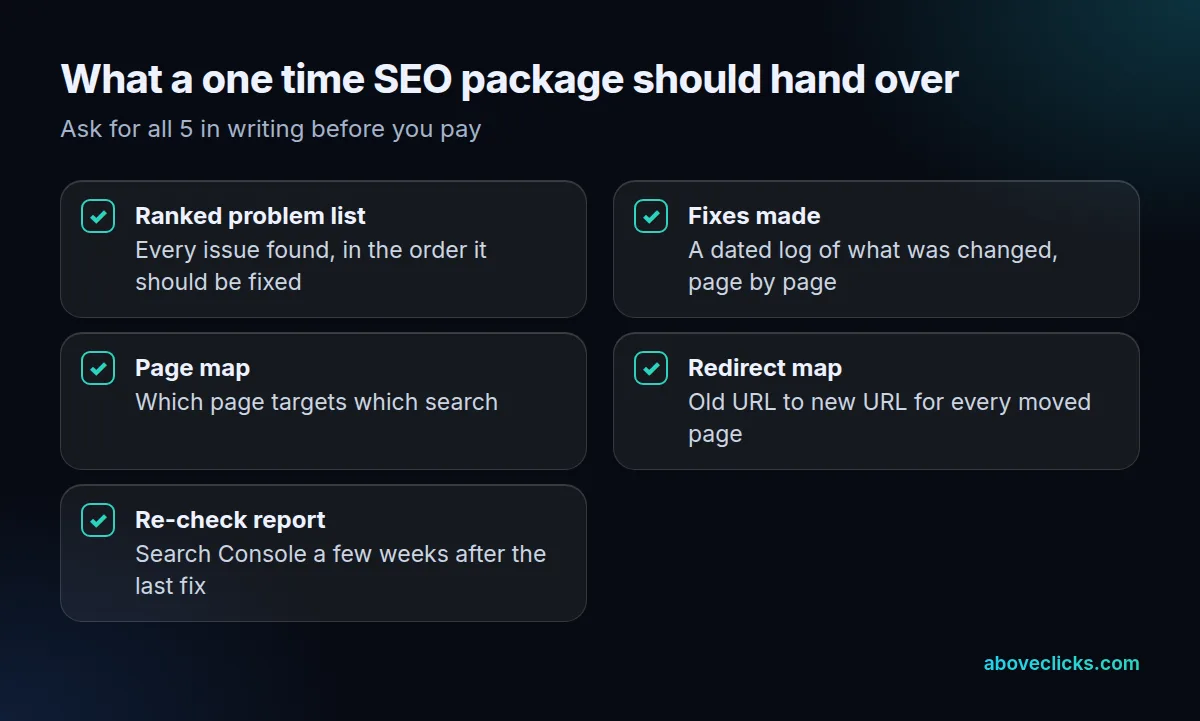
The problem list is the easy part, and some packages stop there. The fix log is what separates an audit from an SEO project: it says which pages were changed, what changed and on what date. On our own ecommerce SEO work, the audit arrives as a PDF within 2 workdays and the fixes are made on a copy of the theme before they go live, so every change can be checked first.
The page map assigns each target search to 1 page, so two of your pages don’t compete for the same query. The redirect map matters whenever URLs change. Google’s site move guide says a small to medium-sized site can take a few weeks for most pages to move, and larger sites take longer, so a missing redirect can cost traffic for weeks before anyone notices.
Ask for ownership too. In Search Console, a property must have at least 1 verified owner, and a verified owner proves ownership with a token such as an HTML file on the site. Keep your own login as the owner and add the agency as a user; when the one time SEO package ends, remove that user and any token the agency added.
How long does a one time SEO project take to show results?
The work itself usually takes a few weeks; the results take longer, because Google has to recrawl the changed pages first. Plan the re-check report for after that wait, not on the last day of the project.
Google’s recrawl guide says crawling can take anywhere from a few days to a few weeks. Its guide to traffic drops adds that some changes take effect in a few days while others could take several months, and suggests waiting a few weeks before analyzing the site in Search Console again.
That gives a simple timeline for any one off SEO project:
- Weeks 1 to 2: audit, problem list and page map.
- Weeks 2 to 6: fixes, rewrites and redirects, logged as they go live.
- About 4 weeks after the last fix: the re-check report.
For the re-check, set Search Console’s Performance report to the last 16 months, as Google recommends, so a seasonal dip isn’t blamed on the work. Compare the 3 months after the fixes with the same 3 months a year earlier.
What drives the cost of a fixed SEO project?
The number of things actually fixed or written, not the length of the report. Site size, how many fixes need a developer and how many pages are rewritten move the price far more than the audit does.
We don’t publish market ranges here; they change too fast to stay true. Instead, fill the worksheet below for each quote you get.
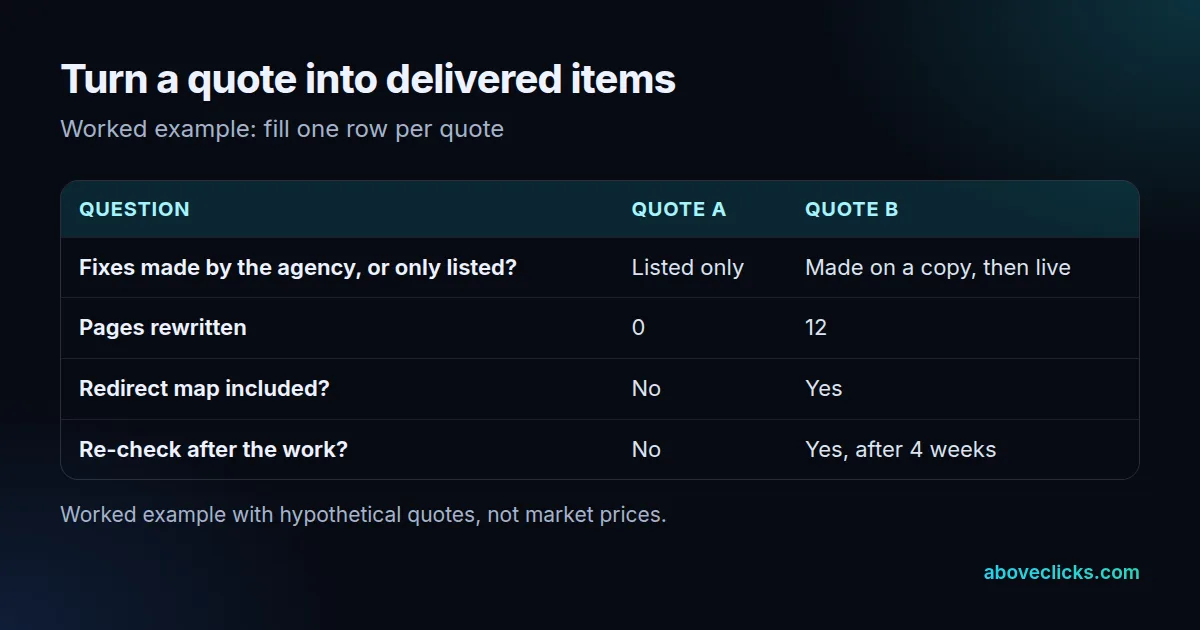
In the worked example, Quote B costs more but makes the fixes, rewrites 12 pages and re-checks after 4 weeks. Divide each quote by its delivered items and Quote A can turn out to be the expensive one. Three questions sharpen any quote:
- Does the agency make the fixes, or only list them for your developer?
- How many pages are rewritten, and who writes them?
- Is a re-check after the work part of the price?
Audits on their own are covered in our SEO audit cost guide, and the pricing models guide explains fixed fees, retainers and hourly billing side by side. Our own starting price cards are on the ecommerce SEO page.
What are the costly gaps to check in a quote?
Fixes that are listed but never made, URL changes without a redirect map, no re-check after the work, and accounts left in the agency’s name. Each one leaves you paying for work you can’t use.
Check every quote for these 4 gaps before you sign:
- Listed, not made: a 60-page audit with no fix log is a to-do list for your own team.
- No redirect map: moved or deleted pages lose the links and clicks they had.
- No re-check: without a report a few weeks later, nobody knows if the fixes worked.
- Ranking promises: Google’s hiring guide says no one can promise a #1 ranking on Google, and warns against anyone who claims a “special relationship” with Google. Treat either as a reason to look elsewhere.
The first gap is the most common. A problem list hands the work back to you: someone on your side still has to change the titles, fix the links and set up the redirects. If your developer bills by the hour, that second bill can be bigger than the first. Ask the agency to name, for each item on the list, who makes the change and by what date.
The second gap shows up later. Pages removed during a clean-up without a redirect keep their old links pointing at an error page, and visitors from those links land nowhere. Ask for the redirect map as a spreadsheet of old URL and new URL, and spot-check 10 rows yourself after launch.
The third gap is about proof. Without a re-check, a one time SEO package ends on the day the work stops, before Google has recrawled anything. A report a few weeks later, built on the same Search Console data, is the only way to see whether the fixes changed impressions and clicks.
A one time SEO package that closes all 4 gaps is easy to judge: you can open the fix log, click through the redirects and read the re-check yourself.
When is a monthly SEO package a better fit?
When your site keeps changing. A one-off project fixes a fixed list; a site that adds products, pages or locations every week creates new problems after the project ends.
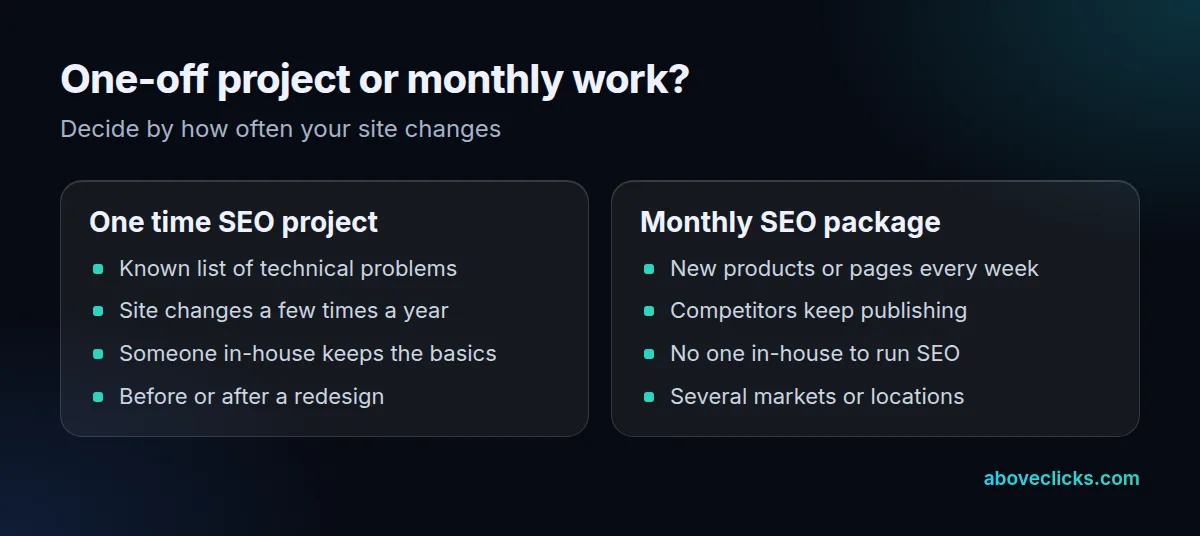
A one time SEO package suits a site that changes a few times a year, has someone in-house to keep the basics in order, or is about to go through a redesign. A monthly SEO package suits a store that adds new products every week, competes with sites that keep publishing, or sells in several markets.
A quick test is to count how many new or changed URLs your site had in the last 12 months. Search Console’s Performance report keeps 16 months of data, so you can see how many pages got their first impressions in that time. If it is a handful, a one time SEO package plus a yearly check is usually enough. If it is 50 or more pages a year, the problems a project fixes will come back, and a monthly plan keeps up with them.
Many businesses do both in order: a one time SEO project first, to fix the base, then monthly work once the fix log shows what’s left. If you want to see which list your own site needs before paying for either, our free audit reads your Search Console with read-only access and sends a PDF within 2 workdays. More guides are in buying guides.