The best LLM SEO tracker is the one that passes eight checks on your own prompts. An LLM SEO tracker asks AI assistants a fixed list of prompts on a schedule and records whether the answers mention, cite or link to your brand.
This guide does not rank brands. It shows what these tools measure, why their numbers move, an eight-point scorecard, a 14-day trial, what no tracker can see and when a spreadsheet is enough.
What does an LLM SEO tracker measure?
Mentions, citations and linked pages across a fixed set of prompts. Most tools turn those counts into a share-of-answers figure, which is a sampled estimate and not a census of everything people ask.
Three things get counted. A mention is your brand name in the answer text. A citation is a link to one of your pages. A recommendation is a mention that frames you as a good choice. Keep them in separate columns, because a brand can be named often and never linked.
Answers also share credit. Pew found that 88% of Google’s AI summaries in its March 2025 sample cited three or more sources, so several brands can appear in one answer. The glossary entry on AI share of voice has the formula and a worked count.
Trackers differ most in how they score the third kind. Some count any mention as a win, others read the sentence around it. Ask which one a tool uses before you compare two shares, because a 15% mention share and a 15% recommendation share are different claims.
Why do LLM SEO tracker numbers change between runs?
Because the answers change. Google says AI Mode and AI Overviews may use different models and techniques, so the responses and links they show will vary, and the same prompt can return a different answer an hour later.
This is why a ranked list of the best LLM SEO trackers can mislead: the order depends on the prompts the writer used. Add the tool’s own choices: which engines it asks, which country it uses, whether it is logged in and how many times it repeats a prompt. Two LLM SEO trackers can both be honest and still report different shares for the same brand.
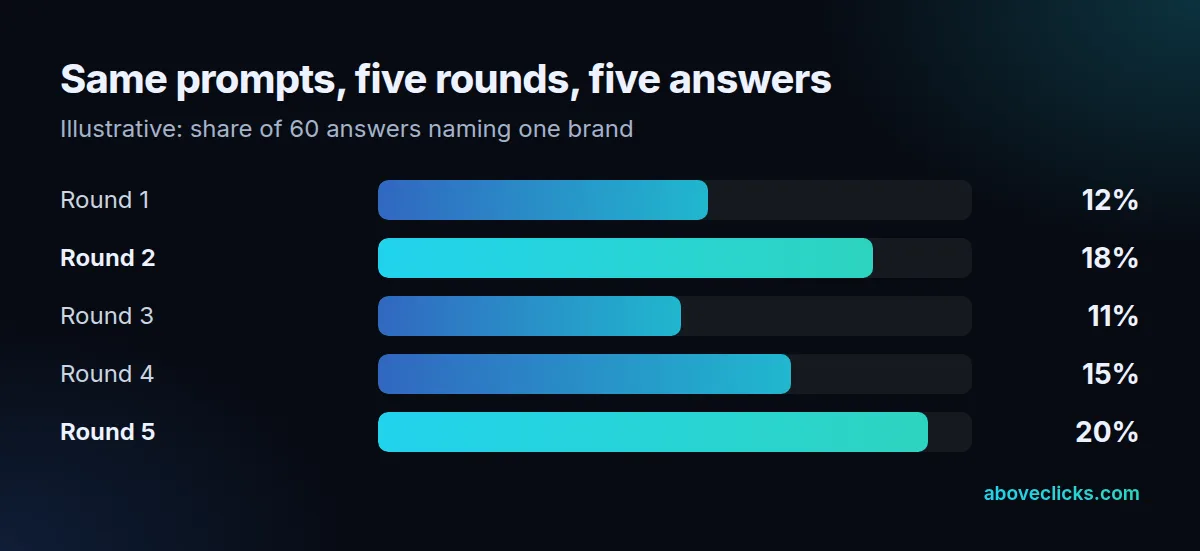
The example above is illustrative: one brand, 60 answers a round, five weekly rounds. The figure moves between 11% and 20% with no change to the site. A jump of two or three points between rounds is noise, so this is the first costly trap: reading one round as a result.
What should the best LLM SEO tracker cover?
Eight things, each a yes or no on your own prompts. A tool that fails the first four can’t give a usable trend, however good its dashboard looks.
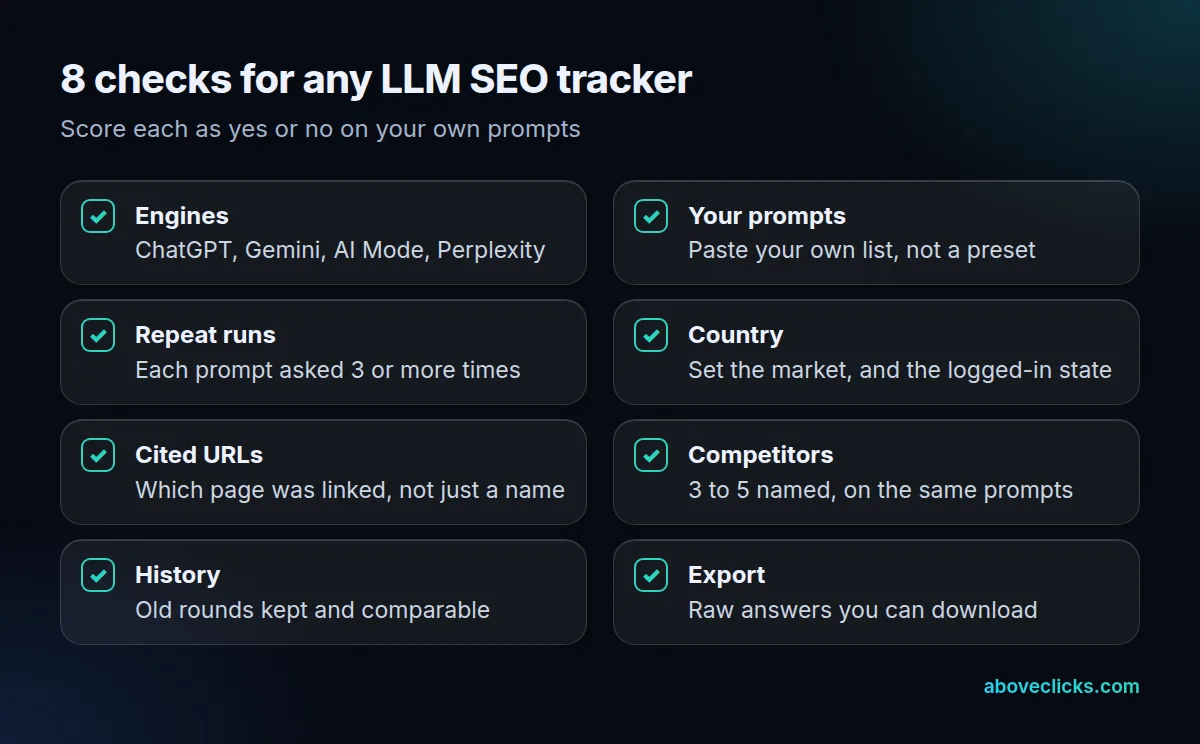
Run each check in the trial below, not from the sales page. The checks are short, but each hides a question a vendor may not answer in a demo. Most of the best LLM SEO trackers pass the engine check and fail the repeat-run one, which hides the noise. Two checks matter more than the rest:
- Your prompts: a preset list measures somebody else’s market. Start from the questions your buyers type, such as price, comparison and trust questions.
- Raw answers: a score you can’t trace back to an answer can’t be checked. Ask for the full text of each answer and the cited URLs.
Engines is not a simple list. Ask whether Google’s AI Mode and AI Overviews are tested separately from the chat assistants, and whether the tool says which model version answered. Country matters as much: an answer in the US can name different brands from one in the UK, so a tool that can’t set the market measures the wrong people.
Competitors and history are what turn answers into a trend. Name 3 to 5 rivals before the first round, and keep every round, because a tracker that overwrites old answers can’t show whether last month’s fix worked. Export is the exit door: if you can’t download the raw answers, you can’t move to another tool without losing the history.
If you compare LLM SEO trackers side by side, give every tool the same 20 prompts, the same country and the same week. Otherwise you are comparing prompt lists, not tools.
How do you trial an LLM SEO tracker in 14 days?
Load 20 of your own prompts, run each one 3 times, then check 5 answers by hand. That is 60 answers per tool, enough to see the spread and few enough to read.
- Days 1 to 2: write 20 prompts from real buyer questions, 4 for each of 5 stages: problem, options, comparison, price and trust.
- Days 3 to 7: run each prompt 3 times in the tool, with the same country and engines.
- Days 8 to 10: ask the same 20 prompts yourself in each engine and read 5 answers in full. Mark where the tool and your reading disagree.
- Days 11 to 14: compute the spread: for each prompt, in how many of 3 runs was your brand named? Prompts at 1 or 2 of 3 are unstable and should be reported as a range.
Keep a log of every surprise during the trial. Note any run where the LLM SEO tracker shows an answer you cannot reproduce by hand, and any prompt where two runs of the same tool disagree. Those notes are the real comparison between LLM SEO trackers, and they take 10 minutes to write.
Pass rule: the tool must agree with your hand reading on at least 4 of the 5 answers, and show the 3 runs of each prompt. That is the second trap: buying on a demo account, where the prompts were chosen for you.
Write the prompts the way buyers type them, with a budget, a country or a rival in them. Google says its AI features may issue several related searches for one question, so a short, vague prompt tells you little about how a real buyer’s answer is built.
What can an LLM SEO tracker not see?
Server fetches, clicks inside Google’s AI features and anything behind a login. A tracker reads public answers. It doesn’t read your server logs or your Search Console.
Crawler traffic is the clearest gap. OpenAI says OAI-SearchBot is used for search, while ChatGPT-User visits happen when a user asks a question, and because those actions are user-initiated, robots.txt rules may not apply. Perplexity also separates PerplexityBot from Perplexity-User. Google’s own crawlers always obey robots.txt rules when crawling automatically. Our entry on OAI-SearchBot explains how to allow it.
Clicks are the other gap. Google reports sites in its AI features in the Performance report, inside the “Web” search type, so they are mixed with regular results. Set the report to 16 months to see the trend. Visits from other assistants are covered in AI referral traffic. The third trap is a tracker that claims to show traffic: it shows answers, not visits. If a dashboard reports visits from AI answers, ask which data the figure comes from.
Can a spreadsheet replace paid LLM SEO trackers?
For a small job, yes. A sheet with 20 prompts and 4 engines gives 80 answers a month, which one person can run by hand in about an afternoon. At 100 prompts across the same 4 engines that grows to 400 answers, which is where hand work stops.
Use one row per answer with six columns: date, engine, prompt, brand named (yes or no), page cited and competitor named. Run it on the same day each month, from the same country and logged-out state. Count the yes answers and divide by 80 to get your share.
Paying starts to make sense when the hand work stops fitting your week: more than about 30 prompts, several countries or weekly rounds. The fourth trap is buying that scale first. A tool you open once a quarter is a cost, not a measurement. Our LLM SEO check shows what to fix on your own pages before you measure anything.
Which LLM SEO tracker suits your situation?
The one that matches the size of your prompt list and the number of markets. Pick the kind of tool first and the brand second: 30 prompts in 1 market and 100 prompts in 3 markets are different jobs.
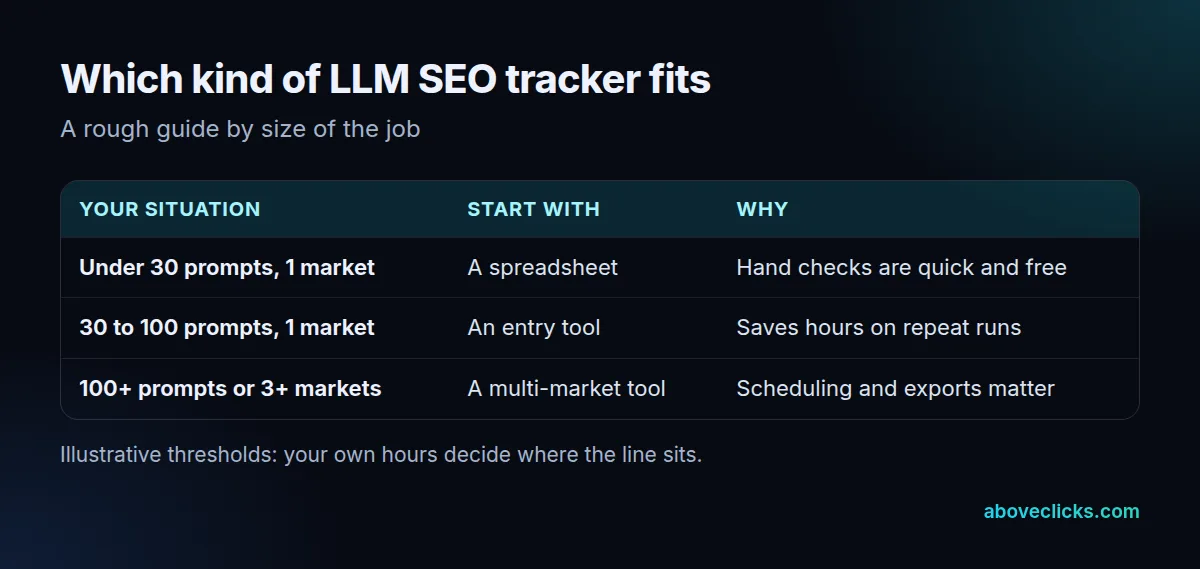
Before you pay, write down the decision each round will change. If you can’t say why you need weekly rounds, start with the spreadsheet and move up when it hurts. The four traps in one line each: reading one round as a result, buying on a demo account, treating answers as traffic and buying scale before you need it. An LLM SEO tracker that survives all four is a fair candidate for the best LLM SEO tracker for your store, whatever its price.
Whatever you choose, fix the order of work: access first, then content that answers the question, then measurement. Our guide on how to rank in ChatGPT search covers the first two.
Want the numbers and the plan together? Our AI search optimization service starts from a measured baseline, and more buyer guides are in buying guides.