Why does SEO cost so much? Because it is skilled time, repeated every month, and spent before any return shows. Google charges nothing for a listing, so the whole bill is people; the useful question is whether the work is worth it at your margin.
This guide takes an SEO quote apart into six drivers, explains why the payback is slow, gives you a break-even test to run in your own numbers and ends with a checklist for the quote in front of you.
Why does SEO cost so much?
The work is mostly expert hours, it recurs every month and it starts long before orders do. Google’s own SEO starter guide says some changes take effect in a few hours while others could take several months, so a plan has to be paid for across that gap.
Three things sit behind most people asking why is SEO so expensive:
- People, not media. Ads spend buys placement. SEO spend buys audits, fixes, writing and reviews by people who need to know your catalog.
- Repetition. Pages age, competitors publish and Google changes. The work does not finish.
- Delay. Money goes out in month 1; the first orders from the work may not arrive for months.
To see where the SEO cost goes, picture one month of 40 hours. In this invented worked example, 12 hours go to technical upkeep, 16 to writing and page work, 6 to links and mentions and 6 to reporting and a call. Add the audit in month 1 and the hours rise, which is why the early months often cost the most.
None of this makes any given quote fair. It explains why how much SEO costs looks large next to a single ad invoice, and why you should look at what is delivered before the total.
Does SEO cost money if Google does not charge for it?
Yes, but not to Google. Google never accepts money to include or rank sites in its results, and it costs nothing to appear in organic results, so every dollar goes to someone’s time or skill.
That also means no payment can buy a position. The same Google page says no one can promise a number-one ranking, and it advises finding someone else if an SEO claims to secure first place.
It also says a small local business can probably do much of the work itself, starting with the SEO starter guide. So the first honest question is whether you have the hours. A store with 5 pages and a free weekend may not need an agency. A store with 2,000 product pages and a redirect problem usually does. So when a quote makes you ask why does SEO cost so much, start by asking whose time is in it.
What makes the SEO cost go up?
Six drivers: how big the site is, how much is broken, how much has to be written, how strong the competition is, how much reporting you want and who does the work. Score each low, medium or high for your site, then read the quote.
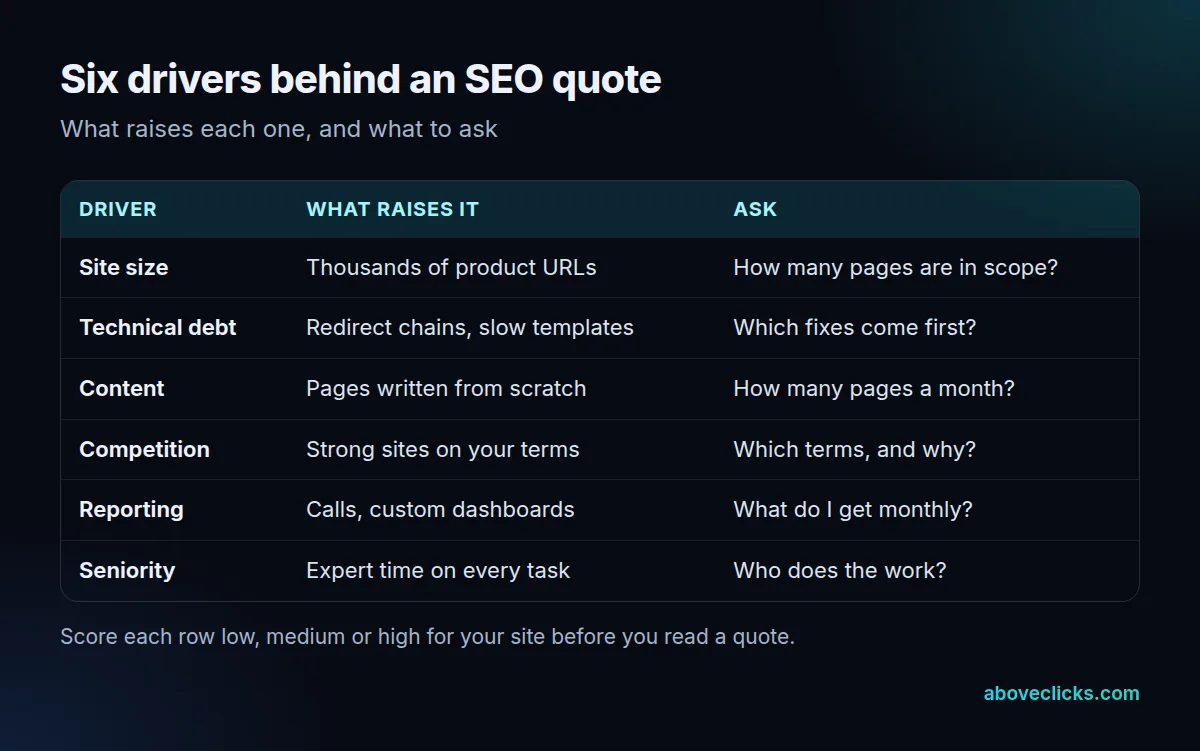
The SEO cost is the sum of these six, not one rate. Here is how each one moves the bill:
- Site size. More URLs means more to audit, map and check. A 20-page site and a store with thousands of products are different jobs, even in the same niche.
- Technical debt. Redirect chains, slow templates and duplicate pages must be fixed before new pages can work. This is why the first months often look heavy.
- Content. Writing and editing a page takes hours. A plan with 6 new pages a month costs more than one with 1, and it should.
- Competition. If strong sites already hold your terms, more pages and more earned links are needed to compete. This is the driver you control least.
- Reporting. A monthly PDF is cheap; weekly calls and custom dashboards are not. Ask what you actually read.
- Seniority. Expert time on every task costs more than expert planning with junior production. Ask who does the work.
Timing adds cost too. Google says crawling can take anywhere from a few days to a few weeks, so a fix needs a monitoring pass later. For comparison, our own ecommerce SEO work sets the audit within 2 workdays and the first monthly report after 30 days, so the early work is visible on a calendar. Ask any provider for dates that specific.
Why does SEO take so long to pay back?
Because Google needs time to find the changes and decide whether the site is better. Its helpful content guide says it could take several months for its systems to confirm that a site as a whole is helpful, and that a site with no effect after a few months may have to wait for the next core update.
Core updates are the other clock. Google says it makes significant, broad changes several times a year, so a piece of work can land just before or just after one.
In practice the cost curve looks like this:
- Months 1 to 3: audit and fixes. Spend is highest, visible change is lowest.
- Months 4 to 6: pages rewritten or added. First gains in impressions, usually before orders.
- Month 7 onward: orders from pages that now rank, if the earlier work held up.
If you are asking why is SEO so expensive in the first quarter, this is the answer: the spend leads the return. This is a general shape, not a promise. A site with serious technical problems spends longer in the first row. Our monthly SEO package guide walks through the 12 months in more detail.
Is SEO worth it at that cost?
It is worth it when the extra orders it brings cover the fee. Run a break-even test: divide the monthly fee by the profit on one order, and you get the extra orders a month the work has to earn.
Worked example (an invented store, not a client result): an $80 average order at a 40% margin leaves $32 profit per order. These are example fee levels, not quotes.
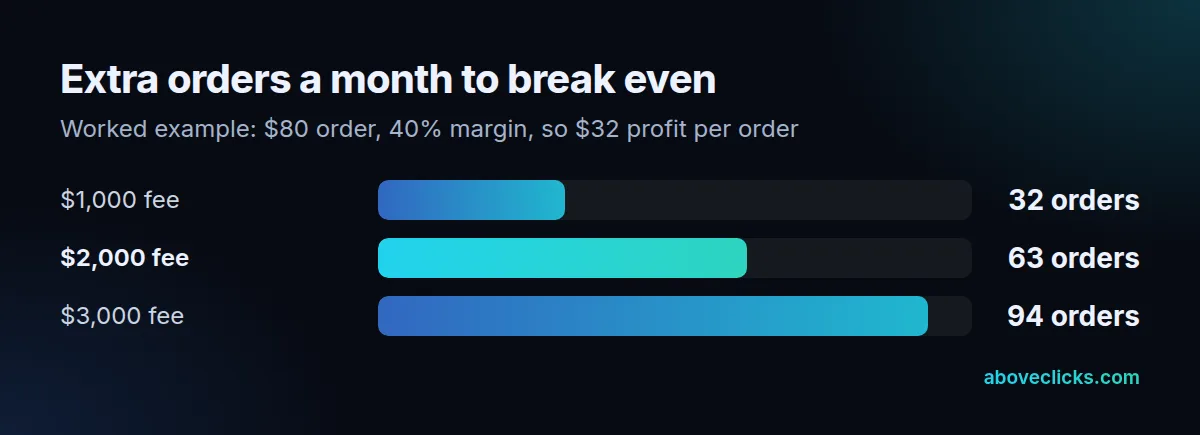
At the lowest example level, SEO has to bring about 32 extra orders a month; at the middle one, about 63; at the highest, about 94. The sums are 1,000 / 32, 2,000 / 32 and 3,000 / 32, rounded up. Put your own order value and margin into the same formula before you say yes, because the SEO cost only makes sense next to the profit it has to earn.
Asking is SEO worth it without a margin gets you an opinion, not an answer. Then ask whether that many extra orders is realistic. Count your orders from organic search now. Search Console’s Performance report can show the last 16 months, which is enough to see the seasons, so you can tell a rise from a holiday spike.
If the number looks out of reach, the answer might be a smaller scope, a project instead of a retainer, or ads for now. That is a fair answer to whether SEO is worth it: sometimes not yet. Our paying for SEO guide covers how to structure payment so you can check the work.
How do you check a quote is fair?
Ask the questions Google itself suggests, and read the answers against your six drivers. A fair quote names what is delivered, by when, by whom and how success is measured.
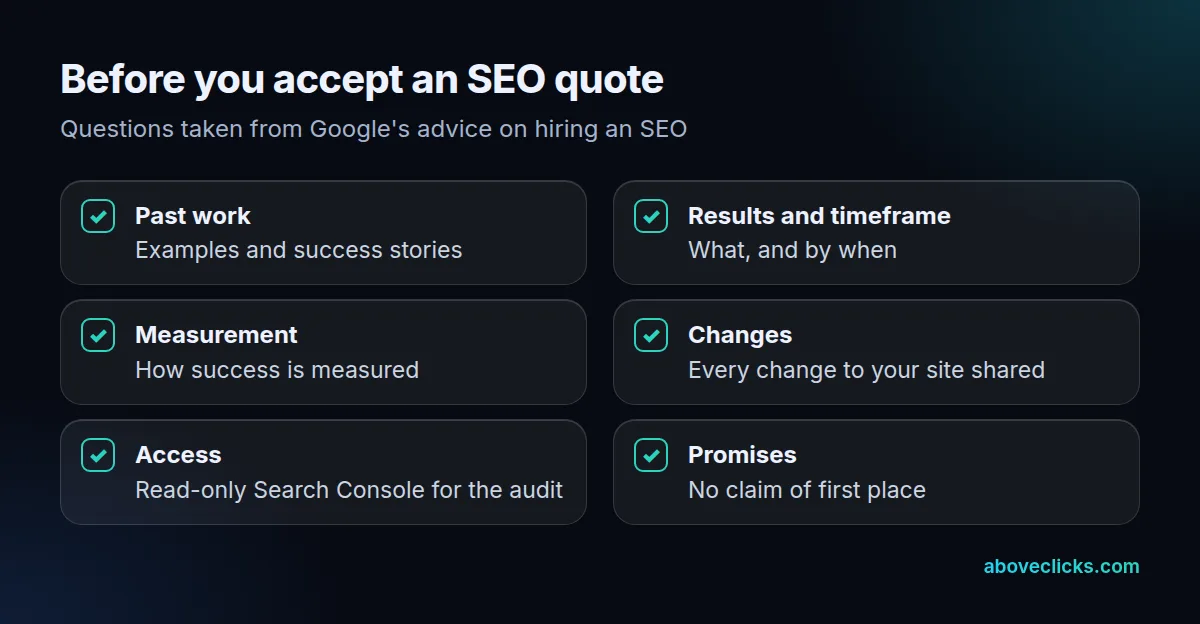
Google’s hiring advice lists 8 sample questions to ask. They include examples of previous work, the results and timeframe expected, how success is measured, and whether every change to your site will be shared. If the provider offers an audit, it says to grant read access to Search Console only at that stage, not write access.
Two further checks help:
- Divide the quote by what it delivers. A quote of $1,800 for 6 pages comes to $300 a page; a quote of $2,400 for 12 pages comes to $200 a page. The smaller SEO cost is the dearer one per page (an invented example).
- Check the scope against your drivers. If your biggest problem is technical debt and the quote is all new content, the quote does not match the site.
If you are still asking how much does SEO cost for a store like yours, market averages by provider type are in the SEO price guide lists the sources, and the average price of SEO guide explains how those averages are built.
How can you lower the SEO cost?
The lowest SEO cost comes from cutting scope, not quality: fewer pages, a narrower set of terms, a project instead of a retainer or a simpler report. Each of the six drivers has a lever, and some are free. Asking how much does SEO cost for each driver lets you trade one for another.
- Fix the cheap things first. Broken redirects and duplicate pages cost little to fix and make later work cheaper.
- Cut the content driver first. Moving from 6 new pages a month to 4 removes about 33% of the writing hours and leaves the technical work alone.
- Focus. Ten pages on the terms that earn orders beat sixty on terms that do not.
- Hire early. Google says a site redesign is a great time to hire, the earlier the better, because fixing a design after launch costs more.
- Do some of it yourself. Product descriptions and photos are often best written by you; leave the technical work to someone else.
- Simplify reporting. One monthly report you read beats weekly calls you skip.
Still unsure what your site needs? Our free audit reads your Search Console with read-only access and tells you which drivers apply. More guides are in buying guides.