How much do retargeting ads cost? You pay the platform per impression or click, so the bill is audience size times how often you show ads times the rate. Retargeting audiences are small, so frequency sets retargeting ads cost more than reach.
This guide shows what you pay for, how audience size and frequency set the bill, how Meta and Google charge, and a worked monthly budget with the arithmetic in plain sight. If you wonder how much does retargeting cost for your own store, the formula below lets you work it out.
What are retargeting ads, and what do you pay for?
Retargeting ads are ads shown to people who already visited your store or app. You pay the ad platform for each impression or click, never for the visit that built the audience.
Google calls this a data segment. Its help page says you can reach people across more than 2 million websites and apps, and gives the example of people who added something to their cart but did not buy. Meta’s website custom audiences work the same way, and Meta lists retargeting people who visited in the last 30 days and have not converted as a core use.
Two charges sit behind retargeting ads cost. The first is media, which is the ad platform’s bill. The second is whoever builds and manages the audiences, which is covered in the budget section below.
How much do retargeting ads cost?
Retargeting ads cost depends on three numbers: how many people are in the audience, how many times each sees an ad per month, and the rate the auction sets. Multiply the first two, divide by 1,000 and multiply by the rate.
That is the whole answer to how much does retargeting cost in media terms. The formula is the same on Meta and Google when you buy impressions. When you buy clicks, replace the impressions with expected clicks and the rate with your cost per click.
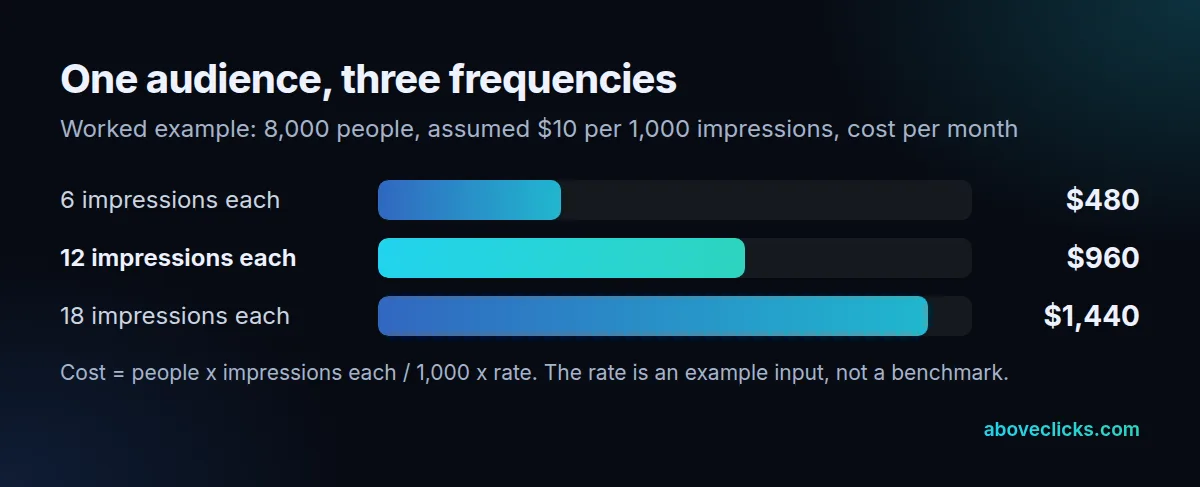
The chart is a worked example. It assumes 8,000 people in a 30-day audience and a rate of $10 per 1,000 impressions. The rate is an input for the example, not a benchmark, because auction rates move by season, country and creative. Read your own rate from Ads Manager or Google Ads before you plan.
At 6 impressions each, the month costs $480. At 12 it costs $960, and at 18 it costs $1,440. The audience did not change, only how often you showed ads to it, which is why retargeting ads cost can double with no new reach. That is why a small audience can still produce a big bill, and why retargeting ads cost is a frequency question first.
How big does a retargeting audience need to be?
Big enough to serve, and small enough that you are not showing the same people ads all month. On Google, a segment needs at least 100 active visitors or users in the last 30 days before it can serve.
Google’s segment size rules apply that minimum of 100 active users in 30 days to the Display Network, the Search Network and YouTube. Customer lists uploaded or refreshed before February 1, 2024 still need the older minimum of 1,000 matched users.
Meta’s website custom audience steps add three more limits that affect cost. The audience starts populating from the time you create it and does not backfill past visits. You pick the audience retention in days. And you can add up to 5 rules per audience, which is how you exclude buyers.
A store with few visitors may have an audience too small to spend on, so retargeting ads cost is not the first problem to solve. In that case, fix traffic first, and keep the retargeting budget for later. Retargeting ads cost little when the audience is small, but they also return little, so do not stretch a budget over a handful of people.
How much does retargeting cost on Meta and on Google?
Meta usually charges per impression, while Google charges for the clicks you buy. Both run an auction, so your rate depends on competition, not a rate card.
Meta’s page on how Meta charges for ads says ads compete in an auction and that you are usually charged by impressions unless you choose otherwise when you create the ad. Your daily budget is a target, not a fixed daily charge. In Meta’s daily budget rules, Meta may spend up to 75% over the daily budget on a good day, but not more than 7 times the daily budget in a week.
On Google, the actual CPC is the final amount charged for a click, and it is often less than your maximum bid, because you pay only what is needed to beat the Ad Rank of the competitor just below you.
If you want market averages by platform, our guides to Meta ads cost and PPC pricing cover what to expect from the ad accounts, and the Google Ads service page lists how we manage them. What changes in retargeting is the audience, which is far smaller than in prospecting, so retargeting ads cost is set by frequency and window length more than by the rate.
What makes retargeting ads cost more?
Showing ads too often, changing campaigns too often and keeping the audience open too long all raise retargeting ads cost. The platform’s rate matters, but these three are the parts you control.
Frequency. The chart above shows it: tripling the impressions per person triples the bill. Cap the number of times a person sees the ad in a week, and check the frequency column in your reports.
Learning and restarts. Meta’s budget page says an ad set in the learning phase may deliver more aggressively, which can lead to higher initial costs. It also says a learning phase is likely whenever an ad set starts and whenever you change bids or budgets. Edit retargeting ad sets rarely, and change one thing at a time.
A tiny budget next to a high bid. The same page warns that a budget close to or lower than your bid can be spent quickly. For a small audience, that means the money is gone in a few hours on the first few people.
Window length. A 30-day window is the default on Google. A longer one keeps people in the audience after their interest fades, so each additional week buys less. Match the window to how long your buyers take to decide, not to the maximum allowed.
Creative that has run too long. If the same ad runs for weeks to the same few thousand people, click rates tend to fall and you pay more per result. Rotate in new creative when frequency climbs.
How do you set a retargeting budget?
Start from the audience, not from a round number, when you plan how much do retargeting ads cost each month. Work out audience times frequency times rate, then divide by 30 to get a daily figure and check it against your gross profit per order.
Take the $960 month from the chart. Divided by 30, it is $32 a day. Under Meta’s rule above, a $32 daily budget can reach $56 on a strong day, and the week cannot pass $224, which is 7 times $32.
Then test the result against profit.
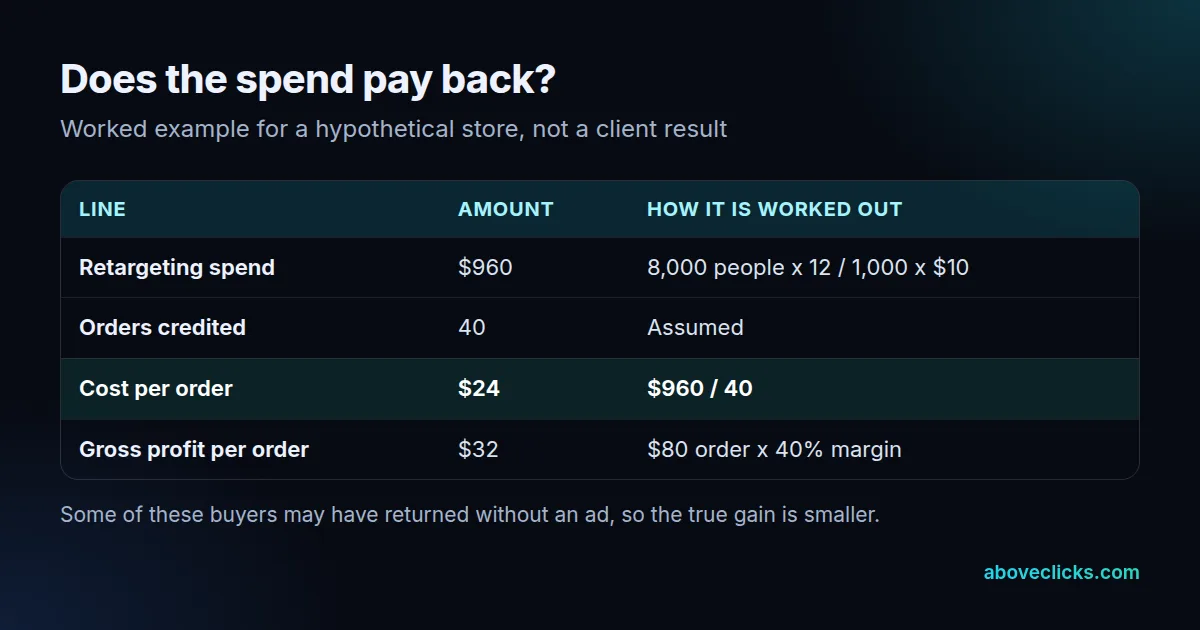
In this example, 40 orders credited to retargeting at an $80 average order and a 40% margin gives $32 of gross profit per order. The cost per order is $24, so the example pays back by $8 an order before any other cost. The figures are for a hypothetical store, not a client.
Some of those 40 buyers would have come back without an ad. The honest number is lower, so treat the check as a ceiling. If retargeting ads cost more than the profit on the orders they win, cut the frequency first, then the window, and only then the creative. We size retargeting so each campaign can exit the learning phase and add exclusions so you stop paying to reach people who just bought, as described on our Meta Ads service page.
Agency fees are separate from media, so how much does retargeting cost in total is media plus the management fee. How a management fee is billed (flat, percentage of spend or per project) is covered in our pricing models guide, and the Meta Ads service page shows our starting prices. A free audit reviews your audiences first and tells you what the exact plan would cost.
Do retargeting ads work well enough to justify the cost?
Often yes for stores with steady traffic, but only if you measure cost per order against profit and exclude buyers. Retargeting reaches people already close to buying, so some orders would have happened anyway.
Use the four checks below before you raise the budget, because retargeting ads cost rises with every wasted impression. Each of them wastes money in a way that does not show up in the platform’s headline return.
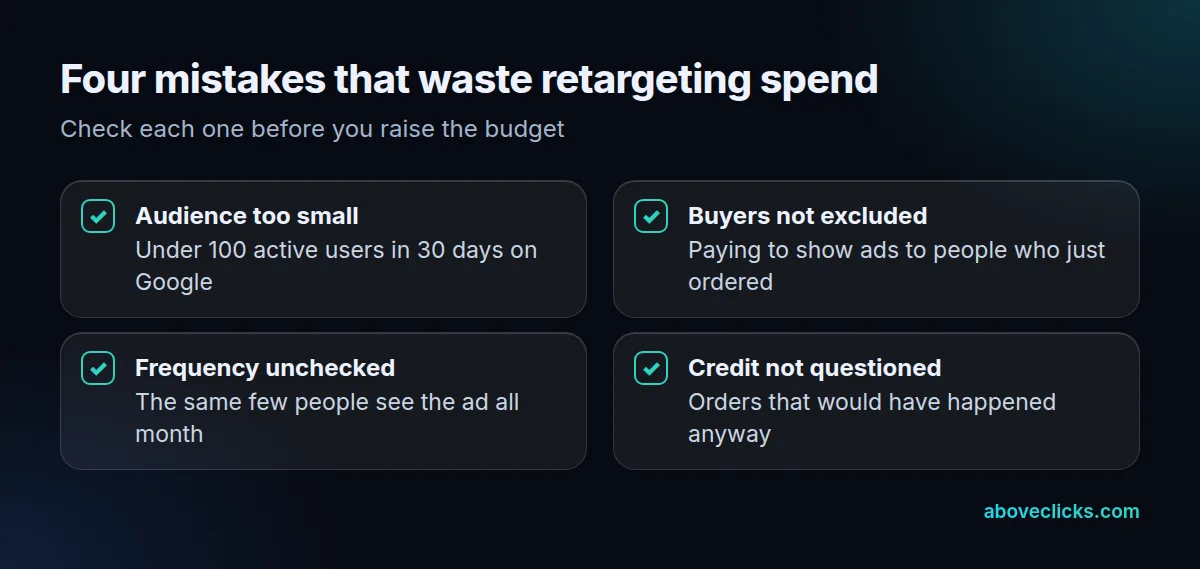
- Audience too small. Google needs 100 active users in 30 days before a segment serves. Below that, you pay for a campaign that cannot run.
- Buyers not excluded. Meta allows up to 5 rules per audience, so remove purchasers or you pay to advertise to people who just ordered.
- Frequency unchecked. The chart shows 18 impressions each costs 3 times the 6-impression budget for the same people.
- Credit not questioned. Platforms credit orders they touched. Compare retargeting orders with orders from a holdout or from the same weeks last year.
Retargeting ads cost the most when nobody checks them, so put the four checks in the monthly report. More buying guides are in our buying guides section.
Google lets you keep a segment for up to 540 days, but a longer window mostly grows the audience with people who stopped caring. For most stores, a window close to your normal buying time is cheaper and cleaner.