Drip vs Klaviyo comes down to two billing meters: Drip charges by the size of your list with every feature included, while Klaviyo bills active profiles and sells text messages separately. Check five things on your own list before you compare features.
This guide uses each vendor’s own pages, dates every plan detail and labels claims that one vendor makes about the other. A note before the Drip vs Klaviyo comparison starts: we set up and migrate Klaviyo accounts for online stores, so that is the platform we know best.
Drip vs Klaviyo: what is the real difference?
Both are email platforms built for online stores, and both connect to Shopify, WooCommerce and BigCommerce. Drip sells one plan with every feature in it, sized by list. Klaviyo has a free plan, paid tiers sized by active profiles, and separate products such as text.
A feature grid makes the two look closer than they are. In a Drip vs Klaviyo decision, five checks change the bill or the workload, and each one can turn into a costly trap:
- Billing meter: Drip prices the number of people on your list; Klaviyo bills active profiles, with email send capacity included in the tier.
- Who counts: On Klaviyo, unsubscribed and suppressed contacts are free, but a checkout-only customer who never subscribed still counts.
- Text messages: Klaviyo bills texts as committed spend on a separate plan. Drip says it supports US SMS inside workflows and has no global SMS.
- Flow stopping: Drip says a purchase can stop a series at once; Klaviyo checks profile filters on entry and before each action.
- Migration and consent: Drip offers free migration, but its comparison page ties the done-for-you version to larger lists, so get the terms in writing.
Start the Klaviyo vs Drip decision from your own store, not from the grid, because a Drip vs Klaviyo grid hides the billing meter. Write down how many contacts you hold, how many of them never subscribed, how many emails you send in a month, and whether you plan to text customers within 12 months. Those four answers settle most of the choice before you open a pricing page.
How does Drip pricing compare with Klaviyo pricing?
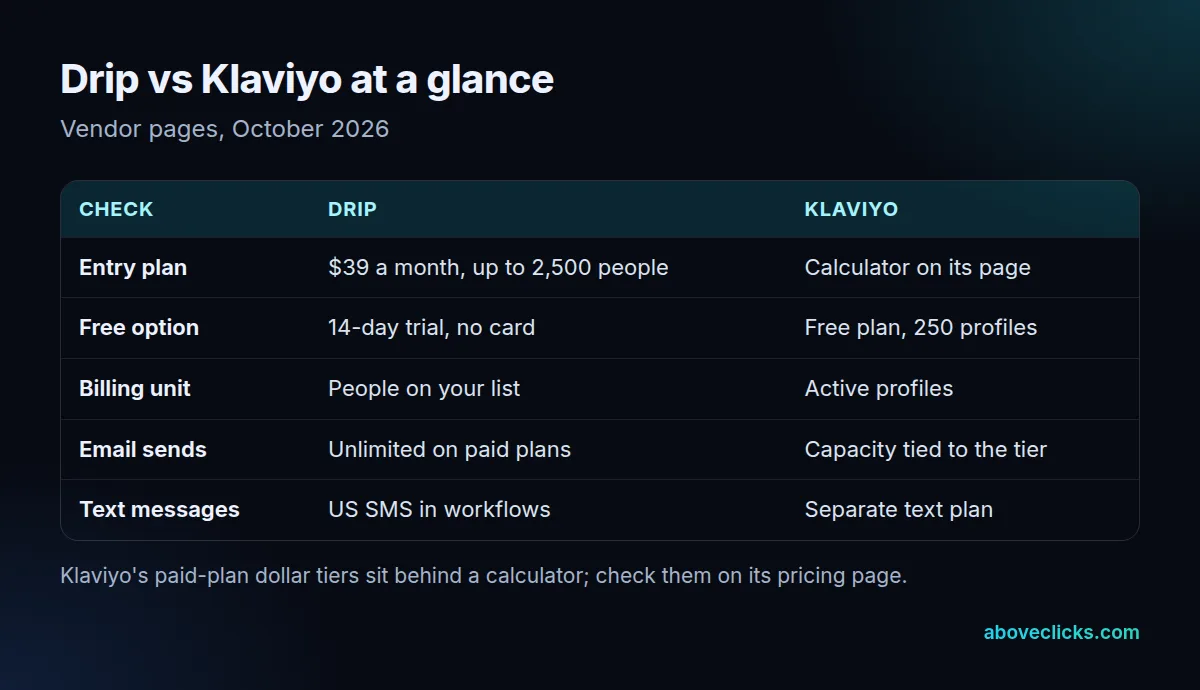
Drip pricing is a single published entry plan, while Klaviyo pricing depends on a calculator. As of October 2026, Drip’s pricing page shows $39 a month for 1-2,500 people, with unlimited email sends, up to 50 workflows, dynamic segments and onsite campaigns included. Larger lists move a slider, and we do not quote those tiers.
Klaviyo works the other way round. Its billing page says Profile and Email plans are priced by active profiles, the people you can reach, with email send capacity included. Unsubscribed and suppressed contacts do not count. Text is committed spend on a separate plan. We state no paid-plan dollar figures for Klaviyo because its calculator changes often.
One example shows why you should check vendor math. As of October 2026, Drip’s comparison page puts Klaviyo at $60 a month for 2,500 contacts in its savings calculator and at about $75 a month in the text of the same page. Both are Drip’s estimates, and they differ by $15. Treat any vendor-written Drip vs Klaviyo comparison as a starting point, and run each calculator yourself.
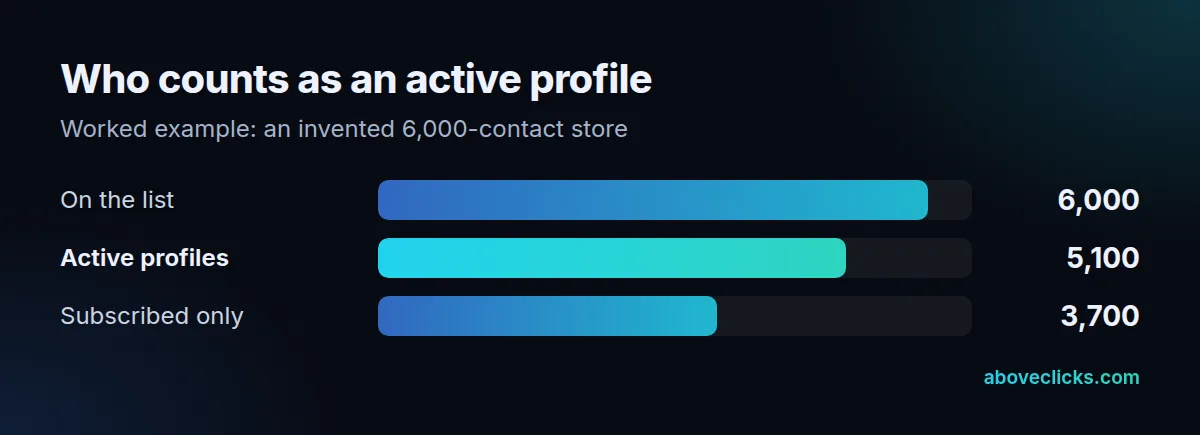
The worked example above uses an invented store with 6,000 contacts. Of those, 900 unsubscribed and 1,400 placed an order but never subscribed. Klaviyo’s help page on active profiles says a never-subscribed profile, such as a checkout-only customer, is still active. So the store pays for 5,100 active profiles, not the 3,700 who opted in, unless it suppresses the 1,400.
What belongs in a Drip vs Klaviyo quote?
Price both tools from the same inputs, or the numbers mean nothing in a Drip vs Klaviyo comparison. For a fair Drip vs Klaviyo quote, collect these five inputs first:
- Total contacts, and how many are unsubscribed or suppressed.
- How many contacts never subscribed, such as checkout-only customers.
- Emails sent in a typical month, including flows.
- Text messages you expect to send in the next 12 months.
- Whether you want done-for-you migration or will rebuild flows yourself.
Our email marketing cost guide shows how to build that comparison for any platform. Keep the date of each screenshot, because both vendors change their plans.
Does the Klaviyo free plan cover a small store?
In Drip vs Klaviyo terms, the free plan is a Klaviyo advantage for a store that has just launched, yes. For a store that already sends regularly, usually not. As of October 2026, the Klaviyo free plan allows up to 250 active profiles and 500 email sends a month, plus $5 of mobile messages, with email support for the first 60 days.
Past those limits, sending can pause until the next billing cycle or until you upgrade. Here is the arithmetic for an invented new store: 250 subscribers times 2 emails each is already 500 sends. A welcome flow and one monthly campaign would use the whole allowance.
Drip does not have a free plan. As of October 2026, its pricing page offers a 14-day free trial with no credit card. Unlimited emails are not available during the trial, and if the trial expires without an upgrade the account goes inactive and active forms and campaigns pause. So the Klaviyo free plan is a place to stay while you are tiny, and the Drip trial is a place to test a migration.
Which platform builds better flows for a store?
In Drip vs Klaviyo, both build the core store flows: welcome, abandoned cart, post-purchase and win-back. The difference is how a series stops once the customer buys, so test that rather than trusting any feature grid.
Klaviyo’s flow trigger guide lists 6 trigger types, including a metric such as placing an order, a list or segment, and a date property. It also says profile filters are checked when people enter the flow and again before actions such as sending an email. Drip’s comparison page says that workflow goals stop a series the moment a purchase fires, and that one workflow can have several triggers.
Drip’s claim about Klaviyo is that the filter check is “not instant”. Klaviyo’s own page describes the check before each action, so a purchase made between two scheduled emails stops the next one at send time. Whether that gap matters depends on how long your waits are.
Run the same test in both trials:
- Build a three-email cart series with waits of 1 hour, 1 day and 3 days.
- Start a checkout with a test address and leave it.
- Complete the order after the first email.
- Confirm no later email arrives and that the profile left the series.
Drip’s pitch of several triggers in one workflow has a Klaviyo workaround: a segment trigger can gather many conditions into one entry point, according to the same guide. Which route is easier depends on how many entry points your store has.
Is Drip or Klaviyo better for Shopify?
For Drip vs Klaviyo on Shopify, both connect and read orders and carts. Klaviyo is the better-known pairing and we know it best, but Drip’s Shopify page shows a one-click connection and the same core flows, so the data feed is rarely what decides it.
Klaviyo’s Shopify guide brings customer profile and order data into Klaviyo and can sync data back to Shopify. It also warns that if you are migrating from another email platform, you must disconnect the prior one from Shopify first, or existing subscribers could get double opt-in emails.
Decide which tool sends the recovery email for abandoned checkouts. Shopify treats a checkout as abandoned when it stays incomplete for more than 10 minutes after the customer gave an email address, per its abandoned checkout guide. If Shopify’s own recovery email and a Drip or Klaviyo flow both run, customers receive two reminders.
A third decision sits with consent. Klaviyo marks never-subscribed profiles with a yellow warning, and says you can add a profile filter to a flow to exclude profiles that have not explicitly opted in. Choose that rule on purpose for either platform.
Does the platform change your Gmail deliverability?
Not by itself, so Drip vs Klaviyo is not a deliverability question. The rules apply to you as the sender, and deliverability depends mostly on list quality and domain setup, not on the logo in the footer.
Google’s sender guidelines say that if you send more than 5,000 messages a day to Gmail accounts you must set up SPF, DKIM and DMARC, keep the spam rate reported in Postmaster Tools below 0.30%, and support one-click unsubscribe in marketing messages. Most small stores sit below 5,000 messages a day, so for them it is a checklist for later.
Two habits help on either tool. Authenticate your own sending domain before the first campaign, so mailbox providers see your brand and not the vendor. And send the first campaigns on a new platform to your most engaged subscribers, then grow volume over 2 to 4 weeks while you watch bounces and complaints.
Should you switch from Klaviyo to Drip?
In a Drip vs Klaviyo switch, move when your quote at your own list size is clearly lower, you do not need global text, WhatsApp or push, and your flows are the standard store set. Stay when texting across several countries is part of how you sell, or when your flows are tightly built around Klaviyo data.
A store with 400 contacts that sends once a month gains little from moving, and the time is better spent on product pages. If the honest answer to “is Drip or Klaviyo better for us” is “not yet”, revisit it when your list or your flows grow. For other pairs, see Omnisend vs Klaviyo and our Klaviyo alternatives.
If you move, order the work consent first, and allow more time for rebuilding and testing each flow than for importing the list:
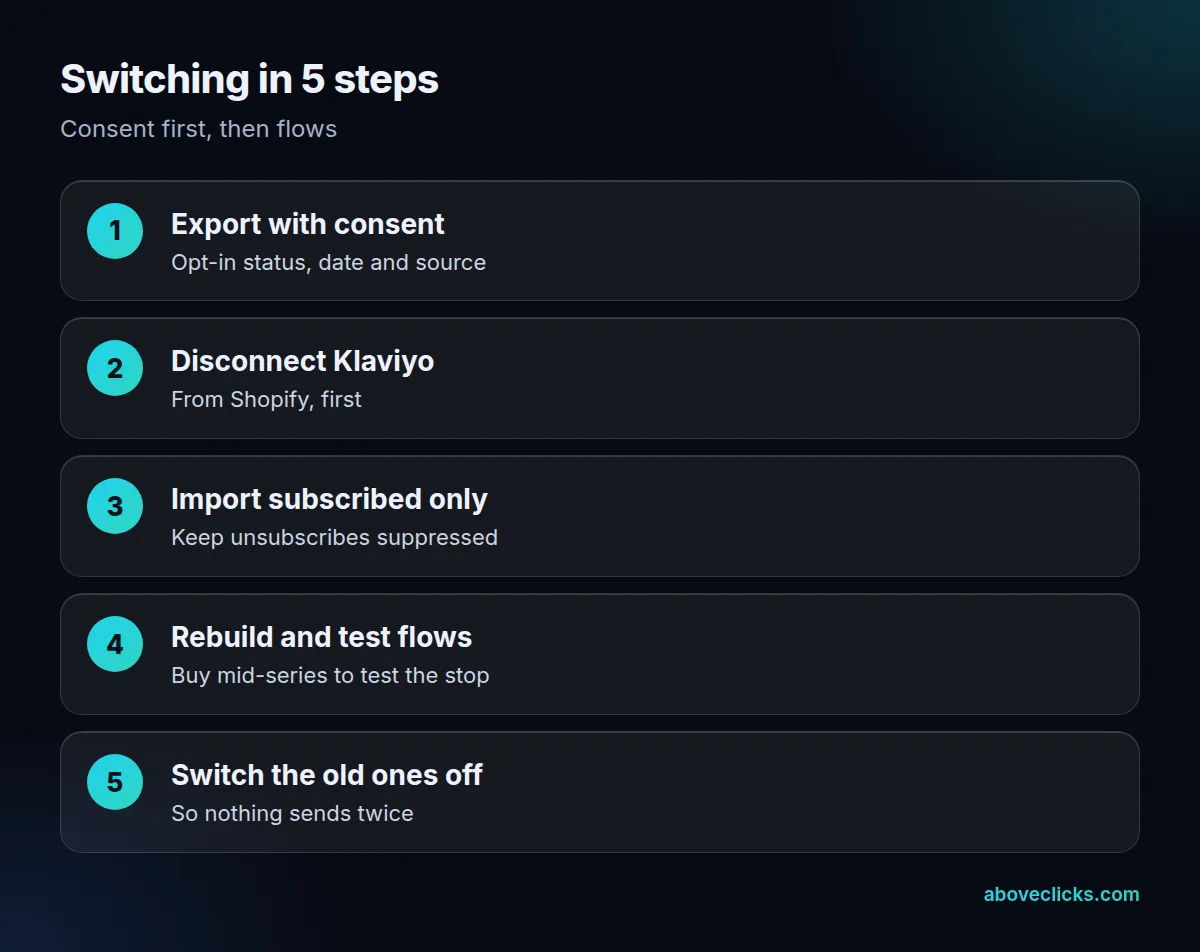
One rule applies on either platform. The FTC’s CAN-SPAM guide says you must honor an opt-out within 10 business days, so never re-import an address that has unsubscribed.
If you want a second opinion before you commit, our Klaviyo email marketing service covers setup and migration, and the free audit reviews your current setup. More comparisons are in buying guides.