Omnisend vs Klaviyo pricing comes down to what each platform counts as a contact: Omnisend bills subscribers plus non-subscribers, while Klaviyo bills active email profiles. Compare the bill for your own contact export, not the headline plan price.
This Omnisend vs Klaviyo pricing guide gives the Omnisend plan numbers, explains what we could and could not verify on the Klaviyo side, works through a sample store, and ends with a worksheet. We set up and migrate Klaviyo accounts, so we say plainly where Omnisend costs less. For features and channels, see our Omnisend vs Klaviyo comparison.
How does Omnisend vs Klaviyo pricing differ?
In three ways: the unit that is billed, what is bundled with each plan, and what happens when your list or sending changes. Four traps sit inside those differences, and the rest of this Omnisend vs Klaviyo pricing guide tests each one.
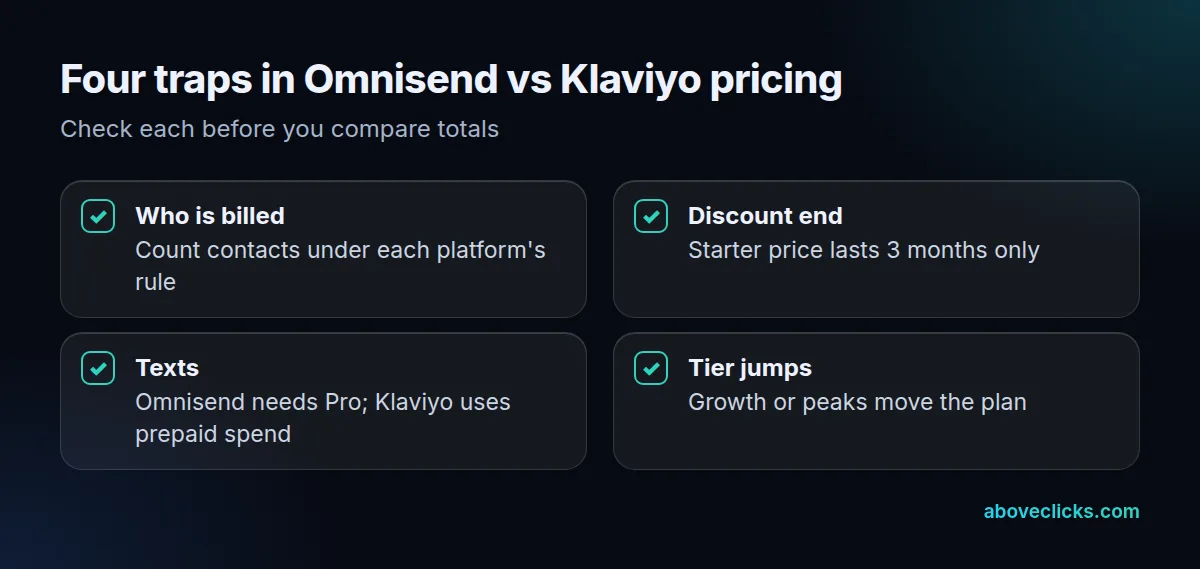
- Who is billed. Omnisend counts subscribers and non-subscribers, as of October 2026, according to its pricing plans article. Klaviyo counts profiles that have an email address and are not suppressed.
- Discount end. Omnisend’s 30% starter discount lasts 3 months.
- Texts. Omnisend sells SMS credits only to Pro accounts started on or after May 4, 2026. Klaviyo sells mobile messaging as prepaid spend.
- Tier jumps. Both platforms move you to a higher tier when your list outgrows the current one.
Klaviyo vs Omnisend pricing also differs in how much is public, and that matters for any Omnisend vs Klaviyo pricing comparison. Omnisend prints plan starting prices in its help center. Klaviyo’s pricing explainer shows profile and send tiers only inside its calculator, so we do not quote a Klaviyo plan price here.
How much does Omnisend cost?
As of October 2026, Omnisend lists Standard from $16 and Pro from $59 monthly, and a free plan with 500 emails a month for up to 250 contacts, according to its pricing plans article. The monthly price rises with your billable contact tier.
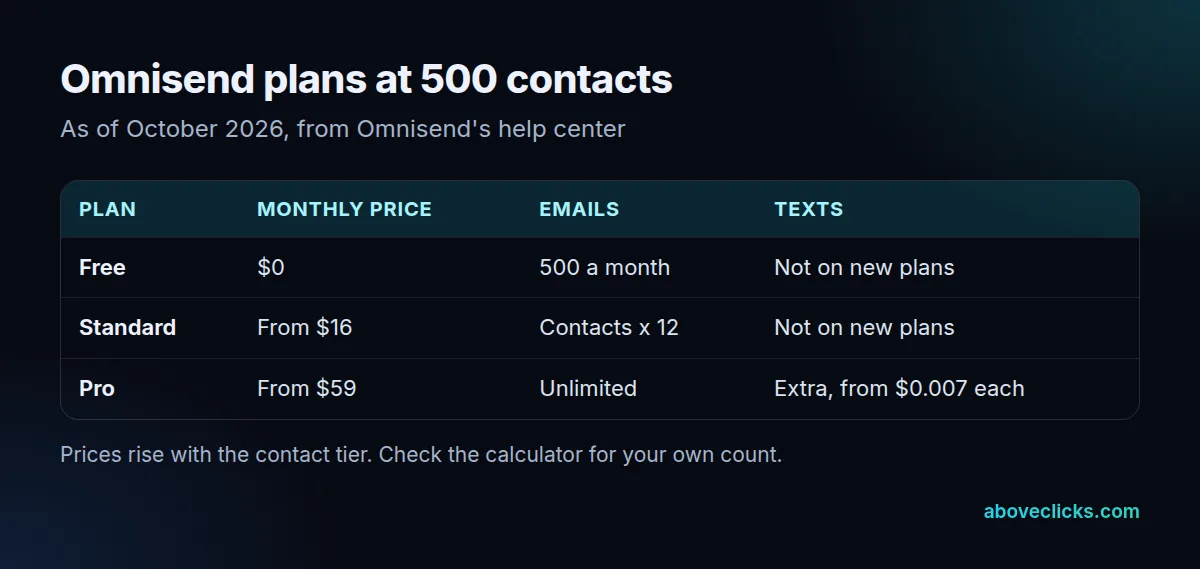
On Standard, included emails equal your contacts times 12 each billing cycle, so 3,000 contacts send up to 36,000 emails. Pro sends unlimited emails, with a fair-use limit, so Omnisend pricing rewards high-volume senders. The pricing page tiers run 0 to 250, 251 to 500, 501 to 1,000, then in steps of 500 contacts up to 3,000, as of October 2026, and its calculator gives the exact price for your tier.
A new paid account can take the starter discount: 30% off for 3 months paid upfront. Here is the first-year sheet at the 500-contact tier, using those published figures, as of October 2026:
- Standard with the discount: $33.60 for months 1 to 3, then 9 months at $16, a total of $177.60 against $192 at list.
- Pro with the discount: $123.90 for months 1 to 3, then 9 months at $59, a total of $654.90 against $708 at list.
As of October 2026, the discount applies once, to your first upgrade, and the regular price returns after month 3, according to the pricing plans article. That is why a first-month look at Omnisend pricing plans understates the cost of month 4, and why an honest Omnisend vs Klaviyo pricing comparison uses the 12-month total.
How much does Klaviyo cost per month?
Klaviyo’s price depends on your active profile tier and the emails you send, and it shows the exact figure in its billing screen, not in a public table. We read the pages on October 31, 2026 and found no Klaviyo tier prices to quote, so treat any list online as unverified.
Klaviyo pricing for Profile and Email plans rests on active profiles, with send capacity bundled, as of October 2026, according to its pricing explainer. Its billing article adds that your plan must cover your active profiles at the end of the billing cycle, or the account moves up to a compliant plan.
To find your own Klaviyo pricing, which is the missing half of Omnisend vs Klaviyo pricing, open Billing, then Overview, then Change plan, and read the cost of the tier that covers your count. If you are still evaluating, ask for a quote against your export.
Klaviyo’s own overage example shows how sending peaks are charged. A store on a $7,000 plan with 70,000 emails needs 80,000 for a sales weekend. The unit rate is $7,000 divided by 70,000, or $0.10 an email, so the extra 10,000 emails cost $1,000. Klaviyo says flexing is typically more expensive than upgrading, as of October 2026, in its billing article. Those are large-account numbers, but the arithmetic is the same at any size.
Which contacts does each platform bill you for?
In Omnisend vs Klaviyo pricing, the contact count is the biggest lever. Omnisend bills everyone who is subscribed or has ever left an email or phone number without opting in, except unsubscribed contacts. Klaviyo bills profiles with an email address that are not suppressed, so phone-only records do not count.
On the Omnisend side, the pricing plans article lists non-subscribers as customers who placed an order without ticking the marketing box, abandoned a cart, created an account or were imported without an opt-in date. On the Klaviyo side, an active email profile has an email address and can receive email, and it explicitly includes people who never subscribed.
Here is a worked example for an invented store with 4,500 records in its Shopify export. It tests the Omnisend vs Klaviyo pricing rules:
- 2,000 subscribed with an email address.
- 1,500 bought without opting in, with an email address.
- 400 bought without opting in, with a phone number only.
- 600 unsubscribed.
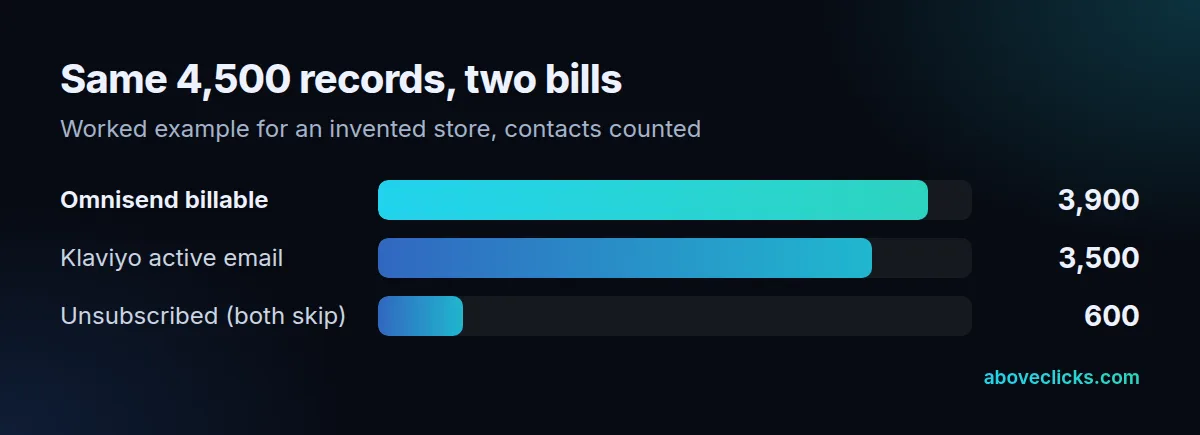
Omnisend would count 2,000 + 1,500 + 400 = 3,900 billable contacts. Klaviyo would count 2,000 + 1,500 = 3,500 active email profiles, because the 400 phone-only records have no email and the 600 unsubscribed records are suppressed. The 400-contact gap can decide which tier you land in, so run this count on your own export before you open either calculator.
What do text messages cost on each platform?
On Omnisend, texts need the Pro plan if your paid plan started on or after May 4, 2026; Standard cannot buy SMS credits. Klaviyo sells mobile messaging as prepaid monthly spend, so you set the budget first.
As of October 2026, Omnisend’s help center says Pro accounts buy an SMS credits subscription with rates as low as $0.007 per SMS, depending on spend and country. Its pricing page shows US rates of $0.009 for $10 to $49.99 of monthly spend, $0.0085 for $50 to $999.99 and $0.008 for $1,000 to $9,999.99.
Worked sum for an invented store sending 2,000 US texts a month: 2,000 times $0.009 is $18, added to the Pro plan from $59, so $77 monthly before tax at the 500-contact tier. The same store on Standard could not buy the texts at all.
Klaviyo’s billing article says a dollar-based mobile plan is paid upfront, for example $15 or $25, resets monthly and does not carry unused dollars over. Rates depend on the channel, country and number type, so read your rate in the mobile usage view before you size the budget.
What happens to the bill when your list or sending changes?
Omnisend vs Klaviyo pricing both change automatically at tier edges. Omnisend adjusts your billing tier each cycle as billable contacts grow or shrink, and Klaviyo upgrades you at the end of the cycle if active profiles exceed the plan.
Four situations move the bill:
- The discount ends. Month 4 on Omnisend returns to list price, as in the sheet above.
- Checkout growth. Every customer who orders without opting in is a billable contact on Omnisend and, with an email address, an active profile on Klaviyo.
- A clean-up. Klaviyo says the displayed count can take up to 72 hours to refresh after a large clean-up, and a lower plan must be chosen unless auto-downgrade is on.
- A sending peak. Klaviyo’s flexible sending gives temporary next-tier capacity at your current unit rate, then returns to base the next cycle.
Cleaning is also a deliverability matter. Gmail’s sender guidelines ask bulk senders to keep reported spam rates below 0.3%, so paying to mail contacts who never engage costs twice. Remove them before you compare Omnisend vs Klaviyo pricing totals.
How do you work out your own Omnisend vs Klaviyo pricing?
For Omnisend vs Klaviyo pricing that fits your store, export your customers, count them under each platform’s rule, then read each calculator for that count. The cheaper tool is whichever bill is lower for your tier, once texts and the discount ending are included.
Use this sequence for your own Omnisend pricing and Klaviyo pricing numbers:
- Export all records with email, phone and consent status.
- Remove unsubscribed and suppressed records, plus long-unengaged ones you will not email.
- Count Omnisend billable contacts: subscribed plus non-subscribed with an email or phone.
- Count Klaviyo active email profiles: records with an email address that are not suppressed.
- Read the Omnisend calculator and the Klaviyo Change plan screen for those counts.
- Add texts: Pro plan price plus texts times rate on Omnisend, and prepaid spend on Klaviyo.
- Build a 12-month total, putting the Omnisend discount ending in month 4.
What belongs in an Omnisend vs Klaviyo pricing quote? Whichever vendor quotes you, ask for the contact count the quote assumes, the tier edges above and below it, the text rate, and the date any discount ends. Our guide to email marketing cost covers the wider budget, and the Klaviyo alternatives list shows other tools to price the same way.
How do you move a Shopify store between them?
Disconnect the old email app from Shopify before you connect the new one. Omnisend advertises a free migration of contacts, data and segments that takes 5 days, on its pricing page, as of October 2026. If Klaviyo wins on your numbers, moving takes planning: Klaviyo’s Shopify setup guide says to disconnect the old email app from Shopify first, to avoid duplicate opt-in emails. Our Klaviyo email marketing and Klaviyo migration pages explain how we handle setup and the move. To review your current setup first, request a free audit. More comparisons like this one are in our buying guides.