Quick answer
Neither wins for every store. Omnisend suits smaller stores that want simple email, SMS and web push with live support on every plan. Klaviyo suits stores that want deeper segmentation, more channels and a larger app ecosystem. Count your billable contacts on both before you compare cost.
| Omnisend | Klaviyo | |
|---|---|---|
| Billing unit | Billable contacts: subscribers plus non-subscribers | Active profiles: reachable contacts |
| Unsubscribed contacts billed? | No | No (suppressed profiles aren't billed either) |
| Free plan (as of Oct 2026) | 250 contacts, 500 emails a month | 250 active profiles, 500 email sends a month |
| Text messages | SMS charged separately from the email plan | Text billed separately, as committed spend |
| Extra channels | Web push included | SMS, WhatsApp, RCS, mobile app messaging |
| Support on the free plan | 24/7 live chat and email | Email support for the first 60 days |
| Migration help | Free migration of contacts, data and segments | Shopify setup guide; prior email app must be disconnected first |
Omnisend
- Billing unit
- Billable contacts: subscribers plus non-subscribers
- Unsubscribed contacts billed?
- No
- Free plan (as of Oct 2026)
- 250 contacts, 500 emails a month
- Text messages
- SMS charged separately from the email plan
- Extra channels
- Web push included
- Support on the free plan
- 24/7 live chat and email
- Migration help
- Free migration of contacts, data and segments
Klaviyo
- Billing unit
- Active profiles: reachable contacts
- Unsubscribed contacts billed?
- No (suppressed profiles aren't billed either)
- Free plan (as of Oct 2026)
- 250 active profiles, 500 email sends a month
- Text messages
- Text billed separately, as committed spend
- Extra channels
- SMS, WhatsApp, RCS, mobile app messaging
- Support on the free plan
- Email support for the first 60 days
- Migration help
- Shopify setup guide; prior email app must be disconnected first
Choose Omnisend if…
- Your list is small and you want live support from day 1
- Web push matters to you
- You want the vendor to move your contacts and segments for you
Choose Klaviyo if…
- You segment heavily on order and browsing data
- You want WhatsApp, RCS or app messaging alongside email
- Your stack needs many integrations
The main Omnisend vs Klaviyo difference is depth versus simplicity: Omnisend packs email, SMS and web push into simple plans with live support on every tier, while Klaviyo offers deeper segmentation, more channels and a larger app ecosystem. Decide by counting what each would bill for your own contacts.
A note before we start: we set up and migrate Klaviyo accounts for online stores, so we know that platform best. This Omnisend vs Klaviyo comparison draws only on each vendor’s own help and billing pages, dates every plan detail in its section, and says plainly where Omnisend is the better fit.
Omnisend vs Klaviyo: what’s the real difference?
Both are email and SMS platforms built for online stores, with flows, segments and sign-up forms. They differ in how they bill, which extra channels they include, and how much support comes with the cheaper plans.
In a Klaviyo vs Omnisend comparison, the headline features look alike: abandoned cart emails, welcome series, product recommendations and reporting on both. The differences that change your bill and your workload sit lower down:
- Billing unit: what counts as a contact you pay for.
- Channels: web push on one side; WhatsApp, RCS and app messaging on the other.
- Support: live chat on every plan versus time-limited support on the free plan.
- Ecosystem: Klaviyo says it integrates with 350+ apps, as of October 2026.
So the honest answer to “Omnisend vs Klaviyo: which is better?” is that it depends on your list, your channels and your team.
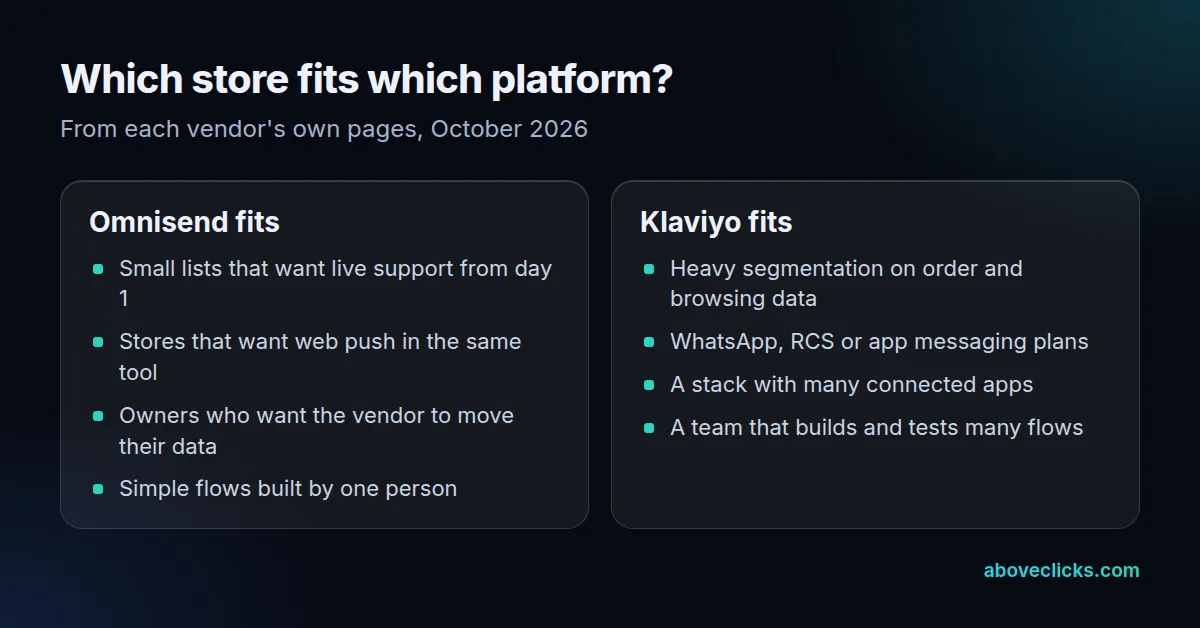
A useful way to read any Klaviyo vs Omnisend comparison is to start from your own store rather than the feature grid. Write down how many contacts you have, which channels you send on today, and who on your team builds the emails. Those 3 answers settle most of the decision before you open a pricing page.
How do the free plans compare?
Almost identically on paper, as of October 2026: about 250 contacts and 500 emails a month on each, so the free tier rarely settles Klaviyo vs Omnisend. The differences are in what else comes free and how long support lasts.
| Free plan, as of October 2026 | Omnisend | Klaviyo |
|---|---|---|
| Contacts | 250 contacts | 250 active profiles |
| Emails | 500 a month | 500 sends a month |
| Extra | 500 web push notifications a month | $5 of mobile messages a month |
| Support | 24/7 live chat and email | Email support for the first 60 days |
As of October 2026, Omnisend’s pricing page lists 500 emails a month to 250 contacts on its free plan, plus 500 web push notifications, and says live chat and email support run 24/7 on every plan, free included.
As of October 2026, Klaviyo’s pricing page limits its free plan to 250 active profiles and 500 email sends a month, adds $5 of mobile messages a month, and gives full email support for the first 60 days only.
For a store just starting out, the free plans are close enough that the deciding factor in Omnisend vs Klaviyo is which tool you’ll still want at 5,000 contacts.
How does each platform count what you pay for?
Omnisend bills subscribers plus non-subscribers who receive automated messages; Klaviyo bills active profiles, meaning contacts it can reach. Neither bills unsubscribed contacts, as of October 2026.
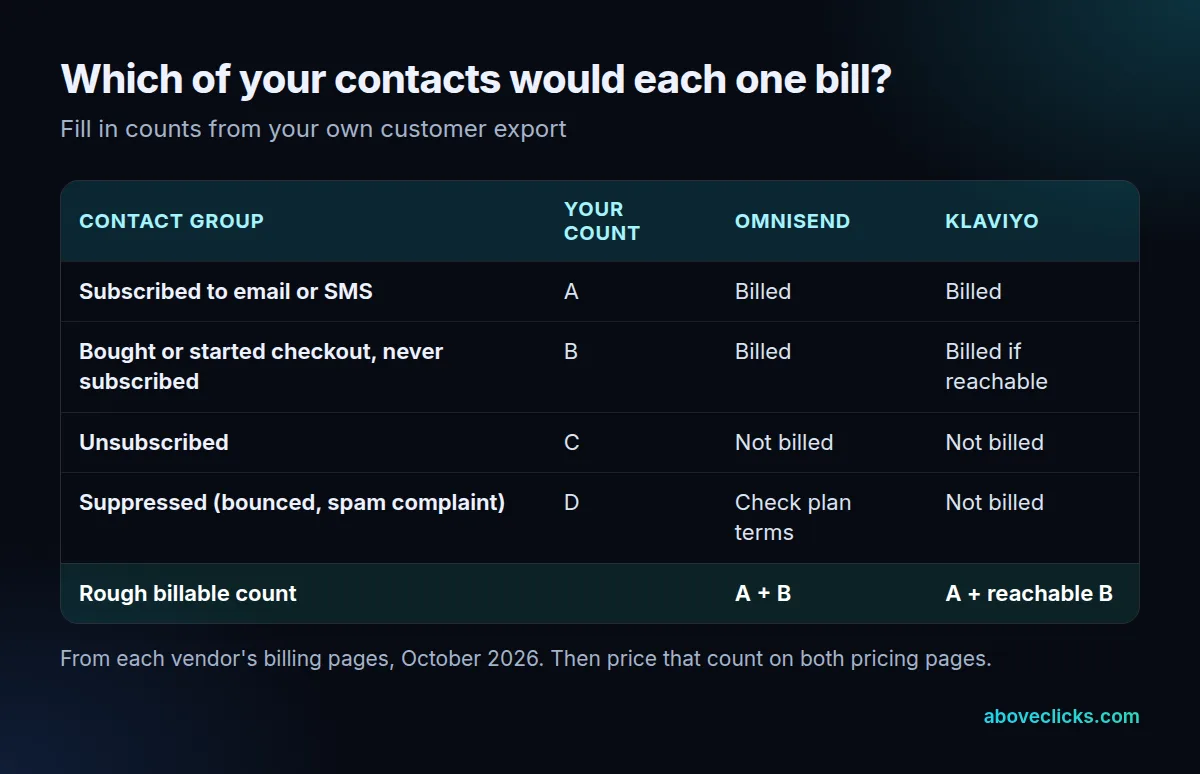
As of October 2026, Omnisend’s billing guide counts 2 groups: subscribers who opted in to email, SMS or push, and non-subscribers who gave an email or phone number through an order or an abandoned cart but never opted in. Non-subscribers count because they can still receive automated messages such as order confirmations and cart reminders.
As of October 2026, Klaviyo’s pricing explainer bills active profiles, the people your brand can reach by email, SMS or other channels, and states that unsubscribed and suppressed contacts don’t count. Each profile tier includes a monthly email send capacity.
Take a store with 4,000 customers in its Shopify export. If 1,500 are subscribed, 2,000 bought without subscribing and 500 unsubscribed, neither platform bills the 500. The other 3,500 customers are where the two billing rules need checking against your own data.
That’s why a Klaviyo vs Omnisend comparison on list size alone misleads. Run your own customer export through the worksheet above: count subscribed, never-subscribed, unsubscribed and suppressed contacts, then price that count on both pricing pages. Cleaning out long-unengaged contacts lowers the count on either platform. Do that clean-up before you run the Omnisend vs Klaviyo numbers, or you’ll compare the cost of contacts you no longer want.
Which channels does each one cover?
Both cover email and SMS, so the Klaviyo vs Omnisend choice on channels comes down to the extras. Omnisend adds web push; Klaviyo adds WhatsApp, RCS and mobile app messaging. Text messages are billed separately from the email plan on both, as of October 2026.
- Omnisend: email, SMS and web push. SMS subscriptions are an add-on charged separately from the email plan, according to Omnisend’s billing guide.
- Klaviyo: email, SMS, MMS, WhatsApp and RCS, plus app messaging. Its pricing explainer says text messaging is separate from the email plan: you commit to an amount of spend that burns down as you send, at rates that vary by message type and country.
If you only send email, this row matters little in Omnisend vs Klaviyo. If you text 1,000 customers or more a month, it can matter more than the email plan itself. If you plan to text customers in several countries, compare the per-message rates for those countries on both pricing pages; our SMS marketing page explains what to check first.
How do they connect to Shopify?
Both install as Shopify apps and sync customers, orders and subscriber status, so Shopify setup rarely decides Omnisend vs Klaviyo on its own. The trap is running two email apps at once: Klaviyo’s guide says to disconnect the old one first.
Klaviyo’s Shopify guide warns that leaving a prior email app connected can send double opt-in emails to your existing subscribers. It also syncs customers who accept email marketing at checkout into a list you choose, and notes that based on your Shopify privacy settings it may not track onsite events for visitors from the EU, EEA, UK and Switzerland without consent.
Whichever platform you pick, consent belongs to the store. Shopify’s subscriber guide says to send promotional emails only to customers who agreed to receive marketing, and prohibits adding bought lists. Settle the consent setup in Shopify before connecting either one, then place 2 orders as a test, one with marketing consent ticked and one without, and check that each lands in the right list. That simple test catches most Omnisend vs Klaviyo setup mistakes before real customers see them.
Does deliverability differ between them?
Less than people expect: inbox placement depends mostly on your domain authentication, list quality and complaint rate, and the same rules apply on both platforms. Neither brand exempts you from them, which makes deliverability the least useful tie-breaker in Omnisend vs Klaviyo.
Google’s sender guidelines require senders of more than 5,000 messages a day to Gmail accounts to set up SPF, DKIM and DMARC, keep the spam rate in Postmaster Tools below 0.3% and support one-click unsubscribe. Yahoo’s sender hub asks bulk senders to honor unsubscribes within 2 days.
US law adds its own rule. The FTC’s CAN-SPAM guide requires opt-outs to be honored within 10 business days, and says each separate email in violation can bring penalties of up to $53,088, as of October 2026.
So in Omnisend vs Klaviyo, deliverability is mostly your setup, not the brand. A store that moves platforms to escape a spam-folder problem usually takes the problem with it, because the cause is the domain setup or the list, not the software. Our email deliverability service checks those settings on either platform.
When should you switch from one to the other?
When the platform stops fitting how you sell: you need channels or segmentation it lacks, or you pay for features you don’t use. Switching mid-season is rarely worth it; plan it for a quieter 4 to 6 weeks.
A Klaviyo vs Omnisend comparison done 2 years ago may not hold today, because both vendors change plans and features often. Re-check the free-plan limits, the billing rules and the channels you need on both pricing pages in the month you plan to move, and weigh the switching effort against the saving: rebuilding flows, re-testing sign-up forms and re-checking consent all take time.
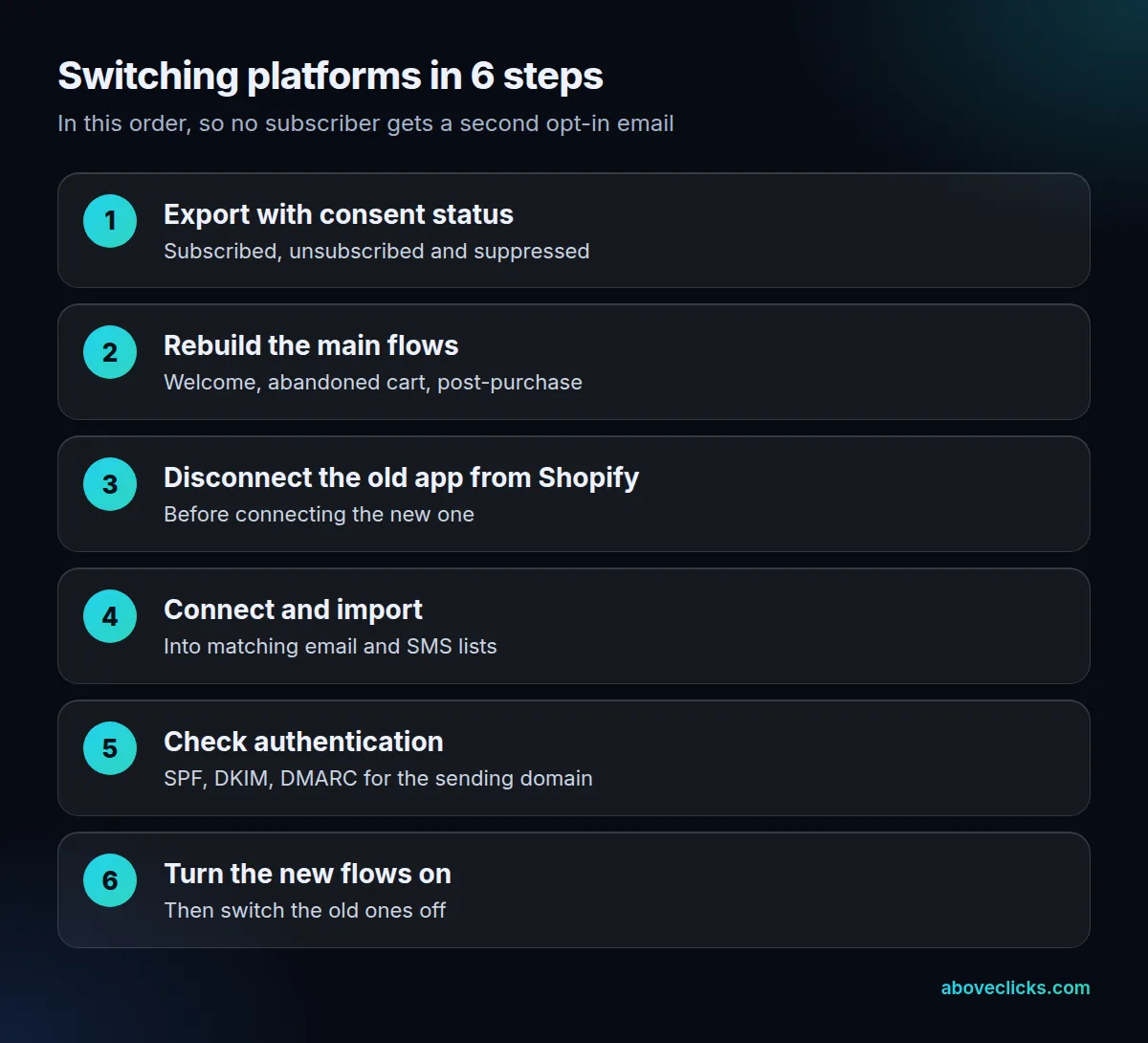
When we move a store between email platforms, we follow the order in the checklist: export every contact with its consent status, rebuild the main flows on the new platform, disconnect the old app from Shopify, then connect the new one and import into matching lists. The old flows go off only after the new ones are live, so no customer misses a cart reminder and nobody gets a second opt-in email.
Whichever direction you move in a Klaviyo vs Omnisend switch, keep the old account readable for a few weeks after the move, so you can check past campaign results and consent records if a customer asks.
As of October 2026, Omnisend’s pricing page offers a free migration of contacts, data and segments. Moving to Klaviyo, our Klaviyo migration service maps what has to move before anything is switched. If you’re already on Klaviyo and unsure it’s paying its way, our Klaviyo email marketing team can review the account, or start with the free audit. More comparisons are in buying guides.