Digital marketing agency fees are everything an agency bills you, plus the costs it passes through and the ad spend you pay to platforms. Add the lines up before you compare quotes, because the retainer is only one of them.
This guide splits marketing agency fees into four layers, shows one formula that turns a headline retainer into a true monthly fee, and lists the account rules that keep leaving free.
What are digital marketing agency fees?
They are the charges for the agency’s work and for everything bought on your behalf: a fee for the work, pass-through costs, one-off fees and, separately, the ad spend that goes to platforms.
Most quotes show only the first line, and some of the other lines arrive later as “extras” on the invoice. Digital marketing agency fees are easiest to read when each layer has its own line. In the worked example below, three hidden lines add $1,025 to a $2,000 retainer. That is why two quotes with the same headline can cost very different amounts by month 3. The pricing models guide explains how the agency fee itself is billed (retainer, percentage, hourly, performance or hybrid). This guide covers the lines around it.
Four lines cause most of the surprises, and they are the hidden lines this guide looks for:
- Creative work quoted per item, outside the retainer.
- Tool subscriptions billed on top, sometimes with a markup.
- Setup and onboarding fees charged once, before any work starts.
- Ad spend that runs through the agency’s account, where the invoice may not show what the platform charged.
We do not state a market average here. No official source publishes one, and numbers copied from agency blogs mix different services and countries. A figure for digital marketing agency fees that comes without a scope is not worth much. A worked example you can rebuild with your own quote is more useful.
What is in a marketing agency fee structure?
Four layers: the agency fee, pass-through costs, one-off fees and ad spend. Each is paid to someone different and controlled by someone different, which is why they need separate lines on the quote.
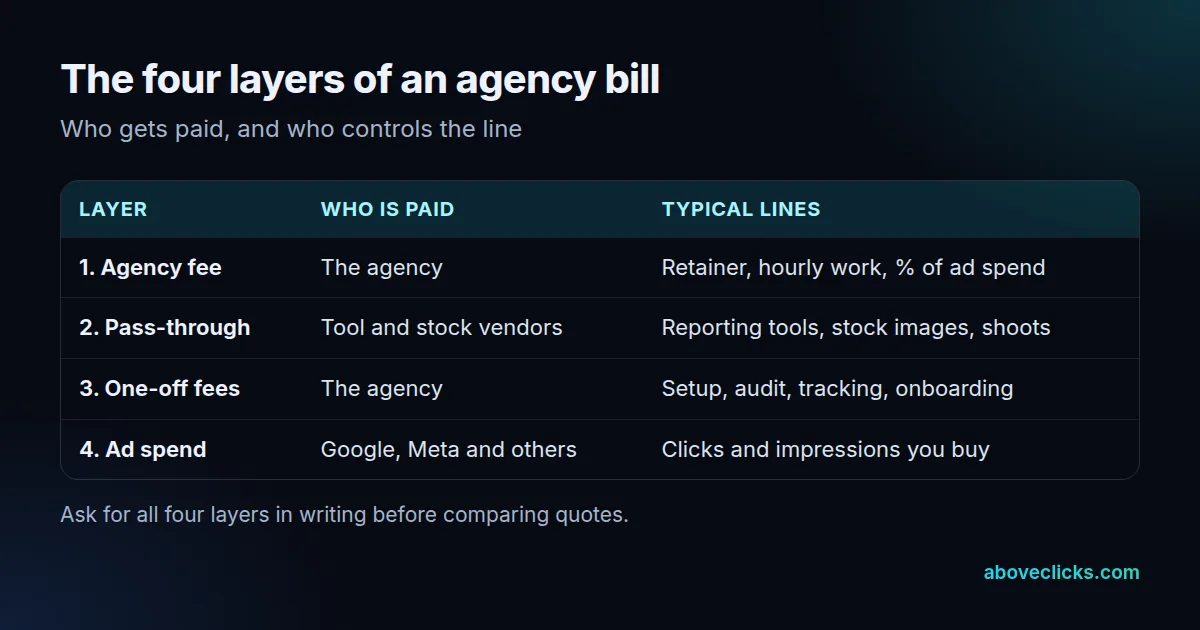
Marketing agency fees follow these layers whatever the agency sells. The agency fee is what you pay for the team’s time, however it is billed. Our hourly rates guide shows how to turn a retainer into an hourly figure and check the hours.
Pass-through costs are bought from third parties: a reporting tool, stock images, a photo shoot, a landing page tool. Ask whether they are billed at cost or with a markup, and whether the subscription stays in your name.
One-off fees cover the work done once: an audit, tracking setup, account setup or onboarding. A $1,500 setup, for example, belongs on its own line. They are not wrong, but they should be itemized and say what you keep.
Ad spend is the money that buys clicks. It is paid to Google, Meta or another platform, not to the agency. A fee set as a percentage of it is explained in our PPC management fees guide.
How much do digital marketing agencies charge per month?
It depends on the scope, the billing model and the layers above, so there is no honest single number for digital marketing agency fees. What you can calculate is your own true monthly fee: the retainer plus the other lines, averaged over a month.
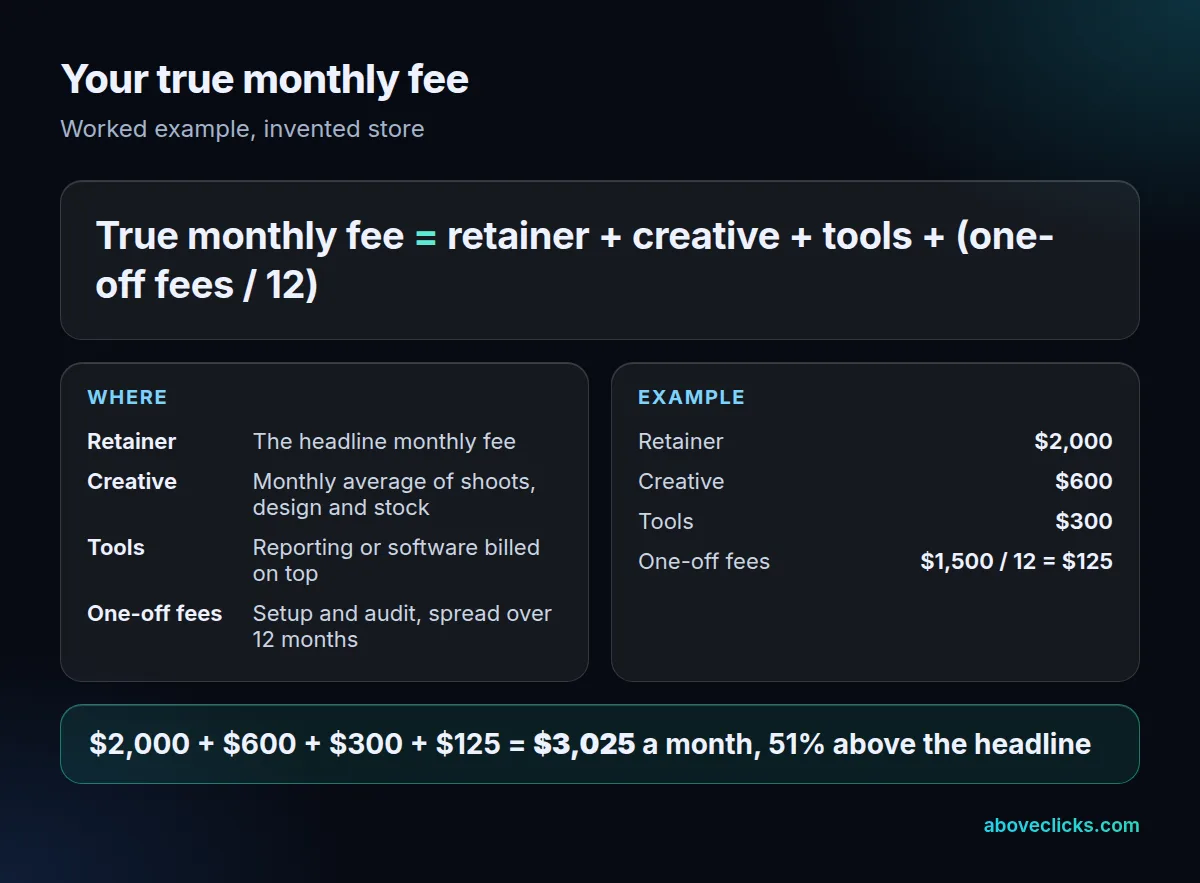
Example: an invented store is quoted a $2,000 retainer. The agency adds $600 monthly for creative and $300 for a reporting tool, plus a one-off $1,500 setup. Spread over 12 months, the setup adds $125 monthly. The total is $3,025, which is 51% above the headline. That is the true cost of these digital marketing agency fees. Compare that total, not the headline, with other marketing agency fees you are quoted.
The ad spend sits on top. If the same store spends $10,000 monthly on ads, it pays the platforms that amount directly. Agency-side cost is then $3,025 of a $13,025 total outlay, and that is the figure to weigh against the sales the ads produce.
Percentage fees need their own check. With 10% of ad spend as the charge, a $10,000 month costs $1,000 and a $20,000 month costs $2,000 for what may be the same amount of work. Ask for a cap or a floor in writing, and see whether the work really doubled.
A package page works the same way. The monthly packages guide lists what a package should contain, so you can check each line of the quote against it.
Which costs sit outside the agency’s fee?
Ad spend, tool subscriptions you hold yourself, and creative that is quoted per project. Ask which of them run through the agency’s accounts, because that decides who can stop, refund or move them. Marketing agency fees that run through the agency’s accounts need the most care. In the worked example, the $10,000 ad spend is paid to the platforms and sits outside the $3,025.
Google describes the main risk on its manager account page. A manager account can be given ownership of a client account, which lets it manage user access, and it can link a payments profile for monthly invoicing. If the agency’s profile pays Google and then invoices you, the ad spend becomes a line on the agency’s bill. That is not wrong, but you need the invoice detail to see the spend and any markup.
Payment access is also set by level. In Google Ads access levels, Admin or Billing access can edit forms of payment, and only Admin can give access or cancel invitations. An agency that needs to edit campaigns does not need Billing access.
A markup is not always visible. A tool that costs the agency one amount and you another is normal in the trade, but it should be a line you agreed to, not a surprise. The same goes for ad spend: the invoice should show the platform’s own charge and the agency’s fee as two separate numbers.
Three questions settle most of it:
- Is the ad account in my name, with my payment method on it?
- Are tool subscriptions billed to me at cost, or to the agency with a markup?
- Is creative quoted per item, with a number of revisions included?
How do you compare marketing agency fees between two quotes?
Comparing digital marketing agency fees works only on the same basis. Put both quotes on the same four layers, convert them to a monthly figure and divide by what is delivered. A quote with lower marketing agency fees often has more lines left blank.
Use this order:
- Write down the retainer, creative, tools and one-off fees for each quote.
- Spread the one-off charges over 12 months and add everything to the true monthly fee.
- List what is delivered each month: campaigns managed, pages built, reports, calls.
- Divide the true monthly fee by the delivered items.
- Check what leaves the scope if you ask for a lower fee.
Example: quote A is a $2,400 retainer with creative and a monthly report included. Quote B is $1,800 with the report only, and creative at $200 per item. If you need four items a month, quote B costs $2,600 and quote A costs less. Only the line-by-line view shows that. If a line is blank, ask whether it is included, extra or not offered.
When the quotes use different billing models, convert both to the same period before you compare. The pricing models guide shows how, and a second opinion on a quote is part of our free audit.
Which contract terms change what you pay?
Digital marketing agency fees depend on the contract as much as the quote. The terms that decide what leaving costs are minimum term, notice, who owns the accounts and content, and what is billed after you stop. Ownership is the one people forget.
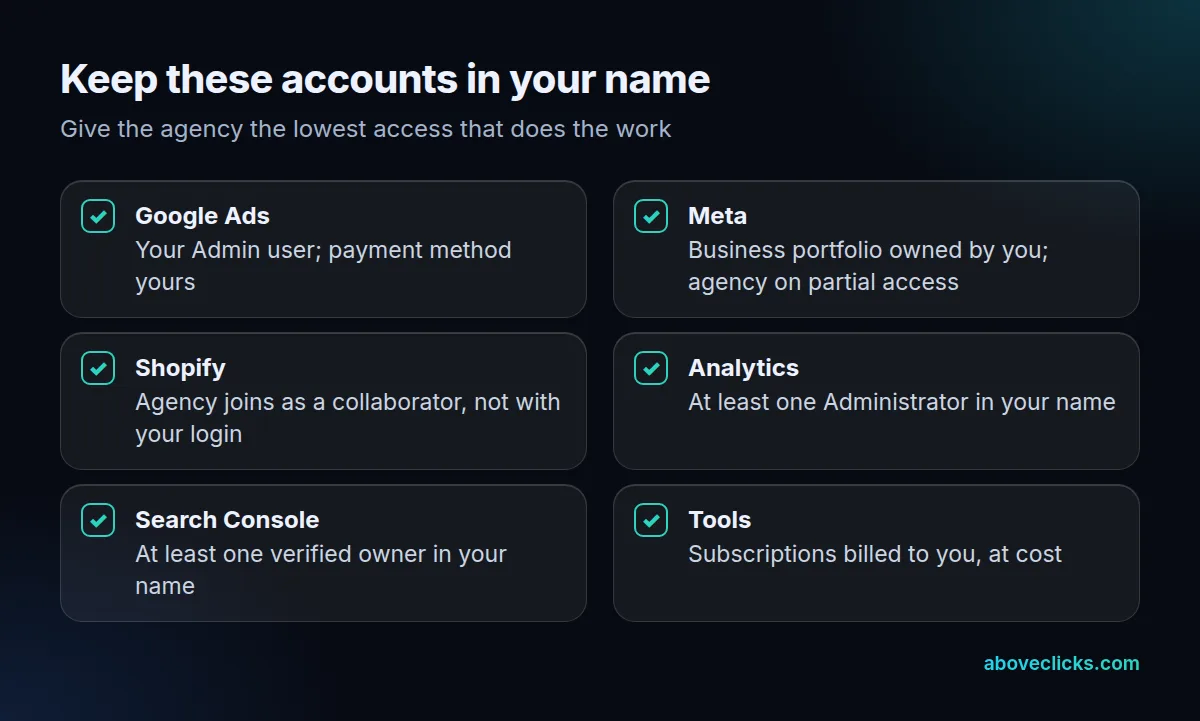
Each platform has a rule that makes ownership easy to check:
- Google Ads: keep your own Admin user, and treat manager-account ownership as a decision you make, as described above.
- Meta: people with full access can claim or remove assets and people, while partial access is limited to assigned tasks. Temporary access lasts from 3 to 75 days and then ends on its own.
- Shopify: the store owner gives a collaborator request code and can accept or reject the request, so the agency never needs the owner login.
- Analytics: adding or changing users needs the Administrator role, so keep one in your name.
- Search Console: a property must have at least one verified owner or no users have access.
A short rule helps: you should be able to remove the agency from every account in an afternoon, without asking permission and without paying a handover fee. If a contract makes that hard, it adds a hidden line to your digital marketing agency fees that no quote will show. Ask about it before you sign, not after the first invoice.
Also ask for the notice period in writing, and whether the last month is billed in full. If you spend on Google Ads, our Google Ads service page shows how we set up access, and more guides on marketing agency fees and other costs are in buying guides.