Real estate marketing programs are recurring sets of marketing work, run on a fixed calendar instead of as one-off pushes. Judge a program by the appointments it books, because lead counts alone hide weak follow-up.
This guide explains what real estate marketing programs contain, how to launch one in 90 days, which advertising rules apply, and how to choose between a pre-built program, a brokerage’s offer and an agency.
What are real estate marketing programs?
A real estate marketing program is a repeating plan: the same few kinds of work, done every month, with one report at the end. A campaign has an end date; a program keeps running.
That fits how property sells. The National Association of Realtors reports that home sellers have now owned their home for a median of 12 years before selling, an all-time high in its 2026 profile. With sellers waiting that long, the agent who stays known for years is the one called when they finally decide.
A real estate marketing program therefore has two jobs: stay known to people who might sell or buy later, and capture people who are ready now. Many agents only do the second, and their real estate marketing strategy stalls whenever ad spend stops.
What does a real estate marketing plan include?
Four parts: past-client follow-up, listing promotion, local search and paid lead ads. Each does a different job, so a real estate marketing plan that leaves one out leaves a gap.
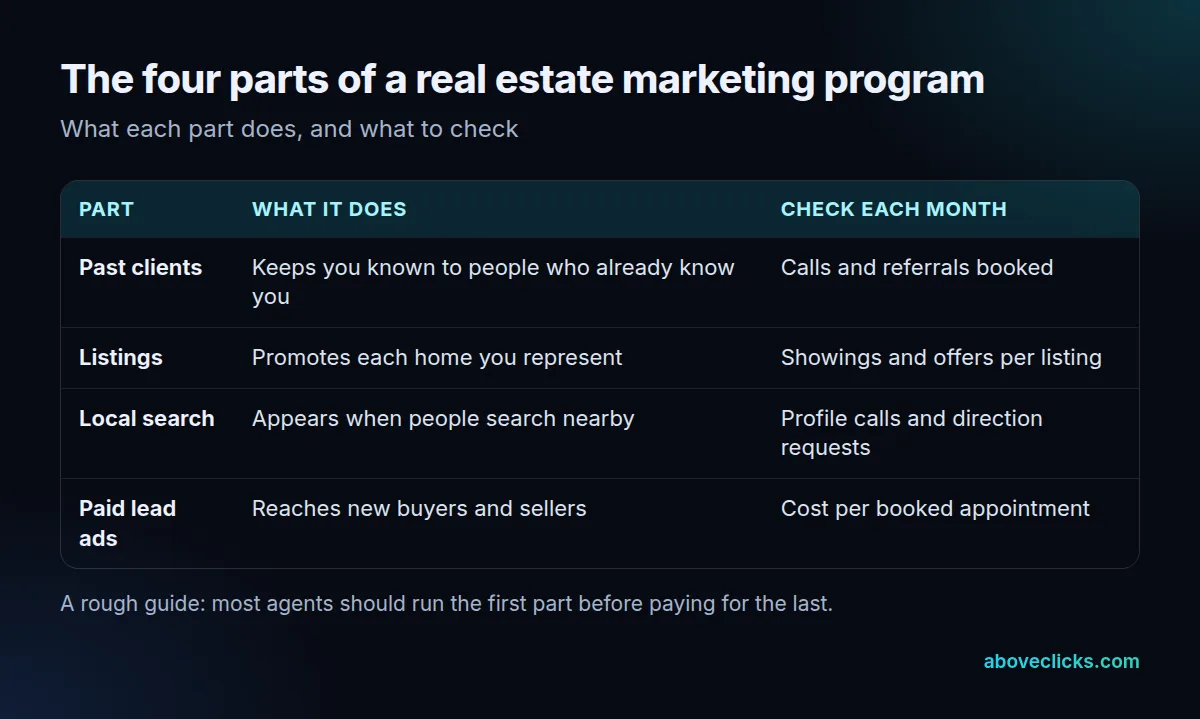
Write it down as a 12-month calendar: 4 parts, one deliverable per part each month, and one review every 30 days. A plan on a single page is easier to keep than a long document.
The table is a model, not a rule. A team with many listings may weight the second row heavily, while a new agent with no past clients starts with local search and paid ads. What matters is that every part has an owner, a monthly deliverable and one number you check.
- Past clients: a short monthly note, a yearly review call and a simple way to ask for introductions.
- Listings: a fixed set of items for each home, such as photos, a description, a video and a social post.
- Local search: a verified Google Business Profile with complete details. Google says verifying your business tells it you’re authorized to represent it, and that complete, accurate info makes a profile more likely to show up in local results.
- Paid lead ads: Search and social ads that send people to a form or a call.
Not every agent needs every part at full strength. A new agent with 20 past contacts has little to follow up and should put more weight on local search and ads. An agent with 300 past clients should do the opposite. The model works as a prompt: for each of the four parts, decide what you will do this month, who does it and how you will know it happened.
Which real estate marketing campaigns belong in a program?
Start with the campaigns that cost least and build trust: follow-up and local search. Add paid real estate marketing campaigns when follow-up is working, so new leads are not left waiting.
Paid campaigns are the part most agents ask about, so here is what we see. In September 2026, an anonymized real estate account on our industry page ran six Meta lead campaigns, covering buyers, sellers, open houses and retargeting. They brought 486 leads at $10.03 each. A Google Search campaign set recorded conversions at $60.32 each.
Those numbers are not comparable. A cheap social lead is not a booked appointment, and a costlier search conversion often is closer to one. Google’s lead forms let people submit their details directly in an ad, which shortens the path, but the follow-up still decides the result. Count appointments, not leads.
If you want help with the paid part, our real estate marketing service covers ads and tracking, and the lead generation ads page explains how we build lead campaigns.
A good real estate marketing program also names what it will not do. Skipping a channel on purpose is a decision; skipping it by accident is a gap. Write down the 1 or 2 channels you are leaving out for now, such as print mailers or video, and set a date, perhaps 90 days out, to look at them again.
How do you launch a real estate marketing strategy in 90 days?
In three stages of 30 days: foundations, follow-up, then paid ads. Skipping ahead to ads before follow-up exists is the most common way to waste a first month of budget.
- Days 1 to 30, foundations: verify and complete the Business Profile, list your past clients, write one listing template, and set up call and form tracking.
- Days 31 to 60, follow-up: send the first monthly note, book 5 to 10 review calls and publish your first listing set using the template.
- Days 61 to 90, paid ads: launch one buyer and one seller campaign with a small test budget, check the first results weekly, and write the first monthly report.
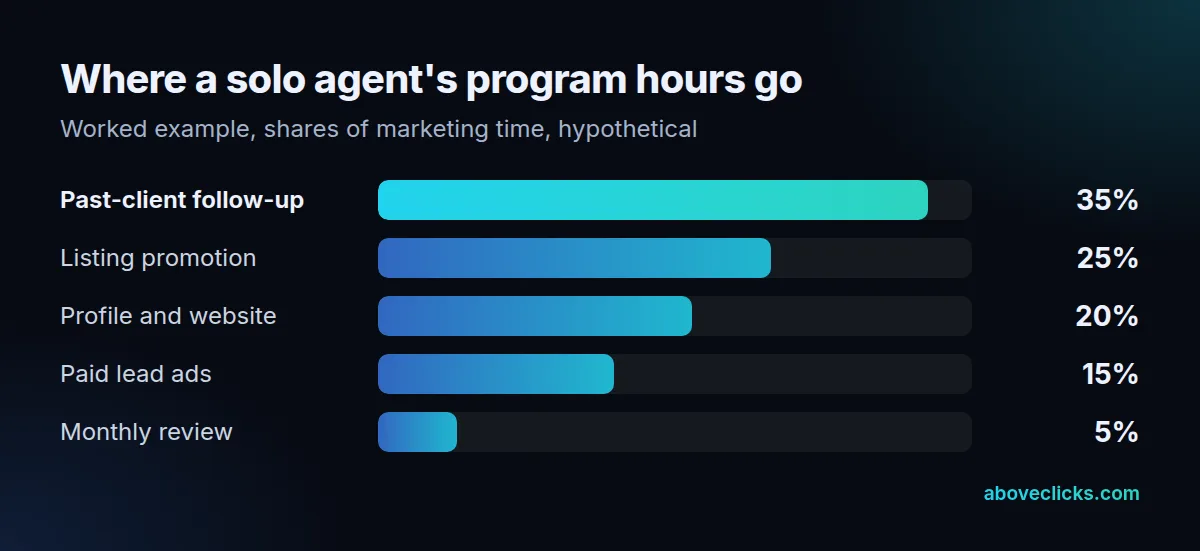
The chart is a worked example for a solo agent at steady state, with hypothetical shares, not a market benchmark. The largest block goes to follow-up because it costs the least and compounds. Your split will differ; the point is to write one down, so the program has a budget of time as well as money.
Keep the monthly report short: 4 numbers, one per part of the program, plus a line on what changed and what you will do next. For paid ads, add spend and the cost per booked appointment. A report you can read in 5 minutes is one you will actually use.
At day 90, run a simple test. Did booked appointments rise? Do you know which part produced them? If the answer to the second question is no, fix the tracking before you spend more.
If you are short of time, shrink the program rather than skip the review. Run only 2 parts, past-client follow-up and local search, for the first 90 days, and add listing and paid parts as hours free up. A small real estate marketing program that runs every month beats a large one that stops after 6 weeks, because the value comes from repetition: the 12th monthly note reaches people the first one never did.
Hand-offs matter too. If a team member, assistant or vendor runs part of the program, give each one a written monthly list and one contact on your side. Most stalled real estate marketing campaigns did not fail on strategy; they stalled when nobody knew whose turn it was.
What rules apply to real estate marketing campaigns?
Housing ads, marketing email and reviews each have rules. Check them before launch, because a rejected or non-compliant campaign costs more than the time to read the guidance.
- Fair housing: the Fair Housing Act protects 7 classes: race, color, national origin, religion, sex, familial status and disability. Ad copy and targeting should never steer by them.
- Meta housing ads: Meta requires you to specify if an ad promotes a Special Ad Category, and notes that using one may limit your audience options.
- Marketing email: the FTC’s CAN-SPAM guide says each message needs your valid postal address and a clear way to opt out, and you must honor an opt-out within 10 business days.
Build the rules into the calendar instead of treating them as a one-time check. Add a line to each monthly send and each new ad: address present, opt-out working, no audience choices that steer by a protected class. It takes a minute per item and protects every later month of the program.
This is not legal advice. Your state real estate commission and brokerage may add rules for advertising and disclosures, so ask your broker before running any real estate marketing program in public.
How do you choose between real estate marketing programs?
Compare them by deliverables, account ownership and reporting, not by the size of the promise. A program that can’t list what it delivers each month can’t be checked.
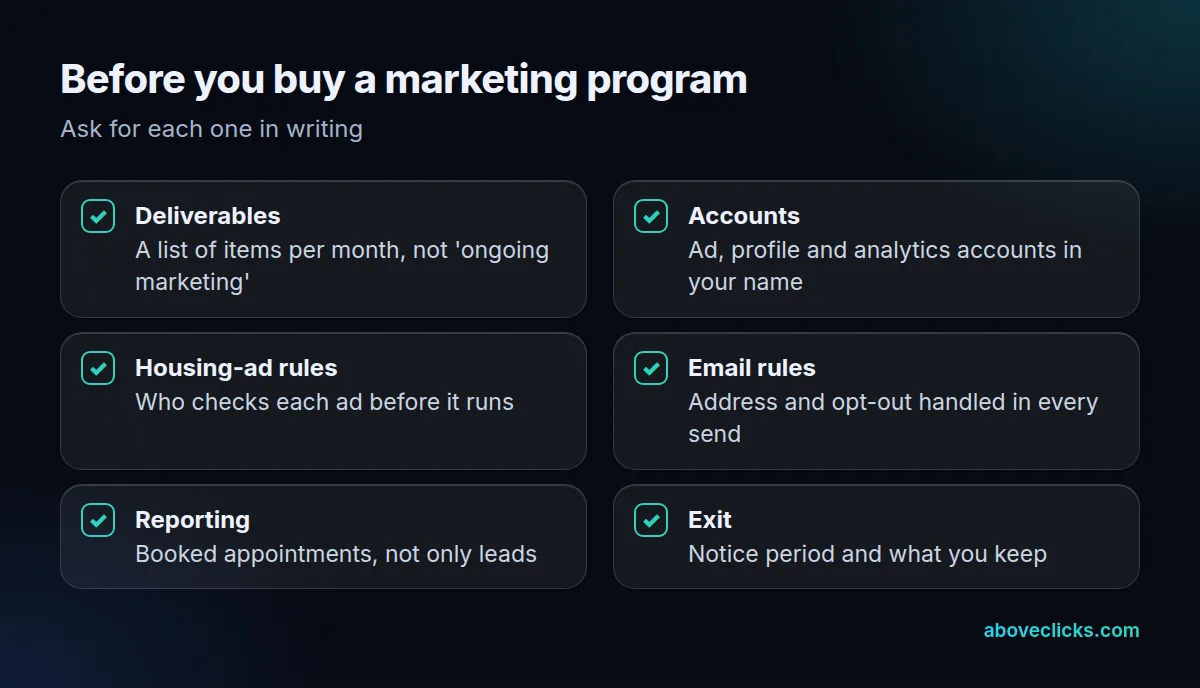
There are three common sources. A brokerage program usually covers branding and listing promotion, and rarely your own follow-up. A pre-built or franchise program gives you templates and a calendar, which suits agents who want structure. An agency takes over the paid parts and reporting, which suits those with little time.
Whichever of these real estate marketing programs you pick, compare at least 3 offers over the same 90 days, using the same list of deliverables, so the quotes can be set side by side. One offer that delivers 2 items a month can cost more per item than another that delivers 8, so divide each quote by its items.
Use the checklist with all three. Two traps to avoid in particular: ad and analytics accounts opened in a vendor’s name, which you then lose when you leave, and a report that lists leads but never appointments.
If you are weighing an agency, our free audit shows how we read an existing setup, with a PDF report in 2 workdays and no obligation. More guides are in the industries section.