Pay per click management fees usually take one of three shapes: a percentage of ad spend, a flat monthly retainer, or a hybrid of the two. Test each quote at your own spend, because the same fee means different things at different budgets.
This guide uses a published 2026 agency pricing guide for typical ranges, shows what a flat fee becomes as a percentage of ad spend, and lists the contract terms that keep your account yours. We state none of our own prices, and every total below is an invented worked example.
What are typical pay per click management fees?
Percentage fees typically run 10% to 20% of ad spend, with 15% the most common, and flat retainers typically run $1,500 to $10,000 a month, as of October 2026, according to the SolidHQ pricing guide. The same guide lists four models: percentage of spend, flat retainer, hybrid and performance-based.
It also lists one-off setup charges of $2,500 to $10,000 as common for serious account builds, as of October 2026. These are one agency’s published ranges, which we cross-checked against a second guide from Taskip that puts all agency retainers at $1,500 to $50,000 a month, so treat them as a way to sanity-check a quote, not a price list. Pay per click management fees also exclude the ad spend itself, which goes to the platform.
For the full bill, including what clicks cost, see our PPC pricing guide. This guide stays on pay per click management fees: how they scale and what the contract should say. A broader view of agency bundles is in our digital marketing packages guide.
Performance-based fees are rare, according to the same source, because attribution is hard to agree on: when Google, Meta, email and organic all touch a buyer, whose conversion is it? If a proposal offers one, ask who decides what counts.
Is a percentage or flat fee better?
Neither is better in general: a percentage fee grows with your spend, while a flat fee stays fixed. The right choice depends on how steady your budget is and how much work the account needs.
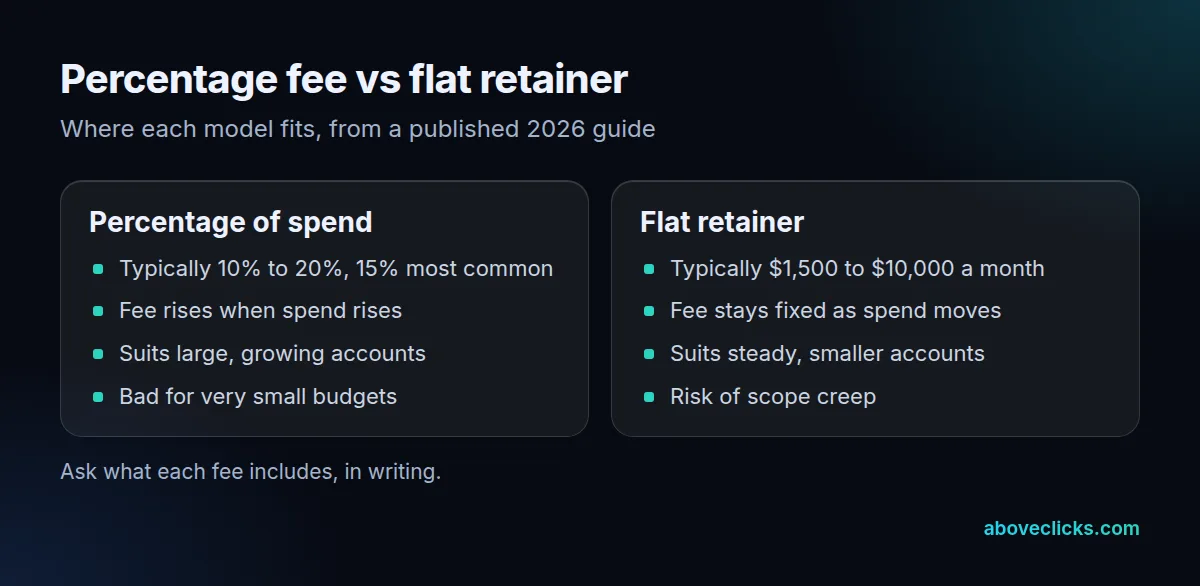
The SolidHQ guide gives a clear warning about percentages on small budgets: 20% of $2,000 is $400, which is not enough to fund proper strategy, creative and account work. A percentage fee also moves with spend, so when spend doubles, the fee doubles.
Flat retainers have the opposite risk. According to the same guide, they can turn into “everything PPC-related forever” without a defined scope, and a $3,000 retainer can mean a senior strategist for a few hours or a junior buyer for many. So with either model, ask who works on the account and for how many hours a month.
When you compare pay per click management fees, divide the fee by the hours and deliverables it buys. Then compare with the leads or orders the account must produce.
When does a flat fee cost more than a percentage fee?
A flat retainer costs more below the crossover spend and less above it. Using the 15% rate that the SolidHQ guide calls most common, as of October 2026, the crossover is the retainer divided by the rate: $3,000 ÷ 15% = $20,000 of monthly ad spend.
Take an invented retainer of $3,000. As a share of ad spend it is 60% at $5,000, 30% at $10,000, 15% at $20,000 and 6% at $50,000.
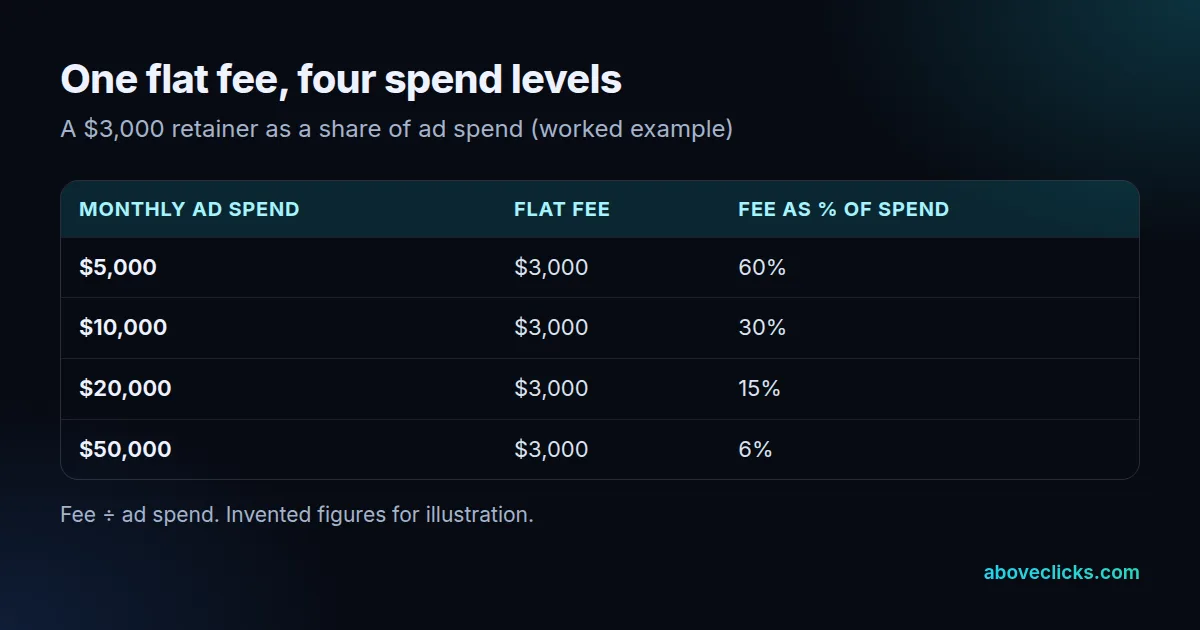
So the same pay per click management fees look expensive or cheap depending on your budget. At $5,000 of ad spend, 15% comes to $750, a quarter of the retainer. At $50,000 of ad spend, 15% comes to $7,500, two and a half times the retainer.
Two practical rules follow for any ppc fees quote. If your spend is below the crossover and steady, a percentage fee or a smaller retainer tends to cost less. If you expect to scale well past it, a flat or hybrid fee protects you from a bill that grows with every test budget. Ask the agency to show its ppc management fees at three spend levels, today’s, double and half, before you sign.
What does a hybrid fee cost?
A hybrid is a base retainer plus a percentage above an agreed spend threshold. As of October 2026, the SolidHQ guide gives the example of 10% of ad spend above $30,000 monthly.
Take an invented hybrid with a base retainer of $2,000 plus 10% of ad spend above $30,000. At $25,000 of ad spend the total is $2,000, because nothing is above the threshold. At $40,000 it is $2,000 + 10% × $10,000 = $3,000. At $60,000 it is $2,000 + 10% × $30,000 = $5,000.
The base pays for strategy, reporting and a defined creative scope, and the percentage applies only when scale needs more work. That makes pay per click management fees predictable for a growing store, but it adds contract complexity. Both sides need to agree what the retainer covers and what the percentage layer funds.
The same arithmetic works for any hybrid you are quoted. Write the formula down, plug in three spend levels and check that the quote matches what the agency says it charges.
How do you compare two quotes with different models?
Put both quotes on the same footing: the total you pay in a month at your real ad spend, plus any one-off charges spread over the first year. Pay per click management fees only become comparable once they sit in one currency, so convert every quote before you debate it.
A short rule keeps this honest: the lowest of the pay per click management fees is not always the cheapest outcome. Judge ppc management fees by cost per lead or per order after the fee, not by the fee alone. If one quote costs $200 more a month but the account produces more orders, it can still win, so review the result at 90 days before you renew your pay per click management fees.
Take an invented store that spends $8,000 monthly on ads and receives two quotes. Quote A is 15% of ad spend with a $2,500 setup charge. Quote B is a flat retainer of $1,600 with no setup charge.
- Quote A: 15% × $8,000 = $1,200, plus $2,500 ÷ 12 = about $208 over the first year, so about $1,408 monthly.
- Quote B: $1,600 monthly.
Quote A is cheaper at $8,000, but at $12,000 of ad spend it rises to $1,800 plus the setup share, and Quote B becomes the cheaper one. So run each quote at your budget today, at double and at half, then ask which scope each includes. A cheaper quote with half the scope is not cheaper.
Also compare what the money buys in time. Ask each agency how many hours a month go into the account, who does the work, and how often you receive a report with the numbers behind it. If an answer is vague, price the vagueness: assume the smaller scope.
Who should own the ad account and pay the platform?
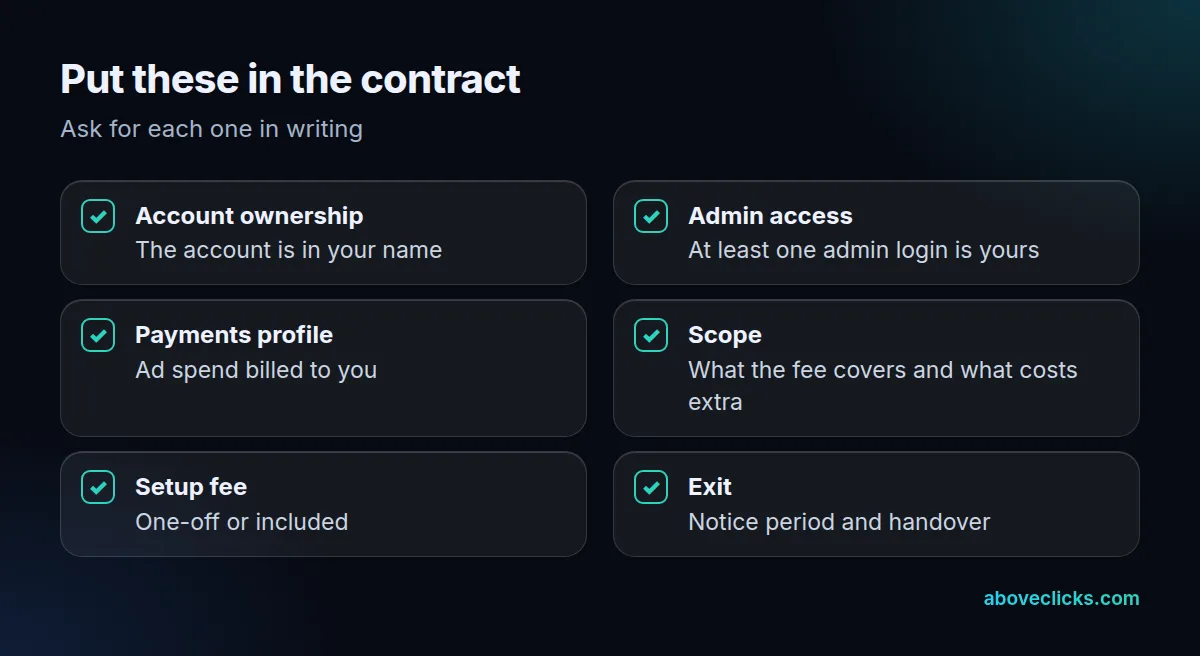
You should. Make sure the Google Ads account is in your business’s name, that at least one admin login is yours, and that ad spend is billed to your payments profile. The agency’s pay per click management fees then pay for the work only.
Google’s rules support this. In its access levels guide, users with Admin or Billing access can update the organization’s payments profile, and an account with only one administrator may lose access to its tags if that user becomes unavailable. Add a second admin.
Google’s manager account guide adds that users with administrative access to a client account can terminate the relationship with the manager account at any time by unlinking it. That is your exit: if the account stays in your name, leaving an agency does not mean losing your history.
Budgets are your call too. Google’s daily budget guide says to divide a monthly budget by 30.4 to find a daily one. A $6,000 monthly budget becomes about $197 a day, and an agency that wants to change it should tell you why.
What should a pay per click management fees contract say?
It should say what the pay per click management fees cover, what costs extra, who owns the account, and how you leave. Four traps cause most of the surprises in ppc fees, and each can cost you months of spend.
A trap with a number attached: a $3,000 retainer on an auto-renewing 3-month term commits you to $9,000 before you can leave.
- A vague scope. Without a written list of deliverables, a flat fee drifts and a percentage fee pays for nothing in particular.
- Hidden setup and extras. Setup, landing pages, creative and reporting tools may bill separately. Ask for the one-off costs in writing.
- Account ownership in the agency’s name. If the agency owns the account, your history leaves when they do.
- Auto-renewing terms. Check the notice period and what you receive on exit: access, data and a written handover.
If you want a second opinion on a proposal, our Google Ads team can review it, and the free audit is a no-cost first look at your account. For Amazon accounts, see Amazon PPC management cost, and for more, browse Google Ads topics.