A digital agency builds and runs digital products such as websites and software, while a digital marketing agency plans and buys marketing such as ads and search. The labels overlap, so choose by the task you need done.
This guide to digital agency vs digital marketing agency explains what each label covers, how the U.S. Census industry codes classify the work, 5 traps that cost buyers money, and a task-based way to pick.
What is a digital agency?
A firm whose core work is making digital products: websites, online stores, apps and the software behind them. Many also offer search optimization and design as extras.
The official industry files back this up. In the U.S. Census Bureau’s classification system, NAICS, code 541511 covers custom computer programming: writing, modifying, testing and supporting software for a particular customer. The index entries for that code include custom web page design services and custom search engine optimization services. So when a firm calls itself a digital agency, the work that fits the label best is building and supporting what lives online.
What you receive from a digital agency is usually a finished thing with a handover: a site, a store or an app, plus the access details and a way to keep it running. That makes it easy to judge, because you can open the result and use it. Ask for the handover list before you sign, and for a named person who will answer questions about the build after launch.
A neighbouring code, 541512, covers computer systems design, which is planning and integrating systems.
What is a digital marketing agency?
A firm whose core work is getting customers to a business through paid ads, search, email and social. It plans campaigns and buys the media they run on.
The matching official definition is code 541810, advertising agencies. It describes establishments that create advertising campaigns and place them in print, digital and other media, with a full range of services that includes advice, creative work, account management, production of advertising content, media planning and buying. The index entries under that code include digital advertising agencies, internet advertising agencies and online advertising agencies. A related code, 541613, covers marketing consulting: operating advice on marketing objectives, planning and strategy.
A digital marketing agency’s work, by contrast, is a stream: campaigns that run every month, reports and changes that are logged. Because there is no finished object, you judge it by the reports, so ask what the first 30 days will produce and how many campaigns will be live by day 60.
The classification is used for statistics, so it is not a legal rule about what a firm may call itself, but it shows how a government body draws the lines.
What is the difference between a digital agency and a digital marketing agency?
One builds and supports digital things, the other buys attention for them. The difference is the main task, and many firms sell both.
Digital agency vs digital marketing agency in one table
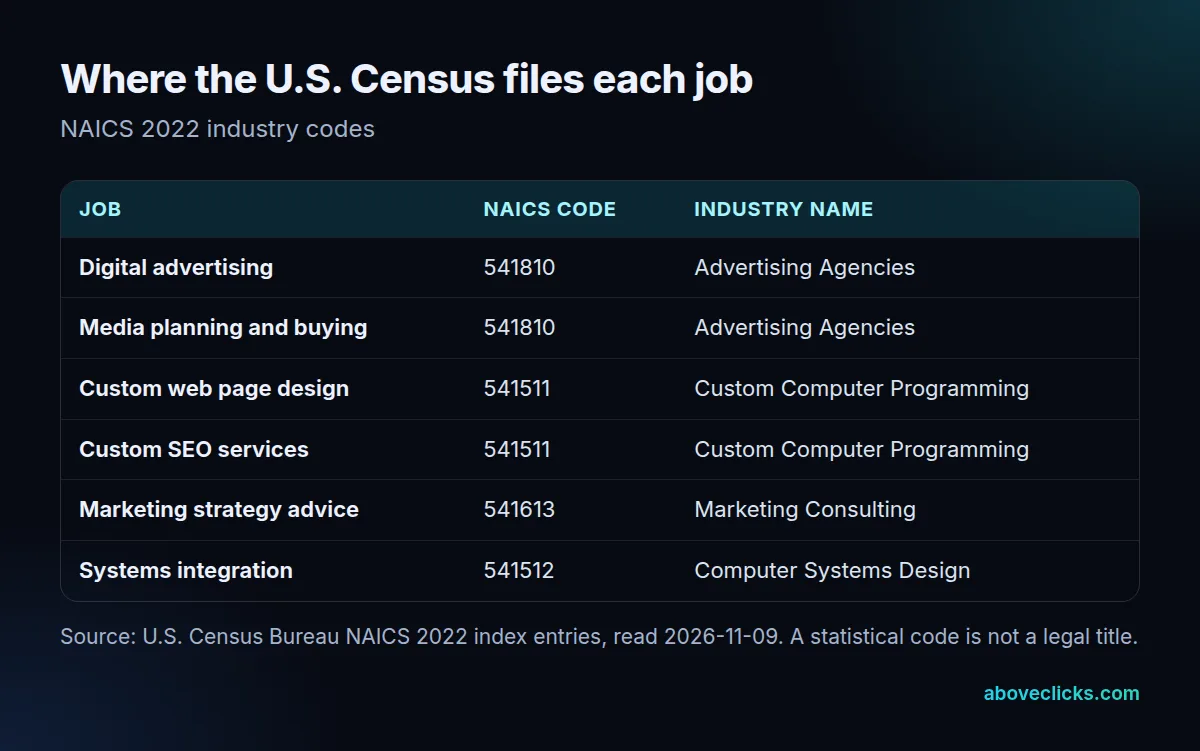
The table shows the split. Three of the 6 jobs fall under advertising or marketing codes, and 3 under computer codes, even though a buyer would call all 6 “digital”. Here are the 5 traps that cost buyers money when they mix the two labels:
- Hiring a marketing agency to fix a site. Ads then send traffic to a page that cannot convert.
- Hiring a builder to run ads. Skill at making pages is not skill at buying media.
- Paying twice for search work. Custom SEO sits in the build code, but a marketing agency may also sell it, so ask who owns which part.
- Expecting one team to do both well. Ask for examples of each job separately.
- Reading the label instead of the task list. The name tells you little, and the list tells you everything.
Our own view is that the first trap is the most common and the most expensive. A store that spends 1,000 dollars on ads a month, sent to a slow product page, loses a share of that money on every visit. A site fix comes before more ad spend.
Here is a worked example with invented numbers. A store gets 20,000 visits a month and 1.5% of them order, which is 300 orders. A product-page fix that lifts the order rate to 1.8% gives 360 orders from the same visits, 60 more, with no new ad spend. Getting 60 extra orders from ads at the old rate would need 4,000 more visits, since 4,000 times 1.5% is 60. The builder’s fix and the marketer’s ads are both useful, but they answer different questions, and the order of the two jobs decides which one pays back first.
Which one do you need?
Pick by the task, not the label. A new site or app needs a builder. Traffic from ads needs a marketing agency. Advice on where to start needs a consultant.
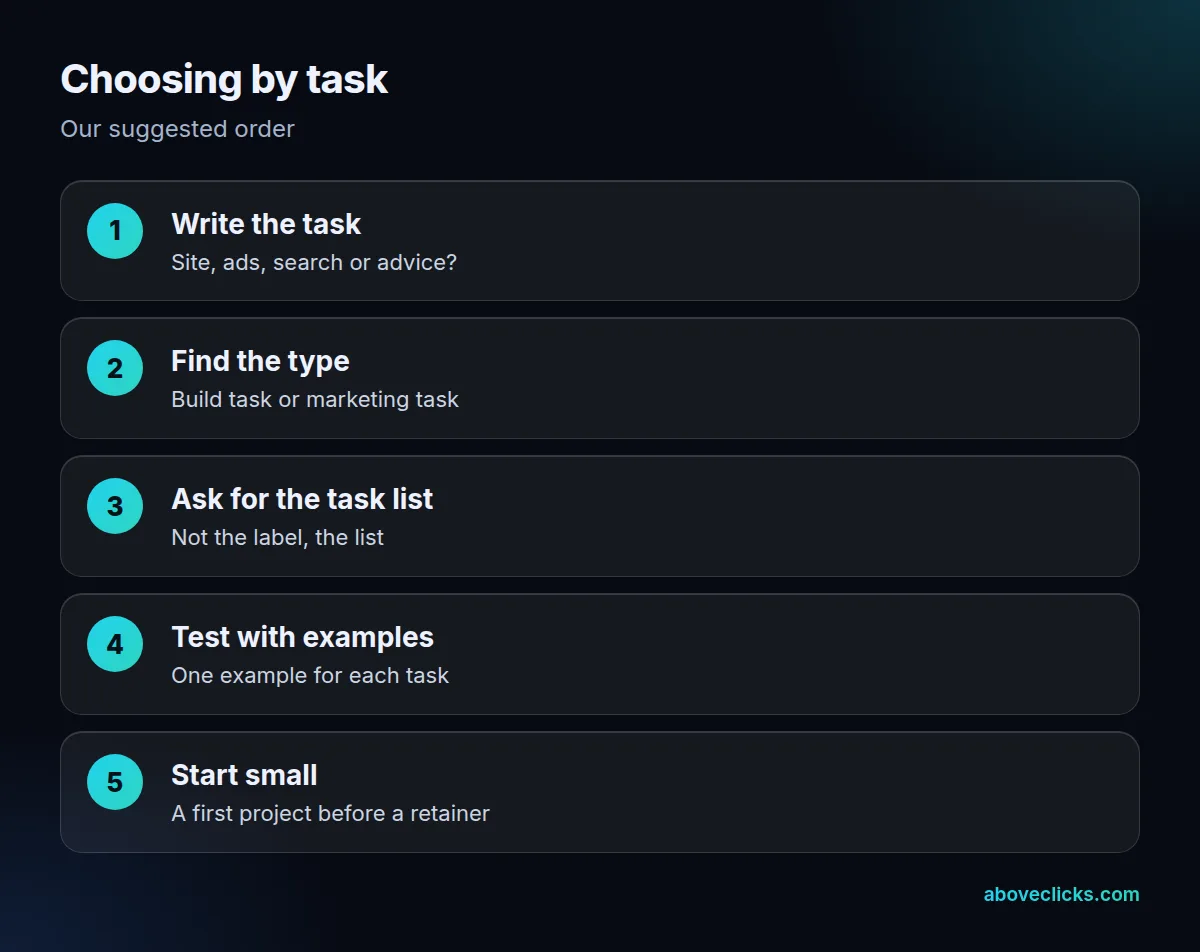
Match the need to the type with these 3 rules of thumb:
- You have no site, or the site is broken: start with a digital agency or a developer, because ads cannot fix a page that does not load.
- You have a working site and no traffic: start with a digital marketing agency, and ask for a test budget before a long contract.
- You are not sure what is wrong: start with a written review. A review of 1 site and its ads costs far less than the wrong 6 month contract.
Use the 5 steps above with an invented example. A shop owner has a slow product page and a small ad budget. Step 1 writes the task as “fix the page, then run ads”. Step 2 sees 2 jobs: a build task first, a marketing task second. Step 3 asks each firm for its task list. Step 4 asks for 1 example of each job. Step 5 starts with a 1 month project on the page before a retainer for ads. The shop buys 2 jobs in the right order instead of 1 label. A digital marketing agency or a digital agency can win the first job, so judge both on the same 5 steps.
If you are comparing firms on cost, see our guide to marketing agency pricing models. If the choice is between a hire and an agency, our guide to in-house vs agency marketing covers it.
How do you check a proposal from either type?
Ask for the task list, examples of each task, a timeframe and a measure of success. The label on the proposal matters far less than those 4 answers.
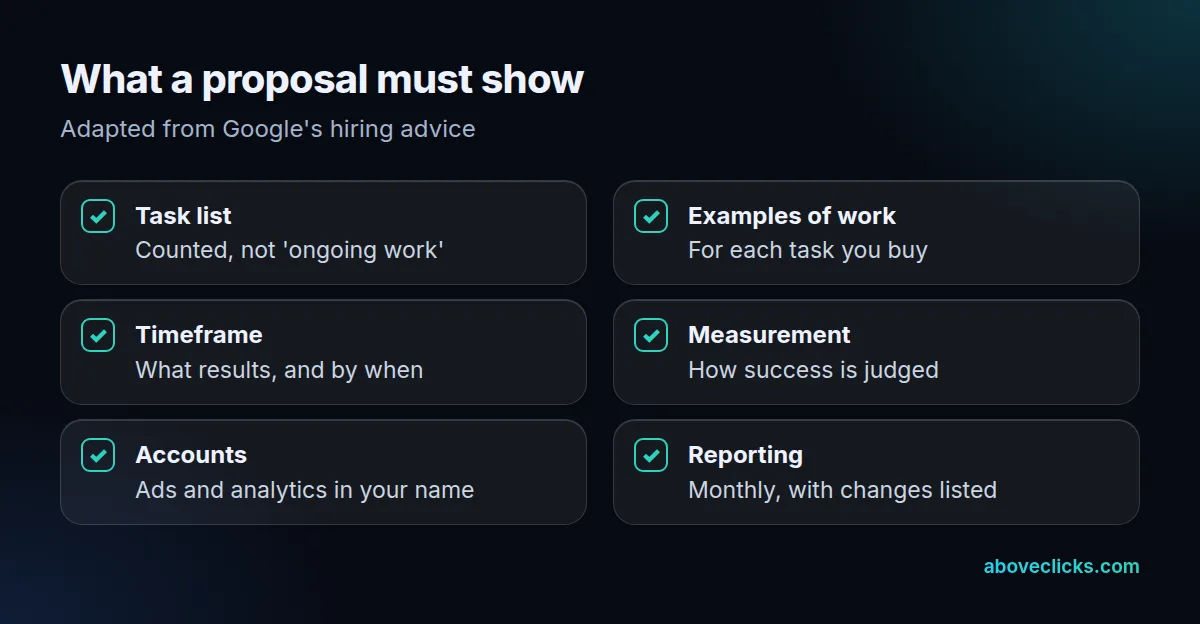
Google’s advice on hiring an SEO is a useful model for any agency. It suggests asking to see examples of previous work, what results to expect and in what timeframe, and how success is measured. It also asks how the firm will communicate and whether you will see every change made to your site. The same page says no one can promise a number one ranking, a rule that applies to a digital marketing agency and a digital agency alike.
It also helps to ask what the first 30 days will look like from each type. A digital agency should show a plan for the build, a list of pages or features, a date for a first working version and a named person for questions. A digital marketing agency should show the accounts it will set up, the tracking it will check, the first campaigns it will launch and the report you will receive. If either one answers with a general promise of growth, ask again until you get a dated list.
Be careful with proposals that name a tool or a platform in the place of a task. A proposal that says “we use” a particular tool tells you what the firm owns, not what you will receive. Ask what that tool will change on your site or in your accounts, and who checks the change.
Overlap is normal, and it is not a warning sign by itself. Many firms started as builders and added ads, or started as marketers and added sites. The warning sign is a firm that sells everything with the same sales page and cannot show a single example for a task. For a firm that does both, ask for 2 separate task lists and 2 separate sets of examples, so you can judge each skill on its own record.
Keep your accounts in your own name, whichever type you hire. The site, the analytics property and the ad accounts should be yours, with the agency added as a user. When the work ends, you remove 1 user instead of chasing a password. For a longer scorecard, see our guide on how to evaluate a marketing agency, and the questions to ask a marketing agency list.
We start with a look rather than a pitch. Our free audit is a written review of your site and ads, and the sample report shows the layout. If your main need is paid search, see our Google Ads service, and for more comparisons browse the buying guides.