Marketing agency hourly rates are what an agency bills for one hour of staff time, and each rate is built from wages, benefits, unbilled time, overhead and margin. Judge a quote by that build-up, because a rate alone says little until you know the hours behind it.
This guide shows the math behind a marketing agency hourly rate, how a mixed team changes it, how to convert a retainer into an hourly rate, and what to check on the bill.
What are marketing agency hourly rates?
The amount an agency charges per hour of work, quoted either as one blended number or per role. It is one of three common ways to bill; the others are a fixed project fee and a monthly retainer.
Sprout Social notes that rates can be hourly, per project or on a monthly retainer. Our guide to agency pricing models compares all of them, so this piece stays on the hourly number.
Before you compare quotes, write down three things for each: the rate, the roles it covers and the hours you expect. Two marketing agency hourly rates only compare when all three match. A rate of $100 with a junior doing the work and a rate of $150 with a senior doing it are different products, and the cheaper hour is not always the cheaper job.
Hourly billing suits work that is hard to scope: an audit, a one-off fix or advice on a decision. At a rate of $134, a 20-hour month comes to $2,680, and a 5-hour fix comes to $670. It suits steady monthly work less well, because the bill moves with the hours and nobody is paid for finishing sooner.
What is the average marketing agency hourly rate?
There is no single average we can source for whole agencies, so we don’t print one. The only range we can cite is for freelancers in one discipline: about $20 to $150 an hour for social media, as of November 2026.
SolidGigs splits that range by experience, from $20 to $35 for beginners to $75 to $150 or more for seasoned specialists. Sprout Social gives the same overall range. Our social media hourly rate guide covers it in detail.
Agency rates sit on top of that, because an agency pays for management, tools and a team around the person doing the work. A published average for all agencies hides differences in country, specialty and team size, so build the number yourself instead, as the next section does. Treat any list of marketing agency hourly rates you find online as a starting question for the agency, not as an answer.
How is a marketing agency hourly rate built?
In 5 steps: a wage, plus benefits, divided by the billable share of the week, plus overhead, plus margin. Each step raises the hourly rate, and you can test any quote against them.
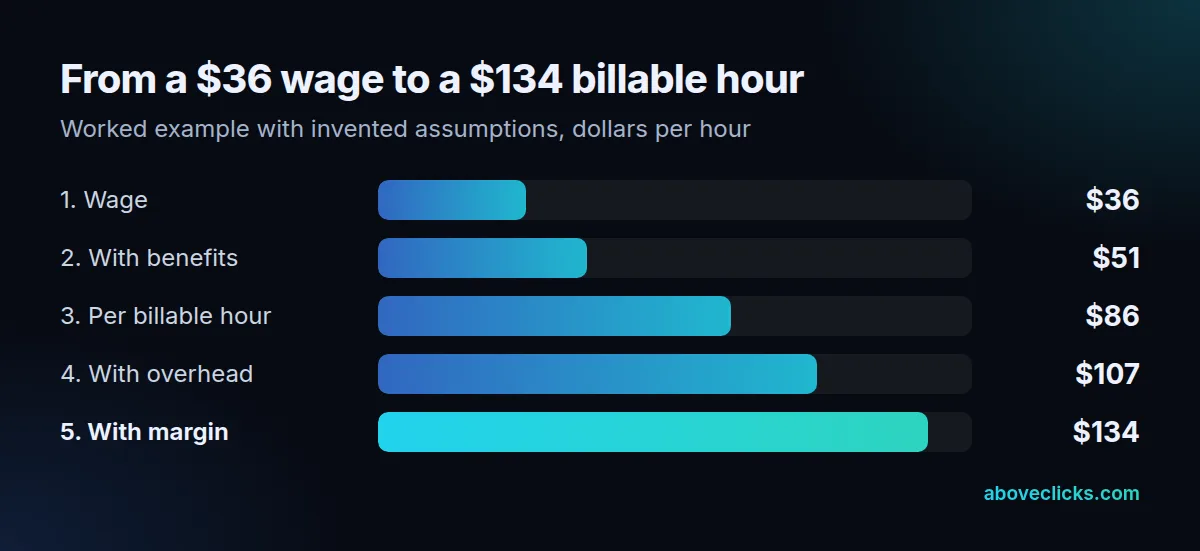
This is a worked example with invented assumptions, not our rate card. It starts with a wage of $36 an hour, close to the $35.94 median hourly pay for public relations specialists in 2025, according to the U.S. Bureau of Labor Statistics.
- Wage: $36 an hour.
- Benefits: the BLS reports that wages were 70.0% of employer costs and benefits 30.0% for private industry in June 2026. Divide $36 by 0.70 and the hour costs the agency about $51.
- Billable share: nobody bills all 40 hours. If 60% of the week is billable, the same cost spread over billable hours is $51.43 divided by 0.60, or about $86.
- Overhead: tools, software, management and rent. At 25% on top, the hour is about $107.
- Margin: at 20% of the final rate, divide $107 by 0.80 to get about $134.
So $36 on the payslip becomes $134 on the invoice, and no step is padding. Change one assumption and the answer moves: at 75% billable the same hour comes to about $107. When you compare two marketing agency hourly rates, ask which of the five steps differs.
Do creative agency hourly rates differ by role?
Yes. Most agencies bill senior strategists above specialists and specialists above juniors, then quote a blended rate that averages the three by the hours each one works.
The BLS puts the 2025 median pay for advertising, promotions and marketing managers at $79.70 an hour, more than double the public relations specialist figure above. That gap carries through the five steps into the bill.
Here is a blended rate for an invented team, using the same hours mix each month:
- Strategist: 20% of hours at $180, which is $36 of the blend.
- Specialist: 60% of hours at $120, which is $72.
- Junior: 20% of hours at $80, which is $16.
The blended rate is $124 an hour. Shift 10% of the hours from the junior to the strategist and it rises to $134, with no change to any single role’s rate. Ask for the mix behind any blended marketing agency hourly rate, and for the named roles on each invoice line.
Rates also differ by what is being sold. Paid media management, technical SEO and design each use different skills, and an agency that is strong in one may quote a different marketing agency hourly rate for each. Ask for the rate per service line, and ask which people sit behind it. Marketing agency hourly rates that look similar on paper can describe very different teams. A small agency with one senior person on every account usually sells fewer hours at a higher marketing agency hourly rate than a large one that fills the same account with juniors.
How do you turn a retainer into an hourly rate?
Divide the monthly fee by the hours worked that month. The result is the effective hourly rate, and it falls as the hours rise.
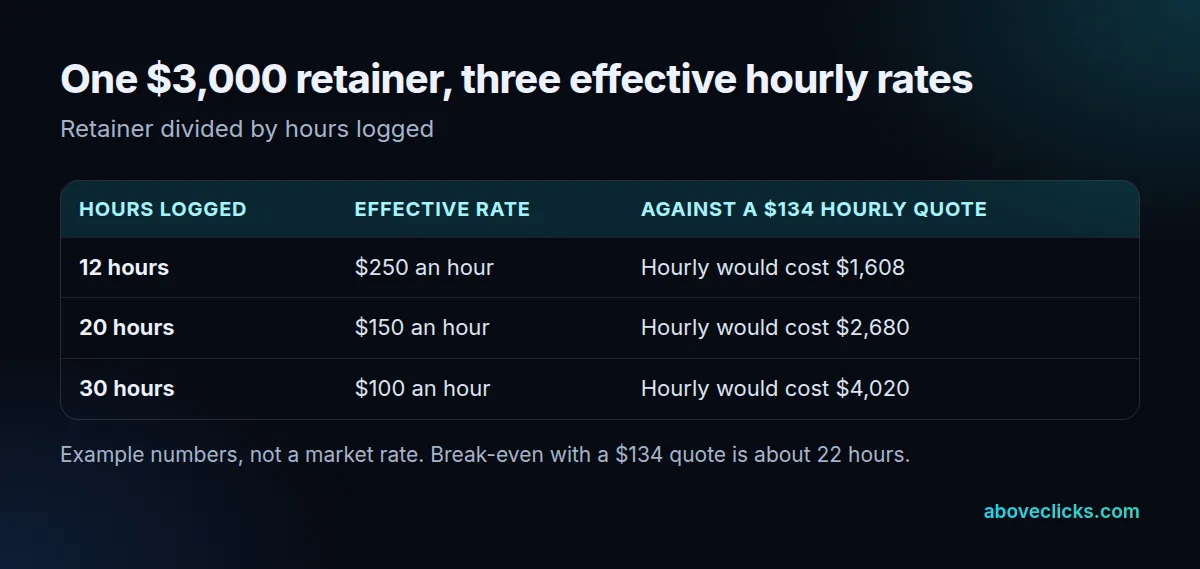
The table uses an invented $3,000 retainer. At 12 logged hours the effective rate is $250; at 30 hours it is $100. Against the $134 quote above, the retainer is cheaper above about 22 hours and dearer below it.
That is why a retainer without a time log is hard to judge. Ask the agency for the hours behind it, or for a list of deliverables each month, and compare that figure with an hourly marketing agency hourly rate for the same work. A retainer also pays for being available and for results, so a higher effective rate is not automatically a bad deal. Our guide to in-house versus agency marketing shows the cost of hiring someone instead.
Retainers also hide a second question: what happens to unused hours. If the agency logs 12 of 20 planned hours, you paid for 8 hours of nothing unless the contract says they roll over. Ask about this before you compare marketing agency hourly rates with a monthly fee.
How do you check the hours on an agency bill?
Ask for a time log, named roles, a monthly cap and approval for extra hours. Four habits cause most disputes: no log, vague task names, rounding up to the nearest hour and work done past the budget without a word.
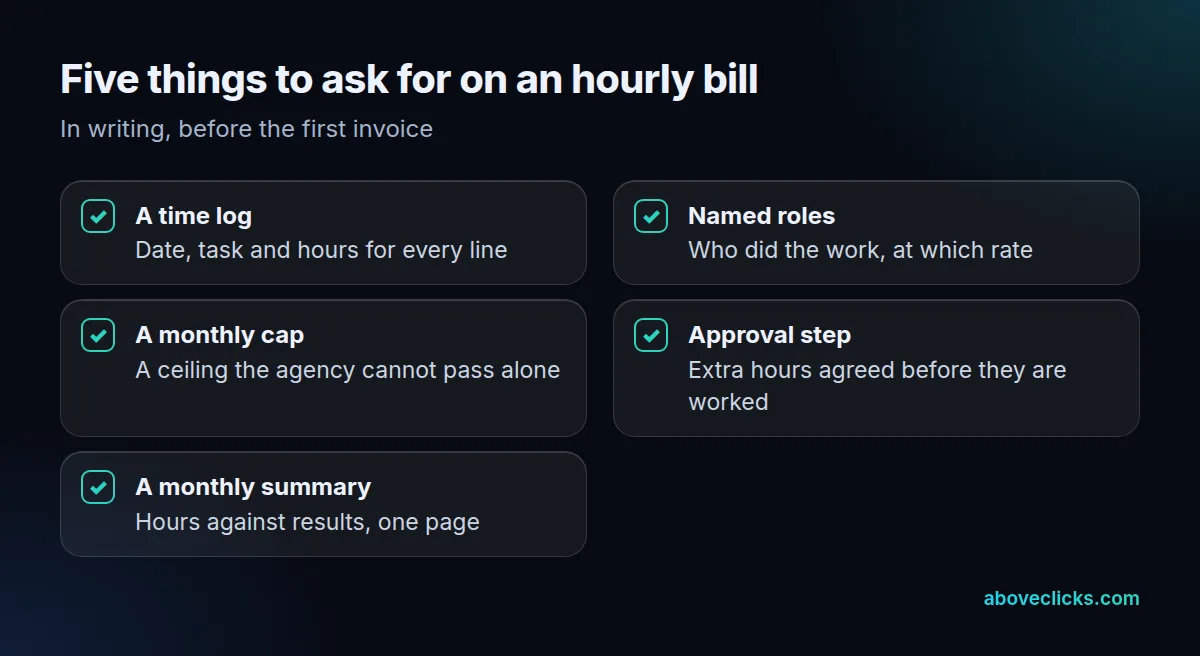
Here is how a bill drifts. An agreement for 20 hours a month at $134 should cost $2,680. If the agency logs 26 hours with no approval step, the bill is $3,484, which is $804 more and 30% over plan. Nothing in the rate changed; the hours did. A cap or an approval step above 20 hours stops that.
A good log has a date, a task and a number of hours for every line. Watch for minimums, such as a quarter-hour charge for a 2-minute email, and for travel or meeting time billed at the full rate.
Costly traps to rule out before you sign:
- An open-ended hourly agreement with no cap.
- A blended rate that never names who does the work.
- A discount that applies to one role only.
- Unused hours that vanish at month end while overruns are billed in full.
If you want to see how an agency explains its work, our sample report shows the format we use, and a free audit is a low-risk way to test any agency’s write-up before you agree a rate. ## When is an hourly rate the right way to buy?
When the scope is small, unclear or one-off, and you want to pay only for time used. Past about 20 hours a month of steady work, a retainer with a clear list of deliverables is usually easier to budget.
A quick test helps: if you can list the deliverables, a retainer or a project fee fits. If you cannot, ask for an hourly agreement with a cap, and revisit it after the first month. Marketing agency hourly rates are easiest to defend when both sides know what the first 20 hours will produce.
Use an hourly agreement for an audit, a short fix or a trial period of 1 to 3 months. Move to a retainer once the work repeats every month and you trust the time log. Marketing agency hourly rates are only one input to that decision. Whichever you choose, write down the rate, the roles, the cap and how a change is agreed, and compare each new marketing agency hourly rate with the build-up above.
More cost guides are in buying guides.