Content marketing for higher education is publishing accurate, useful material that answers what prospective students and families ask before they apply. Judge it by enquiries, applications and enrolments, not by page views.
This guide to content marketing for higher education covers who the content serves, what a college or university should publish first, a 6-step plan, the rules that apply to claims and student stories, and how to measure the work through to enrolment.
What is content marketing for higher education?
It is a steady supply of pages, guides, answers and stories that help a prospective student choose and apply. Its job is to be found, to be believed and to lead to an enquiry.
Google’s guidance on helpful content gives a useful test. It asks whether a page offers original information, reporting, research or analysis, and whether it is written or reviewed by someone who demonstrably knows the topic. A program page written with the program’s own staff passes that test more easily than a generic article.
Stale facts are the usual failure. Example: a college has 24 program pages and 8 of them were last reviewed more than 12 months ago. That is 8 of 24, or 33%, of its pages showing fees, dates or entry rules nobody has checked this year.
Higher education content marketing differs from retail content in one way: the decision takes months and involves families, money and years of someone’s life. Pages are read slowly and compared closely. Accuracy matters more than volume.
The audience is wider than the applicant. Parents ask about cost, safety and outcomes, school counselors ask about entry routes, and mature students ask whether study fits around work. One site can serve all of them if each page says clearly who it is for.
Who is higher education content marketing for?
For applicants at five stages, plus the parents, counselors and advisers who help them. Each stage asks a different question, so each needs a different page.
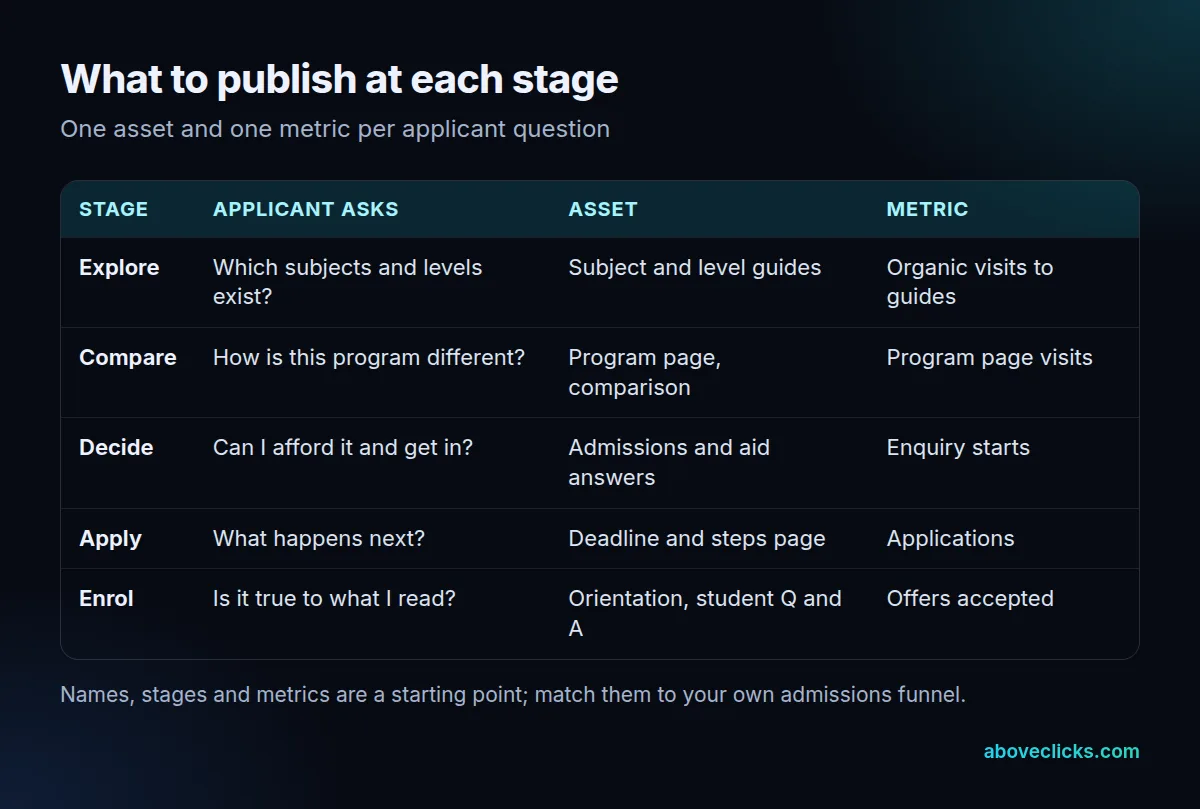
Use the table as a checklist for gaps in your higher education content marketing. Most institutions have strong Compare pages, because every department writes one, and weak Decide pages, because fees, aid and entry requirements sit in PDFs. Content marketing for universities usually pays back fastest where an applicant is closest to applying.
To see how peers present themselves, the US Department of Education’s IPEDS data tools let you download data for more than 7,000 institutions and up to 250 variables, including admissions, enrollment and graduation rates. Use them to build a peer set and to check that your own numbers match what you report to the government. For deeper audience work, see our guide to market research for higher education.
What should a college or university publish first?
For content marketing for colleges, program pages and admissions answers, in that order. They are closest to the decision and the easiest to keep accurate, so they carry the most weight per hour spent.
Here is a worked example for an invented college with 24 programs. Each program gets 3 pieces: a program page, a page answering its entry and aid questions, and one story from a student or teacher. That is 24 x 3 = 72 pieces. At 6 pieces a month, the plan takes 12 months, so the order matters.
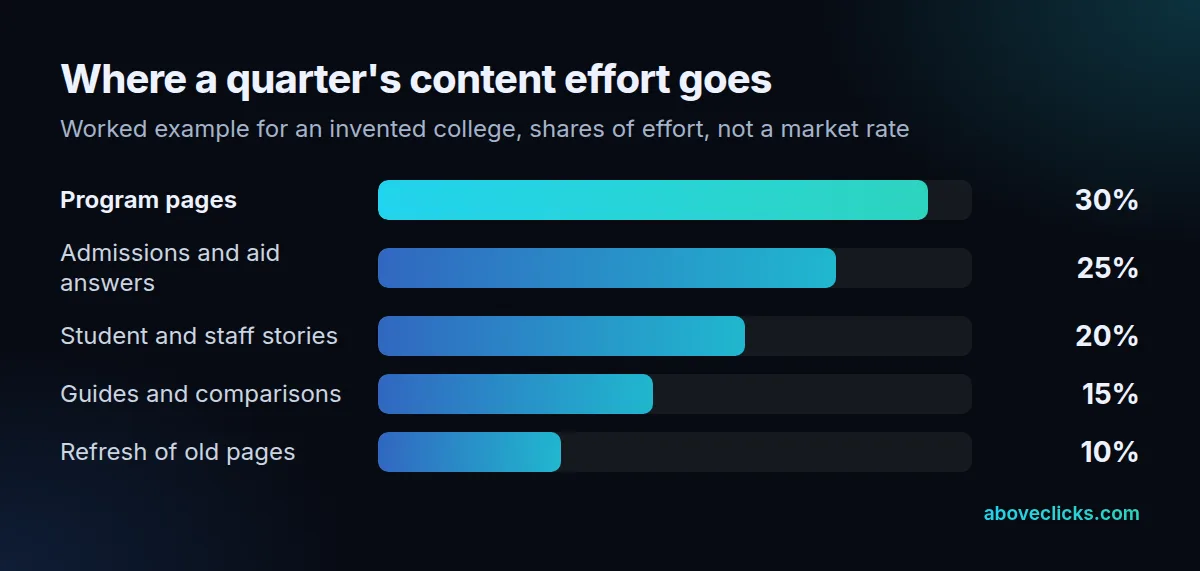
The chart shows how that college might split its higher education content marketing across a quarter. It is a worked example, not a market rate. Program pages lead, admissions answers follow, and a tenth of the time goes to refreshing pages that already exist.
A program page should state the award, the length, entry requirements, fees, intake dates, how to apply and who teaches it. Put each fact in the page text, not only in a PDF, so that people and search engines can read it. Admissions answers work best as one page per question, such as “Can I transfer credits?”, each ending with the next step to take.
Our own education marketing work follows the same logic: reporting follows the funnel from leads to qualified leads, counselling calls, applications, offers and enrolments, so every page is tied to a step an admissions team can see.
How do you plan content marketing for universities?
In 6 steps, in this order: choose the goal, list applicant questions, map them to pages, assign owners, schedule by intake, and set the measures before you publish.
- Choose one goal per program. For example, applications for the next intake, not “awareness”.
- List the real questions. Pull them from admissions emails, counselor calls and Search Console queries, not from guesses.
- Map each question to one page. The stage table above gives the asset type for content marketing for universities; one page per question avoids two pages competing.
- Assign an owner and a reviewer. The owner writes; someone who knows the program checks it.
- Schedule against your intake dates. Fee and deadline pages must be right weeks before applications open.
- Set the measures first. Decide which events count as an enquiry or application before the page goes live.
Example: if applications open on 1 September, fee and deadline pages should be final by 1 August, 30 days earlier, so that admissions staff can check them and counselors can quote them. Work back from each intake date the same way.
A short plan with owners beats a long calendar nobody owns, and that holds for content marketing for universities of any size. Revisit it once a quarter, and keep a list of questions that came in but have no page yet.
Which rules apply to claims and student stories?
Federal regulations treat misleading statements about a program, its costs or graduate employment as misrepresentation, and student privacy law limits what you can say about individuals. This is not legal advice, so ask your compliance office.
Under 34 CFR 668.71, a misrepresentation is any false, erroneous or misleading statement made to a prospective student or the public, and it can sit on a website. It also covers statements that leave out information in a way that misleads, and testimonials a student gave under duress or because the institution required one. Our guide to authority marketing for education covers how to show proof without overclaiming.
For stories, FERPA matters. Its rights pass from parents to the student at 18 or on entering a postsecondary institution at any age. So get written consent from the student, not the parent, before you publish personal details.
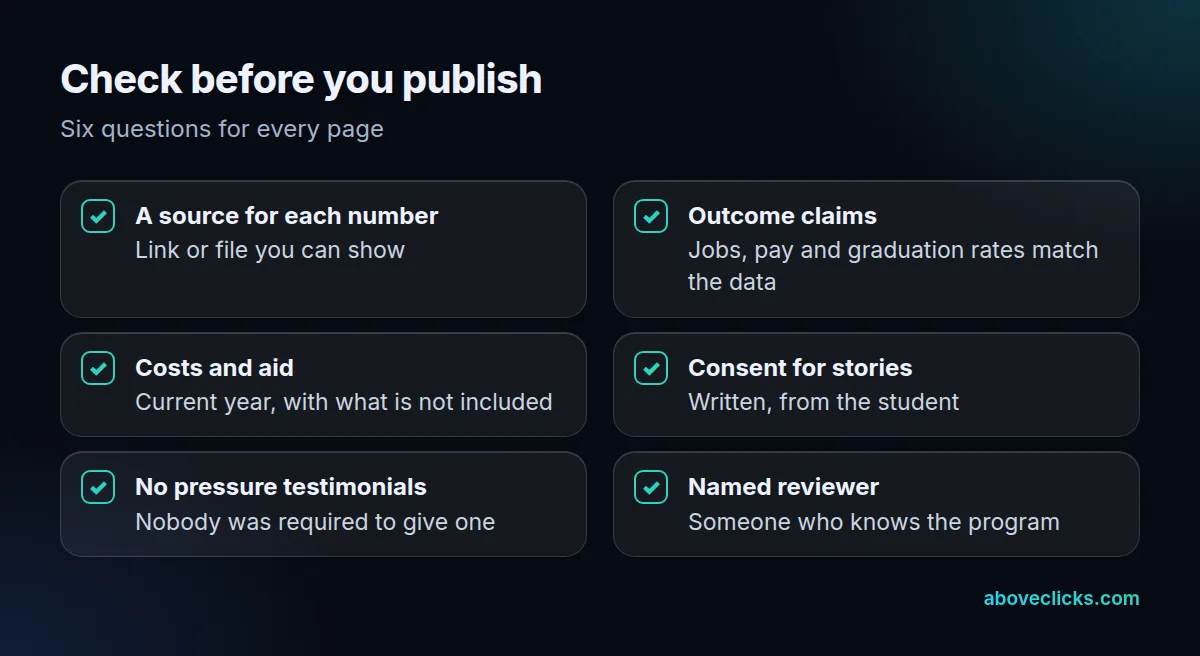
Run every page of your content marketing for higher education through the six questions in the checklist before it goes live, and keep the source file next to the page so the next editor can re-check it.
How do you measure content marketing for colleges?
Follow one chain: search visit, enquiry, application, offer and enrolment, with each link recorded. Page views alone say little, because most visitors will never apply.
Measuring content marketing for colleges starts with search. Google’s Performance report shows clicks, impressions, click-through rate and average position, and its default view covers the past three months. Admissions is seasonal, so switch the range to 16 months, as Google’s guide to debugging traffic drops suggests, and compare each month with the same month last year.
Then record the actions that matter. In Google Analytics, a key event measures an action important to your business, and any event can be marked as one. Mark enquiry starts and application starts. Tag your own links with the UTM parameters utm_source, utm_medium and utm_campaign so campaigns appear in the Traffic acquisition report. For more on credit across touchpoints, see our guide to GA4 attribution.
Here is the arithmetic for an invented program page. It gets 4,000 organic visits in a month. If 2% start an enquiry, that is 80 enquiries. If 25% of those apply, that is 20 applications. If half of the applicants enrol, that is 10 enrolments. The rates are examples; replace them with your own, and the page’s value becomes a number your finance office can read.
Count an enquiry only when it names a program and an intake, and treat a booked counselling call as a stronger signal than a form that was submitted. Counts like these keep a busy page from looking better than it is. See our sample report for the report format we use. Email is the next step for people who enquire, covered in email marketing for higher education.
When should you refresh or stop a piece?
Refresh when the facts change or the page falls against last year’s same months, and stop when it has no readers and no purpose. Review each page at least once a year, before its intake season.
Higher education content marketing goes stale quickly, so build the review into the plan. Use the 16-month Performance view to see which pages lost clicks compared with last year. Check first whether the facts changed: fees, deadlines, entry requirements and rankings go out of date fastest. Update the date only when the content really changes.
Stop or merge a page when two pages answer the same question, or when it has had no enquiries and almost no visits across a full intake cycle. Redirect it to the page that does the job. A smaller set of accurate pages is easier to defend in an audit.
If you want a second opinion on where your pages and enquiry path stand, our free audit reads your Search Console and analytics with read-only access. For more on content marketing for higher education and related topics, see the industries guides.