Authority marketing for education means building proof that a family or student can check, so they choose your school before they compare fees. Build it in a fixed order: facts first, then people, outcomes, outside voices and answers.
This guide, part of our industries guides, covers what the term means for a school, college or course provider, a five-layer plan, the claims US rules treat as misrepresentation, how to show authority on your site, and a 90-day build order.
What is authority marketing for education?
Authority marketing for education is the practice of earning trust by showing evidence, not by claiming to be the best. Authority marketing for education works because enrolling is a big decision that costs 2 to 4 years of study and a large fee, and families check several schools before they trust one.
Google’s guidance points the same way. In its helpful content guide, experience, expertise, authoritativeness and trust (E-E-A-T) are grouped together, and trust is called the most important of the four. It also says E-E-A-T is not a specific ranking factor; Google’s systems use a mix of signals that tend to show helpful content. Our E-E-A-T glossary entry covers the term itself.
So authority marketing for education is not a campaign. It is a set of facts, people and results that stay true on every page, ad and email. Done well, authority marketing for education lets a smaller school win the first call against a bigger name, because its proof is easier to check.
What does authority marketing look like in education?
It looks like a school page that states who accredits it, who teaches, what it costs and what past students achieved, each with a link or a date. A claim without that is only a slogan.
Three examples of authority marketing for education, with no client data:
- A course page that lists the accreditor with a link to its listing, the full fee, and the teacher’s name and background.
- A results page that says which students were counted, in which year, and how a “placed” student was defined.
- A parent guide that answers the questions counsellors hear on calls, written or reviewed by the person who answers them, with a review date at least once every 12 months.
This matches how we run education marketing: ads and pages never promise an offer, a visa or a job; tuition, living costs, exam and visa fees and any service fee appear together; and for degrees studied abroad we state whether the regulator in the student’s home country recognises them, and link to the official source. Authority marketing for education starts with rules like these, because each one is a fact a family can verify in under 5 minutes.
What is an authority marketing strategy for a school?
Build 5 layers in order, because each later layer leans on the one before it. An authority marketing strategy for a school that starts with press or awards, before the facts are right, collapses on the first question.
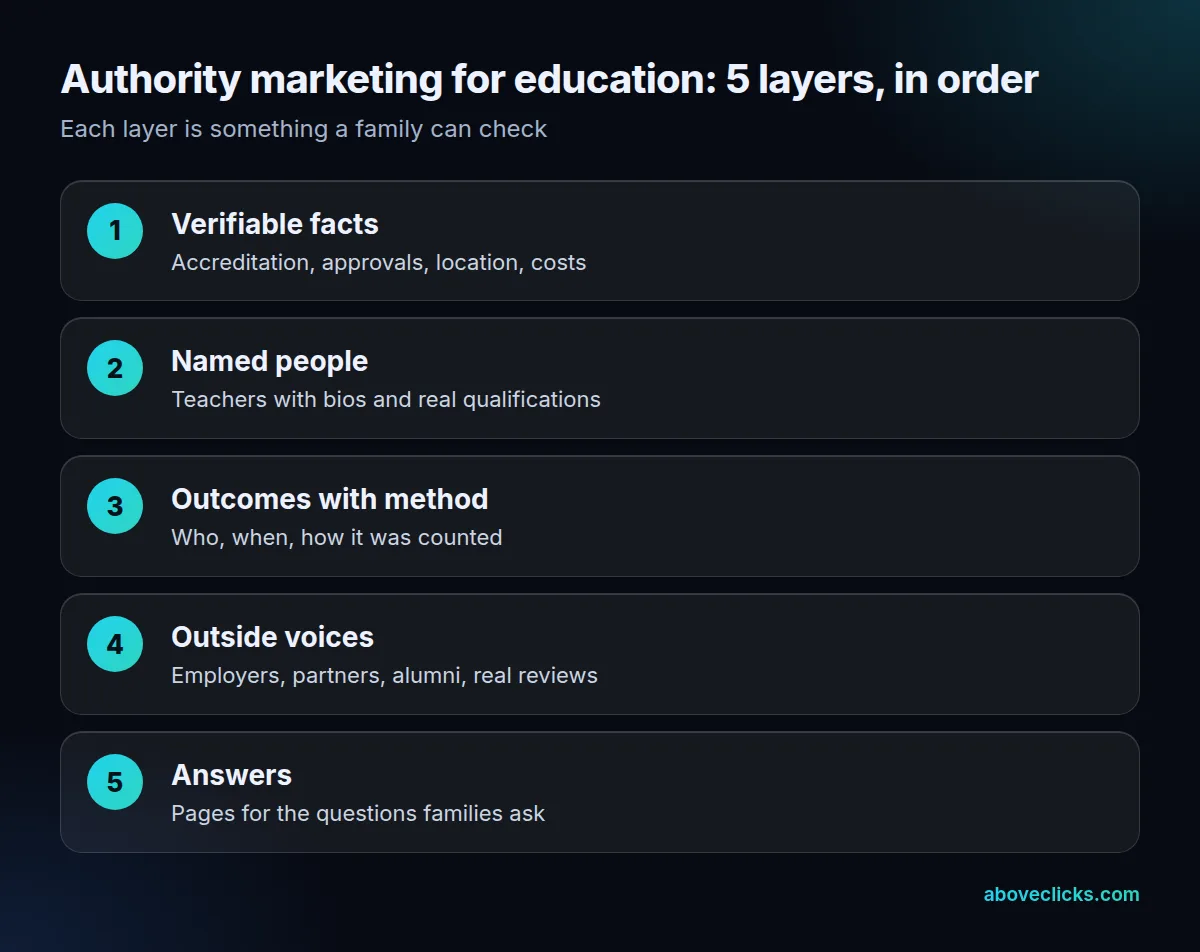
- Verifiable facts: accreditation and approvals, address, contact details, fees and the refund policy, identical on the site, Google Business Profile, portals and ads.
- Named people: teachers, counsellors and the person who leads admissions, with bios that show real qualifications.
- Outcomes with method: results with the cohort, the year and how they were counted.
- Outside voices: employers, partner institutions, alumni and real reviews that you did not write.
- Answers: pages that answer the questions families ask, written by the people from layer 2.
Most schools jump to layer 4 because it is visible, and an authority marketing strategy that skips layers 1 and 2 shows in the first 30 seconds of a visit. But a testimonial next to an accreditation claim nobody can check makes the whole page less believable, not more. If you need the facts behind layer 5, our guide to market research for higher education shows how to find the questions. The whole of authority marketing for education rests on these 5 layers, so give each one an owner and a date.
Which claims need proof before you publish them?
Any claim about accreditation, faculty, cost, pass rates, employment or reviews. Authority marketing for education only works when each of these 6 claims holds up. In the US, the Department of Education lists these as misrepresentation risks, and the FTC bans fake reviews and testimonials.
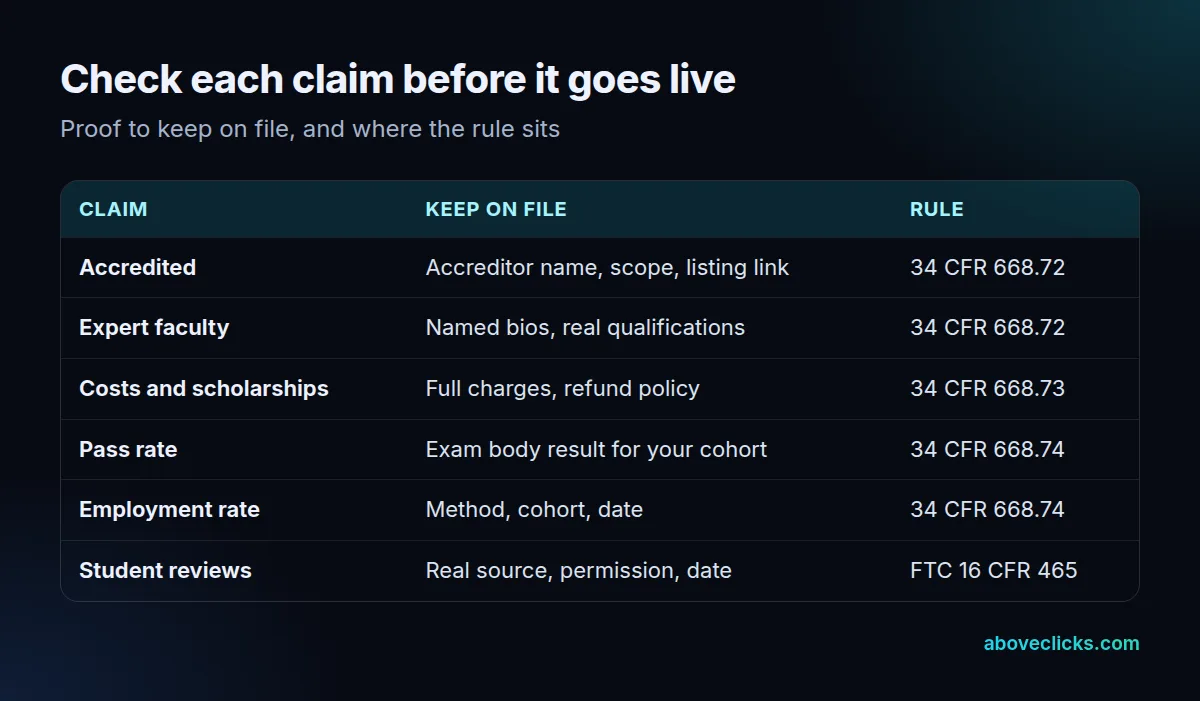
The Department’s rules in 34 CFR Part 668, Subpart F apply to eligible institutions, those in the federal student aid programs. They name, among others:
- false or misleading statements about the type, source and extent of accreditation (section 668.72), including accreditations not obtained or not removed from marketing within a reasonable time after they are withdrawn;
- statements about the number and qualifications of faculty (668.72);
- statements about scholarships, the cost of the program and the refund policy (668.73);
- licensure pass rates and employment rates that are materially lower than the ones in your marketing (668.74).
Section 668.71 also says an institution is responsible for what its representatives, and the people it has an agreement with to provide marketing, advertising or recruiting services, say on its behalf. So the rule reaches your agency and your recruiters. If you are not an eligible institution, the list is still a sound test for any course provider.
The costly trap is a number that was true once. An employment rate copied into an ad, a brochure and a landing page will outlive the year it measured. Keep one source file with the figure, the method and the date, and have every page pull from it.
For reviews, the FTC’s reviews and testimonials rule went into effect on October 21, 2024. It targets fake or false reviews and testimonials, and the FTC’s press release says the final rule lets the agency seek civil penalties. Do not buy reviews, write them yourself or ask staff to post as students; fake proof ends authority marketing for education the day it is found. This is marketing guidance, not legal advice; ask your compliance lead about your own case.
How do you show authority on your website?
For authority marketing for education, put the proof where a reader looks for it: bylines with author pages, an About page that says who runs the school, and structured data that matches the page. None of it is a trick; it is the same facts, made easy to read.
Google’s helpful content guide asks whether pages carry a byline where one might be expected, and whether bylines lead to further information about the author. It also asks for clear sourcing and background about the site, such as through an About page. For a school, that means a named teacher or counsellor on each guide, with qualifications.
Structured data can repeat the same facts for search engines. Google’s Organization markup lets you give your name, url, logo and sameAs links to official profiles. Schema.org also has a more specific type, EducationalOrganization, for schools and colleges. Only mark up what the page already says, because authority marketing for education depends on pages and markup that agree.
Star ratings need care. Google’s review snippet guidelines say that when the entity being reviewed controls the reviews about itself, its pages with Organization or LocalBusiness markup are not eligible for the star review feature. A reviews widget on your own site is the usual example. Show real reviews as plain text with the source and date instead.
Last, keep the facts consistent off-site, because authority marketing for education is judged across every place a family sees you. Compare the fee and the accreditation line in 3 to 4 places: your site, your Business Profile, portals and ads. A fee on your ad that differs from the fee on your page is a trust problem before it is a compliance one.
How do you know authority marketing is working?
Measure authority marketing for education by signs that people trust you earlier, not only by more traffic: more searches for your school by name, enquiries that arrive already informed, and fewer questions about basic facts on calls.
Pick 4 numbers and read them quarterly:
- Branded searches: queries with your school name, from Search Console.
- Enquiry quality: the share of enquiries that match your entry rules.
- Time to a decision: days from first enquiry to application.
- Repeat questions: the facts counsellors still explain on every call.
Compare against the same months a year earlier, because intakes are seasonal and a 12-month view removes the calendar. Authority builds slowly, so a change in one month proves nothing. When you want an outside read of where your site stands, our free audit checks your website, ads and enquiry path and sends a PDF report within 2 workdays.
Do not judge authority marketing for education on rankings alone. A page can rank and still lose a parent who finds a fee that does not match. Our email guide for colleges shows how the same facts should read in follow-up messages.
What should you build in the first 90 days?
Build facts and people in the first 30 days, outcomes and outside voices in the next 30, and answers and measurement in the last 30. Do the work of authority marketing for education in this order so each step has something true to stand on, and review the plan at day 90.
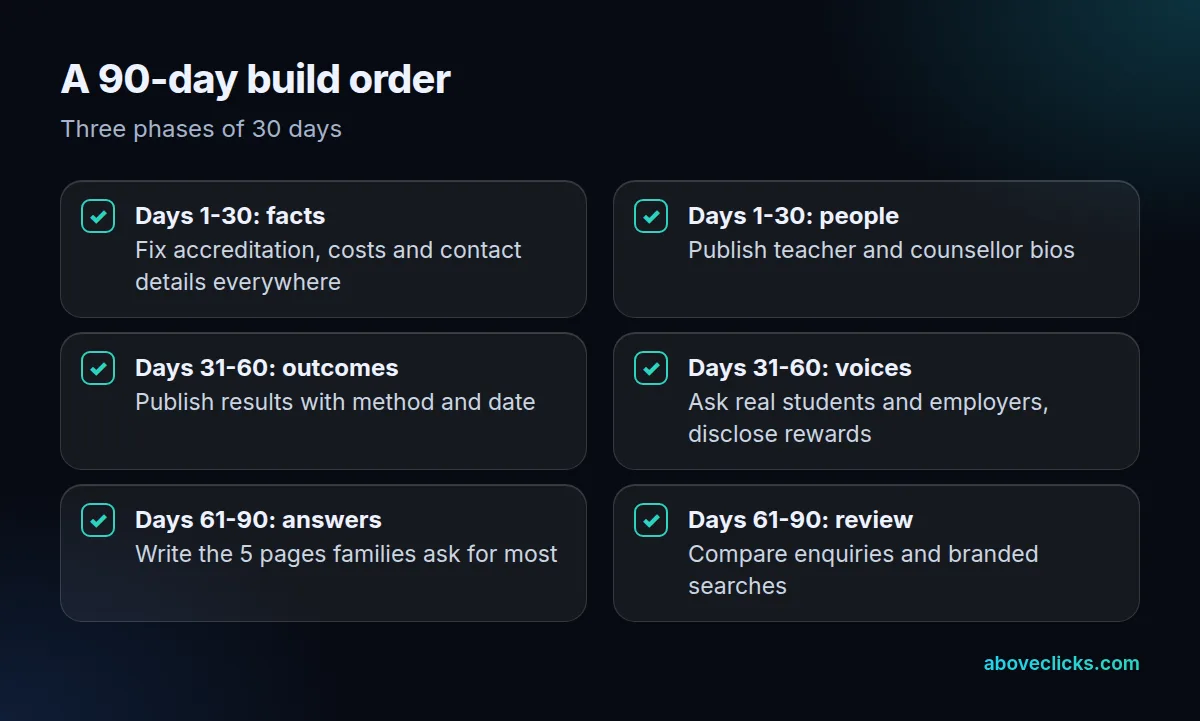
In the first 30 days, list every public claim about accreditation, costs and results, then fix the ones that differ between sites. Write the bios. In days 31 to 60, publish results with method and date, and ask real students and employers for comments; if you offer a reward, say so next to the comment. In days 61 to 90, write the 5 pages families ask for most, using the questions counsellors hear, and set up the four numbers above.
What to cut from authority marketing for education: unverifiable “best” and “top” claims, stock photos of students who do not study with you, and any figure without a date. Each makes a careful reader doubt the rest.