Real estate marketing items are the physical things an agent hands over, mails or leaves behind, from a magnet to a closing gift. Pick each one for the moment it is used, and give it one number that proves it worked.
This guide sorts nine real estate marketing items by moment, shows a cost-per-month test that beats unit cost, covers three rules to check before you order, and ends with a 30-day way to count which item brought a call.
What are real estate marketing items?
The branded things you give or leave so a buyer or seller remembers you: giveaways, leave-behinds, signs and closing gifts. People also search for them as real estate promotional items or marketing items for real estate agents.
They differ from the pieces covered in our guide to real estate marketing materials, which is about flyers, brochures and presentations, and from the tools in real estate marketing products. Here the question is narrower: which small physical item is worth ordering, for whom, and what is it allowed to do? Our industry page collects the related guides.
Most agents buy marketing items for real estate agents on instinct, and then wait 6 to 12 months to find out whether anything worked. A pen looks cheap, a mug looks friendly, a tote bag looks generous. None of that tells you if the item gets kept or leads to a call. The rest of this guide gives you a way to decide.
Which real estate marketing items suit each moment?
Sort them by when they are used: before a listing, while a home is on the market, and after closing. Each moment has a different reader and a different job.
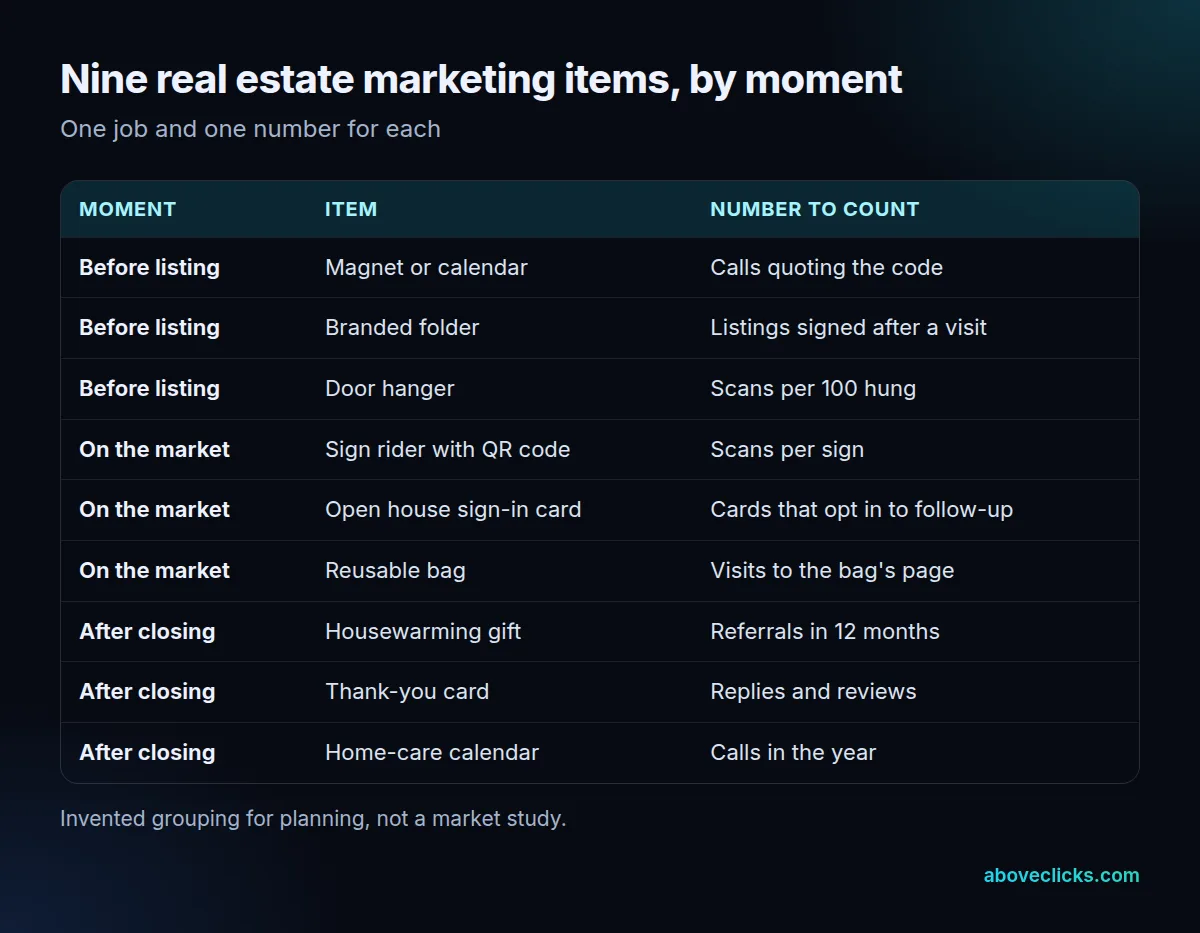
Before a listing, the reader is a homeowner who has not yet chosen anyone. Magnets and calendars stay on a fridge or wall, and a branded folder gives a listing appointment something to hold. While a home is on the market, the reader is a visitor, so a sign rider with a code and a sign-in card do the work. After closing, the reader is a client who may refer you, so a housewarming gift and a card matter more than volume.
A quick way to start with real estate marketing items is a 3-step order:
- Pick one item for each moment, so 3 items in all.
- Order enough for one area, such as 200 homes, not for a year.
- Check the number in the table’s last column after 30 days.
Do not try to use one item for all three moments. A calendar handed to a buyer at a showing says little. The same calendar posted to a farm area in November says “call me when you sell.”
What are the best real estate promotional items by cost?
The best real estate promotional items are the ones with the lowest cost per home-month kept. Unit cost misleads, because an item that is used for a year costs far less per month than a cheaper one that is binned in a week.
Use this formula for real estate marketing items: unit cost divided by the months you expect the item to stay in view. The lengths below are guesses you should replace with your own, and every cost is invented for the example.
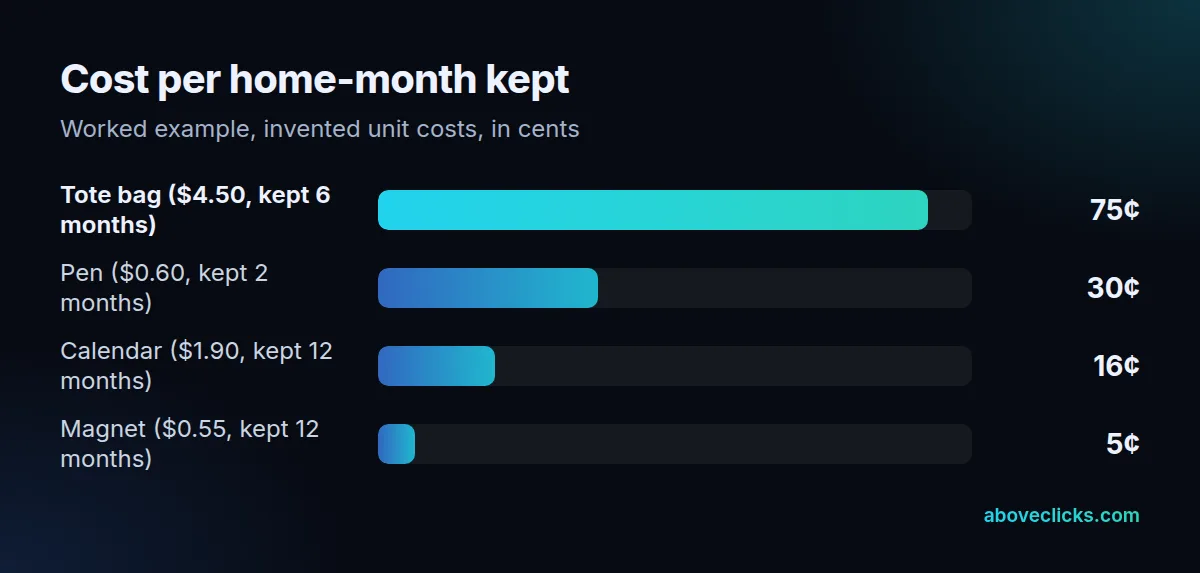
Example: an agent compares four items for a farm area. A magnet at $0.55 kept 12 months costs about 5 cents per home-month. A calendar at $1.90 kept 12 months costs about 16 cents. A pen at $0.60 kept 2 months costs 30 cents. A tote bag at $4.50 kept 6 months costs 75 cents. The tote bag costs the most per month, even though it looks the most generous.
Two cautions. First, “kept” is your estimate until you ask; at your next listing appointment, ask the owner whether they still have your magnet. Second, a high cost per month is not always wrong. A closing gift is not meant to be cheap per month; it is meant to be remembered by someone who may refer you. Judge that one by referrals in 12 months.
How much can you deduct for client gifts?
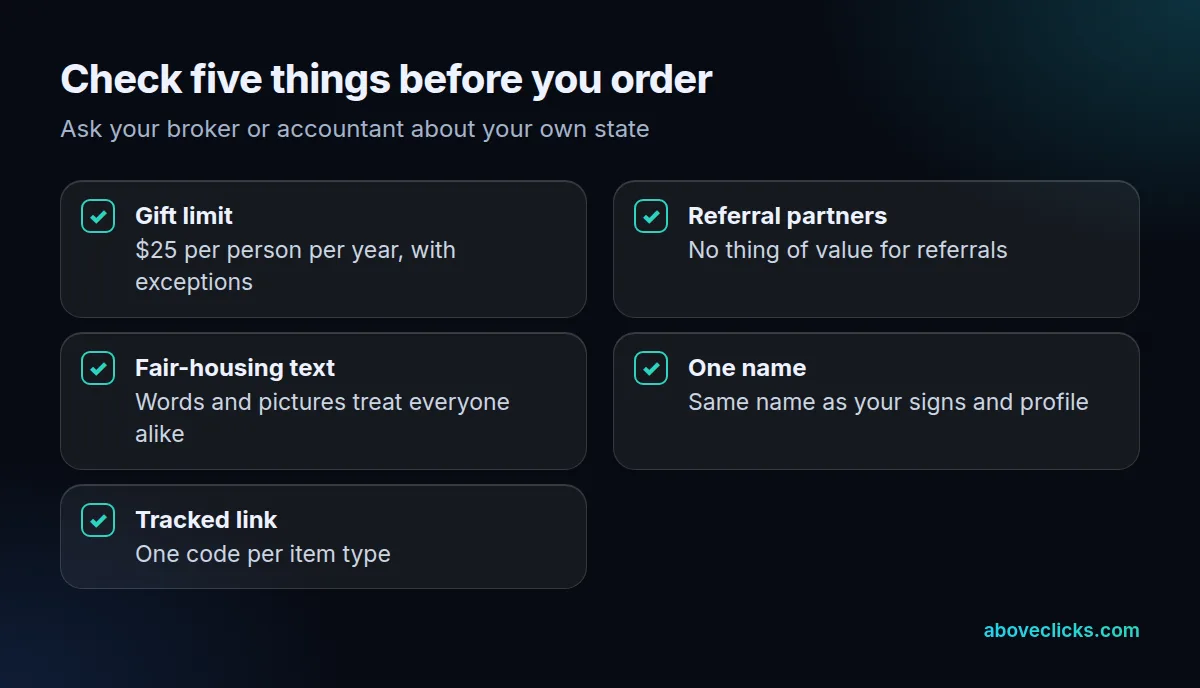
The IRS lets you deduct no more than $25 of business gifts per person per year, with exceptions for low-cost imprinted items and signs. Check your own tax position with an accountant.
According to the IRS’s Publication 463 for 2025, the $25 limit applies to gifts you give directly or indirectly to each person in your tax year. The same page says an item that costs $4 or less, has your name clearly and permanently imprinted, and is one of a number of identical items you widely distribute is not treated as a gift. It names pens as an example. Signs and display racks for the recipient’s premises are also not counted. Packaging and mailing are generally incidental costs and are not added to the cost of the gift.
What that means for real estate marketing items:
- A magnet or a pen sent to 500 homes is promotion, not a gift.
- A $60 housewarming gift for one client is a gift, so only $25 of it is deductible for that person in that year.
- Sending the same client several items in one year adds them together.
Keep a simple list of the real estate marketing items you gave, to whom and when. That is also useful for the next rule.
Can you give real estate promotional items to lenders and title companies?
Not as a reward for referrals. Federal rules ban giving or accepting a fee, kickback or other thing of value for referring settlement-service business. Ordinary promotion is allowed, and the line between the two is how the gift is linked to referrals.
The rule is 12 CFR 1024.14, part of the federal RESPA regulation. It says no person shall give or accept a fee, kickback or other thing of value under an agreement that business be referred, and that a thing of value does not need to be money. It also says an agreement does not have to be written: a pattern of repeated gifts connected to the volume of business referred is evidence of one.
The same section excepts “normal promotional and educational activities” that are not conditioned on referrals and do not cover expenses the recipient would otherwise pay. So a branded notepad in a lender’s office is fine; a monthly gift card sent to a loan officer who sends you buyers is the kind of pattern to avoid.
A safe working habit for real estate promotional items and gifts:
- Give the same item to every partner of that type, not only the busiest.
- Never tie a gift to a past or expected referral, in writing or in speech.
- Ask your broker or a real estate attorney before you start any regular program with a lender, title company or inspector.
This is a rule summary, not legal advice. Your state may have more.
What must the words on an item avoid?
Anything with a message about a home for sale or rent must treat every buyer alike. Federal text covers flyers, brochures, signs, banners, posters and billboards by name, so a sign rider or a door hanger gets the same check as an ad.
24 CFR 100.75 makes it unlawful to print or publish any notice, statement or advertisement about the sale or rental of a dwelling that shows a preference or limit based on race, color, religion, sex, handicap, familial status or national origin. It also lists selecting media or locations that deny some groups information about housing opportunities. So choose the words and pictures on each real estate marketing item with that in mind, and spread door hangers and mailers across the whole area you serve.
A second check on real estate marketing items is your name. Google’s Business Profile guidelines ask you to represent your business as it is consistently recognized across signage, stationery and other branding. Use the same name, in the same form, on your items, signs and profile. Many brokers also require a broker line or license number, so ask yours before any print run.
How do you track which real estate marketing items work?
Give each of your real estate marketing items its own tagged link or QR code, then count visits and calls for 30 days before you reorder. A single shared link cannot tell you which item worked.
Google Analytics Help lists the fields for a custom campaign link: utm_source, utm_medium, utm_campaign and utm_content. Its own examples include a billboard as a source, so print works the same way. For items, a simple scheme is:
utm_sourceis the item, such asmagnet.utm_mediumisprint.utm_campaignis the area or season, such asfarm-nov.utm_contentis the version, such asv1.
Point each code to a short page on your site, not straight to the home page, so your report shows which item sent the visit. Put the code on the item in plain text as well, for people who will not scan. Add a line to your call script: “Where did you hear about me?” and write the answer down.
After 30 days, line up each item’s visits and calls against what it cost. Reorder the ones with a low cost per visit, and rework or drop the rest. If you want a second pair of eyes on the plan, our real estate marketing work and real estate digital marketing page show how the print side connects to ads and email, and our free audit reads what is already tracked. For stage-by-stage pieces for a licensed agent, see real estate agent marketing materials.