Real estate development marketing is the promotion of a multi-unit project before and during its sales. It runs by gates, meaning what must be in place before each kind of activity, because in some places an ad can break the law before a single unit is sold.
This guide covers what counts as marketing, the rule that comes before the first ad, the targeting limits on Meta and Google, how to keep claims and reviews honest, five costly mistakes and a monthly check. It is not legal advice. For the sales phases and the budget, see our guide to real estate developer marketing.
What is real estate development marketing?
It is marketing for a project with a fixed number of units, a build schedule and a sales office, not for one listing. Real estate development marketing uses the same channels as other property marketing, but the rules around it are stricter, because buyers commit money before the building exists. A 48-unit building may take 24 months from approval to handover, and the marketing has to stay accurate across all of it.
That changes the order of work. In an ordinary campaign you write the ad, then check it. In real estate development marketing you find out first what the ad is allowed to say, and to whom.
The size of the project matters too. In British Columbia, a development property includes 5 or more strata lots in one building, and a smaller project can fall outside the Act. Other places draw the line elsewhere, so ask a local lawyer where yours sits.
What counts as marketing in real estate development?
Anything that will or is likely to lead to a sale, not only an ad. British Columbia’s Real Estate Development Marketing Act defines “market” as selling or leasing, offering to sell or lease, and any transaction or activity likely to lead to a sale or lease.
That definition is wide. A project page, a broker briefing, a sign-up form with unit details and a paid ad can all be read as marketing. So can a social post about an open house.
The Act then sets the gate. A developer must not market a unit unless a disclosure statement has been prepared and filed with the superintendent. The statement has to plainly disclose all material facts without misrepresentation, and set out the buyer’s rescission rights. There is one route to start earlier: approval in principle from the local authority plus the superintendent’s permission.
Three more rules shape the marketing that follows:
- The buyer must receive the statement first. No purchase agreement can be signed until the buyer has a copy, a reasonable chance to read it and has signed an acknowledgment.
- The acknowledgment is kept for 3 years. The developer must produce it if the superintendent asks.
- The buyer has 7 days to rescind. The clock runs from the later of the agreement date and the acknowledgment date.
The takeaway applies beyond British Columbia: write marketing that matches the legal document, because the document is what the buyer can rely on. Where a project sits under a different regime, the same habit still protects you.
What does a real estate development marketing strategy cover?
A real estate development marketing strategy covers five stages, from land approvals to handover, and attaches one gate to each. The gate is what must be true before the marketing for that stage goes out.
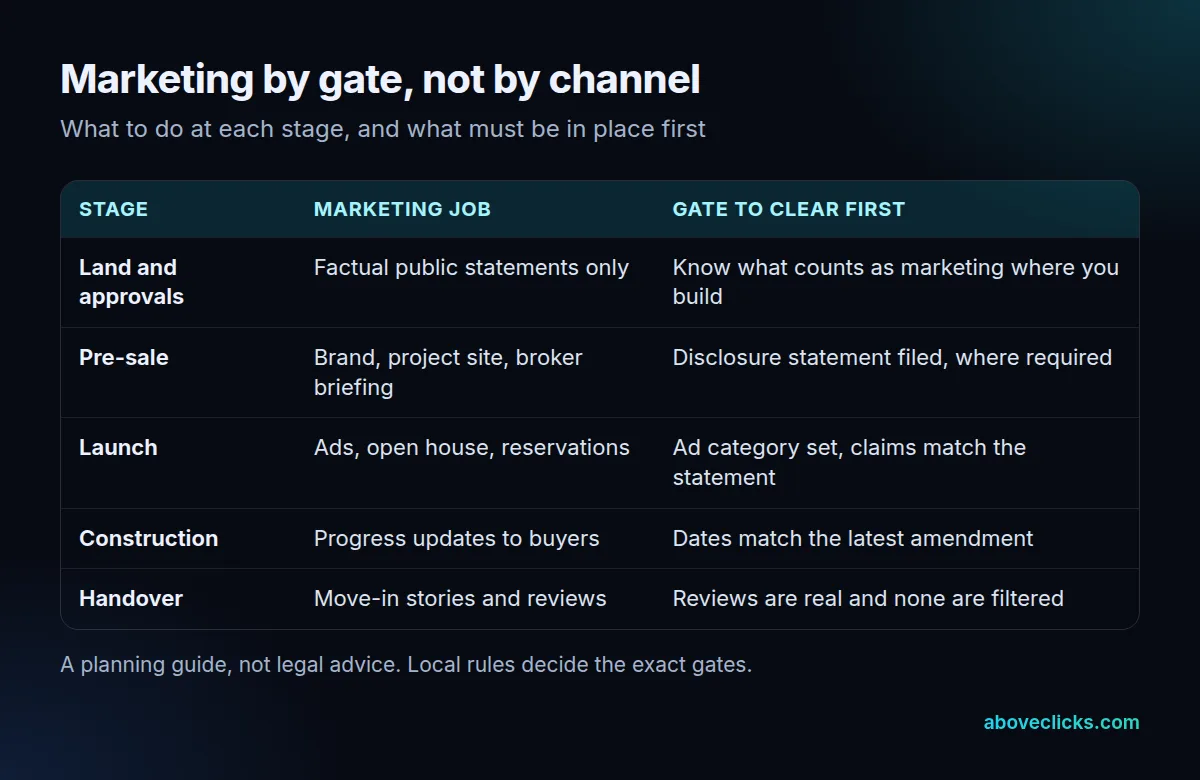
Two points about the table. A project of 60 units over 24 months passes through all five rows, and a real estate development marketing plan that treats them as one campaign skips the gates. First, the first row is mostly restraint. Before approvals are in place, public statements should stay factual, and the team should know what counts as marketing where it builds.
Second, the gates repeat. Each time the completion date, the unit mix or the amenities change, the marketing has to change with them. Under the British Columbia Act, a developer who becomes aware that a statement contains a misrepresentation must file an amendment, so the ads cannot keep quoting the old version.
That is why marketing in real estate development works best with one owner for the claims, and why real estate development marketing is partly a records job. Someone on the team holds the current statement and signs off every new ad, email and page against it. Our real estate marketing work starts the same way: we check lead quality, landing pages and site-visit tracking first, and send a report within 2 workdays.
Which ad rules limit targeting for a new development?
Meta and Google Ads both treat housing as a special category in the US and Canada, and both remove the most common audience tools. Plan the audience for real estate development marketing around the project’s area, not around who you want to reach.
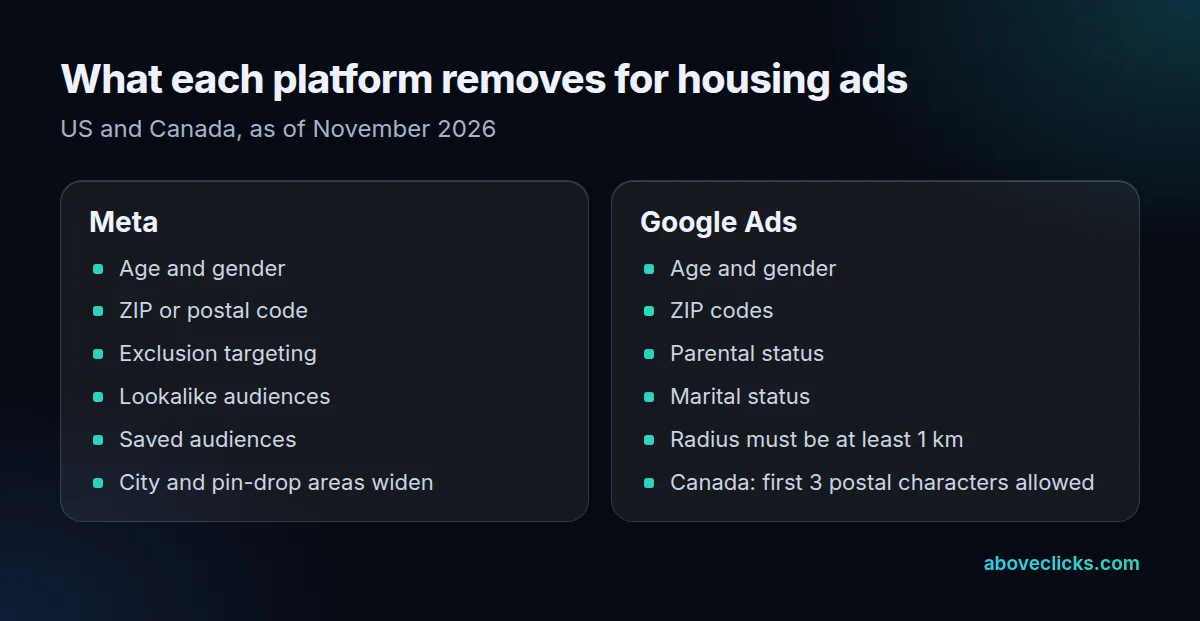
On Meta, you must declare the campaign’s special ad category. For housing ads reaching the US or Canada, age, gender, ZIP or postal code, exclusion targeting, lookalike audiences and saved audiences are unavailable, which is 6 tools gone. Audiences built on a city or pin drop also get an expanded radius.
Google Ads has its own list. In the US and Canada, gender, age, parental status, marital status and ZIP codes cannot be used to target housing ads. Radius targeting is allowed but needs at least 1 km around the location, and for Canada the first 3 characters of a postal code can be used.
The wording of the ad has its own rule in the US. Under 24 CFR 100.75, it is unlawful to publish an advertisement for the sale of a dwelling that indicates a preference or limitation based on race, color, religion, sex, handicap, familial status or national origin. That covers images and copy, not only targeting.
How do you keep ads, renderings and reviews honest?
Tie every claim to a document, label every rendering and use only real reviews. Real estate development marketing fails most often on dates and on pictures, not on bold slogans.
Start with the Act’s own test. “Misrepresentation” there means a false or misleading statement of a material fact, or leaving out a material fact. A material fact is anything that affects, or could reasonably be expected to affect, the value, price or use of the unit. A view, a completion date or a parking count can all qualify.
Reviews come with their own rule. The FTC’s consumer reviews and testimonials rule took effect on October 21, 2024, and bans fake or false reviews and testimonials. The FTC’s answers add that a business posting testimonials on its own website is disseminating them, not merely hosting them. So a handover testimonial on the project page is your claim.
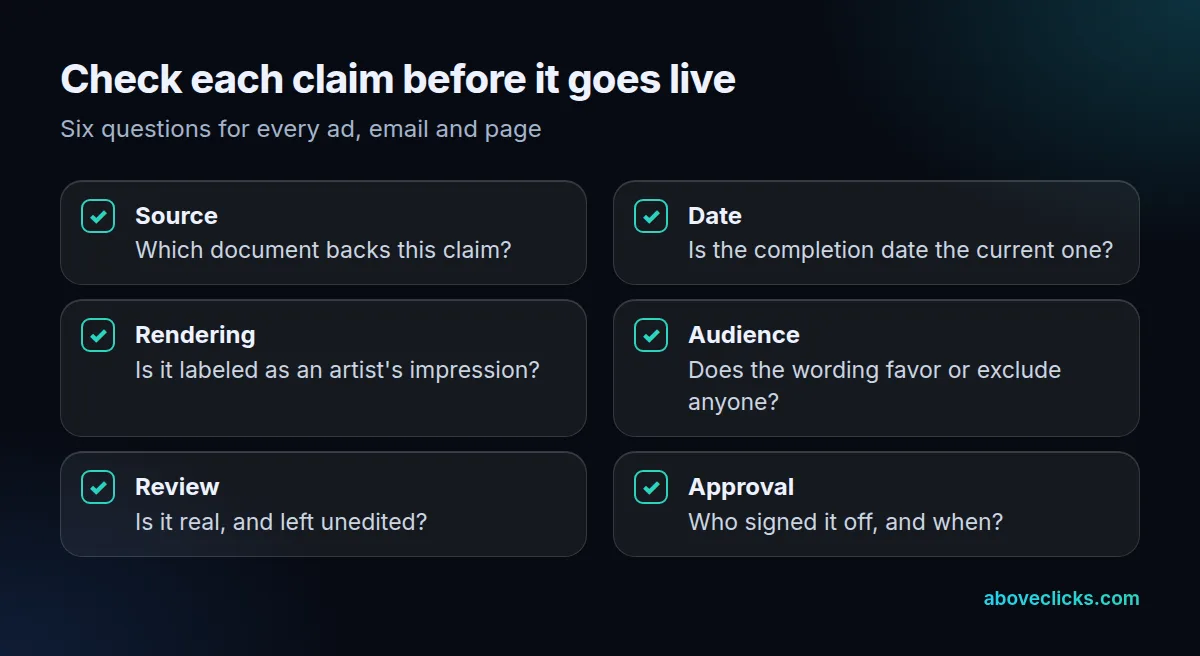
Use the six questions on every ad, email and page. They take about a minute per item once the team has the current statement open, and they catch the errors that cost most to fix after launch.
Which 5 mistakes make real estate development marketing costly?
Marketing before the gate, quoting stale dates, targeting by who instead of where, leaving renderings unlabeled and filtering reviews. Each one is cheap to avoid and expensive to repair once buyers have seen it. A typical launch publishes 30 to 50 factual claims in its first month, so one stale date can sit in dozens of places.
- Marketing before the gate. A teaser page or sign-up form counts if it is likely to lead to a sale. Ask the lawyer before it goes live, not after.
- Quoting stale dates. The completion date in a launch email is the one buyers will hold you to, and a buyer who signs has 7 days to rescind under British Columbia’s Act. When the date moves, every live ad moves with it.
- Targeting by who, not where. The platforms remove age, gender and ZIP or postal-code targeting for good reason. Copy that hints at a “type of buyer” is also a risk under the rule that bars indicating a preference.
- Unlabeled renderings. An image of a finished lobby is a promise. Label it as an artist’s impression and keep the final plans nearby.
- Filtering reviews. Deleting the bad ones, or paying for good ones, is what the FTC’s rule targets. Reply to criticism in public instead.
A sixth cost sits underneath the five in real estate development marketing: nobody owns the claims. Name one person, give them the current disclosure statement and a short sign-off list, and the other five get easier to avoid.
How do you check marketing in real estate development each month?
For marketing in real estate development, keep a claims register: list every factual claim published that month, link each to its source document, and fix the ones that don’t match. A monthly pass takes an hour or two on a small project.
Here is a worked example with invented numbers, not a client result. A sales team publishes 36 factual claims in one month across ads, emails and project pages: completion date, unit count, amenities, parking, distance to transit and so on. Matching them to the current statement and plans shows 30 are backed. Of the other 6, four quote an old completion date and two describe an amenity the plans don’t show.
All 6 get fixed that week, and the team adds the new dates to a one-page fact sheet that every writer uses. The next month, the register shows 40 claims and 40 matches.
Real estate development marketing needs the register to stay light. Keep it in a spreadsheet with four columns: claim, where it appears, source document and sign-off date. The same sheet makes site-visit reporting easier, because you can see which claims sit on the pages that produce visits. If you would like a second pair of eyes on a project’s marketing, our free audit covers ads, landing pages and tracking, and our real estate digital marketing page shows how we plan by segment. For a full marketing plan structure, see our real estate marketing plan guide, and for more guides, browse industries.