Email marketing for higher education is permission-based email to prospective students, applicants, enrolled students and alumni, planned by stage with one job per message. Plan it by who the person is today, not by the calendar, and check each send against four rules before you write the subject line.
This guide to email marketing for higher education covers the stages, a worked recruitment funnel, the sender rules, what FERPA means for a list, what admissions emails can claim and the 5 mistakes we see most. It covers US rules only and is not legal advice.
What is email marketing for higher education?
Email a college or university sends on purpose to people who asked to hear from it, so that more of them apply, enroll and stay in touch. It covers student recruitment email, admissions updates, onboarding and alumni mail.
Higher education email marketing differs from shop email in one way: the decision takes months and the same person changes role. An inquirer becomes an applicant, then a student, then an alumnus, and each stage needs a different message. It also differs in the rules. Each separate email that breaks the CAN-SPAM Act can bring a penalty of up to $53,088, according to the FTC as of November 2026.
Email marketing for universities also sits next to other channels, and it works best when ads and search send people into a stage-based sequence. Our education marketing page covers ads, search and enquiry paths; this guide covers what happens after the enquiry arrives.
Which stage is each person at?
Five: prospect, applicant, admitted, enrolled and alumnus. Give each a single job, and send each only the data that belongs to that stage.

The table is the whole plan for email marketing for higher education in short. A prospect has asked a question and needs a reply or a visit. An applicant needs the missing document named, not a brochure. An admitted student needs the deadline and the next step to pay a deposit. Once enrolled, the student needs orientation dates, and an alumnus needs a reason to stay in touch.
The stages also matter because the law treats them differently. The Department of Education says FERPA rights pass to the student at 18 or on entering a postsecondary institution, so an enrolled student is in a different position from a prospect. The FERPA section below shows where that changes what you can do.
Most of the data for these 5 stages already sits in your admissions system, so student recruitment email can be triggered by a stage change rather than a date. An email platform should read the stage from there, so a person who deposits stops getting prospect emails the same day.
How often should you email a prospective student?
Often enough to answer questions while interest is fresh, then slower. A starting plan is 4 emails in the first 21 days after an inquiry, then one a month until the next deadline.
Treat that cadence as a starting point to test, not a benchmark; we have no source for a standard number. Suppose a program sends the 4 emails on days 0, 2, 7 and 14, and a short call-to-action note on day 21. A person who has not opened any of them by day 21 moves to the monthly list.
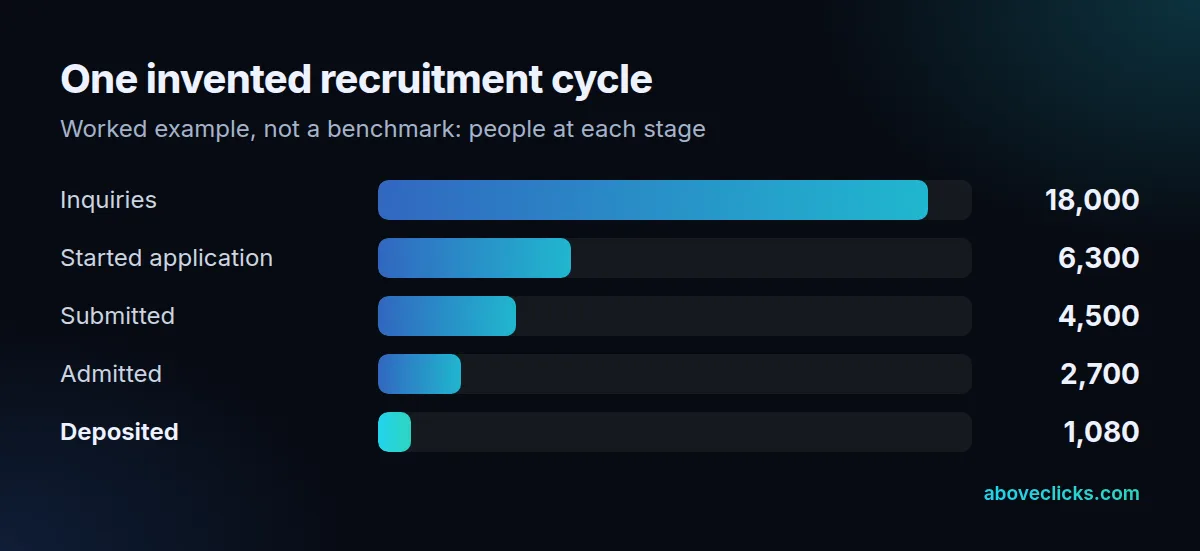
The funnel above is an invented example. A cycle starts with 18,000 inquiries; 35% (6,300) start an application, 71% of those (4,500) submit, 60% of those (2,700) are admitted and 40% of those (1,080) deposit. Read the two kinds of loss separately. The biggest headcount loss is at the start of the application, where 11,700 people stop. The biggest rate drop after that is after admission, where 60% of admitted students do not deposit.
Those are different problems, and good student recruitment email treats them separately. The first needs help starting: a short email on what the application needs. The second needs answers to cost, housing and timing questions. One monthly newsletter to everyone fits neither, which is why email marketing for universities starts from stages.
If your list is large, keep the sender setup tidy too. The email deliverability service page explains what we check, and our real estate agent email guide walks through the sender address and authentication basics that apply to any small sender.
Which email rules apply to a college or university?
Two sets bind any marketing email: CAN-SPAM and Google’s sender rules. A recruitment email is marketing, so the FTC’s rules for commercial email apply to it.
The FTC lists the basics: a true sender, a valid postal address, a clear opt-out and no misleading subject. It says opt-outs must be honored within 10 business days and that the opt-out must keep working for at least 30 days after you send. Google’s FAQ goes further and recommends fulfilling unsubscribe requests within 48 hours.
Google’s sender guidelines add scale rules. As of November 2026, senders of more than 5,000 messages a day to Gmail accounts need SPF, DKIM and DMARC, one-click unsubscribe on marketing mail and a spam rate below 0.30%.
Here is what that means for an invented list. A college with 40,000 prospect addresses finds that 55% are Gmail. One campaign then sends 22,000 messages to Gmail accounts, well above 5,000. A spam rate of 0.30% on 22,000 messages is 66 complaints, so 66 “report spam” clicks put the sender at the limit. That is why a bought list is risky: people who never asked for mail report it more often.
Not every message in higher education email marketing counts as marketing. The FTC reads “transactional or relationship” messages narrowly: a message that confirms or completes something the person already agreed to. A receipt for an application fee can qualify. A mixed message with a program promotion at the top is judged by its primary purpose. For the cost of running this programme, see our email marketing cost guide.

What does FERPA mean for your email list?
FERPA is about education records of students, and its definition of a student is narrow. Ask your registrar which of your lists hold FERPA records before you move them.
Under the regulation, a student is anyone who is or has been in attendance at the institution and about whom it keeps education records. By that wording, a person who has only inquired is not yet a student, but an enrolled student and an alumnus are. We read it that way as a marketer, not as a lawyer, so confirm the status of applicants with your registrar.
The same section lists directory information, and the list includes the email address, major field of study, enrollment status and dates of attendance. An institution may disclose directory information only after giving public notice of three things: which types it designates, the student’s right to refuse, and the period for refusing, under 34 CFR 99.37.
For email marketing for universities, the practical rule is to check opt-outs before you load student data into a new tool. For former students, the same section lets an institution disclose directory information without new notice, but it must still honor an opt-out the student made while in attendance. Keep one suppression list for both, and share it with every tool that sends student recruitment email.
What can admissions emails claim?
Only what you can prove, in email marketing for universities as in any other advertising. The Department of Education treats substantial misrepresentation about the program, the charges or graduates’ jobs as prohibited in all forms of advertising.
The rule in 34 CFR 668.71 names three areas: the nature of the educational program, the financial charges and the employability of graduates. It says the prohibition covers advertising and promotional materials, and it counts what an institution’s representatives or marketing partners say. An email subject line is promotional material.
For a team that writes student recruitment email, that gives three rules for higher education email marketing. Quote tuition and fees from the current official page and name the year. Tie any employment claim to a published, dated outcome report. Never write a program promise you could not repeat to a regulator. We do not promise outcomes in our own work either, and a recruitment email should not either.
How do you know higher education email marketing is working?
By the rate at each stage, not by one overall number, because higher education email marketing runs on a long cycle. Compare each stage’s rate with the same stage last cycle, and watch the spam rate alongside it.
In the invented cycle above, the four rates are 35%, 71%, 60% and 40%. If a new prospect sequence is working, the first rate rises, from 35% to 40% for example, which on 18,000 inquiries is 900 more applications started. If the admitted sequence works, the last rate rises. A change in one stage should not be credited to a different stage’s email.
Track delivery too. Google’s guidance says to keep the spam rate below 0.30%, and its Postmaster Tools report it. Check it weekly in the 2 weeks after each large send, and suppress any address that has complained. Our email deliverability service covers what to look for when the number climbs.
What are the 5 costly mistakes in higher education emails?
One sequence for everyone, treating recruitment mail as exempt, ignoring directory opt-outs, claims you cannot prove, and a list people never asked to join.
- One sequence for every stage. The funnel above shows why: the problem at each step differs, so the email must too.
- Treating recruitment mail as exempt. It is marketing, so it needs the sender details, postal address and opt-out the FTC lists. Penalties run up to $53,088 per email.
- Ignoring directory opt-outs. A student who refused disclosure while in attendance stays refused after graduation unless they rescind it.
- Claims you cannot prove. Tuition, program content and job outcomes fall under the misrepresentation rule above.
- A list people never asked to join. Google says to send only to people who want your mail. At 22,000 Gmail messages, 66 complaints reach 0.30%.
Pick one of these mistakes to fix this week in your email marketing for higher education. If you want a second pair of eyes on the sender setup, flows and claims, our free audit reads your current email setup. If your programs include paid short courses or merchandise sold online, our Klaviyo email marketing service builds the stage flows. More industry guides are in the industries topic.